

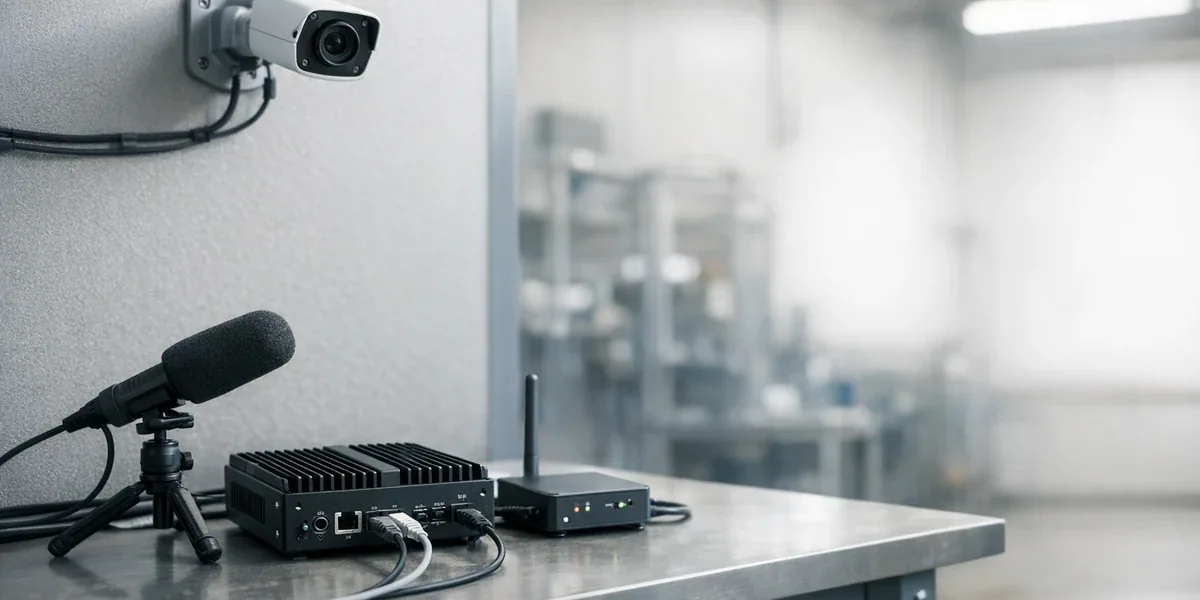
When teams build multimodal edge terminals, they often focus on the models first. They ask whether speech recognition is accurate enough, whether the vision detector is fast enough, or whether the event classifier is light enough to fit the device. But once the system reaches a real site, the first thing that makes it unreliable is often something less visible:
- the camera stream arrives 400 milliseconds late while ASR already returned text
- the event bus triggers an alert before the matching video slice reaches the local buffer
- the device reconnects after a short outage, but the cloud and the edge node now disagree on the timeline
- the model outputs still look normal, yet no one can prove whether a false alert came from input drift, alignment drift, or replayed stale frames under backpressure
The core conclusion of this article is simple: for real-time multimodal edge systems, model quality is usually only the starting line. Long-term reliability is determined more by end-to-end latency budgets, cross-stream time alignment, and whether those runtime problems are observable, diagnosable, and recoverable through an operations loop.
If a system only proves that each model can run on its own, but cannot prove that audio, video, and event streams are still aligned inside the same decision window with controlled latency and explainable failures, it is not yet a production-grade real-time system. It is only a bundle of working parts.
Definition Block
In this article, a "real-time multimodal edge system" means a device-side system that processes voice, video, and event streams together, where outputs from those streams must be interpreted, decided, or replayed within the same business time window.
Decision Block
If voice, video, and event results jointly drive alerts, automation, or operator review, the design priority should not be "connect every model first." It should be "establish one time baseline, one latency budget, and one operational evidence chain first." Otherwise the system may look fine in a demo and then become unstable under real networks and real devices.
1. Why teams often misidentify the real bottleneck
1.1 Model problems are visible; system problems are easier to ignore
Models have visible metrics such as accuracy, recall, and inference time, so teams naturally optimize around them. But the hard part of multimodal edge systems is the combined behavior:
- can a speech result that arrives in 120 milliseconds still match the correct video frame?
- when an event alert fires, is it pointing to a fresh frame or to a delayed buffered slice?
- when CPU saturates, does the system drop frames, accumulate delay, or keep pushing stale outputs downstream?
Without a common time base and operational evidence, those questions are almost impossible to answer after the fact.
1.2 Real deployment failures are usually drift failures, not total inference failures
In the field, the more common failure mode is not that one model crashes completely. It is a gradual form of degradation:
- camera jitter increases the video buffer over time
- the audio path starts dropping segments to stay real-time
- the event bus keeps receiving messages, but the referenced video slice is now behind
- the business layer still receives "complete" outputs, but those outputs no longer belong to the same time window
The system does not look down. It simply stops being trustworthy.
2. A real-time multimodal system must unify more than three inputs
To make a multimodal system usable, it must unify at least four things, not just three data types:
- one time baseline
- one latency budget
- one backpressure and degradation policy
- one operational evidence chain

The important boxes here are not the models. They are the Time Alignment Layer and the Ops Evidence Loop.
2.1 Without one time baseline, there is no real fusion
Audio, video, and event timestamps often come from different places:
- RTP or PTS values from the camera stream
- the local clock of the audio capture thread
- arrival timestamps from the event bus or MQTT broker
If the system simply joins outputs by arrival time or current system time, fusion becomes fragile. A stronger approach is to:
- define which clock source is authoritative
- map the other streams into the same clock domain
- preserve capture time, processing time, and publish time separately for each stream
That is what lets the team distinguish "the input arrived late" from "the processing path became slow."
2.2 Without one latency budget, optimization becomes local theater
Teams often optimize video inference, speech recognition, and event consumption separately, but skip the more important question: what is the maximum delay the business loop can tolerate end to end?
For example, if a security terminal must finish an alert loop within one second, the budget should be split intentionally:
| Stage | Typical budget | What breaks if it overruns |
|---|---|---|
| video capture and decode | 150-250 ms | the frame enters fusion already late |
| audio capture and streaming ASR | 150-300 ms | the transcript no longer matches the visible action |
| event bus handling | 50-150 ms | alert ordering becomes distorted |
| fusion and policy execution | 100-200 ms | the decision becomes “correct but too late” |
| reporting and evidence retention | 100-200 ms | operations cannot reconstruct the incident |
The point is not that every number must match this table. The point is that the team must define which stages may spend time and which stages must never queue. Without that, every module may look locally acceptable while the system is globally unusable.
3. Why synchronization failures are more destructive than model errors
3.1 Sync errors turn correct models into incorrect outcomes
The most dangerous property of multimodal systems is that a model can be right while the business conclusion is still wrong because the streams are misaligned.
Common examples:
- ASR correctly detects "open the door," but the matched video frame is from two seconds earlier
- the event stream says the door sensor fired, but the camera buffer has not advanced to the relevant slice
- an industrial vibration anomaly has already been reported, but the video stream is still replaying older buffered footage
These cases are harder than normal false positives because every individual module can still look healthy.
3.2 Cross-stream sync must answer three questions
A production-grade system must answer at least these:
- which time source is the master clock?
- when one stream arrives late, should the system wait, degrade, or discard?
- is the business output optimized for lowest latency or highest consistency?
If those questions are left implicit, the system will still make a choice in the field. That implicit choice usually becomes the bug.
Comparison Block
The common error in a single-modality system is "the result is inaccurate." The common error in a multimodal system is "each result is individually correct, but they no longer describe the same event." The first is a model problem. The second is a time and synchronization problem.
4. Why operations becomes the real delivery gate
4.1 A field system must run for months, not for one demo session
A system that works for ten minutes in the lab does not automatically work for three months on site. Over time, the failures that matter more are usually:
- buffers grow gradually without triggering a loud alarm
- one input path reconnects and silently resets the time baseline
- CPU saturation changes thread scheduling and suddenly worsens cross-stream delay
- an upgrade changes default parameters and breaks the alignment window
If these effects are not converted into observable signals, the system will only appear as "sometimes slow" or "occasionally wrong," which is much harder to debug.
4.2 The operations loop needs at least five classes of evidence
For real-time multimodal edge systems, the following evidence is not an optional enhancement. It is part of the minimum operating foundation:
- current latency and jitter for each input stream
- the latest reconnect, resync, and clock-correction events
- the input window ID or time range referenced by each fusion decision
- acknowledgements and result state for alerts or linked actions
- a minimal replayable evidence slice, such as a few seconds before and after the incident across streams
Without those artifacts, operations is forced to guess.
4.3 Remote diagnostics decides whether the edge system is actually maintainable
The hardest part of edge deployment is that you are not on site. A stronger design should consider from day one:
- can the team remotely inspect current delay, drift, frame drops, and queue depth for each stream?
- can the system switch degradation policies remotely?
- can it export a minimal evidence package around an incident?
- can one flow or module be restarted without taking down the full terminal?
If the answer is no, the "smart terminal" usually becomes an expensive black box.
5. A safer system boundary
Real-time multimodal edge systems are easier to operate when they are split into four layers instead of being collapsed into one giant process:
| Layer | Primary responsibility | State it should own | Responsibility it should not absorb |
|---|---|---|---|
| ingest layer | bring in audio, video, and events and normalize timestamps | raw timestamps, buffer status, reconnect state | business decisions |
| alignment layer | unify clock domains, window streams, handle lateness | alignment windows, discard policy, sync offsets | complex business rules |
| fusion and decision layer | combine multimodal results into alerts or actions | confidence, correlation context, execution policy | low-level reconnect details |
| operations evidence layer | metrics, logs, replay, ACK, rollback | trace IDs, event snapshots, versions, policy versions | rewriting business meaning directly |
This boundary matters because when a live issue says "the decision arrived two seconds late," the team can isolate whether the fault came from ingest, alignment, or the fusion window itself.
6. When latency, sync, and operations must be priority one
These conditions especially require a system-first approach:
- voice and video jointly determine whether an alert is valid
- an event trigger must pull the correct video or audio slice automatically
- the site network is unstable and stream reconnects are expected
- the device must support remote upgrades without breaking alignment windows
- outputs feed a control or automation chain instead of only supporting human viewing
Under those conditions, a system without one time baseline, one latency budget, and one evidence loop almost always becomes unreliable during scale-up or long-running deployment.
7. When a lighter first version is still acceptable
Not every project needs the full version immediately. A lighter design may be good enough when:
- the system is offline analysis rather than live action
- there is only one dominant video stream and the other modalities are weak helpers
- human review is always available, so automated action is not required
- the current phase is still algorithm exploration rather than long-term deployment
Not Suitable Block
If the project is still a lab proof of concept with no strict real-time action or operations requirement, it is often more economical to validate the model path first. Building a heavy control plane too early can add complexity before the product boundary is clear. But once the system moves into real deployment, these system issues become unavoidable.
8. Conclusion
The hardest part of a real-time multimodal edge system is usually not whether one model works. It is whether multiple streams can work inside the same time window, and whether failures can still be explained, diagnosed, and rolled back when the system is under real load.
That is why the safer delivery order is usually not:
connect every model first -> patch synchronization and operations later
It is:
define one time baseline and one latency budget first -> decide lateness and degradation policy -> build the operational evidence chain -> then optimize the multimodal model combination
If the system is meant to go live rather than just impress in a demo, latency, synchronization, and operations are not future enhancements. They are the foundation.