

CSA Officially Releases Zigbee 4.0: A New Evolution Cycle
On November 18, 2025, the Connectivity Standards Alliance (CSA) officially released the Zigbee 4.0 standard, along with the new Suzi (Sub-GHz Zigbee) specification.
This marks the most significant major-version upgrade since Zigbee 3.0 unified the ecosystem.
Unlike previous updates, Zigbee 4.0 is not an incremental enhancement focused on smart home features. Instead, it represents a system-level upgrade designed for larger, more complex IoT networks, with clear core objectives:
- Meet long-term security requirements for the next decade of IoT deployments
- Support campus-scale and industrial-grade mesh networks
- Reduce deployment and operational costs for large-scale device rollouts
- Break the physical limitations of the 2.4 GHz band
This is precisely why Zigbee 4.0 must be understood together with Suzi.
If Zigbee 4.0 represents a vertical enhancement at the protocol and architecture level, then Suzi is a horizontal expansion of Zigbee’s physical coverage capabilities.
Zigbee 4.0 signals Zigbee’s transition from a “mature and stable” phase to a new long-term evolution cycle designed for large-scale IoT networks.
1. Overview of Zigbee 4.0 Core Features
Based on CSA’s official specifications and announcements, Zigbee 4.0 follows a clear guiding principle:
Full backward compatibility combined with forward-looking enhancements
This allows existing Zigbee systems to be upgraded incrementally without disrupting the established ecosystem.
1.1 Positioning: Not a New Protocol, but a New Generation of Zigbee
First, it is important to clarify:
Zigbee 4.0 is not a brand-new wireless protocol.
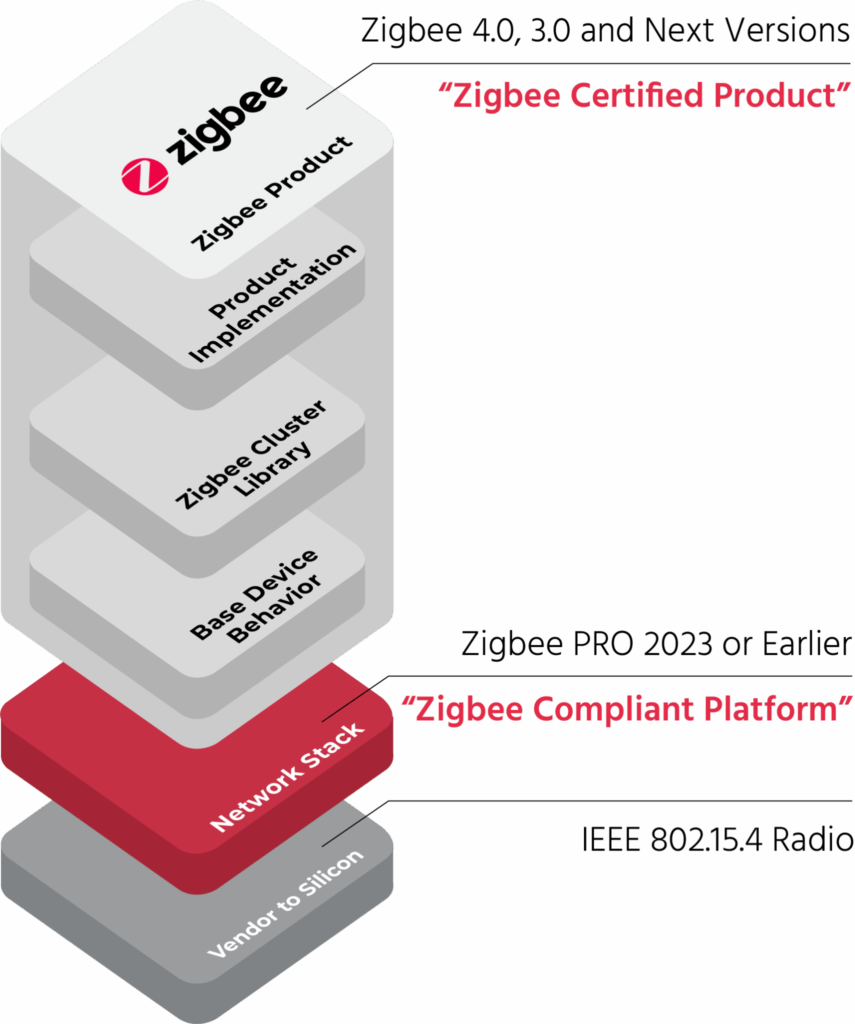
- It remains based on IEEE 802.15.4
- It continues to use the Zigbee Network Layer and ZCL
- It remains compatible with Zigbee 3.0 devices
However, Zigbee 4.0 introduces systematic reinforcement in the following areas:
- Security models
- Network stability and reliable communication mechanisms
- Device lifecycle management and large-scale deployment support
- Physical-layer expansion via Sub-GHz (Suzi)
As a result, Zigbee 4.0 is best understood as a platform-level Zigbee upgrade designed for future IoT scale.
1.2 Zigbee 4.0 Protocol Architecture Overview
From a layered protocol perspective, Zigbee 4.0 retains a clear structure, with changes concentrated mainly in the Network Layer and security-related submodules.
---
title: "Zigbee 4.0 Protocol Architecture (Official Simplified View)"
---
graph TD

%% ===== Styles =====
classDef app fill:#E3F2FD,stroke:#1976D2,stroke-width:2,rx:10,ry:10,color:#0D47A1,font-weight:bold;
classDef zcl fill:#FFF8E1,stroke:#F9A825,stroke-width:2,rx:10,ry:10,color:#5D4037,font-weight:bold;
classDef nwk fill:#E8F5E9,stroke:#2E7D32,stroke-width:2,rx:10,ry:10,color:#1B5E20,font-weight:bold;
classDef mac fill:#F3E5F5,stroke:#8E24AA,stroke-width:2,rx:10,ry:10,color:#4A148C,font-weight:bold;
classDef phy fill:#ECEFF1,stroke:#546E7A,stroke-width:2,rx:10,ry:10,color:#263238,font-weight:bold;

linkStyle default stroke:#555,stroke-width:1.6;

%% ===== Layers =====
A["🧩 Application LayerApplication Objects(Device Logic / Business Functions)"]:::app
B["📘 ZCL & Device Profiles(Device Models / Commands / Attributes)"]:::zcl
C["🌐 Zigbee Network LayerRouting · Security · Reliability"]:::nwk
D["📡 IEEE 802.15.4 MACCSMA · Frame · Addressing"]:::mac
E["📶 IEEE 802.15.4 PHY2.4 GHz / Sub-GHz"]:::phy

%% ===== Stack =====
A --> B
B --> C
C --> D
D --> E
Key differences compared to Zigbee 3.0 include:
- Stricter requirements for security, retransmission, and state synchronization at the Network Layer
- The first standardized introduction of Sub-GHz PHY support (Suzi)
1.3 Four Official Focus Areas of Zigbee 4.0
According to CSA, Zigbee 4.0’s core enhancements can be summarized in four dimensions:
① System-Level Security Enhancements
- Advanced frame counter synchronization
- Dynamic link key lifecycle management
- Replay attack prevention and abnormal node detection
② Reliability Improvements for Large-Scale Mesh Networks
- Enhanced message acknowledgment and retry strategies
- Improved communication stability for low-power devices
- Standardized network recovery and node reconnection mechanisms
③ Deployment and Operations Efficiency
- Batch commissioning support
- Standardized device state and lifecycle management
- More engineering-friendly deployment workflows
④ Physical Coverage Expansion via Suzi
- Extended communication range
- Improved wall penetration and interference resistance
- Enablement of campus-scale and semi-outdoor scenarios
1.4 Relationship Between Zigbee 4.0 and Suzi
In CSA’s official definition:
- Zigbee 4.0 is the core protocol version
- Suzi is the Sub-GHz extension under the Zigbee 4.0 framework
They are complementary rather than competitive:
---
title: "Relationship Between Zigbee 4.0 and Suzi"
---
graph LR;
A["Zigbee 4.0Network Layer / Security / Device Model"]
B["2.4 GHz PHY"]
C["Sub-GHz PHY (Suzi)"]

A --> B
A --> C
Which means:
- Unified application and network logic
- Different frequency bands for various deployment scenarios
- Transparent to upper-layer IoT platforms
2. Key Technical Upgrades in Zigbee 4.0
The real value of Zigbee 4.0 lies not in isolated new features, but in its systematic resolution of long-standing engineering challenges in large-scale IoT mesh networks.
This section focuses on three fundamental questions:
- Is the security model sustainable for long-term operation?
- Can mesh networks remain stable at scale?
- Can devices be deployed and maintained efficiently in real-world projects?
2.1 Security and Reliability Upgrades for Large-Scale Zigbee Mesh Network
In the Zigbee 3.0 era, security mechanisms were sufficient for small networks, but weaknesses emerged in campus-scale and commercial IoT systems.
2.1.1 Practical Issues in Zigbee 3.x Security
Common engineering challenges included:
- Frame counter rollover risks over long runtimes
- Unclear network key lifecycles
- Replay attacks in edge scenarios
- Lack of standardized abnormal behavior detection
These issues are not particularly noticeable in networks with dozens of nodes,
But they become increasingly critical in systems with hundreds or thousands of devices running continuously for 5–10 years.
2.1.2 Security Enhancements in Zigbee 4.0
Without breaking existing encryption schemes, Zigbee 4.0 introduces stricter security controls:
- Advanced Frame Counter Synchronization
- Prevents replay attacks caused by frame counter desynchronization
- Dynamic Link Key Monitoring Mechanisms
- Enables lifecycle management of session keys between devices
- Stricter Trust Center Behavior Constraints
- Reduces the risk of a “weak Trust Center” becoming a security entry point
From an engineering perspective, Zigbee 4.0’s security model gains a critical new characteristic:
Security states become observable and manageable, not merely present.
2.1.3 Security Model Representation at the Network Layer
---
title: "Security Model Representation at the Zigbee 4.0 Network Layer"
---
graph TD;
A["Device Join Request"] --> B["Trust Center Validation"]
B --> C["Link Key Negotiation"]
C --> D["Frame Counter Synchronization"]
D --> E["Normal Communication"]
E --> F["Abnormal Behavior Detection"]
F -->|"Triggered"| B
This enables Zigbee networks, for the first time, to achieve security self-healing under long-term operation.
2.2 Mesh Reliability Designed for Scale
Zigbee 4.0 significantly enhances mesh stability for hundreds or thousands of nodes.
Enhancements include:
- Stricter APS ACK mechanisms
- Standardized retry and backoff strategies
- Support for sleepy-to-sleepy communication (CSL)
- Standardized network state synchronization and recovery
2.2.1 Typical Challenges in Large-Scale Zigbee Networks
In engineering practice, the following issues are very common:
- Unstable communication for sleepy devices (low-power nodes)
- Uneven load distribution across routing nodes, leading to localized congestion
- Slow network recovery and poor self-healing after node disconnections
- Inefficient ACK and retry strategies in large-scale networks
These problems are especially prominent in industrial, building, and campus IoT deployments.
2.2.2 Network Layer Enhancements in Zigbee 4.0
Zigbee 4.0 introduces multiple enhancements at the Network Layer (NWK) and APS layer:
- Stricter message acknowledgment mechanisms (APS ACK)
- Standardized retry and backoff strategies
- Support for sleepy-to-sleepy communication (CSL)
- Standardized network state synchronization and recovery procedures
All of these changes share a single objective:
To ensure that Zigbee network stability does not degrade disproportionately as the number of nodes increases.
2.2.3 Reliable Mesh Communication Flow
---
title: "Reliable Mesh Communication Flow in Zigbee 4.0"
---
graph LR;
A["End Device"] -->|"Transmit"| B["Routing Node"]
B -->|"Forward"| C["Coordinator"]
C -->|"ACK"| B
B -->|"ACK"| A
A -->|"State Sync"| C
From an engineering perspective, Zigbee 4.0 is clearly designed to support industrial-grade mesh networks, rather than being limited to residential or small-scale scenarios.
2.3 Batch Commissioning and Operations in Industrial Zigbee Networks
If security and stability represent the foundational capabilities of Zigbee 4.0,
then improvements in deployment and operations mechanisms represent its most direct value to engineering teams.
2.3.1 Why Is “Batch Commissioning” So Important?
In real-world projects:
- Bringing dozens to hundreds of devices online at once is the norm
- Manual, device-by-device commissioning is practically unacceptable
- Poor device visibility significantly increases operational costs
With Zigbee 4.0, Batch Commissioning is formally incorporated into the standard.
2.3.2 Batch Commissioning Workflow in Zigbee 4.0
---
title: "Batch Commissioning Workflow in Zigbee 4.0"
---
graph TD;
A["Device Power-On"] --> B["Batch Discovery"]
B --> C["Unified Authentication"]
C --> D["Network Parameter Distribution"]
D --> E["Device Successfully Joined"]
E --> F["Platform State Synchronization"]
Engineering value is reflected in:
- Significantly reduced on-site deployment time
- Lower risk of human error during provisioning
- Easier automation and integration with IoT platforms
2.4 Relationship Between Zigbee 4.0, Suzi, Matter, Thread, and LoRa
A realistic question often arises:
With the rise of Matter and IP-based protocols, will Zigbee become marginalized?
In the planning of Zigbee 4.0, CSA provides a very clear answer:
Not replacement, but clearer division of responsibilities.
2.4.1 Protocol Positioning Comparison: Zigbee 4.0 vs Matter and Thread, and More: Where Each Technology Fits
| Protocol | Core Positioning | Typical Strengths | Less Suitable For |
|---|---|---|---|
| Zigbee 4.0 | Low-power mesh | Mature ecosystem, stability | Native IP |
| Suzi | Sub-GHz mesh | Long range, strong penetration | High data rates |
| Matter | Application-layer standard | Cross-vendor interoperability | Low-power mesh |
| Thread | IP-based mesh | Native IPv6 | Device ecosystem maturity |
| LoRaWAN | LPWAN | Ultra-long range | Real-time control |
2.4.2 The “Real Survival Space” of Zigbee 4.0
From both technical and engineering perspectives:
- Matter addresses application-layer interoperability
- Zigbee 4.0 focuses on stable device- and network-layer communication
- Suzi compensates for Zigbee’s historical coverage limitations
This means that, for a long time to come, Zigbee will remain:
One of the core infrastructures for large-scale, low-power, and highly reliable IoT networks.
3. Engineering Value and Deployment of Suzi (Sub-GHz Zigbee)
Suzi addresses a long-standing challenge:
Is Zigbee’s physical coverage sufficient for large IoT spaces?
By introducing Sub-GHz support, Zigbee expands into campus, factory, multi-building, and semi-outdoor environments.
3.1 Engineering Positioning of Suzi
Suzi is not a replacement for LoRaWAN, but a Zigbee extension:
- Mesh-based
- Low-power, low-to-medium data rates
- Significantly improved range and penetration
It targets scenarios where LoRa is too slow and 2.4 GHz Zigbee is too limited.
3.1.1 Engineering Comparison Between Suzi and Other Wireless Technologies
| Technology | Network Topology | Coverage Range | Real-Time Capability | Typical Applications |
|---|---|---|---|---|
| Zigbee 2.4 GHz | Mesh | Medium | High | Home, indoor |
| Suzi (Sub-GHz Zigbee) | Mesh | Medium to long | High | Campus, buildings, factories |
| Thread | Mesh (IP) | Medium | High | Matter devices |
| LoRaWAN | Star | Long | Low | Wide-area sensing |
| NB-IoT | Star | Very long | Medium | Public network IoT |
From an engineering perspective, Suzi fills a critical gap:
“Low-power mesh networking across larger physical spaces.”
3.2 Typical Network Topologies for Suzi
3.2.1 Campus / Factory-Scale Mesh Networks
---
title: "Suzi Mesh Network in Campus / Factory Scenarios"
---
graph TD;
A["IoT Platform"]
B["Zigbee / Suzi Coordinator"]
C["Sub-GHz Routing Nodes"]
D["End Devices (Sensors / Actuators)"]

A --> B
B --> C
C --> C
C --> D
Engineering advantages include:
- Fewer coordinators required
- More stable cross-area communication
- Stronger self-healing capabilities compared to star networks
3.2.2 Multi-Building and Complex Building Scenarios
In multi-building environments, underground spaces, or steel-structure facilities,
2.4 GHz Zigbee often requires a large number of relay nodes.
Suzi can significantly reduce overall network complexity.
---
title: "Coverage Capability of Suzi in Multi-Building Scenarios"
---
graph LR;
A["Coordinator"] --> B["Building A"]
A --> C["Building B"]
A --> D["Underground / Semi-Outdoor Nodes"]
3.3 Hybrid Network Design: Zigbee 4.0 + Suzi
A critical engineering practice is that:
2.4 GHz Zigbee and Sub-GHz Suzi are not mutually exclusive — they can coexist.
3.3.1 Hybrid Network Architecture
---
title: "Hybrid Network Architecture: Zigbee 4.0 + Suzi"
---
graph TD;
A["IoT Platform"]
B["Coordinator"]
C["2.4 GHz Zigbee Devices"]
D["Sub-GHz Suzi Devices"]

A --> B
B --> C
B --> D
The significance of this design lies in:
- High-density indoor devices using 2.4 GHz
- Long-range or cross-area devices using Sub-GHz
- Identical application-layer logic across the system
3.4 Integrating Zigbee 4.0 and Suzi with IoT Platforms
From a platform perspective, Zigbee 4.0 and Suzi do not disrupt existing integration models,
but they significantly enhance device management and network observability.
3.4.1 Key Platform Integration Interfaces
---
title: "Integration Architecture Between Zigbee 4.0 / Suzi and IoT Platforms"
---
graph TD;
A["Zigbee / Suzi Network"]
B["Gateway / Coordinator"]
C["MQTT / API"]
D["IoT Platform"]
E["Device Management / Rule Engine / Visualization"]

A --> B
B --> C
C --> D
D --> E
Platform-level improvements include:
- Clearer device lifecycle states
- More reliable online/offline detection
- More stable event reporting
- Stronger device identity and security models
3.4.2 Practical Impact on Platform Design
| Dimension | Zigbee 3.x | Zigbee 4.0 / Suzi |
|---|---|---|
| Security events | Difficult to standardize | Unified modeling possible |
| Large-scale devices | High operational cost | Batch-oriented management |
| Network stability | Experience-dependent | Standardized enhancements |
| Scenario expansion | Frequency-band limited | Extended coverage |
This makes Zigbee 4.0 / Suzi more suitable as the underlying network for long-running IoT systems.
3.5 Practical Considerations for Real-World Zigbee 4.0 Deployments
Even though Zigbee 4.0 and Suzi are mature at the specification level, real-world deployment still requires attention to several factors:
- Chipset and module availability
- Sub-GHz Zigbee requires PHY-level support
- Certification and product timelines
- Suzi certification is expected to mature gradually around 2026
- Regional frequency compliance
- 800 MHz / 900 MHz bands vary by region
- Network planning capabilities
- Mesh ≠ no planning; node roles still matter
These challenges are not unique to Zigbee, but are common to all mesh networks deployed at scale.
Final Thoughts: The Real Significance of Zigbee 4.0 and Suzi
Zigbee 4.0 represents a pragmatic, engineering-driven evolution:
- Security evolves from usable to trustworthy
- Mesh networks scale reliably
- Deployment shifts from experience-driven to standards-driven
- Coverage expands beyond indoor-only scenarios
With Suzi, Zigbee is no longer confined to the 2.4 GHz indoor world.
Zigbee 4.0 + Suzi re-establish Zigbee as a viable foundational infrastructure for IoT networks over the next 5–10 years.
Frequently Asked Questions (FAQ)
What is Zigbee 4.0 and how is it different from Zigbee 3.0?
Zigbee 4.0 is a system-level evolution of the Zigbee standard that enhances security, mesh reliability, large-scale deployment, and long-term operation. Compared to Zigbee 3.0, it introduces stricter security models, standardized batch commissioning, and expanded physical-layer capabilities through Sub-GHz Zigbee (Suzi).
What is Suzi in Zigbee 4.0 (Suzi Zigbee)?
Suzi is the Sub-GHz Zigbee specification under the Zigbee 4.0 framework. It extends Zigbee mesh networking beyond the 2.4 GHz band, enabling longer range, better penetration, and more reliable communication in industrial, campus, and multi-building environments.
Is Zigbee 4.0 suitable for industrial IoT deployments?
Yes. Zigbee 4.0 is designed to support industrial Zigbee networks with hundreds or thousands of nodes, offering improved security, standardized batch commissioning, stronger mesh self-healing, and better long-term operational stability.
How does Zigbee 4.0 compare with Matter and Thread?
Matter focuses on application-layer interoperability, while Thread provides an IP-based mesh network. Zigbee 4.0 operates at the device and network layers, offering a mature, low-power mesh solution. These technologies can coexist with clear architectural roles in modern IoT systems.
References
- Zigbee Official Solutions Page
https://csa-iot.org/all-solutions/zigbee/- Official Announcement of Zigbee 4.0 and Suzi
https://csa-iot.org/newsroom/- Suzi (Sub-GHz Zigbee) Official Overview
https://csa-iot.org/all-solutions/suzi/
For large-scale or long-running Zigbee 4.0 deployments, a well-designed industrial IoT network architecture is often the key to long-term stability. Explore our industrial IoT solutions.