

Matter Development Services for Smart Devices and Connected Appliances
Move from a Matter product idea to stable commissioning, interoperable device behavior, certification-ready testing, and a maintainable release path.
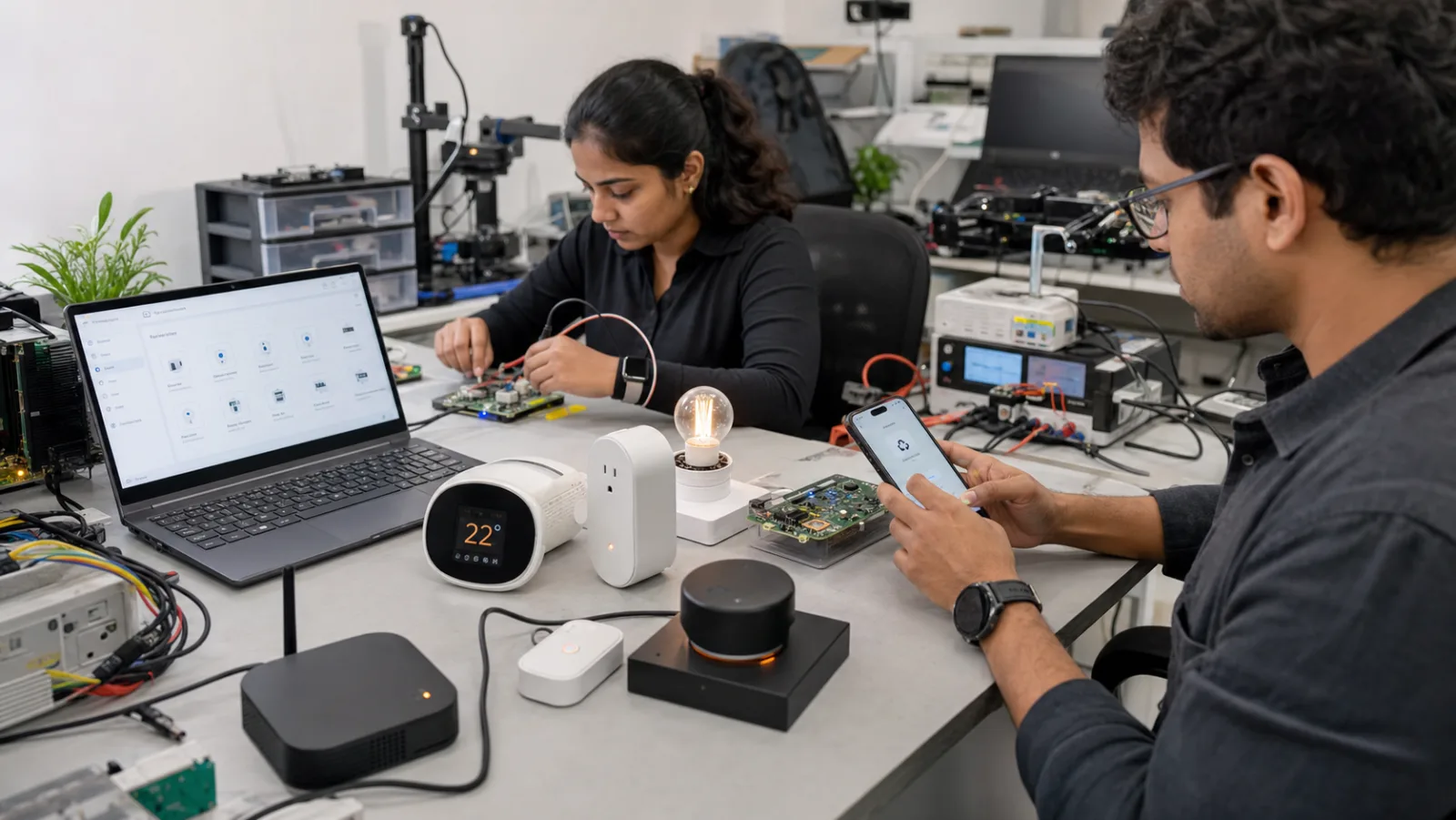
A logo on the roadmap is not the same as a dependable product
Matter removes part of the ecosystem barrier, but the product still has to commission reliably, expose the right behavior, recover from failure, pass tests, and remain supportable after release.
Commissioning must survive real homes
Phone permissions, weak wireless conditions, existing fabrics, resets, and repeated onboarding all affect the first user experience.
Standard clusters still need product semantics
Attributes, commands, events, scenes, and states must match what the physical device can safely and consistently do.
Certification is an engineering workflow
Test evidence, regression, logs, issue reproduction, hardware stability, and release discipline matter as much as protocol code.
Six workstreams from protocol feasibility to product release
We can support a focused protocol task or own the full path across hardware, embedded software, controller behavior, app experience, validation, and handoff.
Protocol stack integration
Integrate Matter application clusters, device types, attributes, commands, events, and lifecycle behavior into the target firmware and product workflow.
Hardware and software design
Review MCU, memory, radio, secure storage, bootloader, OTA, Thread or Wi-Fi transport, and the interfaces needed by the physical product.
Network and security implementation
Plan commissioning, certificates, access control, fabric lifecycle, reset behavior, credential handling, and secure manufacturing operations.
Ecosystem interoperability
Validate the user journey across the target controller ecosystems, multi-admin use, bridge behavior, device discovery, and everyday control scenarios.
Testing and certification readiness
Prepare test cases, evidence, issue triage, regression coverage, and engineering support for certification and ecosystem acceptance.
Custom app and platform integration
Connect setup, account, device status, diagnostics, support, and business workflows when the customer experience extends beyond a controller app.
Design the complete commissioning and ownership path
The important architecture is not only how the device joins once. It is how the product is added, controlled, shared, updated, reset, recovered, and supported throughout its useful life.
Commission
Phone or controller discovers and commissions the device.
Join the fabric
The product joins a Thread or Wi-Fi fabric with the expected security model.
Operate
Clusters, commands, attributes, scenes, and automations behave consistently.
Maintain
OTA, reset, re-commissioning, logs, and support procedures remain manageable.
Choose the Matter path around the product, not the trend
Early decisions should connect market expectations with power, radio, firmware, security, gateway, cloud, app, certification, and support constraints.
Thread, Wi-Fi, or bridge
Choose transport and topology around power, range, installed infrastructure, gateway ownership, and product category.
Device type and cluster model
Map real product controls and state into standard clusters without losing required device behavior.
Commissioning and ownership
Define who can add, share, reset, recover, and support a device across its full lifecycle.
Cloud and app boundaries
Decide what stays local, what still needs a vendor cloud, and how diagnostics or paid services fit around Matter.
Use Matter where interoperability improves the buying and ownership experience
We help evaluate where Matter should be the primary control path, one ecosystem-facing layer, or part of a bridge strategy.
Connected appliances
Add interoperable status, controls, schedules, and service workflows to appliances and environmental equipment.
Smart-home devices
Build switches, sensors, lighting, locks, actuators, hubs, and controllers around a coherent commissioning experience.
Matter bridges and gateways
Bring existing Zigbee, BLE, or proprietary products into a Matter-facing product architecture.
Commercial smart spaces
Use Matter where local interoperability can simplify rooms, retail sites, light commercial buildings, or managed residences.
Validate one product journey before committing to the full ecosystem roadmap
Start with the target device, controller ecosystem, commissioning path, must-have controls, reset behavior, and certification assumptions.
Questions before starting Matter development
Use these answers to frame the product, ecosystem, certification, and delivery decisions before implementation begins.
What types of Matter products can ZedIoT help develop?
We can support connected appliances, switches, sensors, lighting, actuators, controllers, bridges, gateways, and other smart-home or light-commercial devices. Feasibility depends on the device type, required clusters, radio and MCU, controller ecosystems, certification target, and existing firmware.
Can you help choose between Matter over Thread and Matter over Wi-Fi?
Yes. The choice should consider power, bandwidth, range, installed infrastructure, gateway or border-router assumptions, product category, hardware cost, and the expected user journey. We review those constraints before committing to a transport.
Does Matter remove the need for a product cloud or mobile app?
Not always. Matter can standardize local discovery and control, while a vendor cloud or app may still be needed for accounts, remote services, diagnostics, subscriptions, support, analytics, firmware operations, or product-specific experiences.
Can ZedIoT support Matter certification preparation?
We can help prepare product behavior, test cases, regression coverage, issue evidence, interoperability checks, and engineering support around the certification process. Final certification and ecosystem approval remain with the applicable programs and test organizations.
Can an existing Zigbee, BLE, or proprietary product be bridged to Matter?
Often yes. A bridge or gateway can expose selected existing devices to Matter, but the mapping, state behavior, latency, security, reset, support, and product ownership model must be evaluated carefully.
What should a Matter feasibility pilot prove first?
A useful pilot should prove the target hardware, commissioning journey, key clusters and controls, controller ecosystem behavior, reset and recovery, OTA assumptions, and the highest-risk interoperability or certification issue.
Discuss your Matter product path
Share the target device, radio or MCU, controller ecosystems, current firmware status, certification plan, and expected release stage. We will help define the most practical first validation.
- AI + IoT product architecture review
- Hardware, firmware, cloud, and application integration
- Prototype planning and production support