

The main risk in commercial refrigeration is not one short temperature fluctuation. The real risk is that the cabinet temperature drifts, defrost behaves abnormally, a door stays open, power is interrupted, and nobody knows early enough. A traditional freezer controller can regulate the compressor and show local temperature, but it usually cannot tell headquarters which cabinet is deteriorating, how long the event lasted, who handled it, and whether the cabinet recovered.
The core conclusion is simple: remote monitoring and alerts make a freezer controller valuable not because someone can change the setpoint remotely, but because temperature, defrost, door input, power recovery, energy use, and maintenance actions become an auditable operations chain. For one cabinet under constant staff supervision, local control may be enough. For chain stores, unattended locations, food refrigeration, or medical storage, remote monitoring affects loss prevention, responsibility, and maintenance speed.
Decision Block
When the number of freezer cabinets exceeds what manual inspection can reliably cover, a smart freezer controller is no longer just a local temperature device. It becomes an alert, confirmation, and operations endpoint. If the site uses direct Wi-Fi access, a Wi-Fi freezer controller may fit. If centralized monitoring, work orders, and data analysis are required, an IoT platform such as ZedIoT must carry the operations layer.
1. Local control provides stability; remote monitoring provides visibility
The first job of a local controller is to run the compressor, fan, defrost output, and alarm output according to the configured rules. For a single freezer cabinet, that solves many day-to-day temperature problems. The problem appears when cabinets are distributed across stores, warehouses, kitchens, or unattended sites. A cabinet that is still controlling locally is not necessarily visible to the operations team.
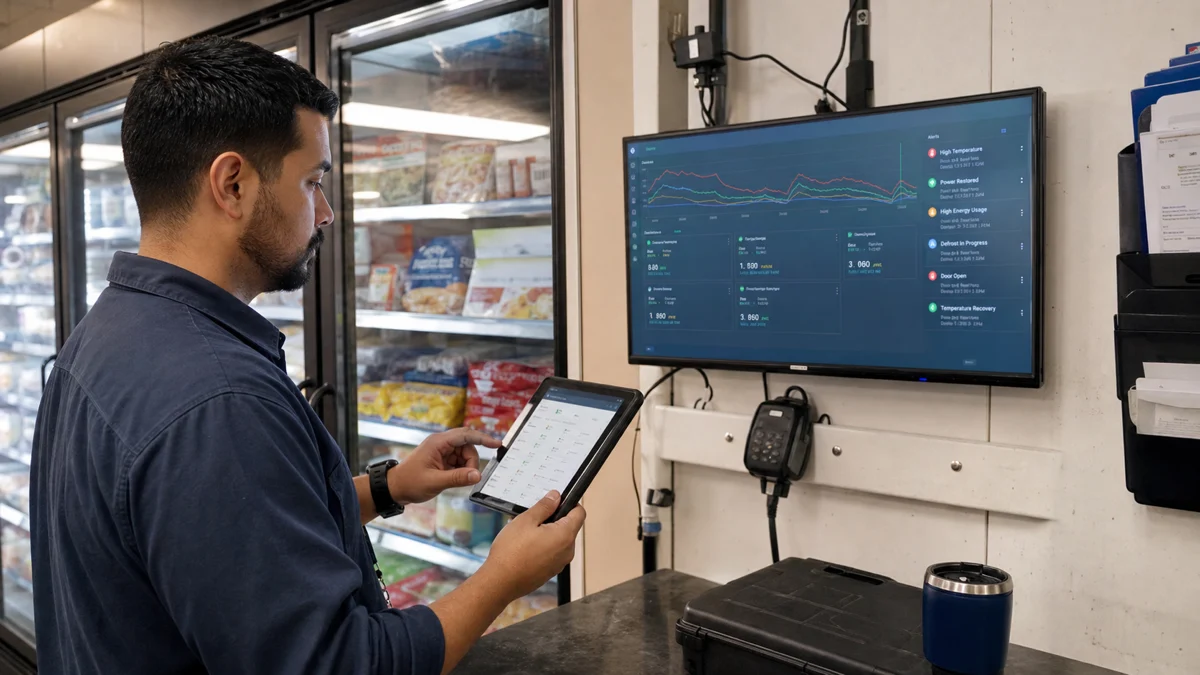
Remote monitoring adds visibility. Temperature curves, compressor state, defrost cycles, door input, sensor failures, network state, and energy metering can move from a local display into a platform. Once that happens, the team can compare cabinets, filter abnormal sites, and review trends instead of waiting for manual inspection.
| Monitored object | What local control can do | What remote monitoring adds |
|---|---|---|
| Temperature | Control the compressor around the setpoint | Record drift, duration, and recovery |
| Defrost | Trigger cycles by schedule or condition | Detect long defrost, abnormal frequency, or slow recovery |
| Door input | Show a local door event | Identify long-open doors, night events, and responsibility windows |
| Power recovery | Continue after power returns | Record outage, recovery, and temperature impact |
| Energy use | Often invisible locally | Detect compressor abnormality, seal leakage, or efficiency drop |
Decision sentence: if a freezer only shows local state, abnormalities are usually found when someone visits the site. If key states enter a platform, operators can see risk trends before product loss happens.
2. Temperature alerts should use duration, not only instant values
A freezer alert should not fire only because a value crosses a threshold once. Door opening, restocking, and the end of a defrost cycle can all raise temperature briefly. If every short excursion pushes an alert, staff will ignore the channel. If the threshold is too wide, the system misses real risk.
A better alert combines temperature, duration, and device state. For example, a temperature that exceeds the upper limit for three minutes may be a warning. If it stays high for ten minutes while the compressor keeps running and recovery is slow, it should become a maintenance alert. If the same event includes a long door-open state, sensor fault, or power recovery record, the priority should rise again.
flowchart LR

A("Temperature<br/>Sensor"):::blue --> B("Local Controller<br/>Compressor / Defrost"):::cyan
B --> C("Gateway or Wi-Fi<br/>Connectivity"):::orange
C --> D("ZedIoT Platform<br/>State Timeline"):::violet
D --> E("Alert Rules<br/>Threshold + Duration"):::green
E --> F("Operator Action<br/>Confirm / Dispatch"):::slate
F --> G("Result Record<br/>Recovery / Loss"):::blue

classDef blue fill:#EAF4FF,stroke:#3B82F6,color:#16324F,stroke-width:2px;
classDef cyan fill:#E9FBF8,stroke:#14B8A6,color:#134E4A,stroke-width:2px;
classDef orange fill:#FFF3E8,stroke:#F08A24,color:#7C3F00,stroke-width:2px;
classDef violet fill:#F4EDFF,stroke:#8B5CF6,color:#4C1D95,stroke-width:2px;
classDef green fill:#ECFDF3,stroke:#22C55E,color:#14532D,stroke-width:2px;
classDef slate fill:#F8FAFC,stroke:#64748B,color:#1F2937,stroke-width:2px;
The important shift is from "a value crossed a line" to "a state event happened." The platform should know when the event started, how long it lasted, which input states were related, who handled it, and whether the cabinet recovered. Without that, remote alerting is only a phone-based version of a local buzzer.
3. Defrost, door input, and power recovery often expose problems earlier than setpoint
Many freezer problems are not caused by a wrong setpoint. They appear because the operating pattern has moved away from normal. Long defrost may indicate icing, poor sensor placement, or seal leakage. Long door-open records may indicate stocking workflow issues or aging hinges. A high temperature rise after power recovery may point to local power and response problems.
A local controller can run these control functions, but a platform is better at long-term interpretation. One long door-open event may not matter. If the same cabinet has long door events every night, the issue may be mechanical or operational. One slow recovery after defrost may not justify dispatch. A recovery time that keeps getting longer is more meaningful.
Decision sentence: when freezer states are recorded continuously, the controller becomes a health data source for the refrigeration asset. If only current temperature is kept, many early failure trends stay hidden.
4. Energy monitoring finds cabinets that still cool but waste power
One difficult freezer problem is a cabinet that still reaches temperature but uses more and more energy. Longer compressor runtime, poor door seals, dusty condensers, and inefficient defrost settings can all raise energy use before temperature crosses a critical limit.
A controller with energy metering can expose that earlier. If one cabinet uses significantly more power than similar cabinets in the same store and also recovers more slowly after door events or defrost, the maintenance direction becomes clearer than it would be from temperature alone.
Energy should not be interpreted alone. Season, restocking frequency, store traffic, setpoint, and defrost strategy all influence consumption. The platform is useful because it can place energy data next to temperature, door input, defrost, and compressor state instead of turning it into a standalone electricity chart.
Decision sentence: if a cabinet can still maintain temperature but energy use keeps rising, the question has shifted from "is temperature controlled" to "is refrigeration efficiency degrading." Energy monitoring can identify that earlier than a temperature alarm.
5. Alerts must close the loop with people
Remote alerts usually fail not because the message cannot be sent, but because nobody owns the response. Store staff, regional supervisors, maintenance technicians, and headquarters should not receive the same alert in the same form. A mild temperature warning may first go to the store. A persistent high-temperature event or failed power recovery should escalate. Sensor faults and network offline states should follow a maintenance process.
A useful alert loop needs at least four elements:
- Severity levels: warning, maintenance alert, and emergency alert must not be mixed.
- Ownership: each alert type needs a default receiver and escalation path.
- Action records: acknowledge, reset, dispatch, arrive, and recover should be recorded.
- Review data: before-and-after temperature, energy, and state changes must be available.
If these actions happen only through phone calls or chat groups, the platform can prove that an alarm was sent, but not that the risk was handled. In food, medical storage, chain retail, and unattended sites, that becomes an operations and accountability risk.
6. When complex remote monitoring is not necessary
Not every freezer cabinet needs a full platform. If there are only one or two cabinets, staff inspect them every day, goods are low-risk, and temperature excursions do not create compliance exposure, local control and local alarms may be enough. A platform would add installation, connectivity, rule configuration, and maintenance cost.
Remote freezer controller monitoring is also not a complete cold-chain management system by itself. Transport cold chain, warehouse cold chain, regulated medical storage, and multi-level inventory management may require batch data, location, owner, calibration records, and business-system integration. The controller provides device-side state data; it does not replace the whole business process.
Use this selection path:
- For one cabinet under local supervision, first make local control and local alarms reliable.
- For multiple cabinets or stores, add remote temperature, door, power recovery, and online-state monitoring.
- If loss or electricity cost is already a problem, add energy monitoring and compressor-runtime analysis.
- If headquarters management, dispatch, or compliance records matter, connect alerts to work orders and reports.
The final recommendation is: do not design remote freezer monitoring around whether the setpoint can be changed remotely. Design it around who knows when an abnormal event happens, who handles it, and how recovery is proven. Only when temperature, defrost, power, energy, and human response are connected does a smart controller become a true cold-chain operations endpoint.