

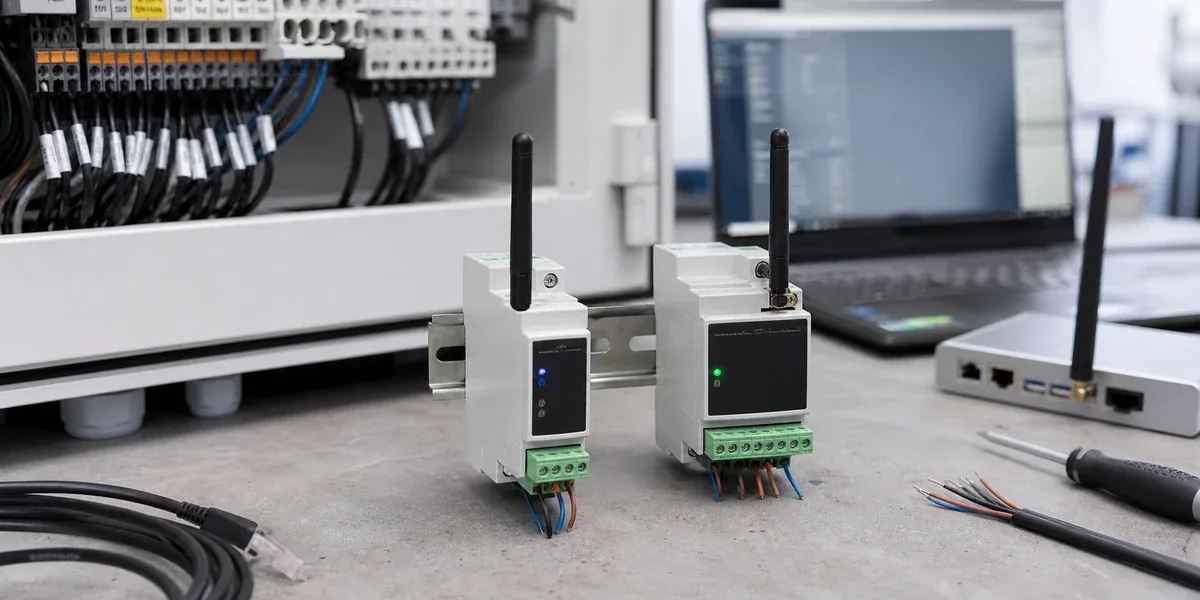
If a site already has RS485 or RS232 equipment, both Wi-Fi serial converters and ZigBee serial converters can bring serial data into a network. The real decision is not which wireless technology sounds newer. The real decision is which option fits the site network, device density, operations model, and platform integration path.
The core conclusion is simple: choose a Wi-Fi serial converter when there are only a few devices, the site already has stable Wi-Fi, and each device can connect directly to the IP network. Choose a ZigBee serial converter when serial points are distributed, cabling is difficult, a mesh-style local device network is useful, and a gateway should manage upstream connectivity. If the system needs hard real-time control, high-frequency data acquisition, or edge computing, either converter is only an access layer, not a replacement for a controller or edge gateway.
Decision Block
A Wi-Fi serial converter solves the problem of quickly connecting a small number of serial devices to an existing IP network. A ZigBee serial converter solves the problem of collecting distributed serial points into a local wireless device network before sending data through a gateway. If the hard part is device modeling, protocol parsing, alarms, and remote operations, the converter must be paired with a gateway or an IoT platform such as ZedIoT.
1. Start with the site network, not the protocol name
A Wi-Fi serial converter fits sites that already have reliable wireless coverage. Examples include a small shop, a lab, an office, a test bench, or a few commercial devices near a stable access point. The path is short: the serial device connects to the converter, the converter joins Wi-Fi, and the upper system receives data through TCP, MQTT, HTTP, or a similar network path.
A ZigBee serial converter fits sites where Wi-Fi coverage is uneven, device points are distributed, or the project does not want every field device to join the IP network directly. Multiple serial points usually join a ZigBee network first, then a coordinator, gateway, or edge box sends the data upstream.
| Decision factor | Wi-Fi serial converter fits better | ZigBee serial converter fits better |
|---|---|---|
| Site network | Stable Wi-Fi already exists | Wi-Fi is uneven or device-by-device provisioning is undesirable |
| Device count | A few devices, mostly direct access | Many distributed points |
| Deployment model | Each device joins the IP network | Devices join a local ZigBee network first |
| Operations focus | Wi-Fi password, signal, IP, connection state | Gateway, coordinator, router nodes, mesh stability |
| Platform integration | Quick TCP/MQTT/HTTP access | Gateway-side protocol adaptation and device modeling |
Decision sentence: if Wi-Fi is already reliable and the device count is low, a Wi-Fi serial converter reduces gateway complexity. If the site has many distributed serial points, ZigBee is valuable because it collects field devices into a more manageable local layer.
2. Device density changes the maintenance cost
For a small number of devices, Wi-Fi is often the fastest path. Once a converter receives Wi-Fi credentials, it can come online quickly. Field engineers can also test the connection from a laptop or a tool on the same local network. For demos, prototypes, small retrofits, and test benches, that directness matters.
As the device count grows, Wi-Fi creates more maintenance objects. Each converter may require signal checks, access point capacity planning, password updates, DHCP behavior, IP conflict handling, and reconnection logic. With enough devices, a simple access choice becomes a network operations problem.
ZigBee usually has a higher starting cost because the coordinator, gateway, node placement, and site coverage must be planned. But when there are many points, it can simplify the long-term model: field devices do not all need to join enterprise Wi-Fi directly, and a smaller number of gateways can manage upstream traffic.

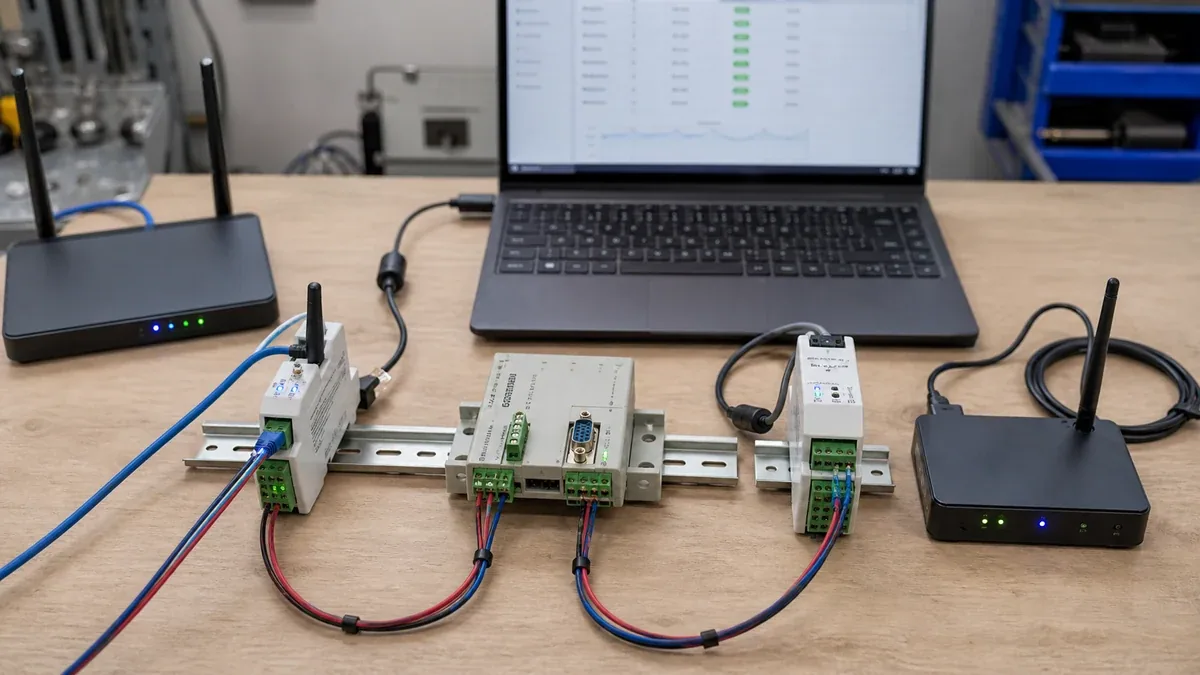
The point of this diagram is not to say that one wireless option is always better. The point is system boundary. Wi-Fi is closer to direct device access. ZigBee depends more on a gateway layer. Long-term maintainability depends on whether that boundary is designed early.
3. Reliability is more than the wireless link
Many projects reduce reliability to signal strength. That is only one part of serial device networking. Reliability also depends on whether the serial protocol is understood, whether the wireless link can recover, and whether the platform can recognize device state correctly.
The risk of Wi-Fi serial converters usually appears when the site network changes. Replaced access points, password rotation, network isolation, router restarts, or DHCP changes can all take devices offline. A few devices can be recovered manually. A large fleet needs bulk configuration, remote diagnostics, and offline alarms.
The risk of ZigBee serial converters usually appears around the mesh and gateway. A poor coordinator location, weak router-node placement, local interference, or gateway downtime can affect many devices at once. ZigBee is not maintenance-free. It shifts the maintenance focus from many IP-connected devices to the local wireless network and its gateways.
Decision sentence: when the team can maintain site Wi-Fi and the device count is small, Wi-Fi simplicity can improve reliability. When the team wants to collect field devices under a gateway layer, ZigBee reliability comes from network planning and gateway operations, not from the individual converter alone.
4. When to choose a Wi-Fi serial converter
Start with a Wi-Fi serial converter when the project matches these conditions.
First, the number of devices is small. A single meter, a test instrument, a controller, or a small device group can be connected quickly without introducing another local wireless network.
Second, the site Wi-Fi is already reliable. Offices, shops, labs, small machine rooms, and some commercial equipment sites often have mature access points, power, and basic network management.
Third, engineers need frequent local testing. If a laptop, TCP tool, or upper-computer application must debug the device on the local network, Wi-Fi is easy to understand and verify.
Fourth, speed matters more than large-scale topology. For POC work, prototypes, small batches, and temporary retrofits, fast deployment may matter more than mesh planning.
The boundary is also clear. If Wi-Fi credentials change often, there are many device points, the customer's IT policy does not allow many field devices on Wi-Fi, or the site is expected to run unattended for years, a pure Wi-Fi serial converter design can leave too much work for operations.
5. When to choose a ZigBee serial converter
Start with a ZigBee serial converter when the project matches these conditions.
First, points are distributed and new cabling is difficult. Commercial freezer controllers, energy meters, environmental sensors, and legacy controllers may sit across shops, warehouses, kitchens, or equipment rooms. ZigBee can organize these points into a nearby wireless device network.
Second, not every device should join Wi-Fi directly. In many customer sites, Wi-Fi is managed by IT, and provisioning many low-value field devices one by one is not practical.
Third, the project needs gateway-based access. ZigBee serial converters usually make more sense when paired with a gateway, edge box, or protocol adapter that handles parsing, buffering, device modeling, and alarms.
Fourth, the data is low-to-medium frequency business data: temperature, status, operating parameters, simple alarms, or occasional configuration commands.
The boundary is also clear. If devices send high-frequency waveforms, large logs, image data, or hard real-time control commands, a ZigBee serial converter should not be the main path. Use Ethernet gateways, edge boxes, or controller-level redesign instead.
6. A practical selection path
Use this order when choosing:
- First verify that the serial protocol is stable. If the protocol is unclear, either converter only moves the problem to the network layer.
- Then check whether stable Wi-Fi already exists. If it does and there are only a few devices, Wi-Fi is usually faster.
- Then look at device density and operations. If points are distributed and unattended, ZigBee plus a gateway is easier to govern.
- Finally check the platform goal. If the goal is transparent access and debugging, Wi-Fi may be enough. If the goal includes device models, alarms, work orders, and fleet operations, a gateway or platform layer is required.
The final recommendation is: do not compare Wi-Fi and ZigBee as isolated products. Compare them as access layers inside a device connectivity architecture. Wi-Fi serial converters are best for quick access to a few devices. ZigBee serial converters are best for collecting distributed serial points before sending data through a gateway. Once long-term operations, alarms, and device models matter, plan the gateway and platform layer together with the converter choice.