

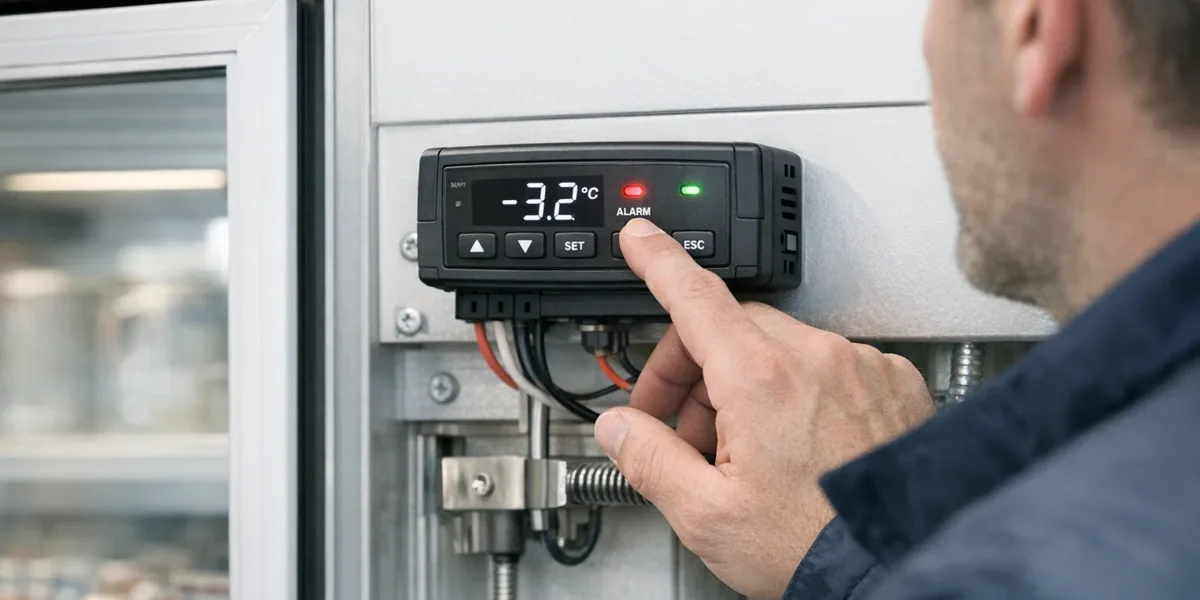
Many teams discuss temperature controllers as if the only questions were “does it read temperature?” and “does the relay switch on time?” That view is acceptable for a stand-alone local controller, but it breaks down once the device enters refrigeration, cold-chain, commercial cooling, or any deployment that needs serviceability and traceability.
The core conclusion of this article is that the real difference between a basic thermostat and an EchoNet-FZ5-class smart temperature controller is not a screen or a network module. It is the fact that the smart controller turns control logic, fault protection, alarm history, remote parameter management, and ongoing operations into one coherent system. A basic thermostat is still fine when the job is only local switching. Once the job includes alerts, recovery, records, or fleet maintenance, its limits appear quickly.
Definition Block
In this article, a “basic thermostat” means a controller focused on local sensing, threshold comparison, and relay switching. A “smart temperature controller” means a controller platform that combines temperature control with alarm handling, event records, remote configuration, and service workflows in one system.
Decision Block
If the device only needs
local display + local switching + occasional manual tuning, a basic thermostat is often enough. If the deployment needsalarm handling,power-loss recovery,historical records,remote parameter changes, ormulti-device maintenance, it is usually better to select a smart temperature controller from the start instead of adding external patches around a basic unit.
1. What a basic thermostat does well, and where it starts to fail
1.1 Basic thermostats are good at local threshold control
A basic thermostat usually follows a simple loop:
- read the probe
- compare temperature with a setpoint and hysteresis band
- switch a relay on or off
- show the current value locally
That is completely reasonable for many small deployments, such as:
- a single stand-alone cabinet
- a small warming or cooling box
- a device that will not be networked
- equipment where an on-site operator can always adjust settings manually
The problem is not that the thermostat is too simple. The problem is that it usually covers only the control action itself, not the engineering problems around that action.
1.2 Real projects are usually constrained by faults and maintenance, not just control
As soon as the controller enters a real service environment, teams start facing questions like:
- What happens when the probe drifts and nobody notices immediately?
- Was the temperature spike caused by a door event, defrost, or power recovery?
- After a restart, did the controller restore parameters and protection timing correctly?
- When support hears “temperature is unstable,” what evidence exists beyond a current reading?
- If there are many deployed units, how are parameter changes applied consistently?
So the critical gap is rarely the relay action itself. It is whether temperature control can be governed over time.
A basic thermostat solves the first layer. A smart temperature controller must solve the next several layers as well.
2. What an EchoNet-FZ5-class smart controller adds in practice
2.1 The difference is not a few features, but a system boundary
A smart controller typically adds several classes of system capability:
- richer control logic such as compressor delay, hysteresis strategy, fan coordination, defrost, or protection rules
- richer exception handling for probe failure, over-temperature, prolonged door-open states, power recovery, or communication faults
- richer records for temperature history, alarm events, parameter changes, and recovery traces
- richer remote capabilities such as remote status, remote parameter updates, alarm delivery, and grouped operations
- richer maintenance capabilities such as online status, firmware lifecycle, site grouping, and support diagnosis
Seen one by one, none of these items sounds dramatic. Put together, they change the controller from a local switching element into a managed device node.
2.2 Connectivity only matters when it leads to operational governance
Some products call themselves “smart” because they expose a mobile app or a dashboard. That is not enough.
If connectivity only shows a live temperature but cannot answer the following questions, the operational value remains limited:
- who changed which parameters and when
- how long an excursion lasted
- what state the system was in before it recovered
- which deployed units fail more often than others
- which parameter templates fit a given cabinet or site type
That is why a smart temperature controller is not about seeing one remote number. It is about moving the temperature-control system into a state that is recordable, auditable, and maintainable at scale.
For refrigeration projects that require alarm records, remote parameter settings, and multi-device operations, ZedIoT’s commercial refrigeration controller is designed as a smart controller system rather than a basic local thermostat.
3. A direct comparison of the engineering boundary
| Dimension | Basic thermostat | EchoNet-FZ5-class smart temperature controller |
|---|---|---|
| Control goal | Local threshold switching | Control logic plus protection, status, and operational governance |
| Parameter handling | Local manual setting | Local and remote parameter management with reusable policy patterns |
| Fault handling | Limited high/low alerts | Over-temperature, probe fault, door-open, power recovery, and related event handling |
| Data retention | Little or none | Temperature history, alarm logs, parameter changes, and recovery traces |
| Remote operations | Usually none | Online status, remote diagnostics, alerts, and grouped maintenance |
| Suitable scope | Stand-alone and low-traceability devices | Multi-site deployments, service-heavy environments, or record-sensitive scenarios |
| Long-term cost | Lower initial cost, higher manual service cost later | Higher initial complexity, lower long-term governance cost |
At first glance, the basic thermostat looks lighter. In practice, once maintenance and service start to matter, many hidden costs shift into manual inspection, phone-based troubleshooting, and on-site recovery work.
The smart controller is not just “more features.” It is a way to absorb those hidden lifecycle costs into the system design.
4. Why refrigeration and cold-chain deployments benefit more from smart controllers
4.1 These deployments care more about the exception process than one instant value
In refrigeration cabinets, medical storage, commercial cooling, or cold-chain systems, operators usually care about questions such as:
- Was the temperature out of range continuously, or only momentarily?
- Was the excursion related to defrost, door-open behavior, or power return?
- How long did recovery take?
- Is one cabinet or one site showing repeated instability?
- Do we need a retained record for service review or accountability?
Those are not strengths of a basic thermostat, because they require:
- continuous records
- event context
- fault classification
- remote notification paths
- visibility after the system has been running for a long time
4.2 Local-only control does not scale well across many sites
If the project has only one device, manual maintenance may still be acceptable. But once it becomes:
- several cabinets in one store
- multiple controllers in one site
- a distributed multi-city deployment
- a service workflow involving both customer and support teams
the real problem changes from “how does this device control temperature?” to “how do we govern this installed base?”
At that point, the valuable questions are:
- which devices are offline
- which ones alarm most often
- which parameters have been changed
- which firmware versions lag behind
- which sites need a coordinated policy update
That is why many industrial and commercial deployments eventually move toward a controller plus platform plus alert-and-record model instead of staying with isolated local controllers.
In multi-site refrigeration scenarios, a smart refrigeration control system helps operators manage temperature history, alarms, device status, and remote configuration from one connected platform.
5. When a smart controller should replace a basic thermostat immediately
The case for a smart temperature controller is stronger when the deployment needs:
- historical temperature records and fault traceability
- remote status access and remote parameter updates
- a common configuration strategy across similar devices
- alert delivery to support teams or customers
- future expansion for door sensors, power-loss detection, or extra environment data
- remote-first service diagnosis before dispatching someone on site
A basic thermostat still remains reasonable when:
- the device is stand-alone and will stay offline
- on-site staff can always intervene manually
- record retention and remote access do not matter
- the number of devices is small enough that manual maintenance is acceptable
- failure consequences are limited and traceability is unnecessary
Boundary Statement
If the consequence of failure is only a comfort issue, a basic thermostat is often enough. If failure can lead to product loss, service interruption, rising support cost, or unclear responsibility, a smart controller is usually the more defensible choice.
6. Four questions that are often missed during selection
6.1 Are you selecting temperature control, or temperature-system governance?
Those are different goals, and they require different architecture and budget decisions.
If the target is long-term serviceability, do not use short-term BOM cost as the only decision metric.
6.2 Do you need a functional box today, or a platform that can expand later?
Many projects start with simple control, then quickly ask for:
- remote parameter templates
- event workflows
- site-level statistics
- firmware updates
- more sensor inputs
If the controller has no platform headroom, later phases become a patchwork of add-ons.
6.3 Will support operate in a swap-first model or a diagnose-first model?
A basic thermostat often leads to “replace the board and see if it helps.”
A smart controller supports “inspect the data remotely, narrow the fault, then decide whether a site visit is needed.”
That difference has a large effect on support cost.
6.4 Do records matter for customer accountability or internal review?
As soon as the deployment touches service guarantees, refrigerated inventory, operational quality, or post-event analysis, retained records stop being optional extras and become a baseline capability.
7. A more practical deployment checklist
Before choosing between a basic thermostat and a smart temperature controller, answer these six questions:
- Does the device need remote status access or remote parameter changes?
- Do you need temperature history and alarm records?
- Will support teams need remote diagnosis before going on site?
- Will the deployment scale across multiple units or multiple locations?
- Do you expect future expansion for sensors, alerts, or platform workflows?
- Could a fault lead to product loss, service interruption, or accountability pressure?
If three or more answers are already “yes,” the project has probably outgrown the reasonable boundary of a basic thermostat.
8. Conclusion
The difference between a smart temperature controller and a basic thermostat is not just price or polish.
A basic thermostat solves a local control action. An EchoNet-FZ5-class smart temperature controller solves long-term runtime governance, exception handling, and remote service in real operating environments.
So the right selection question is not simply “do we need networking?” It is:
- who will maintain the deployment later
- who will judge faults when alarms happen
- whether parameter changes and records must be traceable
- whether the installed base must be governed as one system
Once those questions matter, the smart controller is usually not an optional upgrade. It is the more stable starting point.
Need More Than a Basic Thermostat?
If your refrigeration system needs remote monitoring, alarm records, data logging, or multi-site device management, a smart temperature controller can provide better visibility and control.
ZedIoT provides a commercial refrigeration controller designed for connected refrigeration systems, including device control, cloud monitoring, alarm management, and operational data tracking.