

Industrial IoT System for Manufacturing Factories
A testing-equipment manufacturer needed to connect existing factory equipment and processes for health monitoring, material visibility, production oversight, environmental monitoring, and energy analysis.
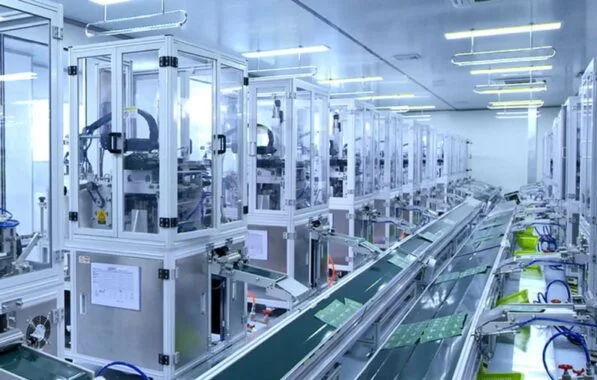
Modernize existing equipment without losing the production workflow around it
The customer was expanding its manufacturing business and needed end-to-end sensing across equipment, materials, production processes, and environmental conditions. Large-screen visualization and mobile monitoring were required to improve production management and reduce operating cost.
- Starting point
- Existing factory equipment
- Data scope
- Production, condition, and energy
- Primary outcome
- Visible, actionable operations
The system had to connect brownfield equipment and new digital workflows
Replacing every machine was not the objective. The project needed a practical acquisition layer, a shared platform, and views that production and management teams could use.
Mixed equipment
Existing machines, meters, sensors, distribution boxes, and new intelligent devices had different interfaces and data quality.
Multiple operating views
Production, maintenance, safety, energy, and management users needed different information from the same field data.
Real-time exceptions
Abnormal states had to trigger rules and alarms without relying on continuous manual observation.
Comparable evidence
Historical and cross-equipment comparisons were necessary for energy and process improvement.
Build one operational loop from acquisition to analysis
The live project organized its value around acquisition, visualization, reporting, and energy analysis. Those four functions remain the core of this page.
Data acquisition and control
Wired and wireless gateways collect production, equipment, environmental, and energy data before forwarding normalized records to central services.
Visual equipment monitoring
Status parameters, production context, rooms, distribution boxes, and equipment groups are represented in views that match the factory layout.
Statistics and reporting
Year-on-year, month-on-month, equipment, environment, and process comparisons support operational and safety analysis.
Energy-saving analysis
Consumption baselines and comparable equipment data help teams identify abnormal use and prioritize cost-reduction actions.
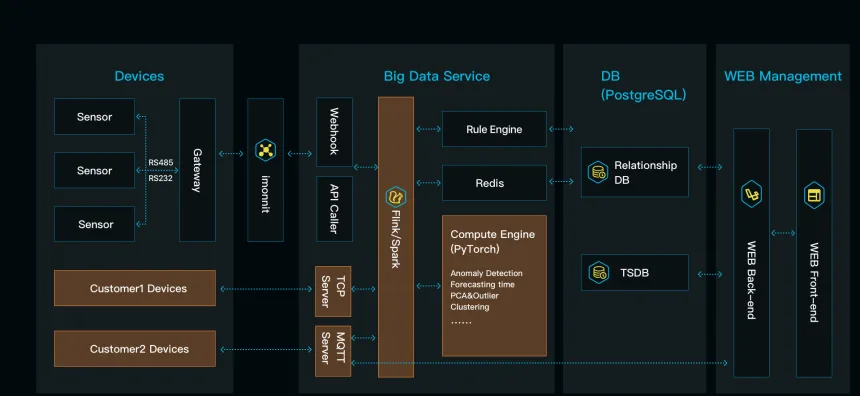
Separate field connectivity from data services and user applications
The published architecture connects sensor and customer equipment through gateways and MQTT, then routes data into APIs, stream processing, analytics, relational and time-series storage, and web applications.
This separation lets the device layer evolve without forcing production teams to replace the reporting and operating workflows above it.
Every layer has a clear responsibility
Equipment state, power, environment, production events, and material signals.
Protocol conversion, local collection, buffering, and controlled cloud transport.
Rules, APIs, time-series storage, analytics, reports, and user permissions.
Monitoring, alarm response, maintenance, energy review, and production decisions.
A reusable industrial IoT foundation for factory operations
The published case reports that the system has operated in customer factories in multiple markets, supporting smart electricity safety and a broader path for connected production management.
One data foundation
Equipment, environment, production, material, and energy signals can be reviewed through a consistent data model.
Faster abnormal-state review
Rules and alerts provide context around equipment status instead of requiring operators to find exceptions manually.
Comparable operating evidence
Reports make it possible to compare devices, lines, and time periods before deciding where to improve.
Deployed factory use
The published case reports successful operation in customer factories at home and abroad for smart electricity safety.
Industrial IoT system questions
Can an industrial IoT system connect existing factory equipment?
Yes, when the equipment exposes usable electrical, serial, Ethernet, fieldbus, or sensor interfaces. A gateway and adapter layer can collect and normalize the data without replacing every machine.
What factory data should be connected first?
Start with data tied to a measurable operating problem, such as equipment status, downtime, energy, environmental conditions, process exceptions, or maintenance. A focused line or equipment group is easier to validate than an entire factory at once.
How are real-time factory alarms created?
The platform applies rules to normalized equipment and process state, then routes alarms with the relevant machine, line, room, time, severity, and acknowledgement workflow.
Can the system support energy analysis and reporting?
Yes. Meter and equipment data can be compared across devices, environments, shifts, and time periods to identify baselines, abnormal use, and energy-saving opportunities.
Planning a connected factory pilot?
Share the equipment list, available interfaces, production workflow, alarm priorities, energy goals, and systems that need integration. We will help identify a focused starting line or equipment group.
- AI + IoT product architecture review
- Hardware, firmware, cloud, and application integration
- Prototype planning and production support