

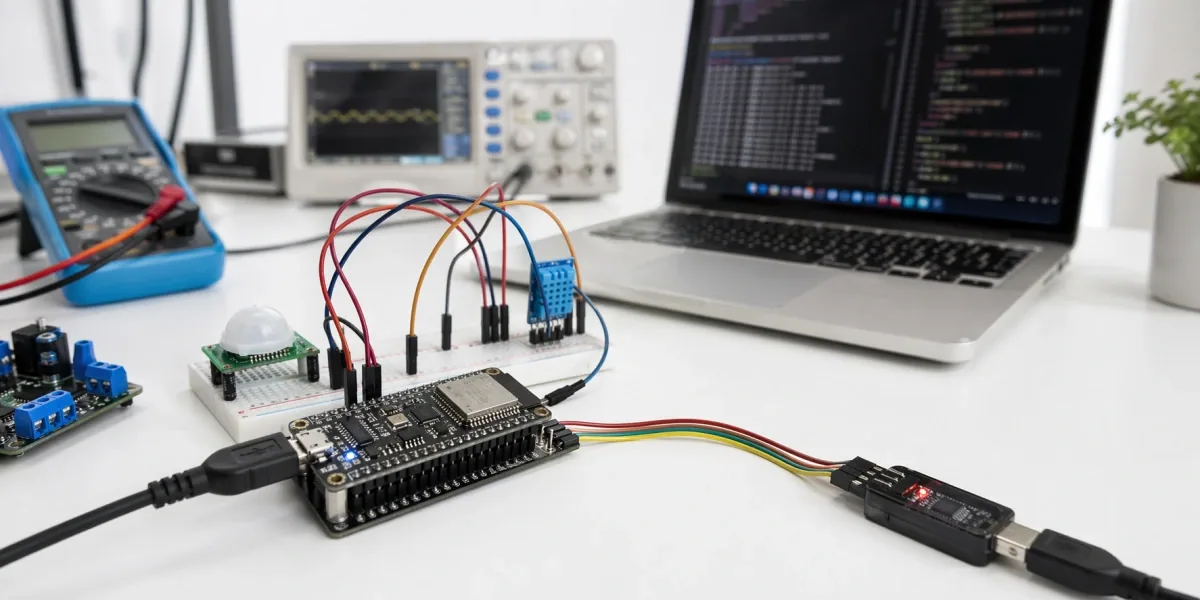
Many teams treat ESP32 firmware development as finished once the device connects to Wi-Fi, reads sensors, and sends telemetry to the cloud. That is enough for a demo, but production firmware gets difficult for a different reason: the system must remain upgradeable, diagnosable, and maintainable after deployment.
For IoT devices, good firmware engineering is not about packing more features into one codebase. It is about separating BSP, drivers, connectivity, state, upgrade logic, and serviceability so one change does not destabilize everything else.
The core conclusion is this: a production-oriented ESP32 firmware architecture should separate at least hardware adaptation, device capabilities, connectivity, state and business behavior, and operations from the first real version onward. If the project stays as a monolithic mix of sensor read + MQTT publish + OTA, the first prototype may look fast, but later changes in telemetry, drivers, or maintenance workflows become increasingly expensive and risky.
Definition Block
In this article,
ESP32 firmware developmentmeans the full software system around an IoT device: board support, drivers, protocols, state handling, remote config, OTA, logs, and field maintenance.
Decision Block
If the product will stay online, receive remote updates, support future peripherals, or need fleet maintenance, the firmware should be designed as a layered engineering system instead of a prototype-style stack. A tightly coupled structure is only acceptable when the device is small in scope and unlikely to evolve after delivery.
1. Why many ESP32 projects become hard to maintain after the prototype phase
1.1 The real problem is usually structural drift, not driver difficulty
Prototype work usually follows a familiar path:
- connect
Wi-Fi - bring up the sensors or actuators
- send data through
MQTT / HTTP - add
OTA
That sequence is normal. The problem appears when everything remains packed inside a few tasks and a few large source files. Then teams start to see issues like:
- adding one new sensor affects networking and state handling
- changing one
MQTT payloadforces edits across storage, alarms, and app-side parsing - an OTA failure requires power cycling in the field because the firmware does not record which layer failed
- support teams hear “the device sometimes goes offline,” but the firmware does not separate
Wi-Fi, broker, watchdog, and business-loop failures
So the useful question is not whether the prototype works. It is whether the structure still supports safe change after the prototype.
1.2 Production-oriented ESP32 firmware should answer five questions early
Before the codebase grows, teams should write down answers for these:
- Will the hardware expand into multiple board variants or sensor combinations?
- Does the device only publish telemetry, or must it also support commands and remote parameters?
- When field failures happen, can logs and state snapshots identify the failing layer?
- Is OTA just a feature, or part of long-term version governance?
- Will the product later add more protocols, peripherals, or local interaction?
If several of those answers are already “yes,” the project should not keep a prototype-style structure.
2. What a more maintainable ESP32 firmware stack looks like
This is closer to a production-ready ESP32 firmware shape:

2.1 BSP / Board Profile should answer “what board is this?”
Board adaptation is easy to underestimate. Once a project gains:
- different modules
- different sensor combinations
- different relay or driver boards
- different power and sampling paths
those differences quickly leak into business logic unless they are isolated.
A cleaner BSP / Board Profile layer should centralize:
- board identifiers
- pin maps
- peripheral initialization strategies
- optional capability flags
- factory calibration entry points
Then higher layers reason about capabilities, not raw pins and electrical quirks.
2.2 The driver layer should not be the device-capability layer
These two layers should stay separate.
The driver layer is responsible for:
- peripheral setup
- stable read and write interfaces
- retries, timeouts, and error codes
The capability layer is responsible for:
- sampling strategies
- filtering, calibration, and derived metrics
- relay, display, buzzer, or storage behaviors
- local safety logic
If sampling algorithms, threshold logic, and I2C / UART details are mixed together, almost any later change will expand the regression surface.
2.3 Connectivity should not own the business state
A common shortcut is to put business rules directly inside MQTT callbacks or HTTP handlers. It is fast early on, but it becomes a maintenance trap.
A better split is:
- the connectivity layer owns sessions, reconnect logic, and payload transport
- the state layer owns current status, parameters, alarms, and command outcomes
That boundary makes later change safer:
- switching from
MQTTtoHTTP / WebSocket / bridgedoes not rewrite the device core - cloud schema changes do not directly infect control logic
- network failures, state mismatches, and command failures remain distinguishable
3. The four engineering surfaces most worth designing early
3.1 Configuration governance is more than reading a few NVS keys
Production devices usually have more than one configuration type:
- factory calibration
- site networking parameters
- remote cloud-managed settings
- local protection thresholds
- debug and log controls
If all of that is flattened into one mixed NVS key-value space, teams usually lose track of:
- which source overrides which
- what should migrate during OTA
- what should roll back and what should remain persistent
A better model is to classify config into at least factory, runtime, remote, and volatile, and define for each:
- source of truth
- override priority
- persistence policy
- OTA migration behavior
3.2 OTA only becomes safe when paired with version governance
An OTA path that can “download and install firmware” is not enough by itself. Teams also need to manage:
- firmware version
- config version
- data-format version
- rollback triggers
- preflight checks
The real question after deployment is not whether OTA exists. It is whether OTA can change the device without breaking older config, local caches, or upstream assumptions.
This lifecycle is closer to what teams actually need:

3.3 Logs and fault snapshots should help field support, not just bench debugging
Too many firmware logging systems are built only for serial-console debugging. Fleet support needs something else:
- enough signal to distinguish network, driver, protocol, and logic failures
- low enough volume to avoid damaging bandwidth, flash, and loop timing
- a way to retain or report the most useful failure facts
From the first meaningful version onward, it helps to separate:
- boot logs
- connectivity lifecycle logs
- command execution logs
- alarm events
- reboot and crash reasons
Then decide which are local-only, retained, or remotely reported.
3.4 Task boundaries should be designed for failure isolation
A common FreeRTOS mistake is to split tasks by feature naming alone. A better question is:
- if this task stalls, what else does it take down?
- if this queue blocks, do networking and local control interfere?
- does this periodic loop need its own watchdog assumptions?
If sampling, connectivity, command execution, and local control all wait on each other, the device becomes fragile under weak networks or bad peripherals.
4. The capabilities that become expensive if they are bolted on later
4.1 Device-state modeling
Do not treat device state as a few fields and a single online flag. A real IoT device usually needs at least:
- current measurements
- control outputs
- connectivity status
- config version
- alarm status
- latest command result
Without those boundaries, support teams keep asking why the dashboard says “online” while control still fails.
4.2 Command and parameter-update paths
If the device accepts remote updates, separate:
- real-time control commands
- slower config updates
- changes that require reboot
- actions that require safety confirmation
Otherwise, teams routinely end up with:
- parameters that appear changed but were never fully applied
- command timeout and execution failure treated as the same error
- reboot-related rollbacks that no one can explain later
4.3 Factory test, calibration, and identity
Many teams keep this information in tools or spreadsheets during EVT / DVT and regret it after production starts.
At minimum, the firmware architecture should preserve:
- serial number or device ID
- board or line identity
- critical calibration parameters
- production test summary
- current firmware and config version
Those facts matter for support, returns, and fleet diagnostics.
5. The most useful guidance is usually about boundaries, not coding tricks
5.1 Define module contracts before task trees and folder names
A safer order is usually:
- define layer inputs and outputs
- decide tasks and queues
- shape folders and source files
Otherwise teams often create neat directory trees while the actual runtime boundaries remain tightly coupled.
5.2 Decouple cloud payloads from internal device state
Whether the device uses MQTT, HTTP, or a vendor cloud, external payload formats should not become the internal state model.
That extra translation step helps because:
- cloud fields change
- different customers want different payloads
- platform-side and firmware-side state granularity rarely match perfectly
A state mapper or command translator costs a little up front and saves large rewrites later.
5.3 Treat recovery paths as part of the architecture
For production IoT devices, failure is normal. What matters is whether recovery is built in:
- how the device reconnects after weak networks
- how it degrades after bad config
- how it rolls back after OTA failure
- whether it can enter a restricted mode after peripheral init failure
Those paths are much more expensive when they are patched in after field incidents.
6. When you do not need such a heavy firmware process
A lighter approach is fine when:
- the device is only a prototype
- OTA is not required
- remote diagnostics are not required
- deployment volume is very small
- the hardware and protocol scope is unlikely to grow
Not Suitable When
If the project is a one-off deployment, a low-volume device, or a system with almost no remote maintenance requirements, a full configuration, logging, OTA, and operational stack may exceed the real payoff. In those cases, keep a minimum structure, but do not mistake that temporary structure for a production architecture.
7. Conclusion
ESP32 firmware development becomes hard not because drivers are impossible, but because many teams try to scale a demo structure into a production system.
For most IoT products headed toward deployment, the most valuable early decisions are:
- separate
BSP,Driver,Capability,Connectivity, andOpsboundaries - govern configuration, commands, and state independently
- build OTA, logs, and recovery as a closed loop instead of an afterthought
If the device will keep evolving, those boundaries belong in the first real version. The best ESP32 firmware architecture is usually not the one with the fewest files today. It is the one least likely to push system risk into production tomorrow.