
Tag - ESP32

{{brizy_dc_image_alt entityId=
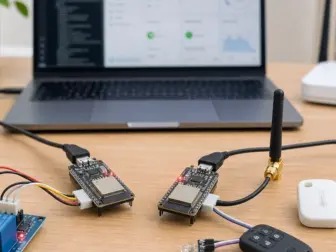
ESPHome is usually the better fit for declarative ESP32 device nodes, sensors, relays, and Home Assistant native integration. OpenMQTTGateway is a better fit for BLE, 433 MHz, IR, and other passive signals that should be collected into MQTT. This article compares the control model, protocol coverage, maintenance cost, and limits.
{{brizy_dc_image_alt entityId=
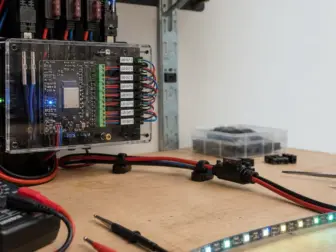
Driving large WS2812 or SK6812 installations with ESP32 and WLED is not just an MCU performance problem. The real constraints are LEDs per output, RMT interrupt or DMA behavior, 800 kHz serial timing, power injection, Wi-Fi load, and multi-controller sync. This article gives a practical architecture guide.
{{brizy_dc_image_alt entityId=
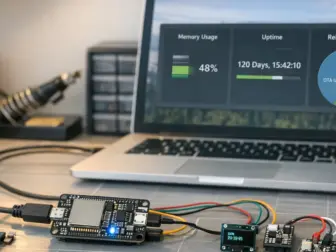
ESPHome devices that fail after days or weeks usually suffer from accumulated system effects: heap pressure, fragmentation, Wi-Fi instability, blocking components, sensor timing, and weak diagnostics. This guide gives a practical ESP32 long-uptime debugging path.
{{brizy_dc_image_alt entityId=
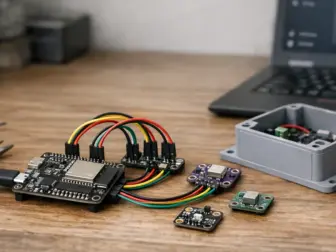
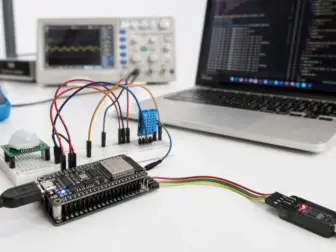
A reliable ESP32 and ESPHome multi-I2C sensor gateway is not just about scanning sensor addresses. It needs bus isolation, warm-up windows, deep sleep trade-offs, power design, diagnostic entities, and clear Home Assistant modeling.
{{brizy_dc_image_alt entityId=
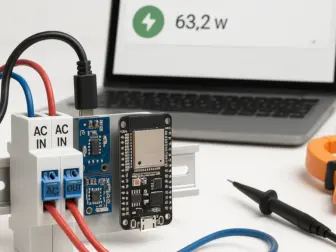
ESP32 energy metering with HLW8032, BL0942, and ESPHome is not just about reading voltage, current, power, and energy. This article explains how to design the UART boundary, sampling cadence, Wi-Fi behavior, calibration, diagnostics, and Home Assistant entities as one stable data path.
{{brizy_dc_image_alt entityId=
The best ESP32 firmware framework in 2026 depends less on hype and more on product lifetime, driver control, Home Assistant alignment, and platform portability. This article explains when ESP-IDF, Arduino, ESPHome, and Zephyr each make sense.
{{brizy_dc_image_alt entityId=
Real ESP32 firmware development is not just about connecting a device to Wi-Fi. It is about structuring BSP, drivers, protocols, config, OTA, logs, and maintenance into a system that can survive production. This guide outlines a more scalable firmware architecture for IoT devices.
{{brizy_dc_image_alt entityId=
Edge AI deployments rarely fail first on model accuracy. They fail when teams cannot see input health, inference health, version context, or diagnostic evidence. This article explains why observability should be designed as a core Edge AI capability from ESP32-class devices to Linux edge boxes.
  • 1
  • 2

Start Free!

Get Free Trail Before You Commit.