

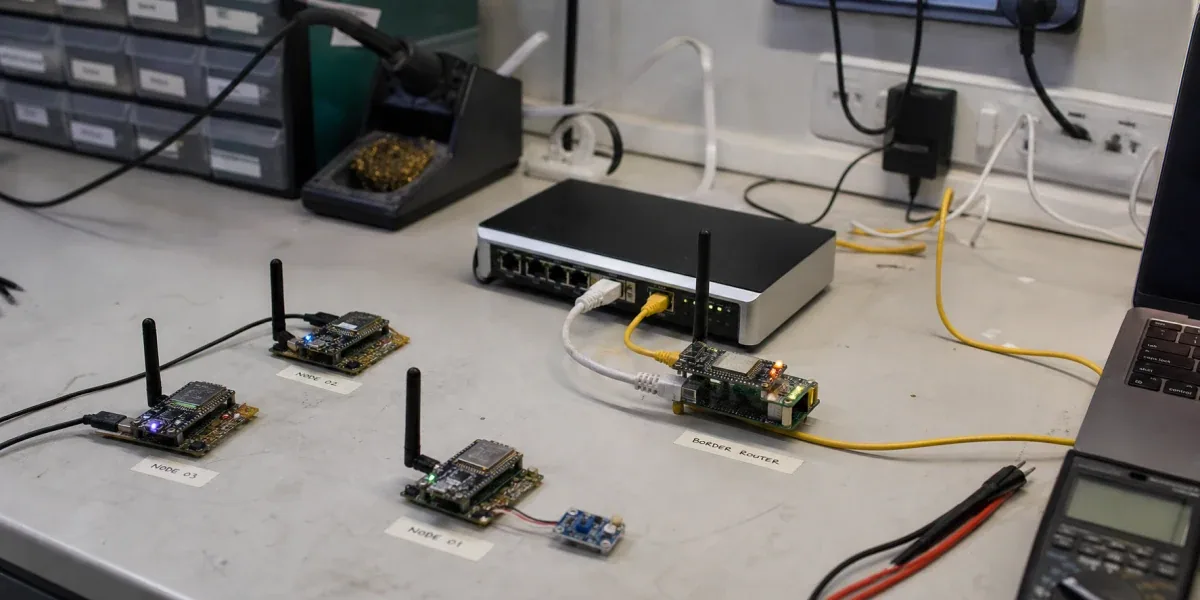
If a product only has a few connected devices, modest data volume, and stable power, Wi-Fi is usually still the simpler answer. Thread starts to make engineering sense when the product has many low-power nodes, needs mesh coverage across rooms or cabinets, and must keep working even when one router node drops out.
OpenThread is not another smart home app protocol. It is an open-source implementation of Thread. Thread solves the low-power IPv6 mesh networking layer; Matter solves the application-layer interoperability model. In practical terms, Thread decides how small devices join and route through the network, while Matter decides how devices are discovered, commissioned, and described to ecosystems such as Home Assistant, Apple Home, and Google Home.
The important decision is not whether Thread is newer than Wi-Fi. The real question is whether the device fleet has enough low-power, multi-node, self-healing, and interoperability pressure to justify Thread, a Border Router, IPv6 debugging, and a more disciplined validation plan.
1. What OpenThread Actually Solves
Most small IoT projects begin with Wi-Fi, BLE, or Zigbee.
Wi-Fi is mature, high-bandwidth, and easy to connect to existing infrastructure, but it is not a great default for every battery-powered node. BLE is excellent for phone-based provisioning, nearby interaction, and simple peripherals, but stable multi-hop mesh productization is a different problem. Zigbee is proven for low-power mesh, yet many commercial deployments still need to deal with gateway-specific behavior, private device models, and ecosystem boundaries.
Thread has a different shape. It uses IEEE 802.15.4 at the radio layer, but the network model is IPv6. With 6LoWPAN compression, mesh routing, and device roles such as Router, End Device, and Sleepy End Device, Thread makes small low-power devices behave more like standard IP network participants.
That is the core value of OpenThread: it gives engineering teams a practical Thread stack for building, testing, and productizing that network layer. It does not remove the need for application logic, device management, security, or field diagnostics. It simply gives the low-power mesh layer a more standard foundation than a fully private gateway protocol.
2. Why ESP32-C6 and ESP32-H2 Are Natural Starting Points
Not every ESP32 chip can become a Thread node. Standard Thread requires an IEEE 802.15.4 radio. Classic ESP32 and ESP32-S3 devices have Wi-Fi and BLE, but not the required 802.15.4 radio. ESP32-C6, ESP32-H2, and ESP32-C5 are the relevant Espressif families when a device must directly participate in a Thread network.
In ESP-IDF, OpenThread projects commonly fall into three patterns:
- SoC / standalone node: the application and Thread stack run on the same 802.15.4-capable chip, such as ESP32-C6 or ESP32-H2. This is a good fit for sensors, switches, and actuators.
- RCP: the Radio Co-Processor handles 802.15.4 radio work, while the host runs more of the network stack. This is common for Thread Border Router designs.
- NCP: the Network Co-Processor owns more of the network stack and exposes a control interface to the host. This can simplify host-side integration when the Thread capability should be packaged behind a co-processor boundary.
For a first proof of concept, two ESP32-C6 or ESP32-H2 development boards running an ot_cli style example can prove network formation and basic connectivity. For a product architecture, that is not enough. As soon as Thread devices need to reach a LAN, cloud service, Matter controller, or IoT platform, the design needs a Thread Border Router.
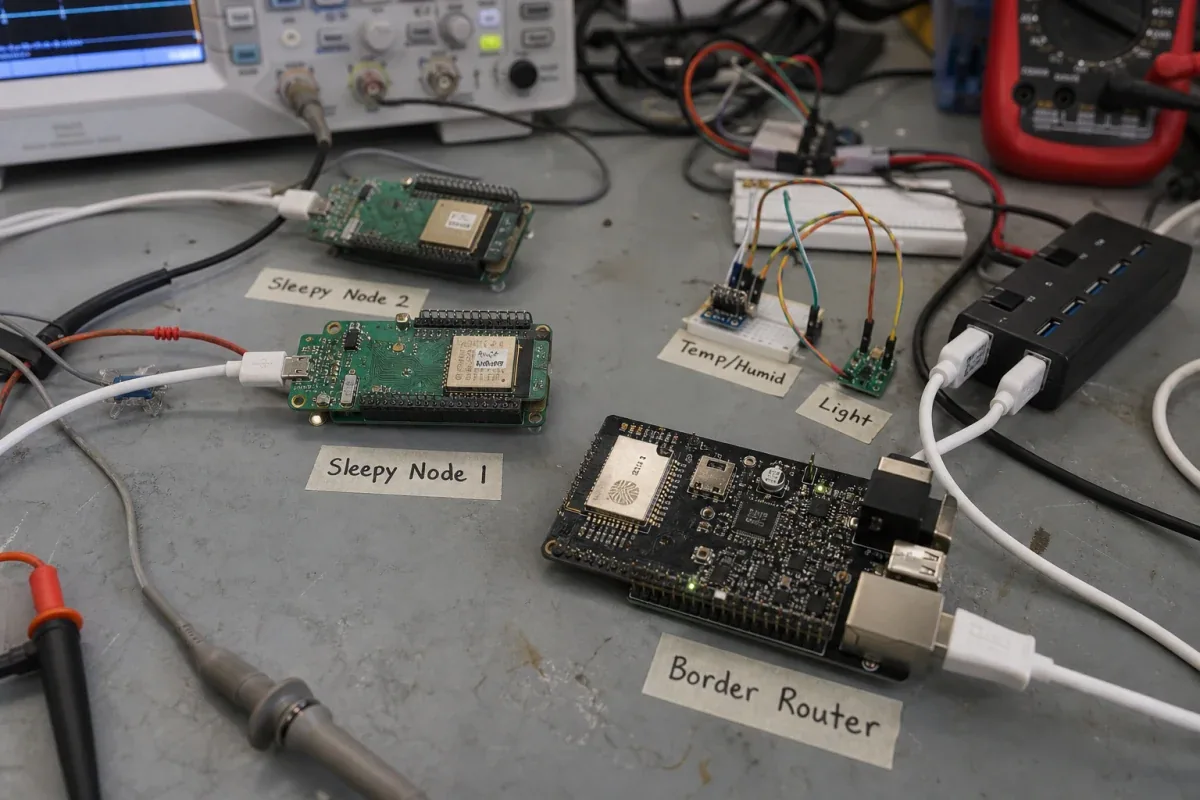
This is the minimum useful validation setup: prove the radio, mesh, RCP or Border Router boundary, and real application traffic before treating the design as a product path.

3. Thread, OpenThread, and Matter Are Different Layers
Matter and Thread are often discussed together, but they solve different layers of the stack.
Matter is an application-layer interoperability standard. It defines device types, commissioning behavior, and the way ecosystems understand device capabilities. Thread is a low-power IPv6 mesh networking protocol over 802.15.4. OpenThread is an open-source Thread implementation.
When a team says it is building a Matter over Thread device, the product actually needs at least three things:
- A chip and radio design capable of Thread, such as ESP32-C6 or ESP32-H2.
- A Thread Border Router that connects the Thread mesh to Wi-Fi, Ethernet, or a broader IP network.
- An application layer that implements the relevant Matter device model, not merely a pair of Thread nodes that can ping each other.
If a prototype only proves OpenThread connectivity, it proves the network layer. It does not prove Matter certification, commissioning behavior, ecosystem compatibility, or long-term product recovery.
4. When OpenThread Is the Right Choice
OpenThread is a strong fit when the device fleet is made of many small low-power nodes. Door sensors, temperature probes, leak sensors, occupancy sensors, and local actuators are good examples. If each node is battery-powered and physically distributed, Thread is usually a more honest architecture than giving every node a Wi-Fi connection.
It is also a strong fit for smart home and building devices that need Matter over Thread. In that case, Thread is not a decorative option; it is one of the network transports the product must support.
Thread also helps when the product needs local self-healing behavior. If one router node disappears, the network can still route through another capable node. That matters in rooms, cabinets, and distributed sensing layouts where a single gateway path is fragile.
Finally, Thread is useful when a team wants to reduce the long-term burden of private gateway protocols. Because the network model is IPv6, diagnostics, service discovery, routing, and platform integration can be reasoned about with a more standard mental model.
Thread does not replace the management layer. Once device data must become monitoring, alerts, permissions, work orders, or fleet operations, the product still needs an IoT platform layer. A platform such as ZedIoT handles the management plane that Thread itself does not attempt to solve.
5. When OpenThread Is the Wrong Tool
OpenThread is not a high-bandwidth data path. Cameras, audio devices, large firmware transfers, frequent image uploads, and media-heavy gateways should use Wi-Fi, Ethernet, or cellular networking. Thread is valuable because it is low-power and mesh-friendly, not because it is fast.
It is also not worth adding to very small simple projects. If a design has one sensor, one gateway, and stable power, Wi-Fi or BLE may be less expensive and easier to maintain. Adding Thread Mesh, a Border Router, IPv6 diagnostics, and ecosystem commissioning for one or two nodes can create more complexity than value.
Teams that are not ready to handle ESP-IDF, IPv6 behavior, Border Router topology, commissioning, and field diagnostics should avoid treating OpenThread as a quick shortcut. The hard part is not lighting up a demo; the hard part is recovery, compatibility, upgrades, and support after deployment.
Classic ESP32 and ESP32-S3 designs also cannot simply become Thread nodes. Without an 802.15.4 radio, they need an external RCP or a move to ESP32-C6, ESP32-H2, or ESP32-C5.
6. A Practical Validation Path
A good OpenThread project should validate in stages.
First, use two 802.15.4-capable development boards to create and join a Thread network. This proves that the chip, SDK, radio configuration, and basic network path work.
Second, introduce a Border Router. That may be an ESP-IDF ot_br / ot_rcp style setup or a Linux host with an 802.15.4 RCP. This stage proves the boundary between the Thread mesh and the IP network.
Third, add real application traffic. Do not stop at ping. Send sensor data, command messages, heartbeat data, or the project protocol over UDP, CoAP, or the intended transport, then measure latency, loss, reconnection behavior, and sleepy device recovery.
Fourth, add Matter or platform integration only after the network boundary is proven. If the product must work with Home Assistant, Apple Home, Google Home, or an enterprise IoT backend, device models, credentials, permissions, state synchronization, and failure recovery become part of the test scope. For gateway-heavy deployments, it may also make sense to evaluate ZedIoT ESP32 development services or an edge device design rather than pushing every responsibility into each Thread node.
7. Choosing Between Wi-Fi, BLE, Zigbee, and Thread
Choose Wi-Fi when the device needs bandwidth, stable power, and direct IP connectivity. Cameras, voice devices, screens, edge gateways, and high-volume telemetry devices usually belong here.
Choose BLE when the main problem is phone-based provisioning, short-range interaction, wearables, or simple peripheral behavior.
Choose Zigbee when the project already has a mature Zigbee gateway, a known device model, and no clear need for Matter over Thread. A working Zigbee ecosystem may be the lower-risk choice for many installed environments.
Choose Thread when the system has many low-power nodes, needs mesh and self-healing behavior, and benefits from Matter or a standard IPv6 network model. The decision should be driven by system constraints, not by protocol novelty.
8. FAQ
Can a classic ESP32 run OpenThread directly?
No. A classic ESP32 or ESP32-S3 does not have the IEEE 802.15.4 radio required for a standard Thread node. Use ESP32-C6, ESP32-H2, ESP32-C5, or an external 802.15.4 RCP.
Is OpenThread the same as Matter?
No. OpenThread is a Thread network stack implementation. Matter is an application-layer interoperability standard. Matter can run over Thread, Wi-Fi, or Ethernet.
Should I choose ESP32-C6 or ESP32-H2?
Choose ESP32-C6 when the device benefits from Wi-Fi 6, BLE, and 802.15.4 in one SoC. Choose ESP32-H2 when the node is mainly a low-power 802.15.4 / BLE device. Final selection still depends on power budget, peripherals, cost, supply, and SDK maturity.
Does every OpenThread project need a Border Router?
Not if the goal is only communication inside a Thread network. It becomes necessary when Thread devices need to reach a LAN, cloud service, Matter controller, or other IP network.
Is OpenThread suitable for industrial sites?
It can fit low-power sensing and local mesh use cases, but it does not replace industrial Ethernet, RS485, CAN, Wi-Fi, or cellular networking. Interference, installation position, power design, maintenance cost, and compliance still need separate validation.
9. Conclusion
OpenThread with ESP32-C6 or ESP32-H2 is valuable because it gives low-power, multi-node, Matter-ready devices a more standard network foundation. It is not a reason to abandon Wi-Fi everywhere.
If the product has only a few devices, high-bandwidth traffic, or a simple direct-connection model, Wi-Fi or BLE is usually still the cleaner choice. If the product has many battery-powered nodes, needs self-healing mesh behavior, and may enter the Matter or IPv6 IoT ecosystem, OpenThread deserves early validation.
The practical path is simple: prove the Thread network first, prove the Border Router boundary second, then add Matter, platform integration, and field operations. A demo that can ping is not the same thing as a product that can be shipped and maintained.
References
- OpenThread official site: OpenThread
- Espressif documentation: OpenThread – ESP-IDF Programming Guide
- Espressif documentation: Thread – ESP32-C6 ESP-IDF Programming Guide
- OpenThread Codelab: Build a Thread Network with ESP32-H2