

Industrial Protocol Integration and HMI Development
A guide for industrial connectivity projects involving PLCs, sensors, serial devices, HMI software, and cloud integration.
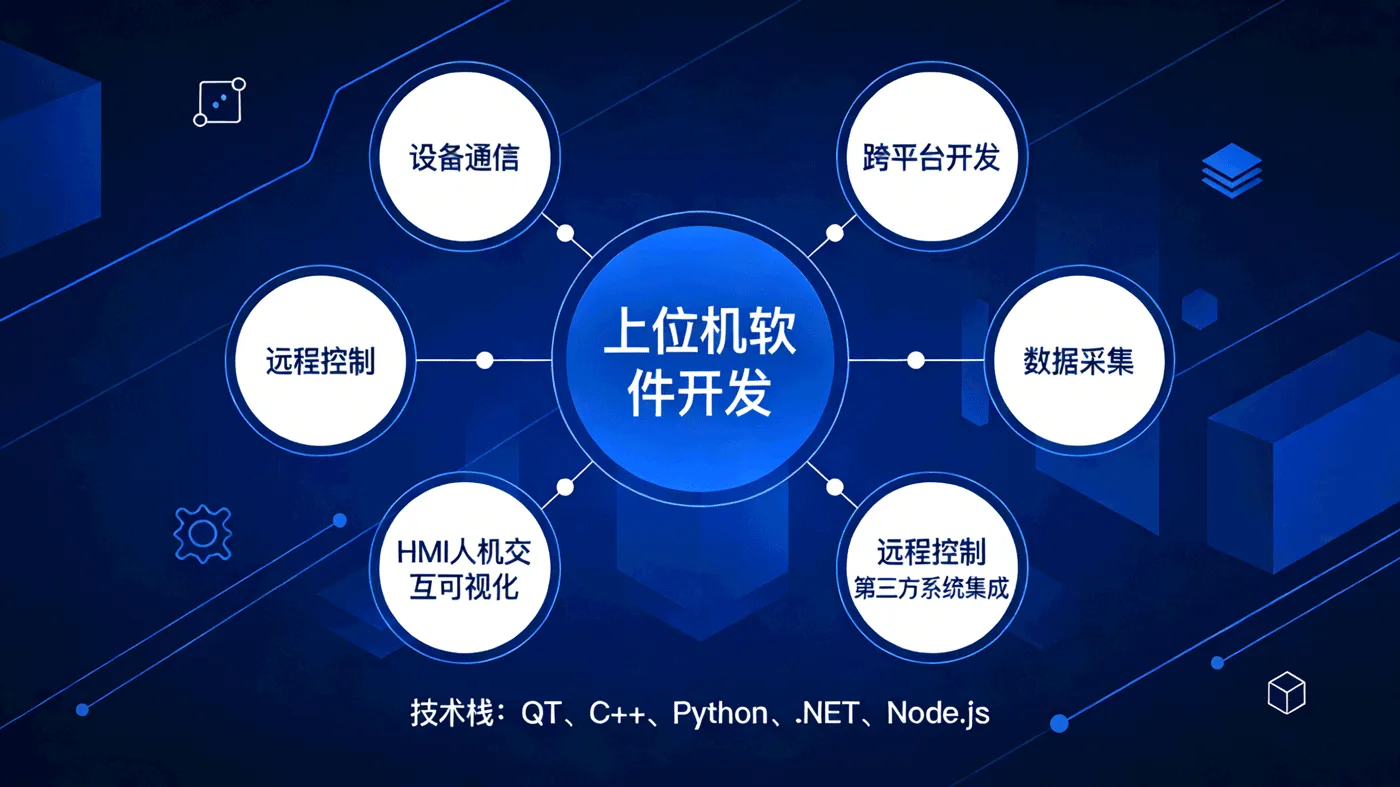
What this topic covers
Industrial protocol integration and HMI development covers how PLCs, meters, sensors, controllers, and vendor-specific devices communicate with local HMI software, gateways, and cloud platforms through Modbus, OPC UA, BACnet, MQTT, serial, or proprietary protocols.
- Manufacturers with PLCs, meters, controllers, inspection devices, or sensors that need stable data collection and control.
- Hardware teams that need custom HMI software, test tools, device debugging utilities, or commissioning interfaces.
- Integration teams that need industrial data connected to cloud platforms, dashboards, or internal data systems.
What to clarify before implementation
Modbus, OPC UA, MQTT, serial devices, HMI software, and protocol adapters determine whether field equipment can become useful data.
Collect the point table
Clarify registers, units, sampling frequency, read/write permissions, abnormal states, and conversion rules.
Build an adapter layer
Do not let business applications depend directly on field protocol details.
Validate with real devices
Protocol documents are not enough; test disconnection, retries, timing, concurrency, and device-specific behavior.
Prepare for operations
Field systems need logs, diagnostics, version control, and safe remote configuration.
Guides that support this decision
Move from topic to buildable stack choices
Related implementation entries
Have equipment that needs to connect?
Start with the protocol, point table, sample device, and target workflow; we can help estimate adapter and HMI work.
Common planning questions
Use these answers to frame the first practical decisions around Industrial Protocols.
Can devices be integrated without complete protocol documents?
Sometimes. We can investigate with sample devices and serial or network debugging, but project risk is lower with full documentation.
Do we need a custom HMI?
A custom HMI is useful when operators need local monitoring, configuration, test tools, or device-specific workflows.
Plan this topic with an AI-IoT engineering team
Share the current equipment, workflow, data source, or system integration you are evaluating. We will help convert the topic into a practical implementation path.
- AI + IoT product architecture review
- Hardware, firmware, cloud, and application integration
- Prototype planning and production support