

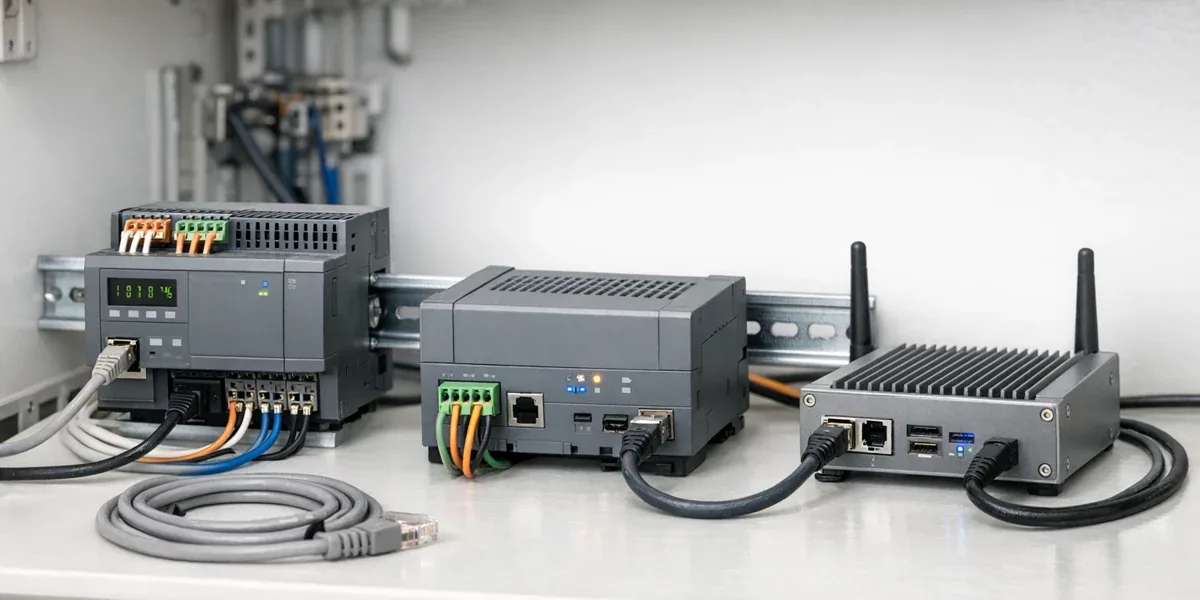
Many industrial IoT and building automation projects start with the same question: should we use OPC UA, Modbus, or BACnet?
The more useful answer is: do not start by asking which protocol is more advanced. Start by asking where the system boundary is. If the job is to read registers from a meter, PLC, or drive, Modbus often gets you moving fastest. If the job is to make HVAC, lighting, access control, and energy systems interoperate inside a building, BACnet usually fits the domain better. If the job is to turn industrial assets, production units, and edge gateways into browseable and governable information models, OPC UA is often the stronger semantic and integration layer.
Decision block
In industrial and building automation,
Modbusis best understood as a device access language,BACnetas a building-system interoperability language, andOPC UAas an industrial information modeling and edge integration language. Most protocol mistakes happen when device access, domain interoperability, and platform modeling are treated as the same problem.
1. Choose by system boundary, not by protocol name
OPC UA, Modbus, and BACnet can all carry device data, but they are not optimized for the same object boundary.
Modbusis close to low-level device read/write behavior: registers, coils, function codes, and polling cycles.BACnetis close to building automation interoperability: HVAC, lighting, access control, energy, and building control objects.OPC UAis close to industrial information access and modeling: nodes, address spaces, methods, events, quality state, and information models.
That means they should not be compared only in a simple communication-protocol table. The first decision is which layer you are solving:

When teams treat the three protocols as direct substitutes, they usually pay in one of two ways: the field integration becomes more complex than needed, or the platform model stays semantically weak for years.
2. Modbus: good for device access, weak as a system model
Modbus has a very practical advantage: it is simple, mature, and widely supported. Many PLCs, meters, drives, data acquisition modules, and controllers can expose basic read/write behavior through Modbus RTU or Modbus TCP.
Modbus is usually a reasonable choice when:
- the device exposes a register or coil model
- data volume is limited and polling cycles are manageable
- control actions are limited and clearly bounded
- field engineers already maintain address maps, scaling factors, and byte order
- the first goal is to connect equipment, not to create a unified information model
The cost is semantic work. Modbus will not tell your platform that a register represents the supply-air temperature of a specific AHU. It will not naturally express device hierarchy, equipment relationships, quality state, or alarm meaning. You must add that meaning in the gateway, driver configuration, or platform model.
Judgment sentence
If the system has only a few devices, simple object semantics, and a fixed upper-layer application, Modbus complexity is low enough to be an advantage. If the platform must reuse data across systems, search assets across projects, or model business objects, exposing raw Modbus registers upward transfers semantic cost to every downstream application.
3. BACnet: strong for building automation, not a universal industrial protocol
BACnet is strongest in building automation. Its value is not that it is simply “more advanced than Modbus.” Its value is that it was designed for building automation and control networks, so it maps naturally to HVAC, lighting, access control, fire systems, energy management, and building management systems.
BACnet is often the better fit when:
- a building automation system must integrate with a BMS or BAS
- HVAC, VAV, AHU, chiller, lighting, or energy devices need to interoperate
- the owner, consultant, or specification requires BACnet-compatible equipment
- the project cares about building-system objects, not PLC register control
- the site already contains many BACnet/IP or MS/TP devices
BACnet also has a clear boundary. It is not meant to cover every industrial field protocol, and it should not be forced onto PLCs, robots, motion control, or production process data unless the equipment and domain model clearly justify it. BACnet is natural inside building systems. In manufacturing environments, it should be chosen only when the building-domain object model is actually the problem being solved.
4. OPC UA: strong for industrial modeling and edge integration, with higher implementation cost
OPC UA is strongest when the system needs information modeling, address spaces, service access, security controls, and cross-vendor industrial interoperability. In practice, it often belongs at the industrial edge, between SCADA, gateways, MES, analytics systems, and platforms, rather than as a direct replacement for every low-level field protocol.
OPC UA deserves priority when:
- multi-vendor equipment must be normalized into a browseable object view
- the platform needs data quality, source, timestamps, and hierarchy
- upper layers should not understand register addresses, scaling, or byte order
- devices, production units, or asset models need long-term governance
- the system needs clearer security, permission, and audit boundaries
The tradeoff is real. OPC UA requires modeling decisions, naming rules, data-type design, permission strategy, and information-model evolution. For a short-lived, low-complexity, single-device project, that work can cost more than it returns.
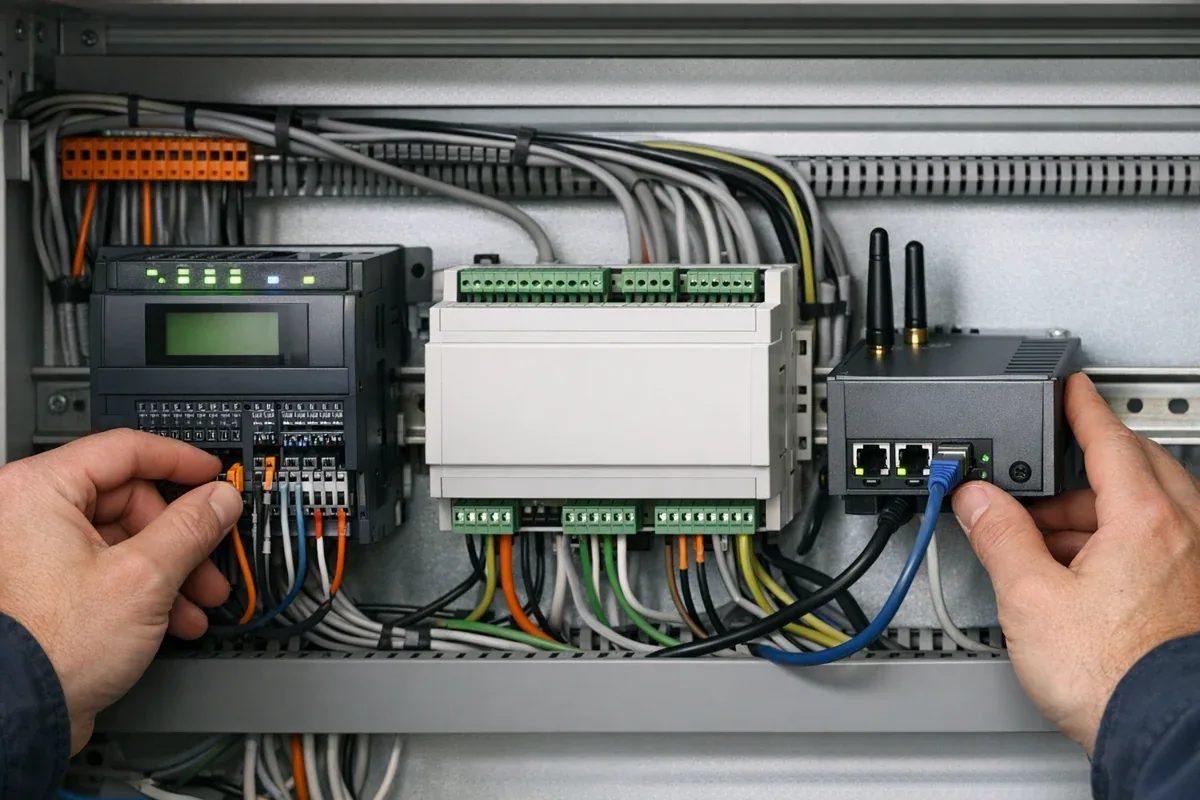
5. A practical comparison table
| Choice | Best fit | Main advantage | Main cost | Poor fit |
|---|---|---|---|---|
| Modbus | PLCs, meters, drives, field modules, low-level device access | Simple, mature, broad device support, fast startup | Weak semantics; point governance must happen elsewhere | Complex object models and cross-system reuse |
| BACnet | Building automation, BMS / BAS, HVAC, lighting, energy systems | Strong building-domain fit and interoperability ecosystem | Limited fit for manufacturing process semantics | Production line control and complex industrial process modeling |
| OPC UA | Industrial edge semantic layer, SCADA / MES / platform integration | Strong information modeling, security, and object views | Higher modeling and implementation cost | Small projects that only need simple register reads |
The table is not a final answer by itself. It is a decision sequence: identify the device and domain boundary first, then decide whether the system needs semantic modeling and platform governance.
6. Real architectures often combine them
In real projects, the most stable answer is often not “pick one.” It is to keep each protocol at the layer where it is useful.
6.1 Industrial devices into a platform
A common path is:
Modbus device -> edge gateway -> OPC UA information model -> platform API / MQTT / database
Here Modbus accesses the equipment, OPC UA shapes registers into objects and nodes, and the platform avoids direct dependency on low-level address maps.
6.2 Building systems into an IoT platform
A common path is:
BACnet devices / BMS -> protocol gateway -> unified device model -> IoT platform
Here BACnet carries the building automation ecosystem, while the platform maps AHUs, VAVs, lighting circuits, and energy meters into a unified asset model.
6.3 Mixed campus or factory-building environments
Many factory campuses have both production equipment and building equipment:
Modbus / OPC UA industrial equipment + BACnet building systems -> edge integration layer -> unified operations platform
In this type of project, forcing one protocol to dominate the whole site is usually the wrong goal. Production equipment, building equipment, and platform objects should be unified at the edge integration layer, not by forcing every field device to speak the same protocol.
7. Three common mistakes
7.1 Using Modbus as the platform data model
A Modbus point map is useful as an integration configuration. It is a poor long-term business model. If platform search, alerts, reports, and customer-facing screens all depend on register addresses, every device replacement or point-map change becomes a platform change.
7.2 Treating BACnet as the answer for every connected device
BACnet is highly useful in building automation, but its object model and ecosystem are not the same as general manufacturing semantics. Manufacturing sites still need to consider PLC, SCADA, OPC UA, Modbus, Profinet, EtherNet/IP, and the actual equipment capabilities.
7.3 Introducing OPC UA too early only because it is standardized
OPC UA information modeling is powerful, but powerful models need maintenance. If a project only reads a few meters, has a short lifecycle, and will not reuse data across systems, full OPC UA modeling may turn a simple problem into a governance problem.
8. A more useful selection order
Use this sequence:
- Start with what the equipment actually supports. If a device only supports Modbus, do not pretend the device layer can become OPC UA or BACnet without a gateway.
- Then identify the domain object. Building objects point toward BACnet. Industrial objects point toward OPC UA or industrial gateway modeling.
- Then decide how upper layers consume data. A single application can stay simple. Multiple consumers require a semantic layer.
- Finally define the gateway responsibility. A gateway should not only translate protocols; it should also govern points, quality state, permission boundaries, and platform object mapping.
Not-fit block
If the project is only a small set of short-lived monitoring points, with fixed devices and no cross-system reuse requirement, do not force OPC UA or full BACnet integration. In that case, a clean Modbus point map, documented naming, and clear units may be more valuable than adding another protocol layer.
9. Conclusion
The real difference between OPC UA, Modbus, and BACnet is not which one is more modern. It is the system boundary each protocol was built to serve.
- Choose
Modbusfirst when the job is low-level device access. - Choose
BACnetfirst when the job is building automation interoperability. - Choose
OPC UAfirst when the job is industrial semantic modeling, edge aggregation, and cross-system object views.
For long-running industrial and building IoT platforms, the strongest architecture usually does not force these protocols to replace one another. It keeps field protocols at the field boundary, adds semantic structure at the edge, and lets the platform consume unified objects. Protocol selection is less about finding one universal standard and more about avoiding the wrong complexity in the wrong layer.