

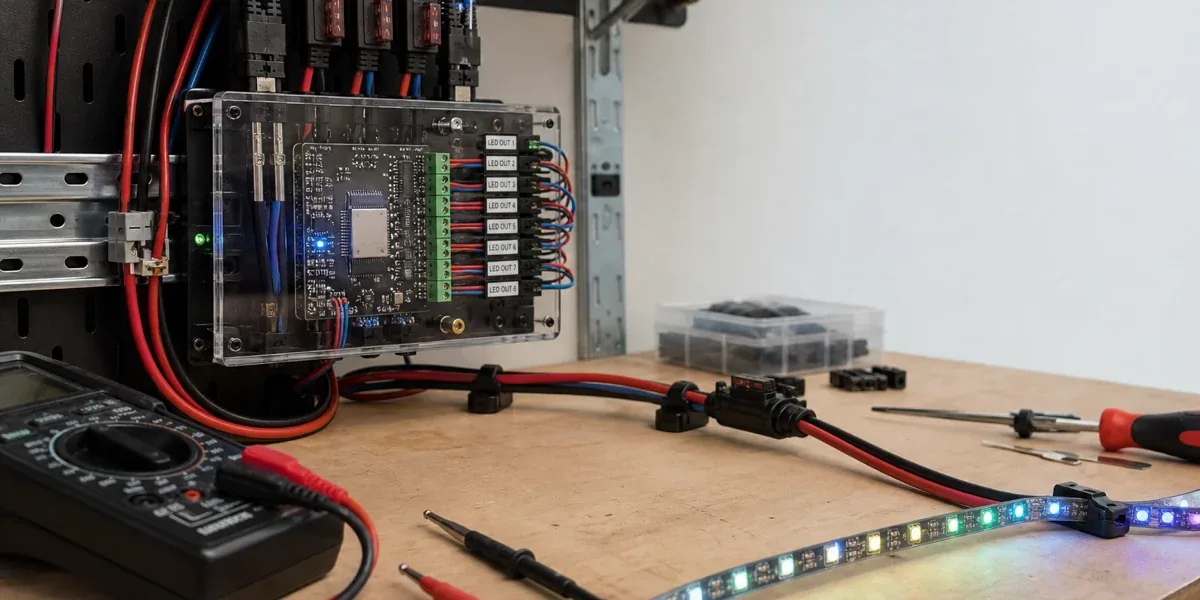
When an ESP32 + WLED project grows from a short decorative strip to hundreds, thousands, or several thousand addressable LEDs, the bottleneck is rarely just “whether the ESP32 is fast enough.” A better answer is: high-density LED control is constrained by output segmentation, serial LED timing, RMT interrupt or DMA behavior, SRAM usage, power injection, Wi-Fi load, and synchronization strategy together.
If you keep adding LEDs to one data line, you will usually see lower frame rate, visible skew, voltage drop, color shift, and occasional flicker before you run out of raw MCU compute. If you only switch to a faster board without splitting outputs, redesigning power, or defining sync boundaries, the 800 kHz one-wire protocol and real installation wiring will still dominate the result.
Definition block
In this article, a “high-density addressable LED controller” means one or more ESP32/WLED nodes driving hundreds to thousands of
WS2812,SK6812, or similar one-wire addressable LEDs. It is not just a strip-light hobby setup; it is a small edge-control system with real-time output, power, networking, and field maintenance boundaries.
Decision block
If the target is above roughly
500LEDs, design around five decisions first:LEDs per output,number of outputs,power injection,sync method, andnumber of controllers. If the target approaches or exceeds2000LEDs, multi-output or multi-controller architecture is usually safer than forcing everything through one long data line.
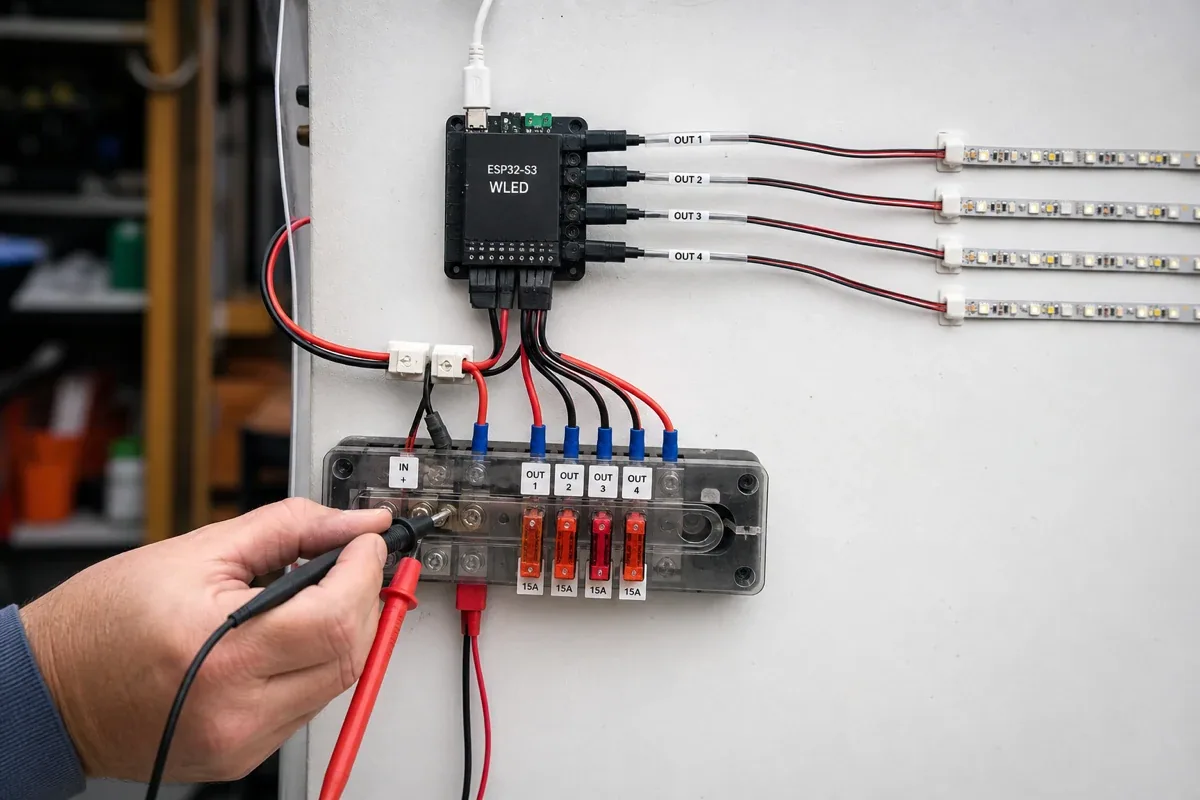
1. Why “more pixels” is not linear scaling
Addressable LEDs create a misleading intuition. If 100 LEDs work, it feels like 1000 LEDs should only mean buying more strip. In practice, this is not how the system scales.
One-wire LED protocols are serialized. The more pixels on one output, the longer it takes to transmit a complete frame. Even if the MCU can calculate the effect, the output line still has to send timing-sensitive data one pixel after another. WLED's multi-strip documentation reflects that reality: it recommends ESP32 for more than one output and describes four outputs as a practical sweet spot. It also gives examples such as 512 LEDs per pin x 4, 800 LEDs per pin x 4, and 1000 LEDs per pin x 4, instead of encouraging one infinitely long strip.
The first rule of high-density LED control is therefore not “buy a faster chip.” It is reduce the length of each serial output chain.
2. Why RMT, DMA, and Wi-Fi affect LED stability
ESP32 projects commonly use the RMT peripheral to drive timing-sensitive WS2812-style signals. RMT was originally designed as a remote-control transceiver, but Espressif documents LED strip output as a practical use case. Espressif also notes a critical limitation: on non-ESP32-S3 chips, large LED output can rely heavily on interrupts and ping-pong buffering, so Wi-Fi or Bluetooth interrupt pressure can create timing exceptions.
This is the source of many flicker problems. The color algorithm is not necessarily wrong. The LED output task is competing with network control, animation calculation, Web UI activity, MQTT traffic, or synchronization work.
ESP32-S3 matters for this reason. Espressif's RMT FAQ recommends ESP32-S3 for RMT-heavy use because it supports RMT DMA, which moves more of the output workload away from the CPU interrupt path. The point is not that ESP32-S3 is always “faster.” The point is: when LED output competes with Wi-Fi, Bluetooth, audio, or sync tasks, DMA and resource separation matter more than peak clock speed.
3. The five architecture decisions in a large WLED build
3.1 LEDs per output set the serial refresh ceiling
Every WS2812/SK6812 output is a serial chain. More pixels per output means lower maximum frame rate and more visible delay in fast effects. If the installation is slow ambient lighting, that may be acceptable. If it is stage lighting, a pixel matrix, or music-reactive output, per-output length must be more conservative.
Decision sentence: When LEDs per output are too high, the first thing you lose is frame rate and dynamic consistency, not static lighting capability.
3.2 Output count determines how much work can be split
WLED supports multiple outputs and lets users configure LED type, GPIO, length, and color order at runtime. For ESP32 builds, multiple outputs are not just a wiring convenience. They split one long serial queue into several shorter chains.
More outputs still have a cost. They increase configuration, power, wiring, sync, and troubleshooting complexity. WLED's own guidance makes four outputs a sensible starting point for many single-controller builds.
3.3 RMT or DMA decides whether output timing is fragile
Classic ESP32 can run many WLED installations, but under high LED count, active Wi-Fi, heavy sync traffic, or audio-reactive effects, interrupt latency can become visible. ESP32-S3 RMT DMA reduces that pressure, but it does not remove the need for output segmentation, power design, and memory budgeting.
Decision sentence: If the installation needs both high-density LED output and real-time Wi-Fi control or audio reaction, choosing ESP32-S3 or splitting the load across nodes is usually safer than squeezing a classic ESP32 harder.
3.4 Power injection decides whether “it lights” also means “it is correct”
Many LED problems are misdiagnosed as firmware problems. Large strips commonly show yellowing at the far end, voltage drop under full white, local flicker, weak common ground, and undersized power wiring. WLED includes an automatic brightness limiter, but current limiting does not replace correct power capacity, wire gauge, injection points, and grounding.
Decision sentence: When power design is weak, reducing brightness can make the system look stable, but it does not prove the control architecture is reliable.
3.5 Multi-controller sync defines the system boundary
As LED count rises, multiple controllers often become more realistic than forcing one controller to own the entire installation. WLED's DDP virtual LED model can attach remote WLED nodes to a controlling instance, or the system can use network-level synchronization. This is useful when the physical installation is spatially distributed, power zones are clear, and one failure should not affect the whole site.
Multi-controller systems also introduce latency, sync skew, configuration drift, and recovery behavior. They work best as an intentional installation architecture, not as a patch for poor early segmentation.
4. Recommended architecture: split outputs before scaling controllers

The key point is to work backward from pixel scale and effect target, then decide LEDs per output, output count, and power zones. Only after those boundaries are clear should you decide whether one controller is enough. Starting with one development board and attaching all strips to it usually mixes timing, power, and maintenance risk into one hard-to-debug system.
5. Practical guidance by project scale
| Project scale | Safer starting point | Main risk | What to avoid |
|---|---|---|---|
| 100 to 500 LEDs | One ESP32 with 1 to 2 outputs | voltage drop, long data line noise | USB-only power or no common ground |
| 500 to 2000 LEDs | ESP32 with 3 to 4 outputs by physical area | long outputs, lower frame rate, brightness limiting | one long serial chain |
| 2000 to 4000 LEDs | ESP32/ESP32-S3 with multiple outputs and strict injection | Wi-Fi load, RMT interrupts, zone maintenance | counting pixels without testing frame rate |
| Above 4000 LEDs | multiple controllers, DDP/network sync, power zoning | sync skew, config drift, network recovery | one controller as the whole-site failure point |
These numbers are not hard limits. They are architecture signals. The higher the pixel count, the more the system should be broken into small, testable boundaries. A reliable installation lets each zone be powered, limited, diagnosed, and recovered on its own; whole-site sync is a coordination layer, not the only thing keeping the installation alive.
6. Pre-delivery checklist for high-density WLED systems
Before handoff, validate at least these points:
- each output's LED count, GPIO, color order, and physical wiring match the configuration
- every power injection point stays within safe voltage and temperature under typical and high-brightness effects
- Wi-Fi control, Web UI, MQTT, sync, or audio reaction do not cause flicker when active together
- one output disconnect, one controller reboot, or a short network interruption has a clear recovery behavior
- field maintenance staff can identify every output and power zone from labels or configuration records
Decision sentence: A high-density LED installation is reliable only when it remains explainable under network load, high brightness, partial power loss, and maintenance handoff. First-light success is not enough.
7. When ESP32 + WLED should not be forced into the whole job
ESP32 + WLED is excellent for small and medium decorative lighting, home automation, cabinets, local ambient lighting, and maintainable multi-zone installations. But some cases should not be forced through one ESP32 + WLED controller:
- large stage or video-wall systems that require strict frame synchronization
- very high pixel counts with high refresh-rate effects
- industrial installations that require long-distance noise immunity and centralized operations
- systems that need wired networking, redundant control, or strict fault isolation
- projects where maintenance teams cannot work from GPIO, zone, and power-injection documentation
Those systems may be better served by dedicated LED controllers, Art-Net/sACN infrastructure, Ethernet-distributed nodes, or WLED as a local zone controller rather than the whole-site master.
8. Conclusion: design boundaries before choosing the board
ESP32 + WLED is valuable because it is fast to deploy, mature, configurable, and practical for real spaces. In high-density projects, however, the decisive question is not “can ESP32 light this many pixels?” The decisive question is whether output, power, timing, and sync have been separated into testable boundaries.
The practical rule is:
- under
500LEDs, get power and wiring right first - between
500and2000, prioritize multi-output segmentation - above
2000, evaluate ESP32-S3, RMT DMA, multi-controller design, and network sync early - at every scale, power injection and field labeling are not finishing details
If the lighting system must run for a long time and be maintained by someone else, it is not just a strip-light project. It is a small edge-control system.