

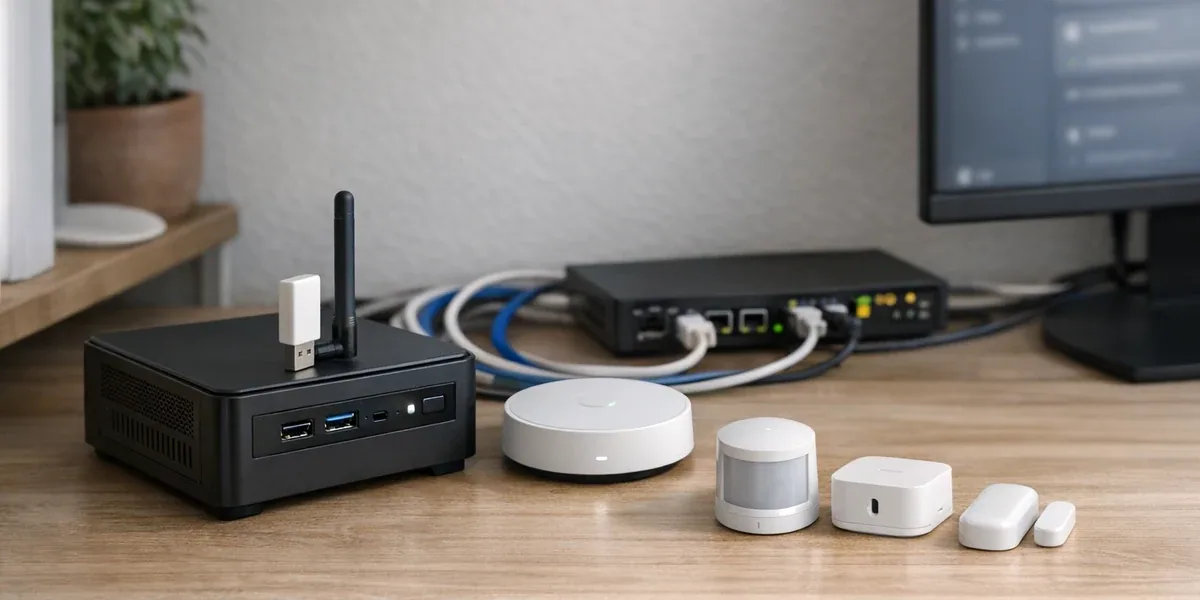
Many Home Assistant users frame the decision as: "Should I use ZHA, Zigbee2MQTT, or Matter?" The question is useful, but it mixes two different decisions. ZHA and Zigbee2MQTT are mainly two ways to integrate Zigbee devices into Home Assistant. Matter is a separate IP-based interoperability standard that can run over Wi-Fi, Ethernet, or Thread.
The core conclusion is: choose ZHA when you want the simplest native path for common Zigbee devices; choose Zigbee2MQTT when you need broader device handling, richer debugging, and a Zigbee layer that can run outside the Home Assistant lifecycle; choose Matter when you are buying new devices and explicitly need cross-ecosystem interoperability with Apple, Google, Alexa, and Home Assistant. Matter is not a direct replacement for an existing Zigbee network.
Definition Block
In this article,
ZHAmeans Home Assistant's built-in Zigbee Home Automation integration.Zigbee2MQTTmeans running the Zigbee network through a separate service and exposing devices to Home Assistant through MQTT discovery.Mattermeans controlling Matter devices through Home Assistant's Matter Server and Matter integration. All three can make devices appear in Home Assistant, but they have different network models, debugging surfaces, and device-fit boundaries.
Decision Block
If a home has one Home Assistant instance, a moderate number of common Zigbee devices, and a strong preference for low maintenance, start with
ZHA. If the installation has many Zigbee devices, mixed brands, a need for detailed logs, and an existing MQTT stack,Zigbee2MQTTis usually the better engineering choice. If the project is centered on new Matter devices and the network is ready for IPv6, multicast, mobile commissioning, and Thread Border Routers where needed, useMatteras the new-device path.
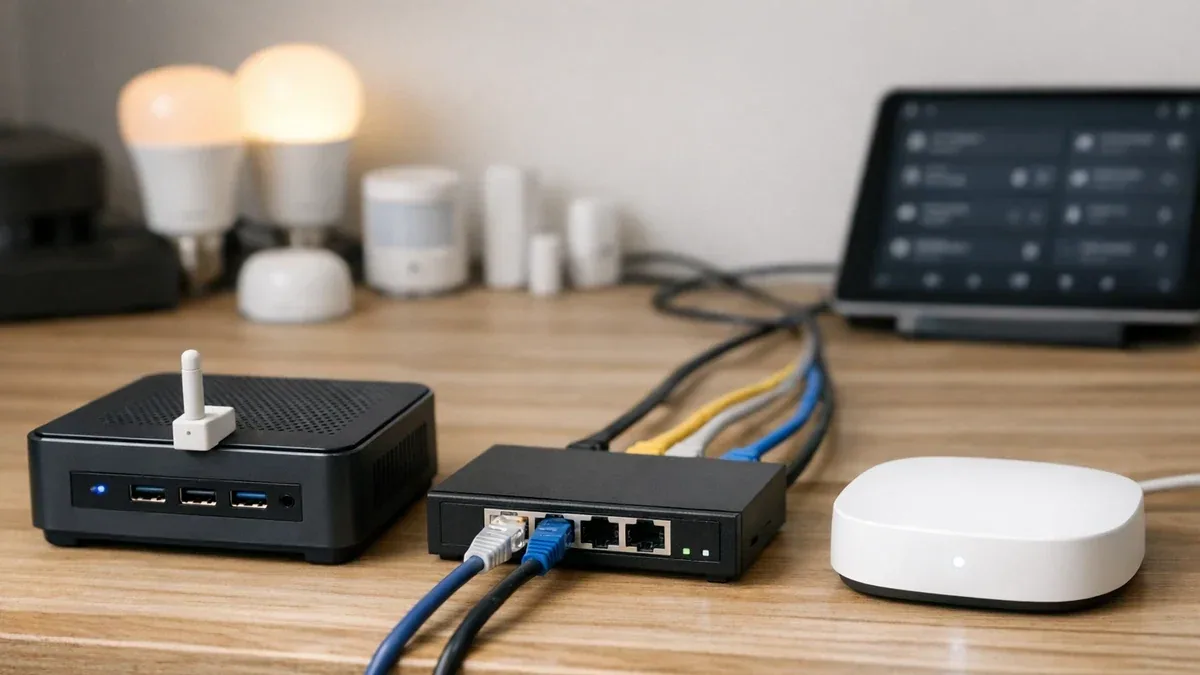
1. First split the decision: Zigbee implementation or new device standard
ZHA and Zigbee2MQTT compete most directly. Both handle Zigbee devices. Both need a Zigbee coordinator. Both depend on Zigbee mesh quality. The difference is architectural: ZHA keeps the Zigbee gateway inside Home Assistant, while Zigbee2MQTT manages the Zigbee network externally and publishes devices into Home Assistant through MQTT discovery.
Matter answers a different question. Home Assistant's Matter integration controls Matter devices through its own Matter controller, exposed to Home Assistant through the Matter Server process. Matter devices may use Wi-Fi, Ethernet, or Thread. Thread itself is only the low-power mesh network; Home Assistant's Thread documentation is explicit that Thread does not control devices by itself. A higher-level protocol such as Matter or HomeKit is still required.
So the decision should not start as a simple three-way comparison. It should start with three questions:
- Are you integrating existing Zigbee devices or buying new Matter devices?
- If the devices are Zigbee, do you value native simplicity or independent gateway observability more?
- If the devices are Matter, is your network ready for IPv6, multicast, mobile commissioning, Thread Border Routers, and device-level compatibility testing?

2. When ZHA is the better starting point
ZHA's strongest advantage is not that it always exposes more features. Its advantage is that it is native to Home Assistant. The official ZHA documentation describes it as a hardware-independent Zigbee gateway implementation that can use coordinators compatible with the zigpy ecosystem.
ZHA is usually the better starting point when these conditions are true:
| Condition | Why it fits ZHA |
|---|---|
| The device count is small or medium | Integrated management reduces operational overhead |
| Devices are common sensors, switches, lights, covers, or plugs | Standard Zigbee device types are usually enough |
| You do not want to maintain MQTT and another service | Fewer moving parts mean fewer failure surfaces |
| There is one main Home Assistant instance | Gateway and automation state live in one system |
| The installer is not comfortable debugging MQTT topics | Most work stays inside the Home Assistant UI |
For normal homes and small demonstration systems, the main benefit of ZHA is that it compresses device onboarding into the Home Assistant workflow. Maintaining one fewer external service is often more valuable than having a deeper debugging panel.
ZHA still has clear boundaries. It supports a single dedicated Zigbee coordinator and a single Zigbee network. Devices that are already joined to another Zigbee implementation usually need to be factory reset before joining ZHA. Some vendor-specific behavior, unusual device features, binding details, or OTA workflows may require more community knowledge and quirk support. When an installation depends on many non-standard devices, advanced binding, OTA management, and detailed troubleshooting, ZHA's simplicity can become limited observability.
3. When Zigbee2MQTT is worth the extra moving parts
Zigbee2MQTT turns the Zigbee network into a relatively independent device layer and then lets Home Assistant discover entities through MQTT discovery. The official Zigbee2MQTT Home Assistant guide puts MQTT discovery at the center of the integration: enable the Home Assistant option in Zigbee2MQTT and enable the MQTT integration in Home Assistant.
Zigbee2MQTT is usually worth the maintenance cost when these conditions are true:
| Condition | Why it fits Zigbee2MQTT |
|---|---|
| There are many Zigbee devices | An independent Zigbee layer is easier to operate over time |
| Brands and models are mixed | Device support mappings and community reports matter more |
| You need detailed troubleshooting | Frontend logs, MQTT topics, and exposed state help diagnosis |
| Zigbee should not fully share the Home Assistant lifecycle | Home Assistant restarts do not have to mean Zigbee service restarts |
| You already run MQTT infrastructure | Broker, discovery, availability, and integration state fit the stack |
The tradeoff is real. You must maintain the MQTT broker, the Zigbee2MQTT service, configuration files, backups, and upgrades. Home Assistant's MQTT documentation also shows that MQTT discovery depends on configuration messages, unique IDs, availability, birth and will behavior, and retained or resent discovery payloads. Those mechanisms bring flexibility, but they also add failure modes.
Zigbee2MQTT is therefore a better fit for users who treat Home Assistant as a small system architecture, not only as an appliance. If you only want to connect a dozen common devices, MQTT topics and external service logs may be unnecessary overhead. If you need to operate a growing Zigbee fleet, the observability and independence become valuable.
4. When Matter is the right answer instead of another Zigbee debate
Matter is the right answer when the actual question is about buying new cross-ecosystem devices.
Home Assistant's Matter documentation explains that the integration controls Matter devices on local Wi-Fi or Thread networks and runs its own Matter controller through the Matter Server process. The attraction is obvious: one device can be more portable across smart home ecosystems instead of being tied to a specific Zigbee coordinator or proprietary bridge.
But Matter also has engineering costs:
- Matter over Thread requires a Thread Border Router.
- Commissioning often depends on a mobile companion app, Bluetooth, and vendor-specific behavior.
- The local network must handle IPv6, multicast, and discovery correctly.
- A Thread logo does not automatically mean the device supports Matter.
- Matter OTA updates, exposed device capabilities, and vendor maturity still affect the real experience.
Matter's best role is not replacing every Zigbee network. It is a screening criterion for new devices where cross-ecosystem interoperability matters. For lights, plugs, sensors, locks, thermostats, and other new purchases, Matter can reduce future platform migration cost when the specific device implementation is mature and the network conditions are ready.
If you already have a stable Zigbee network, or if the priorities are low cost, long battery life, mature device availability, and proven local mesh behavior, there is no reason to migrate just because Matter is newer. Matter is valuable as a new-device interoperability path, not as an automatic replacement for existing Zigbee automation.
5. A practical comparison table
| Path | Best fit | Main benefit | Main cost | Poor fit |
|---|---|---|---|---|
| ZHA | Small to medium Zigbee installations, normal homes, demos | Native setup, low maintenance, fewer services | Less external observability for complex devices | Large mixed fleets, deep debugging, independent Zigbee gateway needs |
| Zigbee2MQTT | Large Zigbee fleets, mixed brands, users who need debugging | Broad device support, clear logs, MQTT flexibility | Broker, service, configuration, backups, upgrades | Lightweight projects that do not want external services |
| Matter | New cross-ecosystem devices and long-term interoperability | Local IP control, ecosystem portability, future compatibility | Thread, IPv6, commissioning, and vendor maturity issues | Replacing stable existing Zigbee networks or minimizing maintenance |
The practical conclusion is simple: ZHA and Zigbee2MQTT are choices inside the Zigbee integration layer. Matter is a new-device standard path. Comparing all three as equivalent protocol options creates confusion.
6. Recommended strategy: stabilize the main device layer, then introduce Matter gradually
A resilient Home Assistant strategy is layered rather than ideological:
- Keep mature Zigbee paths for low-power sensors, buttons, switches, plugs, and other high-volume local devices.
- Start with
ZHAfor small homes or early projects, then evaluateZigbee2MQTTwhen device count and troubleshooting needs grow. - For new purchases, check whether a mature Matter version exists, but judge the exact device, firmware, update behavior, and Home Assistant community feedback.
- If Matter over Thread is part of the plan, validate Thread Border Routers, IPv6, multicast, and mobile commissioning before buying devices in volume.
- Do not migrate a stable Zigbee network without a clear operational benefit.
The short version is: use ZHA for lightweight Zigbee, Zigbee2MQTT for heavy Zigbee, and Matter for new cross-ecosystem devices. Do not treat Matter as a Zigbee gateway implementation, and do not treat ZHA or Zigbee2MQTT as device ecosystem standards.
Sources
- Home Assistant: Zigbee Home Automation (ZHA): https://www.home-assistant.io/integrations/zha/
- Zigbee2MQTT: Home Assistant integration: https://www.zigbee2mqtt.io/guide/usage/integrations/home_assistant.html
- Home Assistant: MQTT integration and discovery: https://www.home-assistant.io/integrations/mqtt/
- Home Assistant: Matter integration: https://www.home-assistant.io/integrations/matter/
- Home Assistant: Thread integration: https://www.home-assistant.io/integrations/thread