

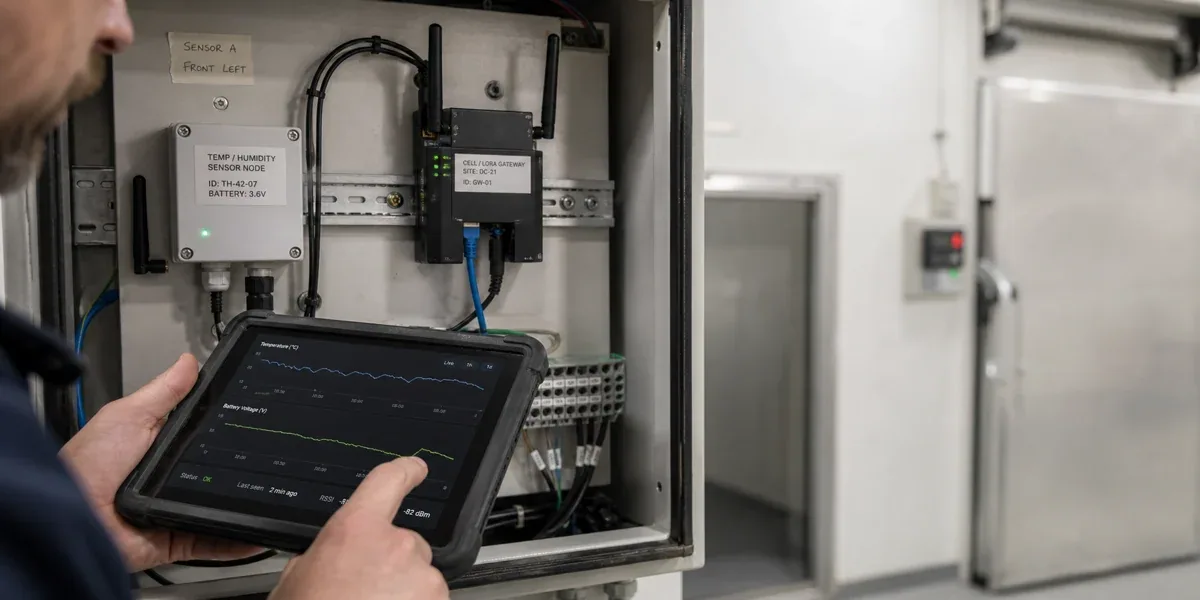
The hardest failures in low-power IoT are often not total silence. They show up as partial signals: battery voltage drifting down, RSSI getting worse, reports arriving later than expected, occasional reconnects, or one firmware version producing more resets than the rest of the fleet. If the platform copies server monitoring and asks every device to stream detailed logs, minute-level metrics, and full event traces, the diagnostic layer can become the thing that drains batteries and overloads narrow links.
The core conclusion is: remote diagnostics for low-power devices is not about sending every log line to the cloud. It is about deciding what problem is worth waking the device for, then combining minimal metrics, tiered logs, field context, and bounded diagnostic windows into enough evidence for action. When battery, cellular cost, weak coverage, and sleep intervals matter, diagnostics must be designed as part of the power and operations model.
If you already have a device management platform, this article builds on two related patterns: the core architecture of an IoT device management platform and device online state modeling. Here we focus on what happens after something looks wrong: how the platform gathers enough evidence without forcing a constrained device to behave like a server.
1. Remote diagnostics is a tradeoff first
1.1 Why server monitoring patterns fail
Server monitoring assumes three things: the node is usually online, power is stable, and bandwidth is cheap enough for frequent telemetry. Low-power IoT devices often violate all three assumptions.
A battery-powered sensor may wake every 15 minutes. An NB-IoT or LTE-M device may close its connection aggressively to save energy. A cold-chain, utility, or agriculture deployment may sit behind weak coverage. If the platform still demands realtime logs, high-frequency metrics, and always-on diagnostic channels, the result is not better troubleshooting. It is more wakeups, more retries, more airtime, and shorter device life.
A safer judgment is: diagnostic data from constrained devices should be collected by value, not by curiosity. Fields that explain battery, signal, firmware, configuration, sensor health, and upload path deserve priority. Verbose debug traces should be collected only inside a bounded diagnostic window.
1.2 The platform is answering several questions
When a constrained device fails, operations needs to answer more than one question:
- is this battery, signal, firmware, configuration, or sensor path
- is it one device, one batch, one region, or one firmware version
- can the device still be reached during its next wake window
- should the team adjust configuration, trigger a restart, roll back firmware, or send a technician
If the platform only stores last_seen_at and an offline flag, none of those questions can be answered well. The diagnostic model needs enough reason fields to guide the next action rather than pushing every case back to field staff.
2. The minimum useful diagnostic signal set
Low-power devices should not stream full logs continuously, but they do need to report a compact signal set. A practical baseline has five groups.
| Signal group | Key fields | What it explains | Suggested cadence |
|---|---|---|---|
| Power state | battery_voltage, battery_percent, power_mode | battery decline or power instability | with heartbeat or business report |
| Radio quality | RSSI, RSRP, SNR, retry_count | weak coverage or retry pressure | on connect or failure events |
| Runtime context | firmware_version, config_version, boot_id, reset_reason | version, configuration, or reboot correlation | on startup and after abnormal events |
| Data freshness | last_sample_at, last_upload_at, queue_depth | sampling failure versus upload failure | low-frequency summary |
| Error summary | error_code, error_counter, last_error_at | whether failures cluster by type | event-triggered or inside a window |
These fields do not need to be uploaded every second. Their value is that they make the fleet searchable by device type, batch, location, and version. If one region shows weaker RSSI and more retries, start with coverage. If one firmware version shows watchdog resets, start with firmware tasks, memory, or timing.
2.1 Define a diagnostic event contract before adding fields
The five signal groups are only a data inventory. A durable implementation needs an event contract that survives device restarts, delayed delivery, firmware coexistence, and platform upgrades. Every event must identify who observed what, when it was observed, which boot and diagnostic window it belongs to, and how much data the upload consumed. The following is a useful starting point:
schema_version: diag.v1
device_id: meter-0421
boot_id: 187
seq: 932
observed_at: 2026-07-31T08:15:00Z
reason_code: uplink_timeout
firmware_version: 2.8.1
config_version: cfg-44
diagnostic_window_id: dw-7f3a
payload_bytes: 286
correlation_id: job-20260731-18
The combination of device_id, boot_id, and seq separates events before and after a restart. observed_at is device observation time and must not be overwritten by server receipt time. reason_code should come from a versioned enumeration rather than free text that cannot be aggregated. payload_bytes lets operations connect diagnostic activity to airtime and data cost. A device can persist an event while offline, but changing its observation time after reconnection would make an old failure look current.
Schema evolution needs an explicit policy as well. Adding an optional field can remain compatible with old firmware. Renaming a field, changing its unit, or reusing an error code breaks historical comparison. The ingestion path should decode by schema_version; unknown versions should enter a quarantine stream with their original payload preserved. Silent drops make it impossible to distinguish a firmware regression from a decoder regression while several firmware generations coexist in the fleet.
2.2 Turn the diagnostic budget into an acceptance criterion
"Send as little as possible" is not testable. Define four budgets per device class instead: diagnostic uplink bytes per day, extra wakeups caused by diagnostics, local queue capacity, and maximum duration of one diagnostic window. Those budgets should vary by power source, access technology, normal reporting cadence, and field-service cost.
For example, a team could start with "no more than 8 KB of diagnostic uplink per day and no more than two consecutive wake cycles for an exception window." That is a design hypothesis, not a universal benchmark. The real limits must be calibrated with current traces on target hardware, weak-link retries, compression behavior, and the carrier's billing rules. When the budget is exhausted, the device should fall back to critical counters plus a window-termination reason. Continuing to retry until the battery is depleted is not a diagnostic strategy.
3. Logs should be tiered, not continuous
3.1 Normal mode should send summaries
In normal mode, a constrained device should send summaries rather than full logs. Useful summaries include:
- last reset reason
- counters for the most recent error categories
- last upload failure reason
- current queue depth
- latest diagnostic window ID
This data is small, aggregatable, and useful for operations search. It does not try to reproduce every log line. It first tells the platform where the problem likely sits.
3.2 Exceptions should open short diagnostic windows
Detailed collection should start only when a condition is met. Common triggers include:
- repeated upload failures
- battery voltage crossing a threshold
- RSSI or RSRP staying below a threshold
- watchdog resets exceeding a limit
- a platform command that opens diagnostics until a specific expiry time
Every diagnostic window needs boundaries: duration, maximum log count, module scope, and a clear return to low-power mode. Without those boundaries, troubleshooting becomes a new battery drain.
3.3 Verbose logs need a decision purpose
The dangerous log is not no log. It is a large log that cannot change the next action. Loop traces, every sampling attempt, every retry stack, and repeated debug strings can consume power and bandwidth without answering whether the team should replace a battery, move an antenna, roll back configuration, or dispatch a technician.
If a field cannot support a decision, it should not be part of the normal diagnostic payload.
3.4 Use priority queues and propagate backpressure
A common constrained-device failure is to put business samples, heartbeats, command receipts, summaries, and verbose logs into one FIFO queue. Opening a diagnostic window then places log volume in front of data the product is supposed to deliver. The device should at least separate security and command receipts, business data, diagnostic summaries, and detailed logs. High-priority traffic needs reserved capacity. When the detailed-log queue reaches its limit, aggregate repeated records and discard the oldest detail while incrementing a dropped_count summary.
Backpressure should travel from the ingestion tier back to the device. If ingestion latency rises, a device exceeds its quota, or quarantine volume grows, the next valid platform response can return a smaller window-byte limit or a lower sampling level. The device should disable verbose collection first, then reduce summary cadence, while preserving command receipts and critical business data. This prevents the positive feedback loop in which poor connectivity creates more diagnostic traffic and that traffic makes connectivity recovery even harder.
Store-and-forward also needs an ordering rule. A reconnect should transmit an accepted or failed command receipt before historical verbose logs because the receipt changes an operator's next action. Within the same priority, ordering by observation time is useful, but the platform must tolerate gaps: a missing sequence may have expired or been deliberately summarized. The device should report that gap rather than keeping the radio awake indefinitely to repair it.
3.5 Allow retries without allowing duplicate effects
On weak links, delivery may succeed while the acknowledgement is lost. End-to-end exactly-once delivery is therefore a poor assumption. Use at-least-once transport and make ingestion idempotent with device_id + boot_id + seq or a stable event_id. A repeated event may increment a delivery-attempt metric, but it must not increment an error counter twice, fire another alert, or create a second work order.
Retry policy should combine exponential backoff, jitter, a maximum attempt count, and event expiry. Expired verbose logs can be discarded, but the device should retain a summary of how many records were dropped, which window they belonged to, and the last failure reason. Payloads with unknown schemas, invalid units, or decoder failures belong in quarantine, grouped by firmware and device type. Logging one server exception and deleting the raw payload removes the evidence needed to separate firmware regression from platform parsing failure.
4. Field context must be structured
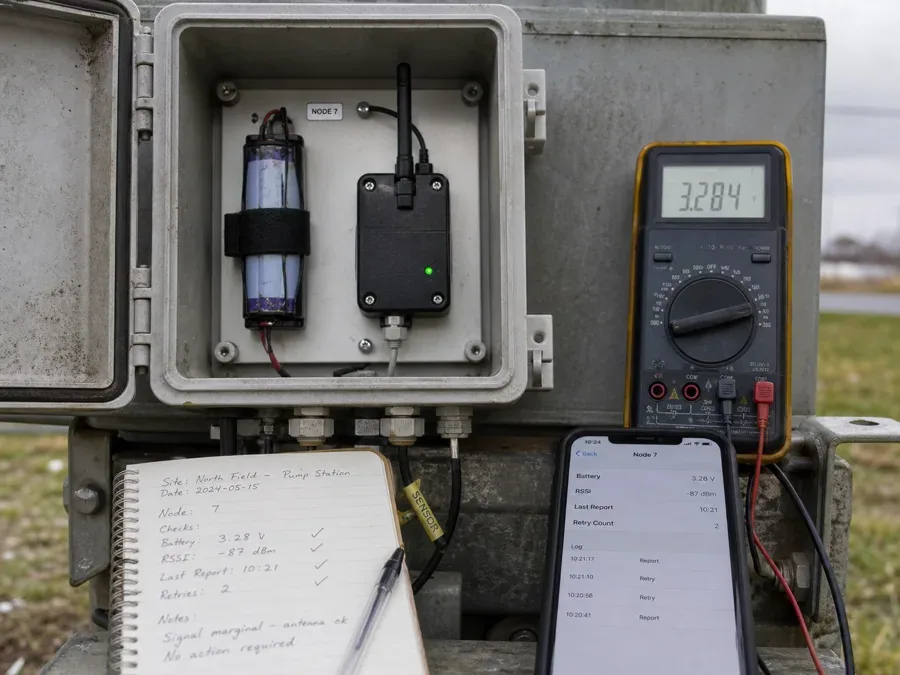
Many low-power failures are tied to physical deployment: antenna position, enclosure material, battery batch, mounting height, shielding, humidity, power source, or the latest service action. Some of that context does not come from the device, but it must still be part of diagnostics.
Useful field context includes:
site_idinstall_locationenclosure_typepower_sourcebattery_batchantenna_typelast_service_actionservice_note
This data may live in the operations console, work order system, or installation record. The important point is that it is bound to the device. Otherwise the platform may see 20 unstable devices in one area without noticing that all of them are mounted behind the same metal cabinet or use the same battery batch.

The point of this flow is not to collect more fields for their own sake. It is to put device summaries, link quality, field context, and version data into one diagnostic context so the platform can choose different actions.
5. Downlink diagnostics need control
Low-power devices should not be treated as always-available RPC targets. Diagnostic commands need four properties:
- An expiry time, so the command disappears if the device misses its wake window.
- A power budget level, such as lightweight status query, short log window, restart, or rollback.
- An idempotency ID, so weak-link retries do not execute the same action twice.
- An execution receipt that reports received, executed, failed reason, and next reporting time.
If diagnostic commands are modeled as normal realtime commands, operations cannot tell whether the device never received the command, rejected it, executed it without a receipt, or missed the wake window. Treat diagnostics as bounded jobs, not instant RPC.
5.1 Model diagnostic jobs as a state machine
A diagnostic job needs more than success and failure. Useful states include queued, delivered, accepted, running, succeeded, failed, expired, and cancelled, with server time, device time, and a reason code on every transition. The platform should permit only valid transitions. An expired job, for example, must not become running because a delayed receipt arrived, although that delayed receipt can remain as an audit event.
The command envelope should carry correlation_id, expires_at, power_class, max_payload_bytes, and the target module. Before execution, firmware checks expiry, available energy, and whether the same correlation ID has already been executed. This turns a duplicated operator click and a weak-link redelivery into one physical action. Without that guard, a device may reboot twice, export the same log bundle twice, or repeat a configuration rollback.
Cancellation has a boundary too. The platform can cancel a queued job, but it cannot assume that a delivered command has been revoked until the device acknowledges cancellation. The console should present that uncertainty explicitly rather than showing a green cancelled badge while an offline device may still execute the original command at its next wakeup.
5.2 Separate hot, warm, and cold diagnostic data
Putting every diagnostic record in one time-series store raises query cost and encourages teams to retain verbose text just to preserve a small amount of important history. A hot tier should hold recent structured summaries and job states for the live console and alerts. A warm tier can hold compressed detailed logs partitioned by device and diagnostic window for recent investigations. A cold tier should retain long-lived job audits, aggregate trends, and specifically preserved incident bundles.
Retention follows query purpose and compliance needs, not the idea that longer is always better. A team might begin capacity planning with seven days hot, 30 days warm, and 180 days cold, then adjust from actual work-order lookback and storage cost. Those numbers are planning inputs, not measured optima for a specific fleet. Deletion must preserve the correlation between job, alert, and work order even after verbose payloads expire.
Indexes deserve the same discipline. Operators usually filter by tenant, device type, firmware version, reason code, site, and time range. An unbounded full-text search over raw logs is rarely the first query. Keep structured dimensions in the hot path and retrieve the detailed bundle only after a candidate device or window is known. That architecture keeps routine fleet triage fast without making raw text permanently expensive.
5.3 Validate the system with fault injection
A happy-path test proving that one log arrived over a stable network does not validate low-power diagnostics. Before rollout, inject at least five failures: repeatedly lose uplink acknowledgements, restart the device during a diagnostic window, fill the local queue, make ingestion reject traffic temporarily, and let old firmware send an unknown schema. For each case, verify that business data is not starved, duplicate events are deduplicated, expired commands are rejected, and quarantined payloads can be replayed.
Acceptance metrics should go beyond "diagnostic success rate." Record extra wakeups, uplink and downlink bytes, retry bytes, time from queued to terminal job state, queue high-water mark, and the share of cases that still require a field visit. Battery products also need current-trace comparison on target hardware with diagnostics enabled and disabled. A small log payload does not prove low energy use if reconnection and retransmission keep the modem awake.
Rollout should be staged by device cohort and firmware version. Start with a small cohort, observe budget consumption and quarantine, then widen only if command completion and business-data delivery remain healthy. The rollback condition must be decided in advance, such as a sustained increase in wakeups, business queue age, or command expiry. A rollout without an operational rollback trigger merely moves the experiment into the field.
5.4 What project-owned platform evidence can support
Current ZedIoT product material explicitly describes device-state monitoring, data models, device logs, alert history, remote control, and project-stage management. That evidence supports the platform boundary in this article: diagnostics should connect the device model, logs, alerts, commands, and deployment context instead of creating an isolated log viewer.
The same material does not prove that one default budget extends battery life by a specific amount or that one retention period is cost-optimal for every customer. Platform capability is therefore a valid implementation starting point; energy, bytes, success rate, and retention still require measurement on the target hardware, network, and operational workflow. Separating verified capability from unmeasured effect is more useful than publishing one precise-looking universal number.
6. What the operations console should show
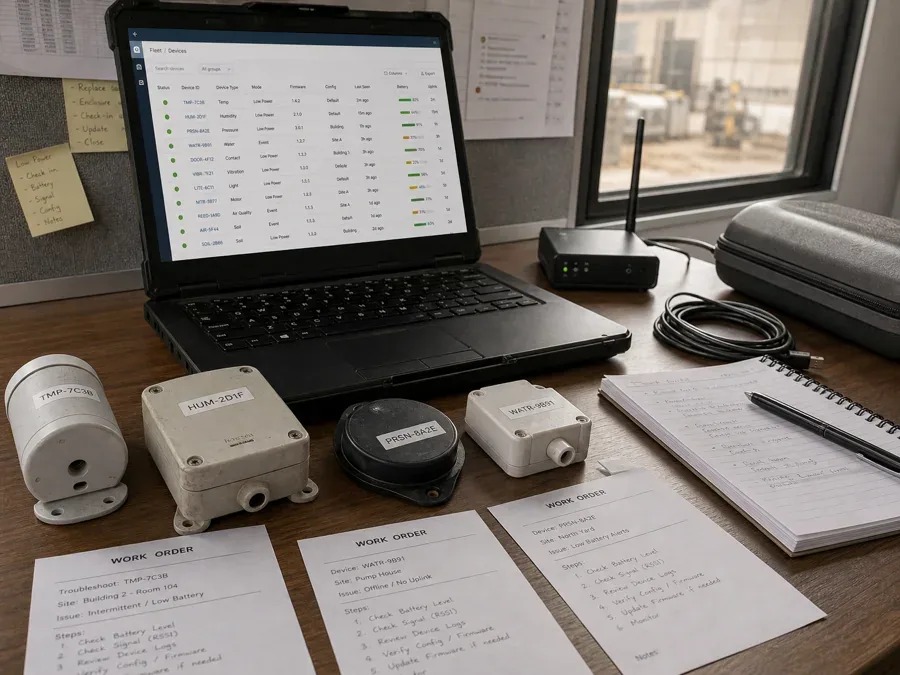
The final consumer of diagnostics is usually an operations or support team. A practical console should show:
- latest valid activity
- latest heartbeat summary
- battery and signal trend
- firmware and configuration version
- recent error summary
- pending diagnostic jobs
- recommended next action
The recommendation needs a reason. For example:
keep watching: reporting cadence is normal, battery and signal are stableopen diagnostic window: repeated upload failures but the device still responds during wake windowsrollback configuration: errors cluster around one configuration versiondispatch field service: low battery, weak signal, and repeated diagnostic job timeout
This is more useful than a red/yellow/green badge because it connects diagnostic evidence to an action.
7. When this is too much
Not every product needs a full diagnostic system. You can keep it simpler when:
- the fleet is small and field service is cheap
- devices are mains-powered and connectivity is stable
- the business only needs recent reporting, not remote repair
- the device is cheap enough that replacement is the intended support model
But once the fleet grows or field visits become expensive, richer diagnostics are usually worth the design cost. Medical cold chain, agriculture, industrial sensing, outdoor metering, and distributed gateways all make mistakes expensive: a wrong diagnosis can mean a wasted truck roll, spoiled inventory, downtime, or missing data.
8. Implementation checklist
If you are designing diagnostics from scratch, start in this order:
- Define wake cadence, reporting cadence, and diagnostic budget per device class.
- Collect only power, signal, version, queue, and error summaries in normal mode.
- Use short diagnostic windows for exception cases instead of always-on debug.
- Bind installation context and work-order history to the device record.
- Give downlink diagnostic commands expiry, power level, and idempotency.
- Show reasons and next actions in the operations console, not just online/offline state.
- Write each diagnostic action back into device history for later review.
The final judgment is: remote diagnostics for low-power IoT is not about collecting more data. It is about preserving enough evidence for a decision while minimizing wakeups, bytes, and unnecessary field work. When logs, metrics, field context, and diagnostic commands are part of one controlled model, operations can move from guessing why a device disappeared to choosing the next action from evidence.