

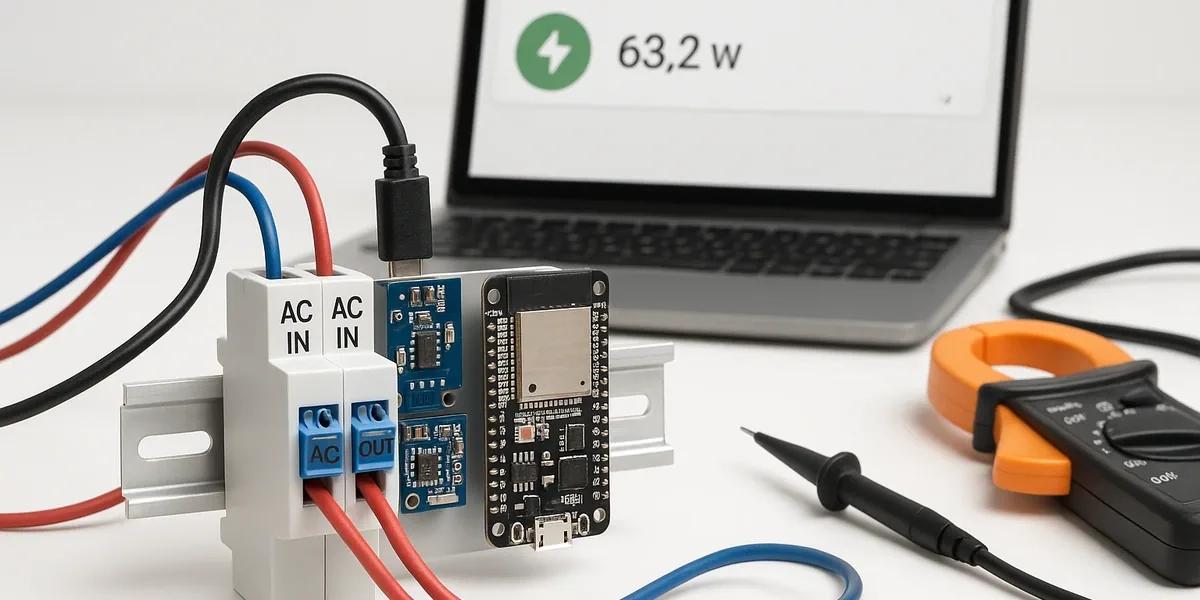
Many ESP32 energy metering projects start well. You connect an HLW8032 or BL0942 module, enable the matching ESPHome component, and Home Assistant quickly shows voltage, current, power, and energy. But reading values is not the same as building an energy metering node that can run reliably over time.
The core conclusion is this: the hard part of ESP32 energy metering is not whether HLW8032 or BL0942 can be read. The hard part is designing the metering chip, UART, Wi-Fi behavior, ESPHome entities, calibration, and diagnostics as one stable data path. If the project focuses only on sensor YAML, it can later fail on transient loads, serial conflicts, unstable sampling, Wi-Fi reconnects, Home Assistant database growth, and calibration drift.
Definition Block
In this article, an ESP32 energy metering node means an edge device where ESP32 reads voltage, current, power, and energy from a metering chip such as HLW8032 or BL0942, then exposes those values through ESPHome to Home Assistant or another upper-layer platform. It is suitable for device energy monitoring, trend observation, and low-risk operational diagnostics. It should not be treated as a billing-grade meter or an electrical protection device.
Decision Block
If the goal is to monitor the energy behavior of one appliance, one small circuit, or one commercial device inside Home Assistant,
ESP32 + ESPHome + HLW8032/BL0942is a fast and low-cost path. If the goal is billing, electrical protection, high-accuracy compliance measurement, or safety interlocking, use certified meters, protection devices, or industrial acquisition hardware instead of stretching an ESPHome node beyond its boundary.
1. Why energy metering is more fragile than ordinary sensing
1.1 Metering data is not like temperature or humidity data
Energy metering often looks like a normal sensor integration, but the data behaves differently. Temperature and humidity usually change slowly. Energy metering has to deal with:
- transient startup and shutdown behavior
- switching supplies, compressors, motors, and heaters
- relationships between voltage, current, power, power factor, and accumulated energy
- tradeoffs between sampling, filtering, calibration, and reporting frequency
That is why the first question should not be only whether ESPHome has a component for the chip. The better question is whether the data path produces stable values, whether abnormal values are diagnosable, and whether the upper platform can store and use the data over time.
1.2 HLW8032 and BL0942 are metering front ends, not complete product architectures
HLW8032 and BL0942 typically provide metering data over UART. ESPHome has official components for these chips, which makes integration much easier. But a component does not automatically solve the product architecture.
A complete node still needs answers for questions such as:
- Is UART ownership fixed, or can it collide with logging, debugging, or other peripherals?
- Is the update interval aligned with the load behavior?
- Where do calibration values come from, and can they be checked in the field?
- What happens when Wi-Fi reconnects or Home Assistant is unavailable?
- How should accumulated energy, instant power, and abnormal state be modeled separately?
If these questions are not answered early, a working reading can hide long-term reliability risk.
2. A more reliable ESP32 energy metering stack
It helps to think in five layers:
| Layer | Main objects | What it should do | What it should not do |
|---|---|---|---|
| Metering front end | HLW8032 / BL0942 / current sensing / voltage sensing | Provide basic electrical measurements | Make business decisions or replace protection devices |
| MCU and firmware | ESP32 / ESPHome / UART | Read, calibrate, rate-limit, and expose entities | Upload every raw fluctuation without filtering |
| Network path | Wi-Fi / ESPHome API | Synchronize stable entities upward | Carry safety-critical actions |
| Platform layer | Home Assistant / database | Display trends, automate, and track energy | Replace a billing or real-time control system |
| Operations layer | logs / diagnostics / calibration notes | Judge whether the node and data are trustworthy | Make conclusions from one power value alone |
The point is simple: an energy metering node is not just a chip integration. It is a trustable data path from sampling to operations. When any layer takes on the wrong job, troubleshooting becomes harder later.
3. Five common mistakes
3.1 Leaving the UART boundary flexible for too long
HLW8032 and BL0942 both depend on a serial communication path. ESP32 has more UART flexibility than ESP8266, but projects still fail when serial resources are treated casually:
- debug logging and the metering chip share a serial path
- RS485, a display, or another serial peripheral is added later
- boot logs, level shifting, and wiring order are not constrained for field use
A more reliable design fixes UART ownership from the first hardware and YAML version. Keep the metering chip’s pins, baud rate, wiring, and debug strategy explicit. Energy metering nodes are not good places for loose field rewiring, because occasional serial noise can turn into permanent uncertainty.
3.2 Reporting as fast as possible
Energy metering is not always better when it is faster. Excessive reporting creates three problems:
- higher Wi-Fi and ESPHome API load
- larger Home Assistant recorder storage
- more false interpretation of motor starts, relay switching, or power supply transients
A better design separates use cases:
- instant power can update more often, but should avoid meaningless jitter
- accumulated energy can update less frequently
- anomaly detection should use duration, thresholds, and device state, not one spike
Judgment Block
If the node is used to tell whether equipment is running, whether energy behavior is abnormal, or whether a device is in standby, stable and explainable reporting is more valuable than a refresh rate that only looks real-time.
3.3 Treating calibration as a one-time YAML value
Default module readings are usually only a starting point. Real calibration depends on shunts, current transformers, module batches, load type, and installation.
In practice, a better workflow is to:
- verify with a known load
- calibrate voltage, current, power, and energy intentionally
- record the date, load condition, and configuration version
- avoid reusing one coefficient set across different hardware batches without checking
Without calibration notes, a later “8% high power reading” is hard to interpret. It could be hardware drift, configuration error, or a real load change.
3.4 Exposing too many Home Assistant entities
It is tempting to expose every available field. That looks rich at first, but it creates long-term cost:
- users see too many unstable or hard-to-explain entities
- database retention and automation logic become harder to maintain
A cleaner model separates entities into three groups:
- core entities: voltage, current, power, accumulated energy
- diagnostic entities: communication state, last update time, error count, node RSSI
- business entities: equipment running state, standby detection, energy band, anomaly flag
Raw readings should support operational judgment, not dump hardware detail into the upper layer.
3.5 Not designing for offline and abnormal data
Once an energy metering node is installed near real equipment, it will face weak Wi-Fi, power loss, load shutdown, chip communication failure, and sudden readings. Without an abnormal-data strategy, Home Assistant often shows:
- a device that looks like it suddenly used too much power
- accumulated energy jumps
- automation triggered by one transient value
- unclear responsibility between equipment failure and node failure
Better strategies include:
- separate diagnostic entities for communication status and last update time
- guards or labels for impossible values
- duration thresholds for anomaly detection
- different states for “equipment has no load” and “metering node unavailable”
4. Choosing between HLW8032 and BL0942
For most ESPHome projects, the choice should depend less on the chip name and more on module availability, wiring, documentation quality, and accuracy expectations.
| Dimension | HLW8032 path | BL0942 path | Practical judgment |
|---|---|---|---|
| Integration | Common in low-cost metering modules, UART based | Common in single-phase metering modules, UART based | Both can fit ESPHome nodes |
| Project focus | Low cost, fast integration, basic energy monitoring | Newer module options, common electrical measurements | Module quality matters more than the chip label alone |
| Main difficulty | calibration, UART boundary, module batches | calibration, UART boundary, interpreting readings | Most risk is system design, not YAML syntax |
| Poor fit | billing, protection, compliance-grade metering | billing, protection, compliance-grade metering | Use professional devices for regulated measurement |
Comparison Block
The HLW8032 versus BL0942 choice is rarely the largest factor in whether an ESPHome energy monitor succeeds. For most projects, reliability depends more on module quality, electrical safety, calibration workflow, UART ownership, and reporting strategy.
5. A production-minded ESPHome design direction
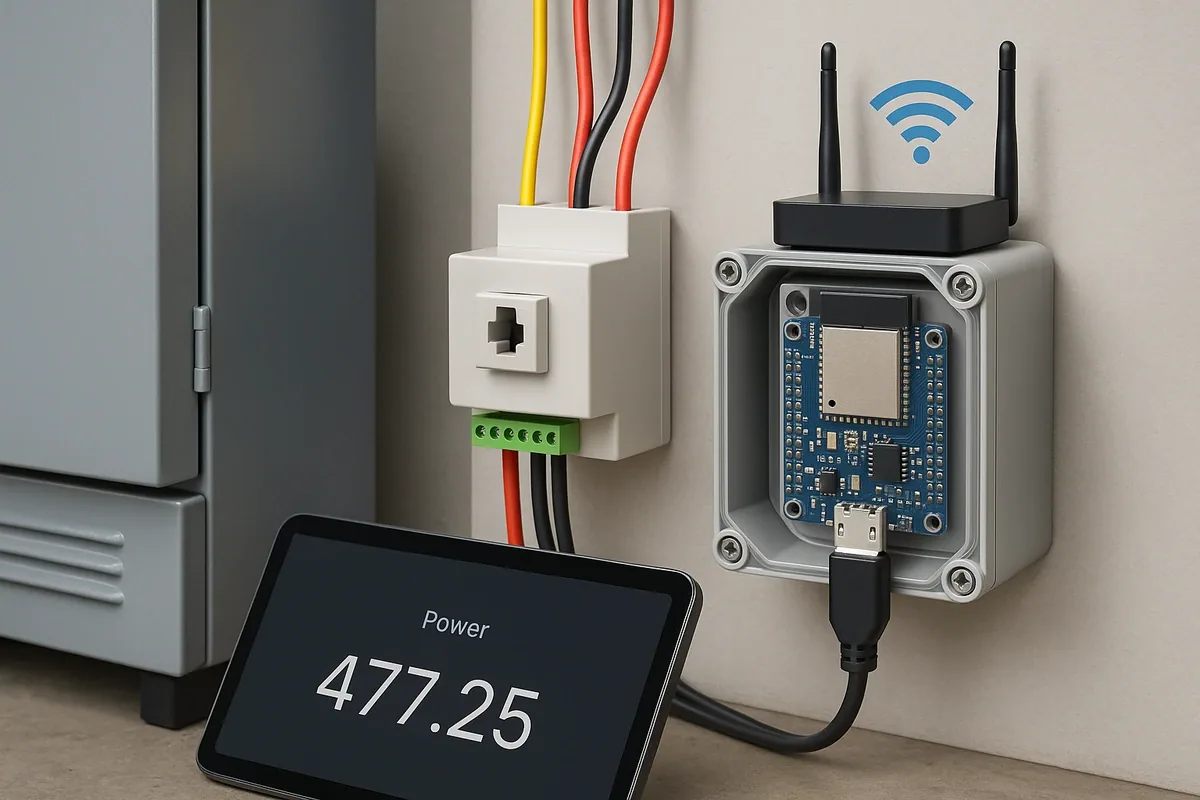
The example below is not a complete drop-in configuration. It shows the design direction:
uart:
  id: metering_uart
  tx_pin: GPIO17
  rx_pin: GPIO16
  baud_rate: 4800
sensor:
  - platform: hlw8032
    uart_id: metering_uart
    voltage:
      name: "Meter Voltage"
    current:
      name: "Meter Current"
    power:
      name: "Meter Power"
    energy:
      name: "Meter Energy"
    update_interval: 10s
For a real deployment, add:
- calibration parameters and calibration notes
- filtering or value guards for readings
- diagnostic entities such as Wi-Fi signal, uptime, and restart reason
- Home Assistant recorder retention and exclusion strategy
- enclosure, isolation, safe wiring, and touch-protection rules
The configuration is only the entry point. Reliability comes from constraints across the full data path.
For teams building energy monitoring nodes for Home Assistant, ZedIoT provides ESPHome Home Assistant integration services to help configure ESP32 devices, map stable entities, test device behavior, and prepare handover-ready setup files.
6. When not to use ESP32 + ESPHome for energy metering
Do not stretch this stack into these cases:
- Billing: billing needs compliance, sealing, metering class, and an audit trail.
- Electrical protection: overcurrent, leakage, and short-circuit protection belong to dedicated protection devices.
- Hard real-time control: protection and critical interlocks should not depend on Wi-Fi and Home Assistant.
- High-noise industrial cabinets: poor isolation, grounding, and power quality can overwhelm a lightweight ESP32 node.
- Many circuits with high refresh rates: multi-circuit acquisition is often better handled by professional meters or gateways.
Not Suitable Block
ESP32 energy metering nodes are strong for visualization, trends, auxiliary diagnostics, and low-risk automation. They are not the right boundary for billing, safety protection, or hard real-time control. Stating that boundary makes the architecture more credible, not weaker.
7. Conclusion
ESP32, HLW8032, BL0942, and ESPHome can quickly produce a node that shows energy data in Home Assistant. But the engineering value is not that the numbers appear on a dashboard. The real value is whether the data path remains stable over time, whether readings are explainable, whether abnormal states are diagnosable, and whether the upper platform is not overloaded with raw entities.
If the goal is to understand whether one device is running or whether its energy trend looks abnormal, ESP32 + ESPHome is a strong option.
If the goal is billing, electrical protection, or hard real-time control, the ESP32 node should stay in its proper role: a lightweight edge monitoring node, not the final authority in the electrical system.