

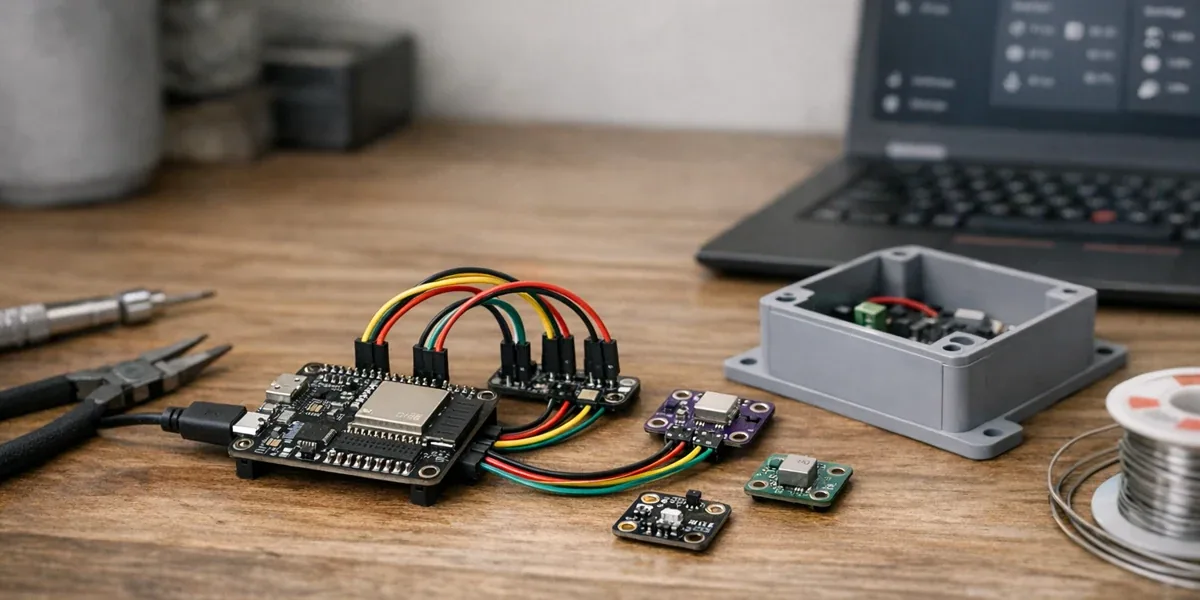
Connecting an SCD41, a BME680, a light sensor, and an electrochemical gas sensor to the same ESP32 can look like a simple ESPHome exercise. In real deployments, the hard part is usually not whether the first readings appear. It is whether the I2C bus, sensor warm-up behavior, power noise, deep sleep schedule, and Home Assistant entities are designed as one system.
The core conclusion is simple: a multi-I2C environmental gateway is not an ESP32 with more sensors attached; it is a constrained data chain from power and bus design to sampling, diagnostics, and publication. If every sensor is treated as an independent YAML block, the project is likely to fail on address conflicts, unstable first readings, drift after sleep, or unclear failure diagnosis.
Definition block
In this article, a multi-I2C environmental gateway means an ESP32 running ESPHome that reads several environmental sensors and publishes temperature, humidity, CO2, VOC, light, or gas trend data to Home Assistant or another platform. It is useful for trend monitoring, automation triggers, and device-side diagnostics. It should not be treated as a lab-grade calibrated instrument or a safety interlock.
1. Why a multi-sensor gateway is more than a component list
ESPHome provides an I2C bus component and common environmental sensor integrations such as SCD4x and BME680. That makes prototyping fast, but a working example for one component is not the same thing as a production-ready gateway design.
A real multi-sensor node has to handle five constraints at once:
- Addressing and topology: fixed sensor addresses can collide, and cable length affects bus reliability.
- Warm-up and measurement cadence: CO2, VOC, and electrochemical sensors may not be trustworthy immediately after power-up.
- Power and noise: sensor heaters, Wi-Fi transmission, long wires, and weak regulators can affect both analog front ends and I2C stability.
- Deep sleep: saving ESP32 power changes the meaning of continuous measurement, baselines, and first readings.
- Platform semantics: Home Assistant needs reliable entities and diagnostic signals, not every raw register.
Decision sentence: when one ESP32 handles multiple I2C sensors, Wi-Fi publication, and low-power wake cycles, reliability depends more on sampling cadence and fault isolation than on the number of sensors the board can physically connect.
2. Recommended layering: separate bus, sampling, and publication

The important point is the boundary. Hardware should solve power and bus risks. Firmware should control sampling, filtering, and failure marking. The platform should receive entities that already have operational meaning. If these responsibilities are mixed together, every strange reading becomes a long argument about whether the sensor, the bus, or the automation rule failed.
3. I2C bus design: resolve conflicts before tuning sampling
ESPHome’s I2C scan option is useful during development, but it should not be the main operational diagnostic. A deployable gateway should answer these questions before the enclosure is closed:
- Do any sensors have fixed addresses that collide with other modules?
- Will cable length, connectors, or enclosure placement weaken the I2C signal edge?
- Are pull-up resistors duplicated across breakout boards?
- Is an I2C multiplexer such as TCA9548A needed for same-address devices?
If every sensor is on the same small PCB and addresses do not collide, a single bus is usually enough. If sensors are distributed inside an enclosure, use long wires, or include same-address modules, bus segmentation or a multiplexer is more reliable than hoping a lower I2C clock will solve everything.
| Scenario | Better approach | Avoid |
|---|---|---|
| Short traces, no address conflict | One I2C bus with fixed SDA/SCL and known pull-ups | Depending on boot-time scans as topology control |
| Same-address sensors | TCA9548A or separate buses | Parallel wiring and hoping software can distinguish them |
| Long or removable sensor cables | Reduce bus risk and add diagnostics | Treating I2C as a long-distance fieldbus |
| Low-power wake node | Fixed warm-up and measurement window | Publishing the first value immediately after power-up |
Comparison block
I2C is a good board-level or short-distance module bus. It is not a replacement for an industrial fieldbus. If the sensors are remote, noisy, or frequently reconnected, evaluate RS485, CAN, Ethernet, or dedicated acquisition modules instead of adding more I2C devices.
For teams connecting multiple sensors into Home Assistant dashboards, ZedIoT provides ESPHome Home Assistant integration services to help configure ESP32 sensor gateways, map entities, test device behavior, and prepare handover-ready setup files.
4. Warm-up and deep sleep: power saving changes data meaning
SCD41-style CO2 sensors, BME680-style environmental sensors with gas estimation, and electrochemical gas sensors may need stable measurement windows or warm-up time. ESP32 deep sleep can reduce average power, but it also introduces three costs:
- The first values after power-up may not be suitable for automation.
- Continuous measurement or baseline algorithms can be disrupted.
- Electrochemical sensors may need bias current and stabilization time that is much longer than the ESP32 wake window.
A practical design should separate sensor classes:
- Temperature, humidity, and light: often acceptable with shorter wake windows.
- CO2 trend: needs enough measurement time before publication.
- VOC or gas trend: benefits from continuity and baseline stability.
- Safety-related gas detection: should not rely only on a low-cost ESPHome node.
Decision sentence: if the sensor needs warm-up or a continuous baseline, deep sleep must be evaluated against data trustworthiness; saving power is not worth publishing unreliable readings.
5. ESPHome modeling: separate diagnostics from business entities
This is a structure example, not a complete production configuration:
i2c:
  id: bus_a
  sda: GPIO21
  scl: GPIO22
  scan: true
sensor:
  - platform: scd4x
    co2:
      name: "Room CO2"
    temperature:
      name: "Room CO2 Sensor Temperature"
    humidity:
      name: "Room CO2 Sensor Humidity"
    update_interval: 60s
  - platform: bme680
    temperature:
      name: "Cabinet Temperature"
    humidity:
      name: "Cabinet Humidity"
    pressure:
      name: "Cabinet Pressure"
    gas_resistance:
      name: "Cabinet Gas Resistance"
    update_interval: 60s
Before shipping, add:
- Wi-Fi signal, uptime, reset reason, last valid reading time, and sensor timeout diagnostics.
- Rules that mark first, impossible, or stale values instead of triggering automation immediately.
- Home Assistant recorder retention decisions to avoid storing high-frequency noise.
- Installation position, power design, and firmware configuration version for each sensor group.
6. When ESP32 and ESPHome are the wrong fit
Do not force this architecture into these situations:
- Compliance monitoring, life safety, or hard interlock requirements.
- Long sensor distances, strong interference, or frequently disconnected modules where I2C is the wrong link layer.
- Battery life targets measured in months while the sensor itself needs long warm-up or continuous baselines.
- Large industrial deployments that need calibration traceability and field maintenance workflows.
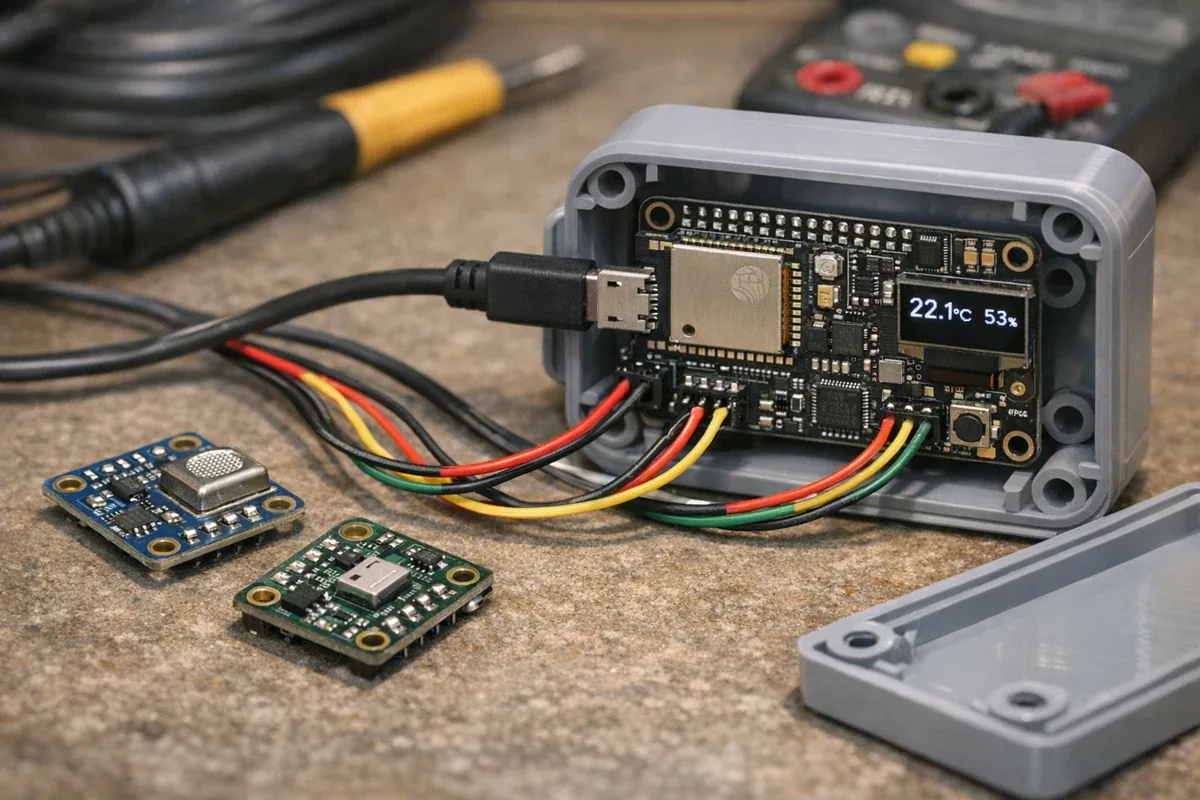
The realistic boundary is clear: ESP32 + ESPHome is a good fit for home, lab, small server room, cabinet, and device-adjacent environmental trend gateways. If the goal becomes compliant monitoring, industrial-scale acquisition, or safety action, move to industrial acquisition hardware, distributed buses, or dedicated sensor gateways.