

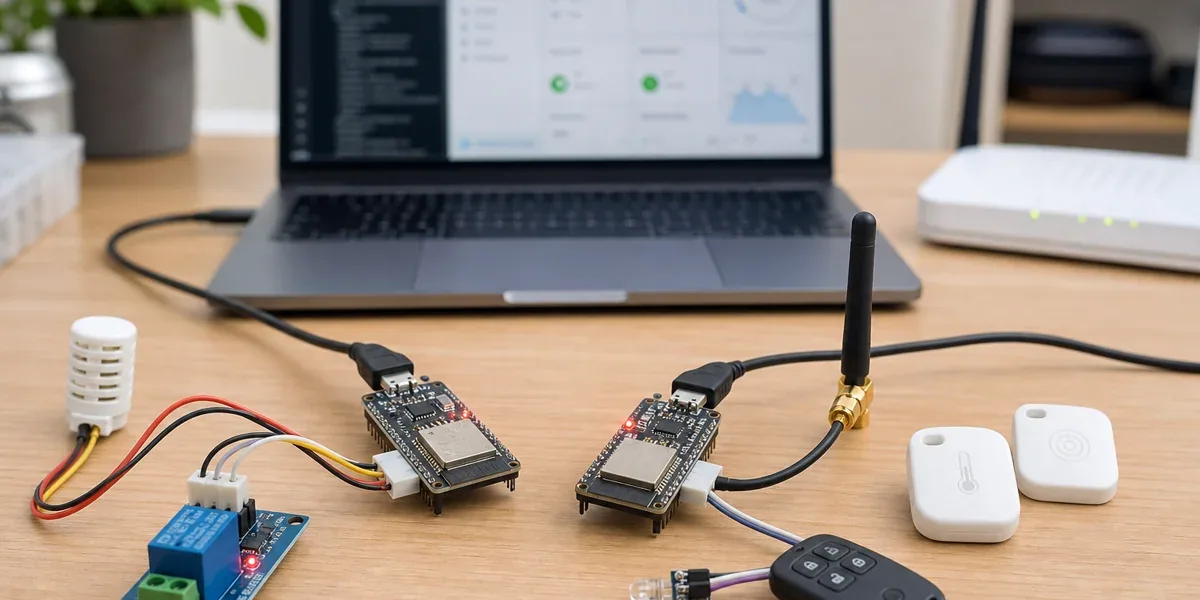
If you want to connect a temperature sensor, relay board, RS485 module, or custom GPIO device to Home Assistant, ESPHome is usually the safer first choice. If you want an ESP32 to act as a listener that receives BLE advertisements, 433 MHz remotes, IR commands, or several non-IP device signals and publishes them into MQTT, OpenMQTTGateway is often the better fit.
The core conclusion is this: ESPHome and OpenMQTTGateway are not separated by which one is more powerful. They use different device models. ESPHome turns an ESP32 into a declarative, controllable, OTA-maintainable device node. OpenMQTTGateway turns an ESP32 into an MQTT gateway for passive multi-protocol signals. Projects usually fail not because the ESP32 was the wrong chip, but because a device node and a protocol gateway were forced into the same maintenance model.
Decision Block
When the ESP32 needs to expose clear sensors, switches, relays, serial buses, or Modbus entities, start with ESPHome. When the ESP32 mainly needs to listen to BLE, RF, IR, or similar external events and publish them to MQTT, start with OpenMQTTGateway. Do not treat them as the same bridge framework just because both can run on ESP32 hardware.
1. Start by separating two bridge requirements
Many comparisons start with "which project supports more features." A better first question is: what should this ESP32 be operated as after deployment?
The first type is a device node. It has clear inputs, outputs, entities, state, control logic, and configuration: a relay temperature controller, an RS485 data collection node, an ESP32 plus sensor board, or a field device that needs OTA updates, logs, and Home Assistant entity mapping. This requirement values control, clarity, and per-device maintenance.
The second type is a protocol collection gateway. It may not represent one physical endpoint. It continuously listens to nearby wireless, infrared, or broadcast signals and converts multiple external device events into MQTT messages: BLE beacons, 433 MHz remotes, IR codes, Bluetooth temperature broadcasts, or low-cost sensor signals. This requirement values protocol coverage, decoding, and topic contracts.
If your project is closer to the first type, ESPHome's declarative configuration and Home Assistant integration usually reduce maintenance cost. If it is closer to the second type, OpenMQTTGateway's multi-protocol gateway model matches the problem more directly.
2. ESPHome behaves like declarative device firmware
ESPHome's strength is that it lets ESP32 nodes describe entities, sensors, switches, binary sensors, bus components, automation logic, logging, and OTA behavior in YAML. For Home Assistant projects, that model is straightforward: the device node exposes entities, while Home Assistant handles automations, UI, and long-term management.
This creates three practical advantages.
First, the device boundary is clear. An ESPHome node usually maps to one physical device or one field control point. The configuration file explains which GPIOs, sensors, buses, and Home Assistant entities belong to that node.
Second, the control path is direct. ESPHome supports a native API integration with Home Assistant and can also use MQTT. Most home automation and lightweight IoT projects can use the native API for entity discovery, state updates, and command feedback. MQTT can be introduced when a broker contract or cross-system integration is required.
Third, custom control logic is easier to keep near the hardware. Temperature control, relay interlocks, sensor filtering, Modbus polling, I2C readings, and simple local automations fit naturally into the ESPHome device configuration. Hardware-dependent logic stays at the edge instead of being pushed entirely into an upper automation layer.
The limit is that ESPHome should not be stretched into a universal passive protocol listener. It supports many components, but once the primary goal becomes "listen to many BLE/RF/IR devices and convert them into a topic stream," the configuration and semantic boundary can become harder to maintain.
3. OpenMQTTGateway behaves like a multi-protocol MQTT collector
OpenMQTTGateway is closer to a gateway. It receives or sends signals from BLE, RF, IR, and other sources, then passes data to Home Assistant, Node-RED, n8n, or another system through MQTT. Its core value is not making the ESP32 look like a normal device node. Its value is bringing many non-IP or weakly structured signals into an MQTT data plane.
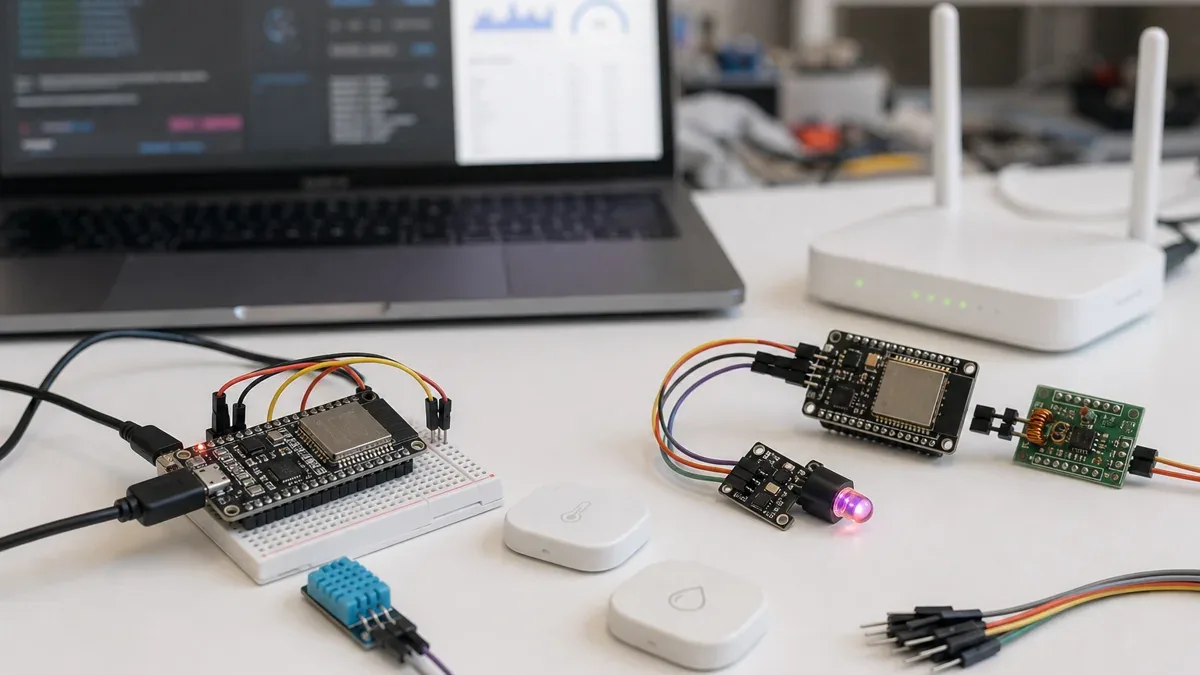
This model fits scenarios such as:
- collecting BLE temperature, humidity, contact, or beacon advertisements
- listening to 433 MHz remotes, doorbells, sensors, or simple RF devices
- sending or receiving IR remote codes for legacy appliances
- converting devices without a formal API into MQTT events before the platform interprets them
OpenMQTTGateway's advantage is protocol coverage and MQTT centralization. If topics, payloads, and device discovery rules are designed clearly, the upper platform can treat it as an event inlet instead of maintaining firmware for each small external device.
Its cost comes from the same place. You need stronger governance for MQTT topics, payload versions, device identifiers, duplicated messages, retained messages, and discovery behavior. If the gateway keeps adding external devices without naming and topic rules, troubleshooting can become harder than maintaining several simple ESPHome nodes.
4. Comparison: do not only ask whether it can be done
| Decision dimension | Better fit for ESPHome | Better fit for OpenMQTTGateway |
|---|---|---|
| Main object | A clear ESP32 device node | A gateway that listens to or forwards multi-protocol signals |
| Integration focus | Home Assistant entities, native API, device configuration | MQTT topics, payloads, discovery, external events |
| Typical hardware | GPIO, relays, I2C, UART, RS485, sensor boards | BLE beacons, 433 MHz modules, IR transmit/receive, RF remotes |
| Control model | Clear state, good for closed-loop control | Event and message oriented, good for collection and forwarding |
| Maintenance style | Per-node YAML and OTA lifecycle | Gateway configuration plus topic contracts |
| Main risk | Too much local logic makes the node configuration expand | Topics drift, device identity changes, payload semantics become inconsistent |
The point of the table is not to declare a winner. It is to avoid a mismatch. If a project needs reliable relay control and Modbus register collection but uses a gateway mindset, it may lack a clear device state model. If a project only needs to collect BLE broadcasts and RF events but splits everything into many ESPHome nodes, maintenance cost grows with the number of external devices.
5. A practical decision flow

First ask whether the ESP32 represents a clear device node. If yes, prefer ESPHome. Typical examples include sensor gateways, controllers, relay boards, ESP32 plus RS485 data collectors, and ESP32 plus local displays. These scenarios need device-level state, OTA updates, logs, and entity mapping.
Second, ask whether the ESP32 is mainly listening to signals from other devices. If yes, prefer OpenMQTTGateway. Typical examples include BLE advertisement collection, RF remote events, IR controllers, and low-cost wireless sensor aggregation. These scenarios need protocol decoding and an MQTT message plane.
Third, handle mixed scenarios carefully. If you need local closed-loop control and a large amount of wireless event collection at the same time, do not rush to put everything into one ESP32. A more maintainable design is often to split the boundary: ESPHome handles deterministic control, OpenMQTTGateway handles event collection, and Home Assistant or the platform layer connects the two.
6. When neither should be the first choice
ESPHome and OpenMQTTGateway are both strong paths for bridge prototypes and local automation nodes, but they are not the end state for every production system.
If you are building commercial device firmware with strict power budgets, production tests, secure boot, encrypted credentials, partitioned upgrades, remote diagnostics, and long-term version governance, custom firmware directly on ESP-IDF may be a better fit. ESPHome is excellent for prototypes and many local automation nodes, but it does not solve every production firmware governance problem.
If you are integrating industrial sites that need consistent telemetry models, edge buffering, device authentication, tenant isolation, and platform-grade audit trails, OpenMQTTGateway should not become the whole edge gateway. It can be a protocol entry point or validation tool, but a formal system still needs a clearer adapter layer, state model, and data quality rules.
If your core requirement is Matter, Zigbee, or Z-Wave ecosystem integration, do not start with an ESP32 bridge by default. When a mature coordinator and integration can solve the problem reliably, adding a programmable bridge layer may create extra operational work without enough benefit.
7. Recommended conclusion
For Home Assistant and lightweight IoT projects, the default path is:
- clear entities, sensors, relays, buses, and local control logic: choose ESPHome
- BLE, RF, IR, broadcast events, and multi-protocol signal collection: choose OpenMQTTGateway
- both control and listening: split into two clear boundaries instead of building one all-purpose gateway
- commercial firmware or industrial gateway needs: use both as validation paths, then design formal firmware or a protocol adapter layer
The most important distinction is this: ESPHome optimizes maintainability for device nodes, while OpenMQTTGateway optimizes the efficiency of bringing multi-protocol signals into MQTT. Once that boundary is clear, ESP32 bridge projects become much easier to operate beyond the prototype stage.
Reference starting points: