

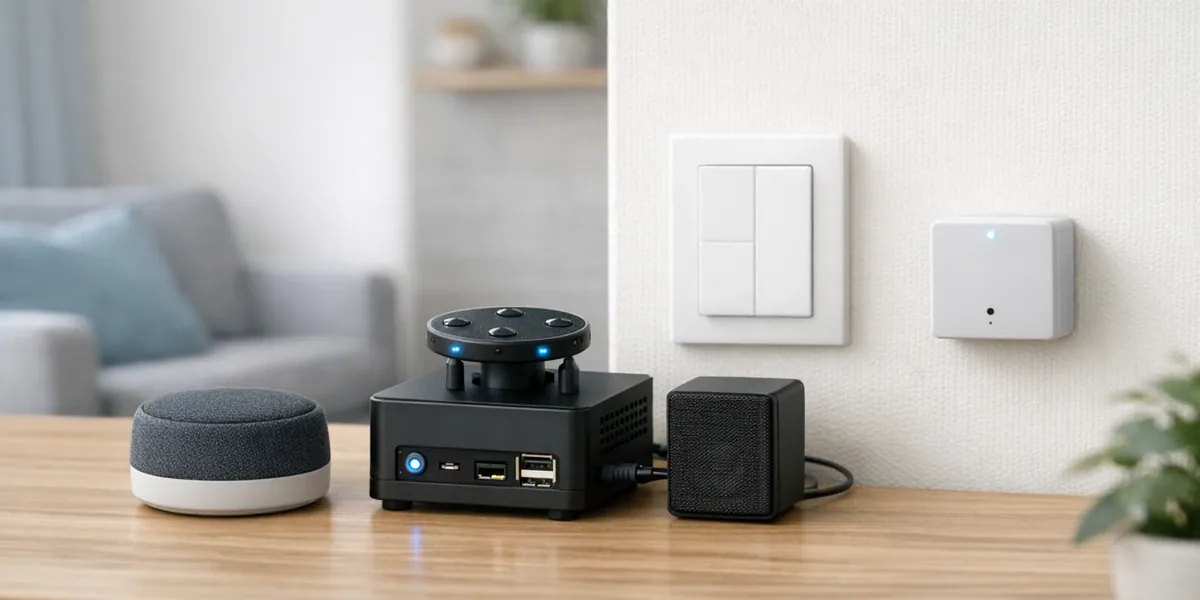
When people start exploring Home Assistant Voice, the first question is often framed too narrowly: which board should I buy, or can an ESP32-S3 handle everything by itself? Neither question is wrong, but both are incomplete. What usually defines the real experience is what role the terminal is supposed to play, where it lives in the room, how much pickup distance and noise it must tolerate, and how much hardware and audio maintenance you are willing to own over time.
The core conclusion is this: if your goal is to validate the official Home Assistant open-voice path as quickly as possible and with the least hardware friction, start with Voice Preview Edition; if your goal is to deploy room-grade voice endpoints with better acoustic control and long-term extensibility, DIY voice satellites are usually the stronger direction; and if your goal is to embed voice into a wall panel, bedside controller, doorway terminal, or another custom device, ESPHome voice nodes are highly valuable, but they should not be assumed to be the best universal primary endpoint for the whole house. In other words, you are not choosing the single best open voice device. You are choosing the terminal form factor that best matches your deployment path.
Definition Block
In this article,
Voice Preview Editionrefers to the more official, more appliance-like path into open voice forHome Assistant;DIY voice satellitesrefers to self-built room endpoints with deliberate choices around microphones, speakers, enclosure, power, and compute; andESPHomevoice nodes refers to the engineering path where voice is integrated into anESPHomedevice such as a custom panel or dedicated control point.
Decision Block
If your priority is "get the official open-voice chain working with minimal hardware noise," choose
Voice Preview Editionfirst. If your priority is "build durable room endpoints with better acoustic fit and expansion headroom," choose DIY satellites. Only prioritizeESPHomevoice nodes when the device is already part of a custom endpoint and you are willing to handleI2S / PDM, buffering, power, enclosure acoustics, andWi-Filatency tuning.
1. The real choice is not the strongest board, but the right terminal path
1.1 Voice in Home Assistant is an end-to-end system problem
Open voice in Home Assistant is not just a microphone feature. A real interaction path includes:
- room pickup and echo behavior
- wake-word or push-to-talk triggering
- audio capture and transport
STT, intent recognition, automation execution, andTTS- playback and audibility in the room
That means hardware selection should not be reduced to "does it have a mic" or "is it the official device." It should be driven by what role this terminal plays in the full chain. In noisy rooms, longer pickup distances, or uneven networks, the first failure point is often not the model. It is the terminal's microphone path, buffering behavior, or latency consistency.
1.2 Most real deployments are solving one of three different goals
In practice, most home deployments fall into one of these goals:
- validate the official voice path quickly
- deploy durable always-available room endpoints
- embed voice into a custom device instead of building a standalone speaker
Those goals map naturally to:
Voice Preview Edition- DIY voice satellites
ESPHomevoice nodes
If those goals get mixed together, two mistakes become common:
- using a pilot-friendly device as if it were the final room standard
- forcing a lightweight embedded endpoint to serve as the main voice terminal for the entire home
2. What each hardware path is actually good at
2.1 Voice Preview Edition is the shortest path to validating the official stack
If your main question is whether Home Assistant Voice is worth using in your environment at all, Voice Preview Edition is usually the shortest path. Its value is not that it must have the strongest far-field performance in every room. Its value is that:
- it stays closer to the official and actively evolving usage path
- it helps separate system-level voice questions from self-inflicted hardware complexity
- it lowers the amount of integration noise during the first stage
It is a strong fit when you want to:
- run a single-room or small pilot first
- validate
Assist, wake-word handling, intent flow, and device control - avoid spending the first phase on microphones, power, amplifiers, enclosures, speakers, and audio tuning
Its boundaries matter too:
- it may not be the strongest answer for every acoustic environment
- it is less flexible when you want wall-mounted, ceiling-mounted, bedside, or doorway-specific form factors
- once you want each room optimized for distance, noise, appearance, and power strategy, appliance-style hardware hits limits sooner
So the more accurate judgment is: Voice Preview Edition is the best path for getting the open-voice chain right early, not necessarily the permanent answer for every room.
2.2 DIY voice satellites are stronger when room fit and long-term deployment matter
Once you know a room needs a permanent voice endpoint, DIY satellites usually become much more compelling. The reason is simple: you can design around the room instead of forcing the room to adapt to one fixed device.
This path is strong because it lets you:
- choose microphones and speakers that better fit the room size and noise pattern
- expand across multiple rooms while optimizing each endpoint deliberately
- control power, enclosure, mounting, network, and maintenance strategy
- treat the endpoint as a real engineering object instead of a temporary gadget
It fits especially well when:
- the room has variable noise or longer pickup distances, such as a living room, kitchen, or work area
- you want the terminal to become part of the room rather than remain a pilot device on a shelf
- you plan to scale to several rooms and are willing to standardize the endpoint design
But the cost is real:
- you must make system-level decisions about microphones, speakers, power, enclosure, and thermal behavior
- once you build several units, consistency and firmware lifecycle become ongoing work
- if the network environment is unstable, troubleshooting shifts from one bad device to the design of the endpoint class itself
That is why the real value of DIY satellites is not that they are "more hacker-friendly." It is that they let you optimize voice terminals as first-class room infrastructure.
2.3 ESPHome voice nodes are strongest when voice is part of another device
Many people see voice-related capabilities in ESPHome and immediately think: why not just use ESP32-S3 everywhere? That path is possible, but its strongest value usually lies elsewhere.
ESPHome voice nodes are most compelling when:
- you are already building a wall panel, bedside controller, doorway terminal, or desk control device
- voice is one interaction layer among others, not the only one
- you are prepared to tune
I2S / PDM, buffering, buttons, status lights, speakers, and enclosure geometry around a specific use case
Its main strengths are:
- high flexibility in cost and form factor
- natural alignment with the broader
ESPHomedevice ecosystem - a strong fit for control-panel style endpoints that already own sensors, buttons, or displays
But it should not be romanticized into a universal answer:
- far-field pickup and playback may not be stable enough for every room
Wi-Fijitter, buffering, and audio-chain tuning can directly affect responsiveness- enclosure design, microphone placement, power noise, and speaker size can change the experience dramatically
- once it becomes the main voice entrance for the home, maintenance overhead can climb much faster than expected
In other words, ESPHome voice nodes are best at putting voice into a device, not automatically at becoming the easiest whole-home primary voice terminal.
3. Compare them on the dimensions that actually matter
| Dimension | Voice Preview Edition | DIY voice satellites | ESPHome voice nodes |
|---|---|---|---|
| Best goal | fast validation of the official voice path | durable room endpoints and expansion | embedding voice into a custom endpoint |
| Setup speed | high | medium | medium |
| Room-specific acoustic fit | medium | high | depends on your audio design |
| Local-control flexibility | medium to high | high | high |
| Long-term maintenance overhead | low to medium | medium to high | high |
| Form-factor freedom | low | high | very high |
| Multi-room consistency | medium | high if standardized | low to medium, often fragmented by project |
| Typical risk | turning a pilot device into the permanent standard | underestimating engineering scope | forcing an embedded node to act like a primary room endpoint |
The more useful decision questions are:
- are you building a pilot or defining a long-term endpoint standard?
- are you more afraid of slower deployment or of unstable experience?
- do you need a standalone voice terminal or a custom device that happens to support voice?
4. A more practical decision sequence

The point of this flow is simple: define terminal role first, then choose hardware. If you reverse that order, the project usually pays for it during the second phase.
5. Recommended paths for common Home Assistant projects
5.1 You are trying Home Assistant Voice for the first time
If what you lack most is certainty rather than ultimate flexibility, the safer path is usually:
- start with
Voice Preview Editionin one room - observe real pickup distance, false triggers, response latency, and household acceptance
- decide whether the second phase should stay appliance-like or shift toward DIY satellites
The advantage is that you validate whether voice is worth doing at all before you sink effort into hardware engineering.
5.2 You want long-term endpoints in living rooms, kitchens, or work areas
If the goal is no longer a pilot but durable room infrastructure, the stronger path is often:
- classify rooms by quiet, semi-open, and noisy conditions
- treat DIY satellites as the standardized endpoint direction
- define shared power, network, audio, and enclosure rules
- use
ESPHomenodes only where custom embedded terminals add special value
In this kind of deployment, endpoint consistency, maintainability, and room fit matter more than saving a few setup steps.
5.3 You are already building a panel, bedside controller, or doorway endpoint
This is where ESPHome voice nodes become especially valuable because voice is not isolated. It sits alongside:
- buttons or touch input
- scene and relay control
- status display
- local environmental sensing
In these cases, the better design is usually not to chase extreme far-field performance. It is to treat voice as a near-field supplemental interface. That keeps the acoustic requirements more realistic and the overall system easier to stabilize.
6. The real costs and boundaries that belong in the design
6.1 The cost of Voice Preview Edition
- limited flexibility across room shapes and mounting styles
- once you scale out, installation fit can become a constraint
- excellent for validation and early deployment, but not automatically the best long-term room endpoint
6.2 The cost of DIY voice satellites
- requires system-level hardware design rather than just one development board
- multi-room rollout creates long-term work around firmware, spare parts, and consistency
- you become responsible for pickup, playback, power, and network behavior
6.3 The cost of ESPHome voice nodes
- audio-path tuning effort is high
- performance is sensitive to
Wi-Fijitter, buffering strategy, and enclosure design - if used as the default primary voice terminal, rework risk rises quickly
7. Final recommendation: choose by terminal role, not by chip enthusiasm
If you want one simple execution order, use this:
- define whether the device is a pilot endpoint, a room-grade primary endpoint, or an embedded control point
- choose
Voice Preview Editionfirst for pilot endpoints - choose DIY satellites first for room-grade primary endpoints
- choose
ESPHomevoice nodes first for embedded control points - do not let lightweight
ESPHomeendpoints become the default whole-home voice entrance unless you are prepared to own long-term audio and network tuning
The best open-voice hardware strategy for Home Assistant is not the one with the prettiest spec sheet. It is the one that stays stable in your rooms, on your network, and under your maintenance model for the next six to twelve months without becoming a burden.