

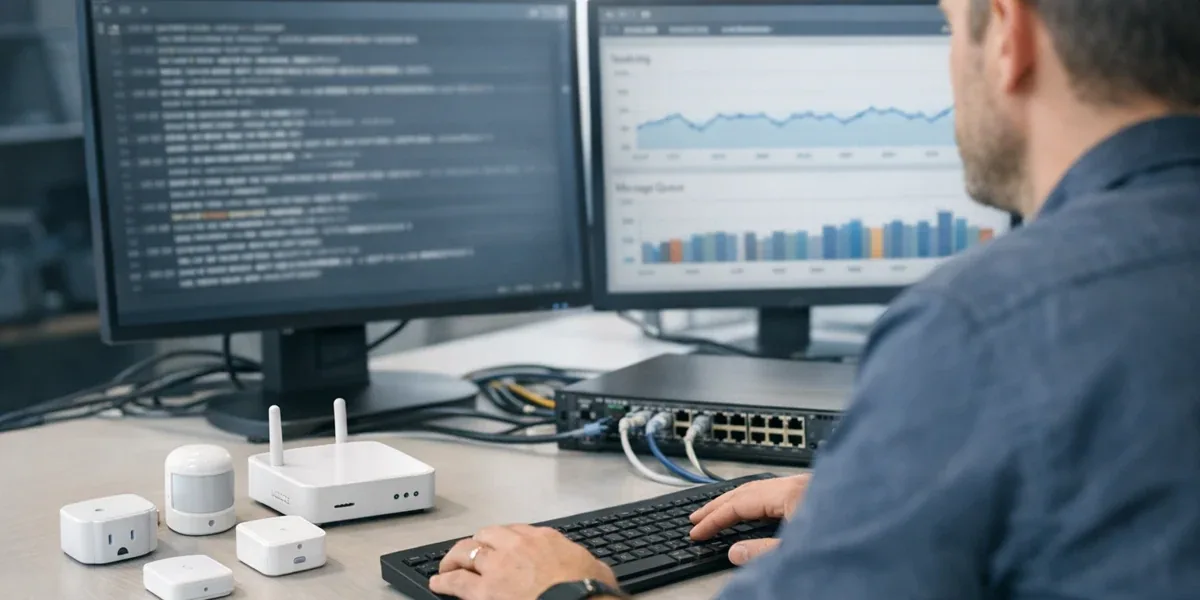
When teams connect Tuya devices to an IoT backend, they often ask a simple question: should device status changes be pushed to a webhook, or should the system consume Tuya events through Pulsar? If the only requirement is receiving an event, both options can look acceptable. If the system must support alarms, automation rules, operations dashboards, support diagnostics, and multiple consumers, the choice becomes an architecture decision.
The core conclusion is this: a webhook-style integration is suitable for low-volume, low-risk, single-consumer event forwarding. Pulsar is a better fit for production IoT event pipelines that need reliable consumption, backlog visibility, offline recovery, fan-out, and state reconciliation. If every device event is pushed directly into one business webhook, the first implementation is fast, but the system later pays for retry ambiguity, duplicate events, endpoint downtime, consumer scaling, and recovery gaps.
Decision Block
If the system forwards a small number of device events to one automation tool, a webhook-style entry point can be enough. If the system handles multi-tenant devices, alerts, command results, audit trails, or multiple downstream services, Tuya events should first enter a Pulsar or message-consumption layer, and then be distributed to internal event streams, task queues, or webhook fan-out targets.
For teams building production IoT backends, event synchronization is often part of a larger Tuya IoT Cloud integration project, including device data ingestion, API integration, message processing, dashboards, and downstream business workflows.
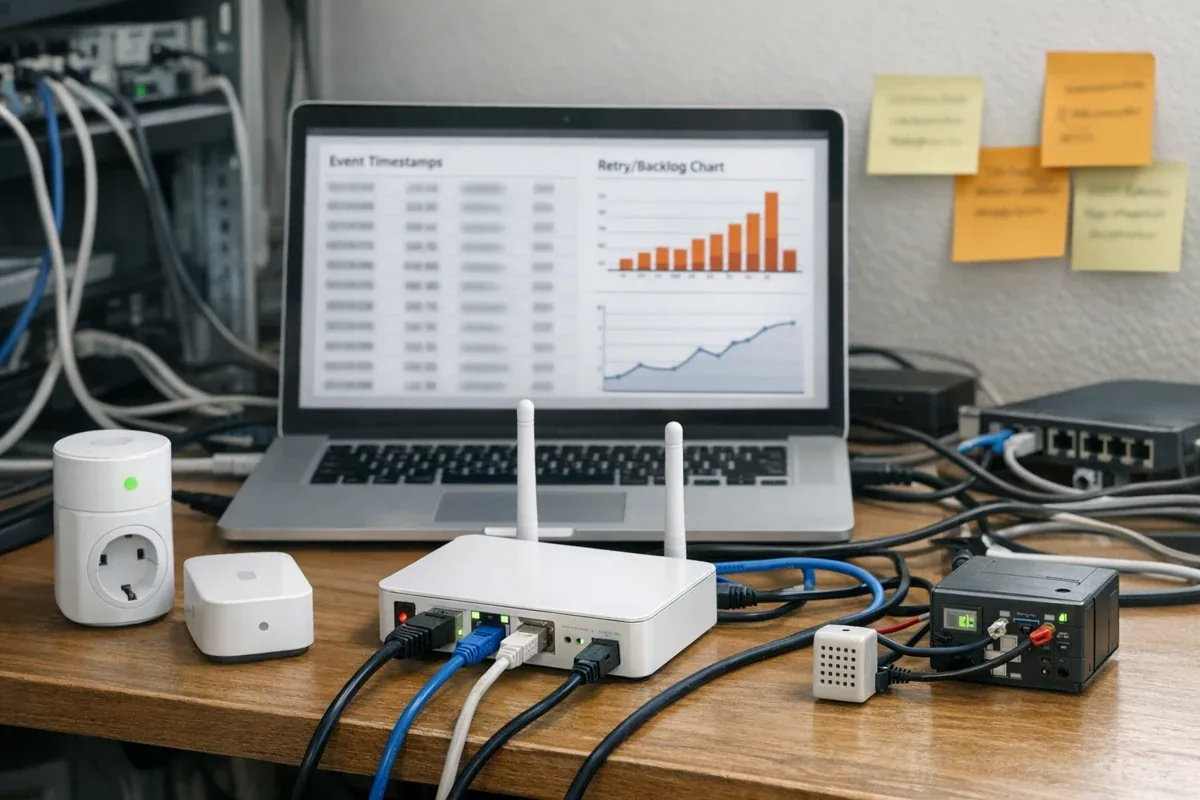
1. This is not just a question of which API is more advanced
Tuya’s message service documentation explains that events such as device registration, data reporting, and offline status can be actively pushed through message service, and that integration can be implemented with a Pulsar SDK. Apache Pulsar itself is a publish-subscribe messaging system: producers publish messages to topics, consumers subscribe to topics, process messages, and acknowledge them.
So the practical Webhook vs Pulsar comparison is not a comparison between two identical Tuya switches. It is a comparison between two implementation patterns:
| Pattern | What it means | Typical shape | Main risk |
|---|---|---|---|
| Webhook-style integration | Forward the event quickly to a business endpoint | Tuya event consumer or bridge posts to an HTTP endpoint | If the business endpoint is unavailable, recovery and fan-out become weak |
| Pulsar message queue integration | Treat Tuya events as consumable, acknowledged, observable messages | Tuya Pulsar SDK -> event consumer service -> internal systems | Higher integration and operations cost |
The real question is whether the system can recover when the event path fails. If an event only sends a notification, manual recovery may be acceptable. If an event drives automation, alerts, device state, billing, or support workflows, the event path needs acknowledgment, traceability, and compensation.
2. Where a webhook-style integration works well
2.1 Low volume, one action, tolerable failure
The main advantage of a webhook-style integration is its short path. When an event arrives, the bridge calls an HTTP endpoint and the business system handles it. This is often enough for:
- a small number of devices
- forwarding events to n8n, Zapier, Slack, a support tool, or an internal notification endpoint
- low-risk actions such as notifications, logs, or non-critical dashboards
- one consumer that does not need separate delivery semantics
The engineering value is speed: fewer components, easier debugging, and a shape that business teams understand. The cost is that reliability mostly depends on the HTTP call and the endpoint behind it.
2.2 The boundary: a webhook is not an event platform
As device count, event types, and business consumers grow, a webhook-style design exposes four limits:
| Boundary | Common symptom | Consequence |
|---|---|---|
| Processing failure | The endpoint times out, returns 500, or is being deployed | Event outcome becomes uncertain |
| Consumer scaling | The same event must feed alarms, dashboards, tickets, and automation | Webhook fan-out becomes a hidden event platform |
| Ordering and idempotency | Retries create duplicate POSTs or device states arrive out of order | State rollback, duplicate alerts, duplicate tickets |
| Observability | Logs show HTTP failures, but not backlog, cursor, or replay range | Recovery depends on manual log searches |
For that reason, webhooks are better as event exits than as the only production event entry. If the system is expected to grow, place webhook delivery after the internal event layer rather than at the external platform boundary.
3. Where Pulsar is the better fit
3.1 Reliable consumption and offline recovery
The key difference is the consumption model. A consumer subscribes to a topic, processes a message, and acknowledges it. If the consumer is offline or processing fails, the message does not disappear just because an HTTP endpoint was unavailable at that moment. Apache Pulsar’s official documentation treats subscriptions, acknowledgments, redelivery, and subscription types as core messaging concepts.
That matters for IoT event synchronization because device events are naturally bursty:
- many devices report state after a network recovery
- a new automation rule increases one event type suddenly
- alerting, operations dashboards, and analytics stores process the same event at different speeds
- a consumer service is deployed, scaled, or temporarily unavailable
Pulsar lets the integration layer receive events first and then control the pace of internal delivery. It does not remove complexity, but it puts the complexity into an observable and replayable message-consumption layer instead of scattering it across multiple webhook endpoints.
3.2 Multiple consumers are easier to govern
In a production IoT system, the same device event is often used by several systems:
- the alerting system needs low latency
- the device-state service updates latest state by
device_id - the automation engine matches trigger conditions
- the analytics pipeline writes long-term records
- support and audit systems keep operational context
If all of this is handled by direct webhooks, either one endpoint becomes too coupled, or a temporary fan-out service starts POSTing to every consumer. The second option often becomes a homemade message system without cursor management, replay, or subscription semantics.
The safer design is: consume Tuya events through Pulsar, then validate, deduplicate, normalize, and persist them before distributing them to internal topics, task queues, or webhook exits. Webhooks can still exist, but they should be downstream delivery targets, not the system’s only reliability boundary.
For production Tuya Cloud API integrations, the event layer is only one part of the risk. Teams also need to handle authentication, rate limits, command retries, data consistency, and state reconciliation. See our Tuya Cloud API production pitfalls guide before finalizing the backend design.

If the same device event needs to support alerts, dashboards, automation rules, analytics, and support workflows, the event layer should be planned together with the broader IoT platform development architecture.
4. Choose by failure consequence, not by integration effort
4.1 Use webhook-style delivery when these conditions hold
A webhook-style first version is reasonable when all of these are true:
- device count is small and event frequency is low
- the event triggers one low-risk action
- losing one or two events is not a business incident
- the endpoint can recover quickly and failures can be repaired manually
- there is no requirement for fan-out, audit, replay, or backlog monitoring
In these cases, Pulsar may be heavier than the problem requires. The team can keep a lightweight bridge, but it should still implement authentication, idempotency keys, and failure logs. Even a lightweight webhook should not be unauthenticated or impossible to replay.
4.2 Use Pulsar when any of these conditions appears
Prefer Pulsar or an equivalent message-consumption layer when any of the following is true:
- events drive alerts, automation commands, support tickets, or operations decisions
- the same event must be consumed by several systems
- the team needs to know what was processed, what is stuck, and what failed
- business services are deployed, scaled, degraded, or temporarily offline
- state reconciliation must be done by device, tenant, project, or event type
- event loss can produce wrong device state, duplicate alerts, or support cost
In these systems, Pulsar’s complexity is not extra complexity. It makes the existing complexity visible. You already need retry, backlog handling, duplicate suppression, ordering decisions, monitoring, and compensation. A webhook-only design simply delays those problems until an incident exposes them.
5. Production design: do not only consume messages; define the boundary
5.1 Standardization and idempotency come first
Whether the upstream source is Tuya Message Service, an internal gateway, or another platform, events should be converted to an internal standard shape before business processing:
event_id: used for idempotency and tracingdevice_id/tenant_id/project_id: used for isolation and routingevent_type: state change, online/offline event, alarm, command result, and so onoccurred_at/received_at: separates device occurrence time from platform receive timeraw_payload_ref: preserves a reference to the original payload for diagnostics
If the upstream does not provide a stable event_id, generate an idempotency key from message id, device id, event type, occurrence time, and the relevant payload. Do not interpret Pulsar redelivery as a reason to skip business idempotency. The message system handles delivery semantics; the business system still owns the consequences of duplicate processing.
5.2 Consumer offset and business state are different boundaries
A common mistake is assuming that once a consumer acknowledges a message, the business state is correct. In production, acknowledgment, database writes, alert delivery, and webhook fan-out often sit in different transaction boundaries.
A safer flow is:
- Consume the event and validate its shape.
- Apply idempotency checks.
- Write the event into an event log or inbox table.
- Update device state, trigger alerts, or enqueue downstream work.
- Acknowledge only after the current consumer responsibility is complete.
- Put downstream failures into retry queues or dead-letter records without blocking unrelated consumers.
This adds storage and task handling, but it makes three questions separable: was the event received, was the business action processed, and did downstream delivery succeed? For IoT operations, that is much stronger than a single webhook log.
6. When both patterns should be used together
The most practical production design is often not either-or:
- Upstream: Tuya events enter a Pulsar or message-consumption layer.
- Middle layer: validation, idempotency, normalization, state update, audit, and alert routing.
- Downstream: selected stable events are delivered by webhook to loosely coupled business systems.
This keeps the integration convenience of webhooks while preserving the reliable-consumption properties of a message queue. The order matters: do not make external business webhooks responsible for the reliability of the Tuya event entry point. Let the message-consumption layer own entry reliability, and use webhooks as business exits.
Planning a Tuya Cloud API, Pulsar, or webhook-based event pipeline? Review your Tuya event architecture with ZedIoT before deciding how to handle retries, fan-out, state synchronization, and downstream workflows.
7. When Pulsar is not the right starting point
Pulsar should not be the default answer for every small project. Avoid starting with a heavier message system when:
- there are only a few devices and events are used for personal or small-team notifications
- no one will monitor backlog, consumer failure, or dead-letter records
- the project is still a demo and future device scale is unknown
- event failure can be repaired manually without affecting customers or billing
In that case, a lightweight webhook with clear logs, idempotency keys, and failure alerts is a more realistic start. Move the entry point to a message-consumption layer when event volume, consumer count, or failure consequence grows.
8. Conclusion
The real Tuya Webhook vs Pulsar question is not which integration is faster. It is whether the system can explain, recover, and compensate when event synchronization fails. Webhook-style delivery is appropriate for lightweight forwarding and low-risk automation. Pulsar is more suitable for production IoT event pipelines that need fan-out, reliable consumption, backlog monitoring, and offline recovery.
If your system only pushes a small number of device events into a notification tool, starting with a webhook is fine. If device events drive alerts, automation, operations dashboards, tickets, or state reconciliation, treat Tuya events as a message stream: consume them through Pulsar or an equivalent message layer, then apply idempotency, normalization, state updates, and downstream delivery. The architecture is more explicit, but during incidents the system can answer which events arrived, which were processed, and which need compensation.