
Case Study

Beverage Cooler IoT Monitoring for Refrigeration OEMs

Case Overview

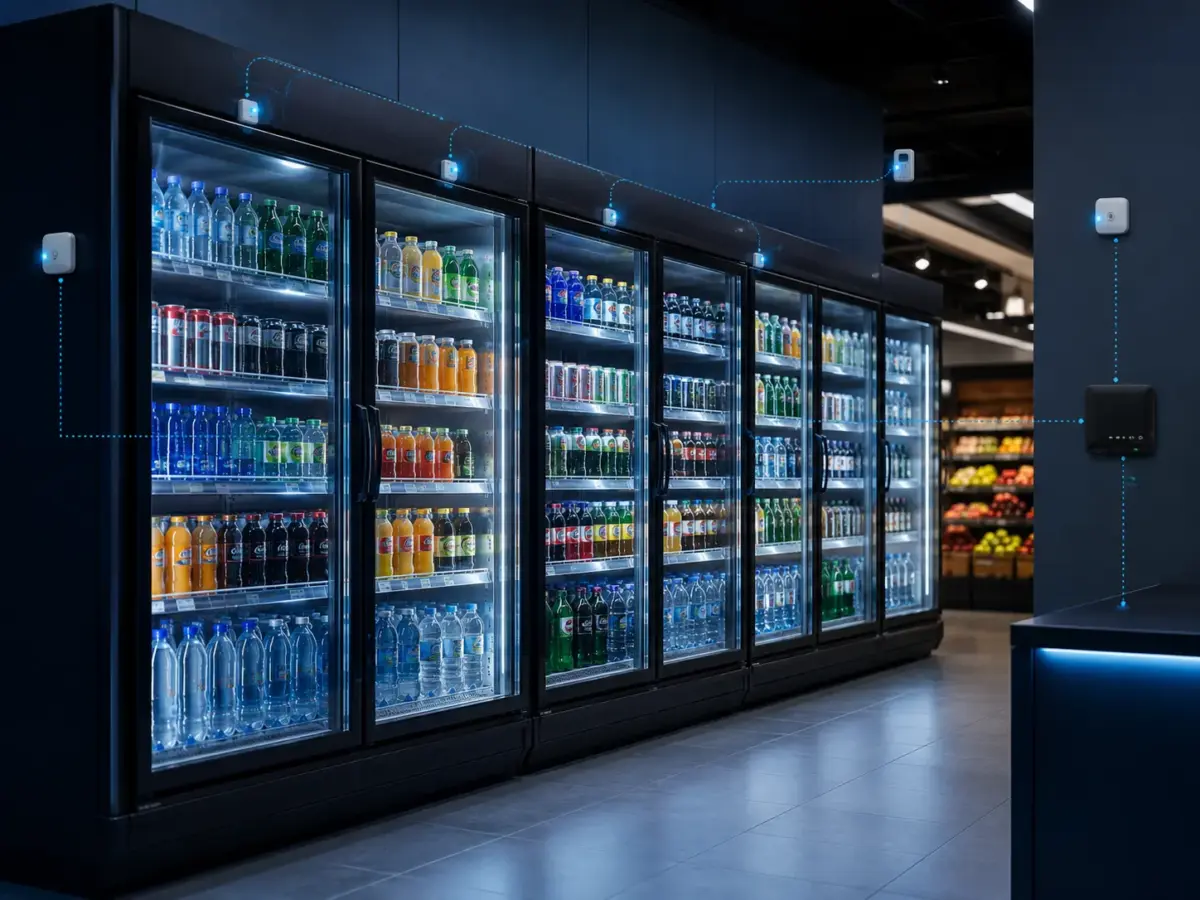
This application case focuses on a commercial refrigeration equipment company that develops beverage coolers and display refrigeration cabinets for beverage brands, retailers, and field operators. The company belongs to the beverage cooler IoT monitoring and commercial refrigeration IoT industry because its equipment must do more than keep drinks cold. It also needs to support controller data collection, alarm visibility, gateway communication, and remote monitoring after the cooler is installed in the field.

The company’s challenge is practical. Once a beverage cooler leaves the factory or warehouse, the equipment may sit inside a store, supermarket, gas station, bar, restaurant, or beverage sales point. The manufacturer or equipment provider may not know whether the cooler is running at the right temperature, whether a door is being opened too often, whether a compressor or fan is behaving abnormally, or whether the site team has noticed an alarm.

For its customers, these problems are not just technical. A cooler that runs too warm can affect drink quality. A cooler that fails silently can create service complaints. A cooler that is moved, misused, or poorly maintained can become difficult to track. When the company only learns about problems through phone calls, delayed service reports, or manual checks, it becomes hard to support customers quickly and improve the equipment over time.


Company Background

The company designs and supplies beverage coolers and display refrigeration equipment for commercial use. Its products are used in customer-facing environments where cold drinks need to stay visible, accessible, and properly stored. These coolers may support beverage brands, distributors, convenience stores, supermarkets, cafés, restaurants, or other retail locations.

In daily operation, the cooler is both a refrigeration product and a business asset. It helps keep drinks at a suitable serving condition, supports product display, and affects the customer’s experience at the point of sale. For the equipment company, this means the cooler needs to be reliable after delivery, easy to support in the field, and adaptable to different customer requirements.

However, field use is rarely simple. Different customers may require different cabinet sizes, compressor settings, fan logic, defrost rules, sensor layouts, alarm outputs, and communication options. Some sites may have unstable operating conditions. Some equipment may be moved or used in ways the manufacturer cannot directly observe. Some problems may only become visible after product temperature has already drifted, an alarm has been ignored, or a service team has been called.

The company, therefore, needs a connected product approach that starts at the equipment level. Adding a dashboard alone is not enough. The refrigeration controller, sensors, relay outputs, alarm signals, gateway, and monitoring platform need to work together so the company can provide a more complete connected cooler solution.


Why This Company Needs Beverage Cooler IoT Monitoring

For this type of company, beverage cooler IoT monitoring is useful because the most important information is often inside the equipment, not in the office. Temperature trends, door status, relay behavior, alarm events, and controller status can help show whether a cooler is operating normally or starting to develop a problem.

Without this visibility, the company and its customers may depend on manual inspections, store feedback, or delayed service reports. That creates several pain points. A site may report that drinks are not cold enough, but the service team may not know whether the issue is caused by temperature settings, door usage, compressor operation, sensor failure, power problems, or poor ventilation. A technician may visit a site without enough equipment history. A product team may receive complaints but lack the data needed to improve future controller logic or equipment configuration.

A connected design gives the company a better way to support field equipment. The controller continues to handle local refrigeration control, while useful operating data is collected and prepared for remote review. The gateway then helps move that data from the cooler to a dashboard, alert system, or maintenance platform.

This is especially relevant for refrigeration OEMs and equipment solution providers that want to offer connected coolers without rebuilding the entire product from scratch. The goal is to build a practical path from local control to remote visibility: control logic first, useful data points second, gateway communication third, and platform-ready information last.


Project Requirements

The company needed a practical integration path for connecting beverage cooler equipment with both local control and remote monitoring functions. The goal was not to create a complex platform first. The first step was to make sure the equipment could provide reliable, useful, and readable data from the controller side.

Reliable Local Control

The cooler still needs stable local control for temperature, compressor operation, fan control, defrost, and alarms. Remote monitoring should not replace the controller’s core control function. It should build on top of it and help teams understand how the equipment behaves after deployment.

Useful Sensor and Signal Collection

The system needs to collect practical data from temperature sensors, humidity inputs, relay status, door signals, and alarm outputs. These data points help the company understand what is happening inside the cooler, not only whether the device is online.

Gateway Communication

The controller data needs to be transmitted through a gateway-ready communication path. For field equipment, the gateway acts as the bridge between the refrigeration unit and the monitoring platform. It should support equipment-level data transmission without making the cooler design unnecessarily complex.

Maintenance and Service Readiness

The company needs equipment data that can support service review, alarm handling, and maintenance decisions. This requires clear data mapping, simple status definitions, and a structure that helps technicians and operators understand what action may be needed.


Common Project Challenges

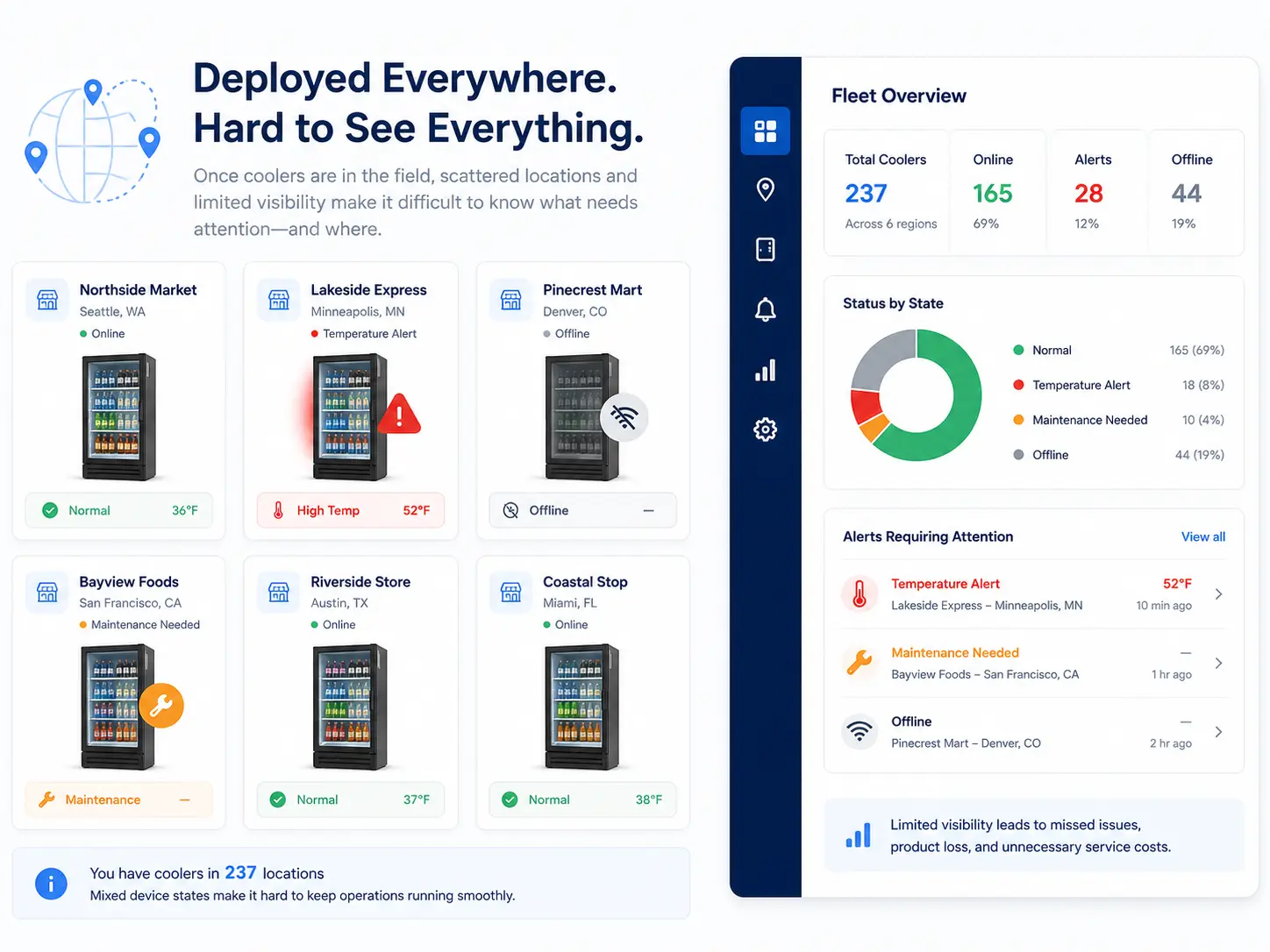
Distributed beverage cooler monitoring challenges for refrigeration equipment companies

Limited Field Visibility

Once beverage coolers are deployed, temperature status, door events, alarms, and equipment faults can be difficult to review remotely. The company may only hear about issues when a store reports a problem, a customer complains about drink temperature, or a technician is sent to inspect the unit.

Different Customer and Site Conditions

A cooler may work well in one location but face different conditions in another. Store layout, door opening frequency, ambient temperature, power quality, ventilation, and maintenance habits can all affect equipment behavior. A useful monitoring model needs to make these operating differences easier to review.

Mixed Equipment Configurations

Different cooler models may use different sensors, relay outputs, compressor logic, fan control, defrost settings, and alarm requirements. The integration needs enough flexibility to support several product lines without creating a separate monitoring design for every model.

Controller and Gateway Alignment

The controller must collect the right data, and the gateway must transmit it in a usable way. If the controller data structure is unclear, the dashboard may show information that is technically correct but difficult for operators or maintenance teams to act on.

Platform-Ready Data

Remote monitoring is not only about sending raw values. The data needs to be organized into useful information, such as temperature trends, abnormal status, alarm events, device condition, and maintenance logs. This helps the company turn equipment data into something service teams can actually use.


ZedIoT’s Integration Approach

ZedIoT supports connected refrigeration projects by combining controller configuration, sensor and relay data collection, IoT gateway communication, and monitoring platform integration.

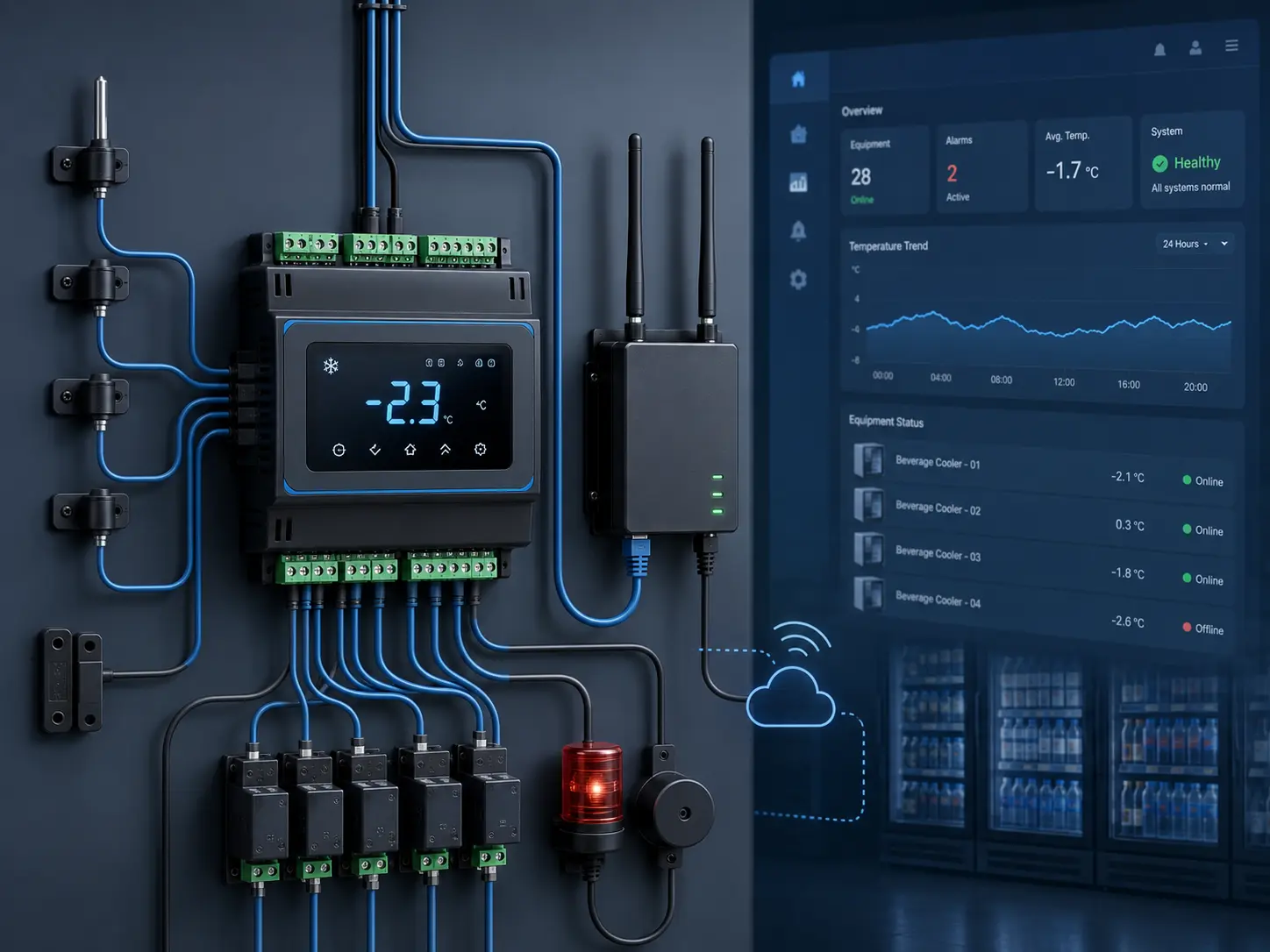
Refrigeration controller and IoT gateway integration for beverage cooler monitoring

For this company profile, the integration starts from the refrigeration equipment itself. The controller needs to manage local operating logic while also preparing key equipment data for remote use. This helps the company avoid a disconnected system where local control and remote monitoring are handled separately.

ZedIoT’s commercial refrigeration controller capabilities support controller configuration, sensor inputs, relay outputs, alarm rules, and gateway-ready connectivity for connected refrigeration projects.

Controller Configuration

Configure control logic for temperature control, compressor operation, fan control, defrost, and alarm outputs. The controller should match the equipment type and the company’s product requirements instead of using a one-size-fits-all setup.

Sensor and Relay Data Collection

Connect temperature sensors, humidity inputs, door signals, relay status, and equipment alarms for local control and remote visibility. These signals help the system understand both storage conditions and equipment behavior.

IoT Gateway Connectivity

Transmit refrigeration data through gateway-ready communication paths for dashboard display, alerts, and data logging. The gateway acts as the communication bridge between field equipment and the monitoring platform.

Monitoring Platform Readiness

Prepare equipment data for remote monitoring, alarm handling, maintenance review, and multi-unit visibility. This includes selecting the right data points, organizing status values clearly, and making the information useful for operations and service teams.


System Architecture

From Beverage Coolers to Remote Monitoring

The system architecture should be presented as a pure HTML and CSS diagram, not as a text-based image. This keeps the architecture content readable for users, editable for the website team, and easier for search engines to understand.

The flow is simple:

Beverage Coolers → Refrigeration Controller → Sensors & Relay Outputs → IoT Gateway → Remote Monitoring Dashboard → Alerts & Maintenance Logs

The system connects commercial beverage coolers with controller-level data collection and gateway-based communication. This helps the equipment company prepare its refrigeration products for remote visibility, alarm review, and maintenance data use.

Text Architecture Flow

Use the following text-based flow in the WordPress editor. This keeps the architecture simple, readable, and easy to edit without relying on an image or custom code.

Beverage Coolers
↓
Refrigeration Controller
↓
Sensors & Relay Outputs
↓
IoT Gateway
↓
Remote Monitoring Dashboard
↓
Alerts & Maintenance Logs

Architecture Nodes

Beverage Coolers
Commercial coolers and display refrigeration equipment are deployed across stores, outlets, or customer sites.

Refrigeration Controller
Local control for temperature, compressor operation, fan control, defrost logic, and alarm outputs.

Sensors & Relay Outputs
Temperature inputs, humidity data, door signals, relay status, equipment alarms, and operating conditions.

IoT Gateway
Gateway-ready communication path for sending refrigeration data from field equipment to remote systems.

Remote Monitoring Dashboard
Dashboard visibility for cooler status, temperature trends, device condition, alarm events, and logs.

Alerts & Maintenance Logs
Alarm handling, fault awareness, operating history, and maintenance review for distributed refrigeration assets.


Key Capabilities for the Company

Temperature Monitoring

Track cooler temperature data for storage condition visibility. This helps the company and its partners determine whether equipment remains within the expected operating range.

Alarm Visibility

Detect abnormal temperature or equipment status through remote alerts. Alarm visibility is useful when teams need to respond before a small issue affects product storage or equipment reliability.

Controller Integration

Connect sensors, relay outputs, compressors, fans, defrost, and alarms. This creates a stronger technical foundation than only adding a separate monitoring device outside the control system.

Gateway Communication

Send refrigeration data to dashboards or monitoring platforms. Gateway communication enables equipment data to support broader maintenance and operations workflows.

Operating History

Log equipment data for maintenance review and issue tracing. Historical data can help the company review recurring problems, alarm timing, and equipment behavior.

OEM Adaptability

Adjust controller and monitoring logic for different refrigeration equipment types. This is useful for an equipment company that needs a reusable integration model across several cooler models or product lines.


Built on Refrigeration Control and IoT Integration Experience

ZedIoT provides commercial refrigeration controller and IoT integration capabilities for OEM refrigeration equipment, display cabinets, cold rooms, and multi-unit systems.

The controller-side foundation supports control logic, sensor inputs, relay outputs, alarm rules, and gateway-ready connectivity for connected refrigeration projects. This makes the integration more practical for a refrigeration equipment company that needs both local control and remote data visibility.

This case does not claim a fixed deployment quantity, named customer, or measured cost-saving result. It focuses on a realistic company profile in the commercial refrigeration IoT industry and shows how beverage cooler equipment can be prepared for controller-based monitoring and gateway connectivity.


What This Integration Enables

Remote Equipment Visibility

The company can prepare its beverage coolers for remote review of cooler status, temperature data, and alarms without relying only on manual checks after installation.

Earlier Fault Awareness

Abnormal temperature, sensor failure, or equipment status can be surfaced earlier through connected alerts. Earlier visibility can help service teams decide whether to inspect, reset, repair, or replace equipment.

Reusable OEM Integration Model

The same controller-gateway-monitoring structure can be adapted for display cabinets, beverage coolers, cold rooms, and multi-unit refrigeration systems. This makes the model useful beyond a single equipment type.

Better Maintenance Review

Logged operating data helps the company and its service partners review equipment behavior, alarm history, and maintenance needs. This can support more informed maintenance planning and reduce dependence on scattered field feedback.


Related Refrigeration Monitoring Solution

Need a similar refrigeration IoT solution?

For projects that involve multiple stores, distributed refrigeration assets, or centralized alarm visibility, explore ZedIoT’s commercial refrigeration monitoring solution.

ZedIoT helps refrigeration OEMs and equipment solution providers connect controllers, sensors, gateways, and monitoring platforms for practical commercial refrigeration projects.


Start Free!

Get Free Trail Before You Commit.