Executive Summary: Tuya OEM to SDK Migration Case Study
This case study analyzes a successful Tuya OEM to SDK Migration for a North American commercial HVAC provider. ZedIoT helped the client overcome the limitations of the standard OEM platform by implementing a hybrid architecture with the Tuya Ray Framework. This strategic move resolved critical building "energy conflicts" and achieved a 25% reduction in operational costs.
Context: When the System Works, but the Product Is Stuck
Many teams start with a Tuya OEM App to get their IoT product to market quickly.
It’s fast, stable, and works well in the early stage.
This client—a North America–focused provider of commercial HVAC IoT solutions—followed the same path.
Their system launched smoothly, devices connected reliably, and early users had no trouble using the product.
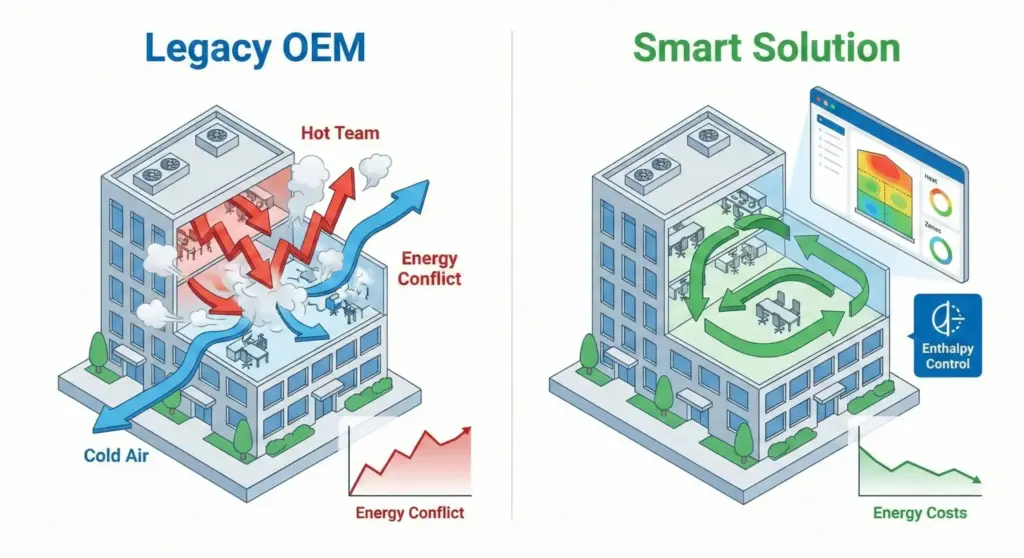
As adoption grew, however, a different problem emerged:
- The system kept running, but overall efficiency declined
- Devices behaved independently, with limited coordination
- The team could see the issues, but adjusting system behavior through the OEM app became increasingly difficult
Nothing was “broken,” but the product became harder to manage, harder to adapt, and harder to grow.
Why Tuya OEM Apps Hit a Ceiling at Scale
Before working with ZedIoT, the client had already tried incremental fixes through their tech team.
Those changes helped in the short term, but the core issue remained.
After reviewing the system together, we reached a clear conclusion:
This was not a device limitation, and not a Tuya platform issue.
The OEM application layer no longer matched the product’s stage.
The Tuya OEM App is well suited for early validation.
But once a product enters commercial deployment or starts scaling, it typically needs:
- More flexible application logic
- Clearer control over device structure and permissions
- Operating strategies that can evolve continuously, not remain fixed
At that point, adding features is no longer enough—the application layer itself needs to change.
The Upgrade Path: From Tuya OEM App to Tuya SDK App + MiniApp
Instead of rebuilding the entire system, the client chose a Tuya OEM to SDK migration with a controlled, step-by-step approach:
- The device layer remained unchanged, continuing to use existing Tuya hardware
- The application layer was upgraded to a Tuya SDK App, giving the team full control over structure and logic based on the capabilities provided by the Tuya SDK .
- Frequently changing operating strategies were decoupled from the main app and delivered through MiniApps
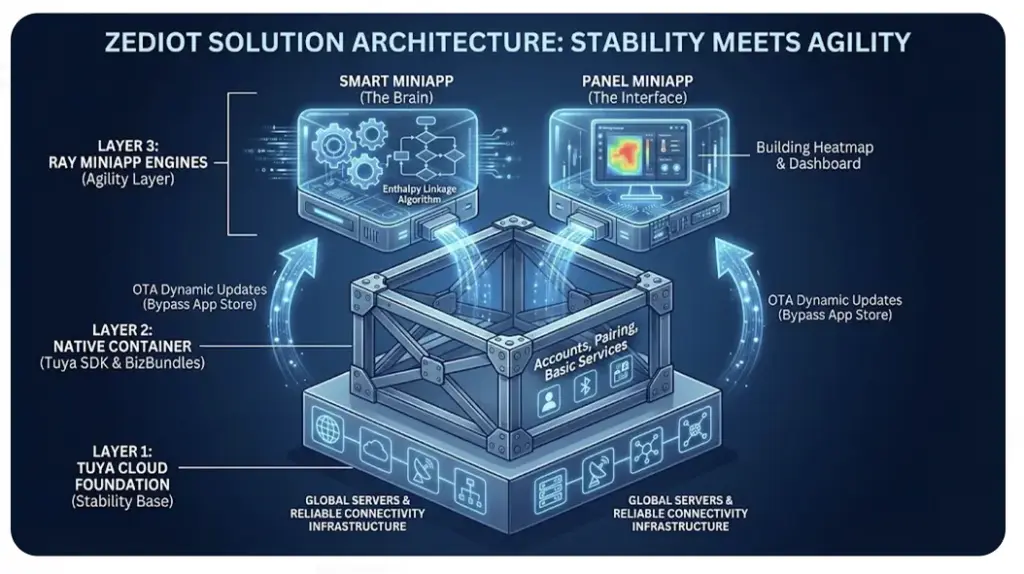
This was not a technical experiment.
It was a structural upgrade aligned with the product’s lifecycle.
What Changed After Moving to a Tuya SDK App
A Controllable Application Layer
With the Tuya SDK App, the client was no longer constrained by OEM templates.
This enabled true Tuya custom app development, including:
- Custom application structure and business logic
- Clear device grouping and permission management
- Room for future features and product expansion
What this solved
- OEM app limitations with complex workflows
- App structures that could not evolve with the product
Strategy Decoupling with MiniApps
High-frequency operating strategies were moved out of the main app and into MiniApps:
- No dependency on app store releases
- Remote updates that take effect quickly
- Different strategies applied under different conditions
This project also serves as a Tuya Ray framework case study, showing how Ray can support strategy-level decoupling in commercial systems.
What this solved
- Every adjustment requiring an app update
- Slow response to operational or environmental changes
From Device Actions to System Decisions
By combining the SDK App with MiniApps:
- Device states could be evaluated together
- System behavior was driven by unified logic instead of isolated triggers
What this solved
- Devices working against each other
- System behavior that was hard to predict or explain
Stability as a Baseline
To meet commercial reliability requirements, essential safety logic remained on the device side:
- Automatic fallback to safe operating states during network issues
- Protection against incorrect behavior caused by cloud or connectivity problems
This ensured stability without adding operational risk.
A Management View Focused on System State
The management interface shifted from device parameters to system-level visibility:
- Faster identification of abnormal or high-consumption areas
- Reduced human error
- Lower operational learning cost
This laid the foundation for long-term smart building energy management, without redesigning the entire system.
The Outcome: A Product Built to Scale
After the migration, the client didn’t just get a new app.
They gained:
- An application layer designed to evolve over time
- A system that moved from “usable” to operationally sustainable
- A product foundation ready for long-term growth and service-based expansion
Why ZedIoT for Tuya OEM to SDK Migration
Tuya provides a stable and powerful IoT foundation.
ZedIoT helps teams apply that foundation correctly—at the right product stage.
We specialize in end-to-end Tuya IoT development services, expecially Tuya SDK App development and commercial deployment, helping teams:
- Transition smoothly from Tuya OEM to Tuya SDK
- Build application layers that reflect real business logic
- Turn connected systems into long-term operational products