

ESP32-C3 Low-Power Sensor Node for Industrial Monitoring
An industrial monitoring product needed an ESP32-C3 sensor node that could wake, measure, transmit, and return to deep sleep without making battery life an afterthought.
Make energy use predictable before the enclosure and battery are fixed
A low-power claim is only useful when every wake source, sensor warm-up, radio retry, and idle peripheral is measured under a representative duty cycle.
- Project focus
- ESP32-C3 low-power sensor node
- Delivery scope
- Power profiling + Wake-cycle firmware
- Operating goal
- Measured duty cycle
Hardware, firmware, and product behavior had to be validated together
- 01
Separate sleep current from active acquisition and radio peaks
- 02
Handle sensor stabilization without keeping the MCU awake unnecessarily
- 03
Recover safely from weak networks and failed uploads
- 04
Leave room for battery, enclosure, and environmental constraints
Treat power as a system behavior, not a single ESP32 setting
ZedIoT structured the firmware around timed wake events, bounded sensor acquisition, controlled radio sessions, local status handling, and repeatable current measurements on representative hardware.
Power profiling
Measure sleep, acquisition, connection, transmit, and recovery states separately.
Wake-cycle firmware
Coordinate RTC wakeup, sensor timing, buffering, and deep-sleep entry.
Reliable telemetry
Limit retries, preserve important readings, and expose communication health.
Prototype validation
Test representative batteries, intervals, temperatures, and weak-signal conditions.
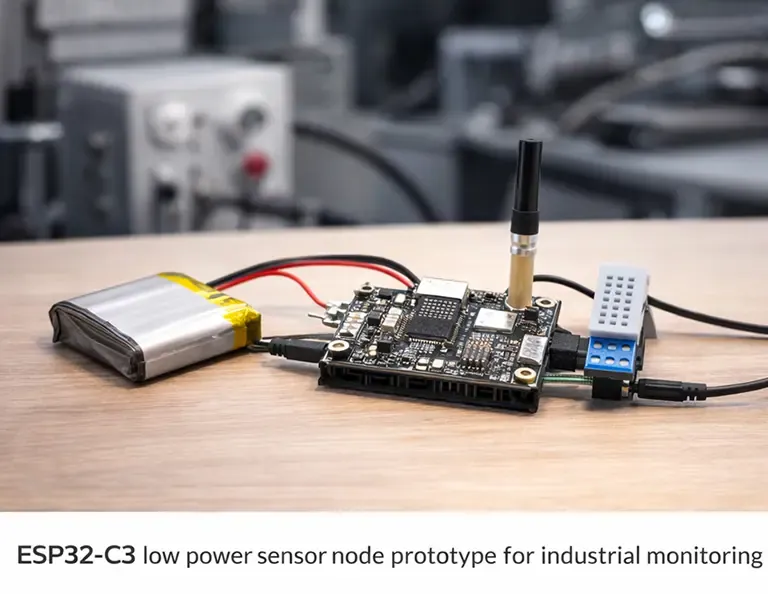
A working prototype, not a concept-only specification
The working prototype combined the ESP32-C3 board, sensors, battery operation, and field telemetry.
From wake event to verified sleep
Wake
RTC or configured event starts a bounded measurement cycle.
Measure
Sensors stabilize and produce validated readings.
Transmit
The node connects, publishes, and records delivery state.
Sleep
Peripherals shut down and measured current returns to baseline.
A validated power strategy for the next hardware decision
The project established a working sensor-node firmware path and evidence for selecting the battery, interval, enclosure, and connectivity strategy.
Measured duty cycle
Power decisions were tied to real firmware states instead of a chipset data-sheet number.
Recoverable communication
Weak-network behavior and retry limits were designed into the node rather than discovered in the field.
Production-ready questions
The prototype exposed the remaining battery, sensor, enclosure, and environmental tests before productization.
Battery-life estimates remain conditional until final hardware, network conditions, sampling intervals, temperature range, and battery chemistry are tested.
ESP32-C3 low-power sensor node questions
What did ZedIoT deliver for this esp32-c3 low-power sensor node project?
ZedIoT structured the firmware around timed wake events, bounded sensor acquisition, controlled radio sessions, local status handling, and repeatable current measurements on representative hardware. The final scope depended on the customer's devices, interfaces, operating workflow, and acceptance criteria.
Can this project pattern be adapted to another product or site?
Yes. The reusable pattern is the way wake, measure, transmit are connected. Device protocols, deployment topology, data ownership, and operating rules are validated for each new project.
What should be confirmed before starting a pilot?
A useful pilot starts with representative hardware, interface documentation, real operating conditions, expected users, failure cases, and measurable acceptance criteria. Battery-life estimates remain conditional until final hardware, network conditions, sampling intervals, temperature range, and battery chemistry are tested.
Planning a related AI + IoT project?
Share the current device or system, the operating problem, available interfaces, intended users, and the result you need to validate. ZedIoT can help define a focused prototype and production path.
- AI + IoT product architecture review
- Hardware, firmware, cloud, and application integration
- Prototype planning and production support