

Convenience store refrigeration monitoring for coolers, freezers, and beverage cabinets
Convenience stores often run many distributed coolers and freezers, but temperature checks, alarm response, and service evidence still depend on local staff. ZedIoT connects Wi-Fi refrigeration controllers, cabinet status, temperature alerts, store grouping, dashboards, and service workflows.
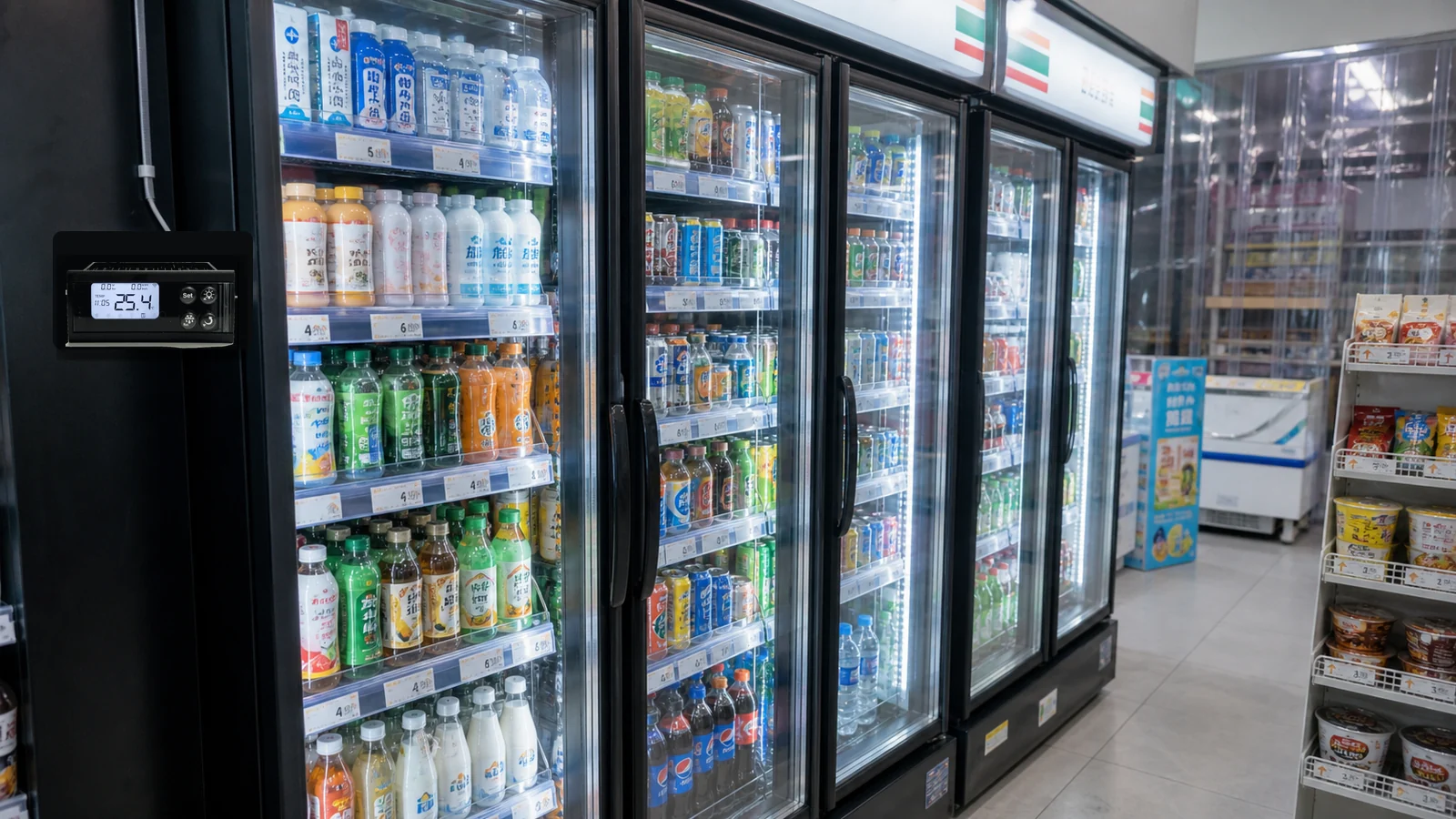
Best fit for convenience stores with distributed beverage coolers and freezers
Convenience-store chains, gas-station stores, small groceries, beverage cooler operators, and refrigeration service teams
- Customer problem
- Convenience stores often run many distributed coolers and freezers, but temperature checks, alarm response, and service evidence still depend on local staff.
- ZedIoT delivery
- ZedIoT connects Wi-Fi refrigeration controllers, cabinet status, temperature alerts, store grouping, dashboards, and service workflows.
- Expected outcome
- The result is remote temperature visibility, faster exception response, reduced manual checks, and clearer refrigeration service records across stores.
Store coolers become visible before temperature risk escalates
Each cabinet can report temperature, operating state, and alarm history into a store and regional view.
- Store and cabinet grouping
- High and low temperature alerts
- Cooling and defrost state
- Alarm and service records
How cabinet events become store-level refrigeration operations
The solution connects controller-side temperature and equipment state with store grouping, alert rules, and service evidence so teams can act before losses grow.
Controller
Wi-Fi refrigeration controllers keep local cooling and defrost logic while reporting temperature and device state.
Connectivity
Wi-Fi and BLE onboarding support individual cabinets and smaller store deployments without a dedicated gateway.
Platform
Dashboards, alarm rules, store grouping, roles, and records turn cabinet data into daily operations.
Service loop
Temperature events, parameter checks, and maintenance notes give operations and service teams shared evidence.
What the solution includes
The scope is shaped around the scenario, existing devices, required integrations, operating team, and rollout stage.
Cabinet-level monitoring
Connect beverage coolers, display cabinets, freezers, and fresh-food cabinets with Wi-Fi refrigeration controllers.
Store and region grouping
Group cabinets by store, city, region, operator, cabinet type, or service responsibility.
Temperature exception workflow
Turn high or low temperature, probe fault, defrost issue, door event, or offline state into actionable alerts.
Service evidence
Keep alarm history, response records, parameter changes, and equipment status visible to service teams.
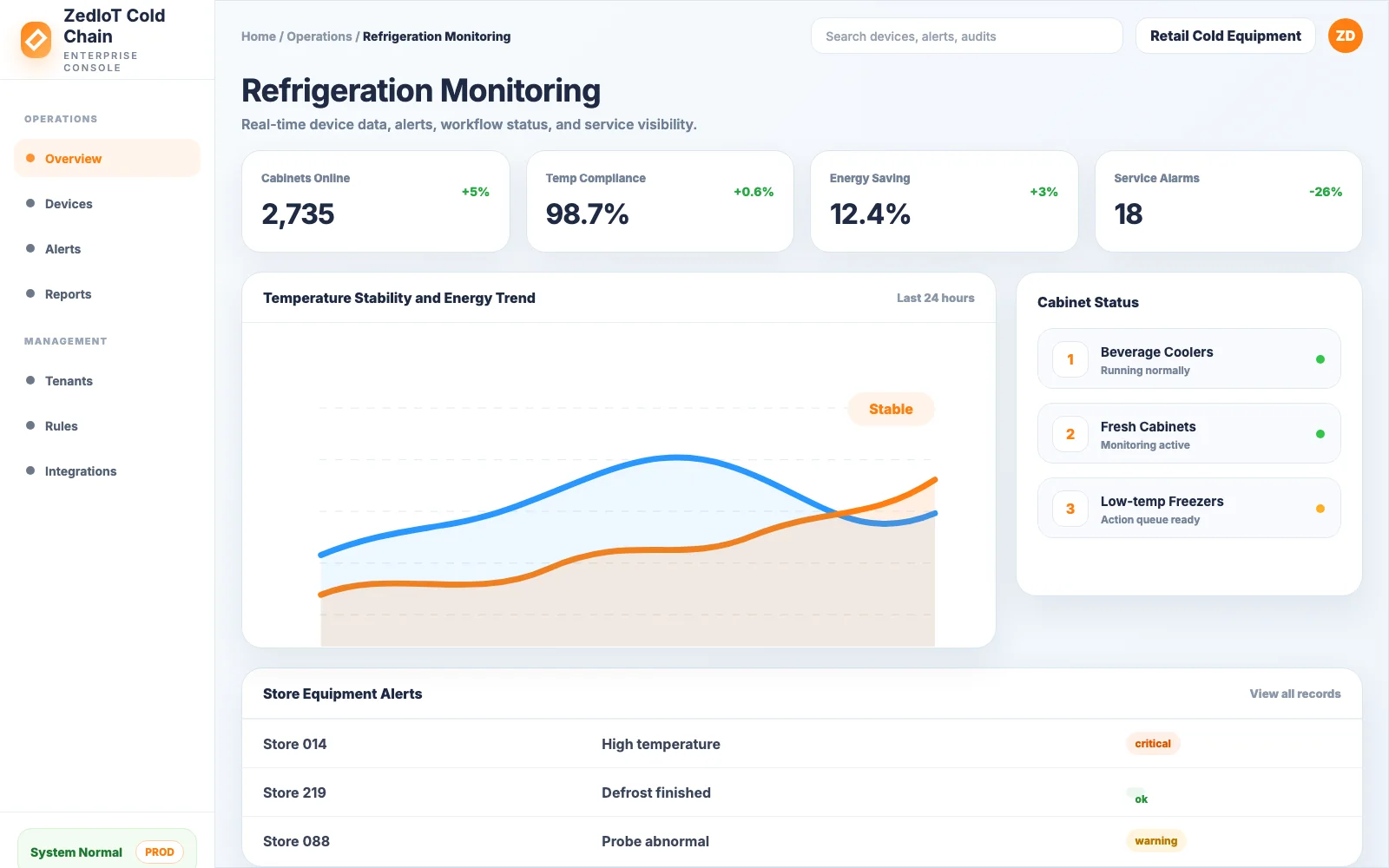
A dashboard for store, cabinet, alarm, and service context
Operators can group equipment by store, cabinet type, region, and service priority instead of relying only on local inspection.
- Confirm cabinet type, controller wiring, probe placement, and local cooling or defrost logic before rollout.
- Validate store Wi-Fi coverage and fallback behavior for disconnected cabinets.
- Define alarm thresholds, escalation rules, store roles, and service ownership before connecting many locations.
- Use a pilot store to verify temperature data, alarm accuracy, and operator workflow before regional deployment.
Questions to answer before a solution pilot
Is this page different from the supermarket refrigeration monitoring solution?
Yes. This page focuses on convenience stores, gas-station stores, beverage coolers, and smaller distributed sites where Wi-Fi controller onboarding and store-level alarm handling are often the fastest path.
Can existing beverage coolers and freezers be upgraded?
Often yes, but the controller wiring, probe type, relay outputs, cabinet safety logic, and panel structure must be checked before replacement or retrofit.
What happens if a store Wi-Fi connection is unstable?
Local refrigeration control should remain inside the controller. The platform design should define reconnection behavior, offline alarms, data buffering expectations, and store response rules.
Can regional managers see all stores?
Yes. Store, region, cabinet type, user roles, and alert escalation can be modeled in the platform so different teams see the right equipment and alarm records.
Talk to an AI-IoT engineering team
Share your product idea, current hardware, target workflow, or integration challenge. We will help you evaluate the fastest path to a working prototype and production-ready system.
- AI + IoT product architecture review
- Hardware, firmware, cloud, and application integration
- Prototype planning and production support