
Tuya OEM-to-SDK Migration for Commercial HVAC
A North American commercial HVAC provider had reliable connected devices, but its Tuya OEM application could no longer support the coordination, permissions, and operating strategies required at scale.

The devices worked, but the application layer constrained the product
Independent equipment behavior created energy conflicts, while fixed OEM templates made it difficult to coordinate building-level strategies or evolve the product without workarounds.
- Starting point
- Working Tuya OEM product
- Upgrade
- SDK app + MiniApps
- Published outcome
- 25% operating-cost reduction
The field data needed business and operating context
- 01
Preserve installed Tuya hardware and device connectivity
- 02
Gain control of application structure, users, groups, and permissions
- 03
Update operating strategies without waiting for full app releases
- 04
Show system state and energy behavior at a building level
Upgrade the application layer without rebuilding the device estate
ZedIoT moved the product to a custom Tuya SDK application, used the Ray Framework for native product experiences, and decoupled frequently changing strategies into MiniApps.
SDK application
Custom navigation, roles, groups, device models, and business logic replace OEM-template constraints.
MiniApp strategy
Frequently changing HVAC logic can evolve independently of the main application release.
System coordination
Equipment actions are evaluated against building state and energy objectives.
Operations view
Dashboards focus on system conditions, conflicts, trends, and action history.
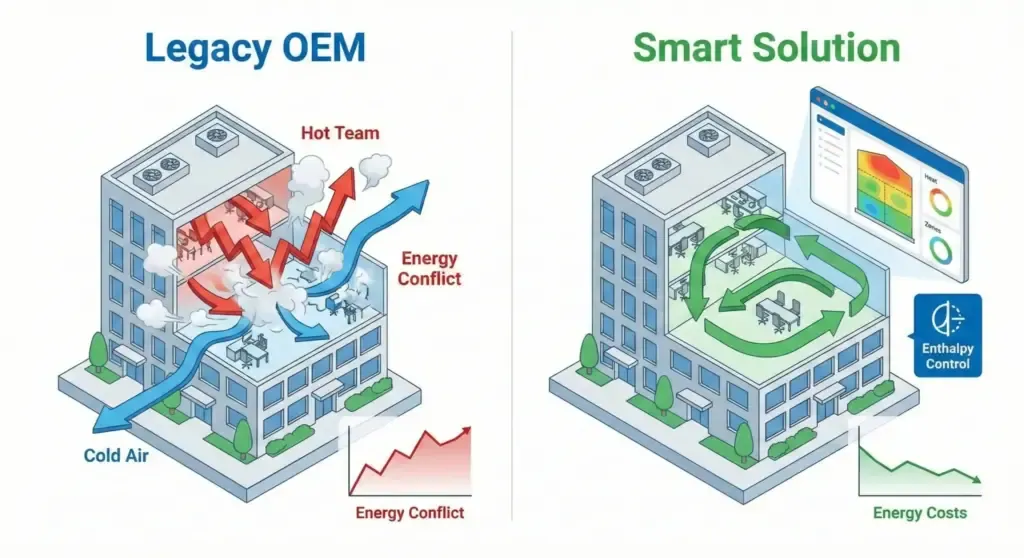
An operating view connected to the system architecture
The source case compares isolated OEM control with the coordinated SDK and MiniApp operating model.
A controlled application architecture above the existing Tuya devices
Tuya devices
Installed hardware continues to use the proven Tuya device and cloud layer.
SDK app
The application owns product structure, identity, permissions, and experience.
MiniApps
Independent strategy modules can be updated for different operating conditions.
HVAC decisions
Coordinated actions reduce conflicts and produce reviewable operating evidence.
A commercial product that could evolve beyond the OEM stage
The published case reports that the upgraded control strategy resolved energy conflicts and reduced operating costs by 25% while preserving the installed device layer.
Controllable product layer
The customer could shape workflows and permissions around its own commercial HVAC offering.
Faster strategy updates
MiniApps separated high-change operating logic from the main application release cycle.
Scalable operations
Building-level state and coordinated actions replaced isolated device control.
Savings depend on building type, equipment, climate, control policy, occupancy, baseline, and commissioning; each deployment requires its own acceptance evidence.
Tuya HVAC OEM-to-SDK migration questions
What did ZedIoT deliver for this tuya hvac oem-to-sdk migration project?
ZedIoT moved the product to a custom Tuya SDK application, used the Ray Framework for native product experiences, and decoupled frequently changing strategies into MiniApps. The final scope depended on the customer's devices, interfaces, operating workflow, and acceptance criteria.
Can this project pattern be adapted to another product or site?
Yes. The reusable pattern is the way tuya devices, sdk app, miniapps are connected. Device protocols, deployment topology, data ownership, and operating rules are validated for each new project.
What should be confirmed before starting a pilot?
A useful pilot starts with representative hardware, interface documentation, real operating conditions, expected users, failure cases, and measurable acceptance criteria. Savings depend on building type, equipment, climate, control policy, occupancy, baseline, and commissioning; each deployment requires its own acceptance evidence.
Planning a related AI + IoT project?
Share the current device or system, the operating problem, available interfaces, intended users, and the result you need to validate. ZedIoT can help define a focused prototype and production path.
- AI + IoT product architecture review
- Hardware, firmware, cloud, and application integration
- Prototype planning and production support