

For a site that already runs RS485 or RS232 equipment, the key question is usually not whether the devices can be connected. The real question is which connectivity path creates the lowest retrofit cost without creating a fragile operations burden later. A ZigBee serial converter is not the right answer for every serial device. It is most useful when device points are distributed, new cabling is expensive, data rates are moderate, and the project needs to bring existing equipment into an IoT platform quickly.
The core conclusion is this: use a ZigBee serial converter when legacy RS485/RS232 devices only need periodic data collection, remote monitoring, or low-frequency control, and the site cannot easily add Ethernet or stable Wi-Fi. If the project needs high-frequency telemetry, hard real-time control, large log streams, or local edge computing, use an Ethernet gateway, an edge box, or a controller-level redesign instead.
Decision Block
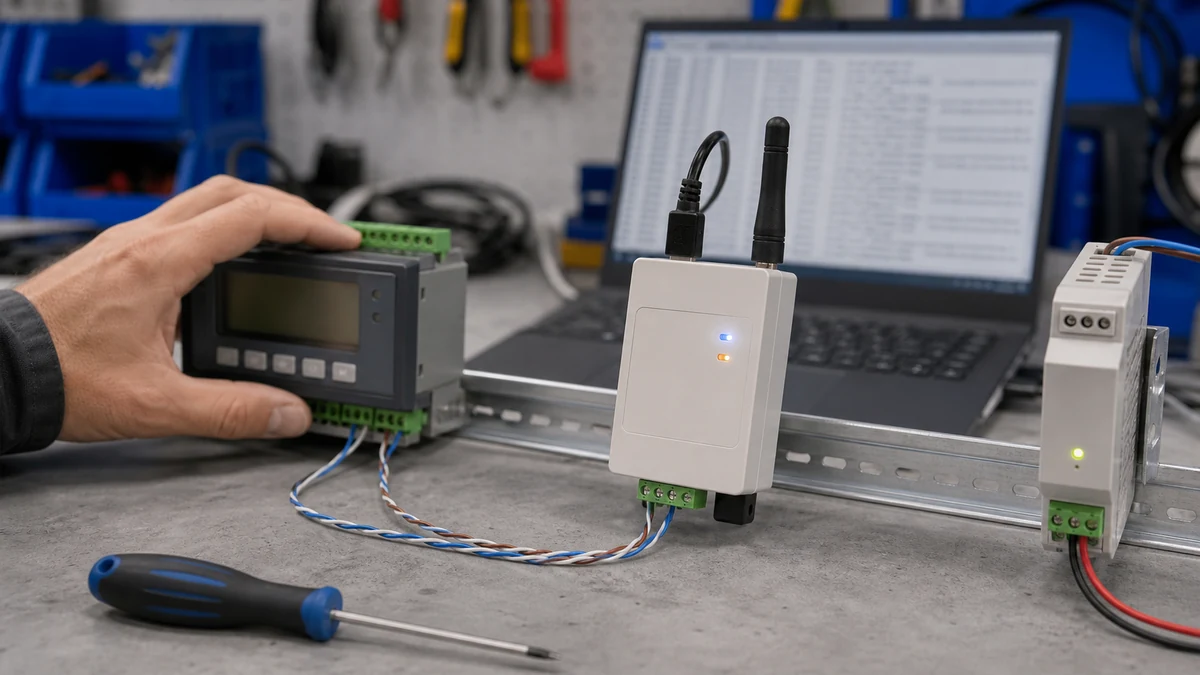
A ZigBee serial converter solves the last-hop wireless serial access problem. It should not be treated as a full edge gateway. The converter brings serial data into a ZigBee network; the gateway, protocol adapter, and platform should handle parsing, device modeling, alarms, and remote operations.
1. First decide whether the device fits wireless serial access
The value of a ZigBee serial converter appears when three conditions are true at the same time: the device already has a stable serial protocol, physical cabling is hard or costly, and the business only needs low-to-medium frequency data. Typical examples include commercial kitchen equipment, freezer controllers, energy meters, environmental sensors, and small controllers that expose status, parameters, alarms, or a few configuration commands.
If the site can easily add Ethernet, or if the device produces large streams of waveform data, logs, images, or continuous high-rate telemetry, ZigBee should not be the first option. Wireless serial access is useful because it is flexible, not because it is high-throughput.
| Site condition | Is a ZigBee serial converter a fit? | Reason |
|---|---|---|
| Existing RS485/RS232 device already runs reliably | Good fit | The device can be connected without replacement |
| Many distributed points and difficult cabling | Good fit | Installation and downtime can be reduced |
| Periodic collection, alarms, low-frequency commands | Good fit | ZigBee can carry moderate device data |
| High-frequency telemetry or large logs | Not preferred | Bandwidth and reliability goals do not match |
| Hard real-time control loops | Be careful | The control loop should stay in the local controller or gateway |
Decision sentence: if the project value comes from quickly bringing legacy serial devices into platform management, a ZigBee serial converter is worth evaluating. If the value comes from real-time control, edge inference, or high-rate processing, it should only be one layer of the connectivity design.
2. The typical architecture: the converter is not the platform
A serial converter handles physical access and wireless transport. The business value usually comes from the next layers: gateway-side protocol parsing, platform-side device models, and application-side alarms or work orders.
flowchart LR

A("RS485 / RS232<br/>Legacy Device"):::device --> B("ZigBee Serial<br/>Converter"):::converter
B --> C("ZigBee Mesh<br/>or Coordinator"):::mesh
C --> D("AIHub / IoT Gateway<br/>Protocol Adapter"):::gateway
D --> E("ZedIoT Platform<br/>Device Model + Rules"):::platform
E --> F("Operations<br/>Dashboard / Alert / Work Order"):::ops

classDef device fill:#f8fafc,stroke:#64748b,stroke-width:2px,color:#0f172a;
classDef converter fill:#ecfeff,stroke:#0891b2,stroke-width:2px,color:#0f172a;
classDef mesh fill:#f0fdf4,stroke:#16a34a,stroke-width:2px,color:#0f172a;
classDef gateway fill:#fff7ed,stroke:#f97316,stroke-width:2px,color:#0f172a;
classDef platform fill:#eef2ff,stroke:#4f46e5,stroke-width:2px,color:#0f172a;
classDef ops fill:#fefce8,stroke:#ca8a04,stroke-width:2px,color:#0f172a;
This is why selection should not stop at “serial to wireless.” The project also needs to confirm:
- whether the device protocol is known or requires custom private-protocol adaptation
- whether the gateway can receive ZigBee node data reliably
- whether the platform has device inventory, point models, alarm rules, and remote operations
- whether the site needs local buffering, offline alarms, or gateway-side logic
ZedIoT’s local product material describes the ZigBee serial converter as a product for RS485/RS232 legacy device access, used with the AIHub box and ZedIoT platform. It also mentions preset protocol coverage and support for private-protocol customization. That positioning fits a combined device-connectivity and platform-operations architecture, not an isolated module purchase.
3. Good-fit scenarios: distributed points, light data, fast retrofit
3.1 Commercial equipment and back-of-house sites
Restaurant chains, convenience stores, and commercial kitchens often have controllers, freezers, meters, and small machines spread across a physical site. Running new cables may interrupt operations, while replacing every device is rarely economical.
In this environment, a ZigBee serial converter turns an existing RS485/RS232 port into a networked node. The platform can then collect temperature, running status, fault codes, and energy data for alarms, inspections, and reporting.
3.2 Meters and energy collection
Electric meters, water meters, and environmental instruments usually produce small amounts of data, but they are distributed. If the collection interval and accuracy requirements are reasonable, ZigBee access can reduce low-voltage cabling work.
The project still needs a data-quality plan. Energy data is useful only if the system handles collection intervals, missing values, timestamps, meter addresses, and platform-side validation.
3.3 Pilot retrofit projects
Many companies do not replace all field devices at once. They start with one store, one line, or one area. A ZigBee serial converter is a practical low-intrusion pilot tool: prove that data access and platform workflows create value first, then decide whether to add a richer edge gateway or controller redesign.
4. Poor-fit scenarios: do not treat wireless serial as a universal gateway
The limits should be written into the design before deployment.
- High-frequency data streams: large curves, raw logs, images, or millisecond-level sampling should not run through a ZigBee serial path.
- Critical real-time loops: safety interlocks and fast control actions should remain in PLCs, local controllers, or edge gateways.
- Unclear protocol ownership: if field protocols are undocumented, address tables are missing, or private protocols have no owner, do protocol discovery before hardware rollout.
- Very poor wireless environments: metal shielding, strong interference, or long node distances require site testing and gateway planning.
Decision sentence: a ZigBee serial converter reduces access and installation cost. It does not automatically solve unclear protocols, weak device models, or missing platform operations.
5. Selection checklist before rollout
| Check | What to confirm | Risk if ignored |
|---|---|---|
| Serial settings | baud rate, parity, stop bits, address | wiring works but communication is unstable |
| Protocol type | Modbus or private protocol | the platform cannot parse data correctly |
| Collection interval | seconds, minutes, or event-driven | overly frequent polling weakens the link |
| Point distance | node-to-gateway range and obstruction | high offline rate after deployment |
| Power | stable local power for nodes | maintenance cost rises |
| Gateway capability | protocol adapter and buffering | data arrives but does not become business objects |
| Platform model | points, alarms, reports, permissions | connected data remains unused |
For product selection, start from the ZigBee serial converter product page. If the project also needs device inventory, alarms, remote operations, and analytics, evaluate the converter together with a ZedIoT platform or AIHub gateway instead of comparing only hardware unit price.
6. Conclusion
A ZigBee serial converter is strongest when the job is to bring existing RS485/RS232 devices into an IoT system with minimal intrusion. Its advantages are reduced cabling, fast retrofit, distributed point coverage, and moderate data collection. Its boundaries are bandwidth, real-time behavior, protocol governance, and platform operations.
If your goal is to get legacy devices online, visible, and alarm-capable, a ZigBee serial converter is a practical access layer. If your goal is high-frequency collection, edge computing, complex local automation, or hard real-time control, design it as part of a layered system with a gateway, platform, and controller strategy instead of expecting one converter to carry the whole system.
References
- Local ZedIoT product material:
05_星野自研产品/ZigBee串口转换器/爱采购产品-ZigBee串口转换器.md - ZigBee serial converter product page