
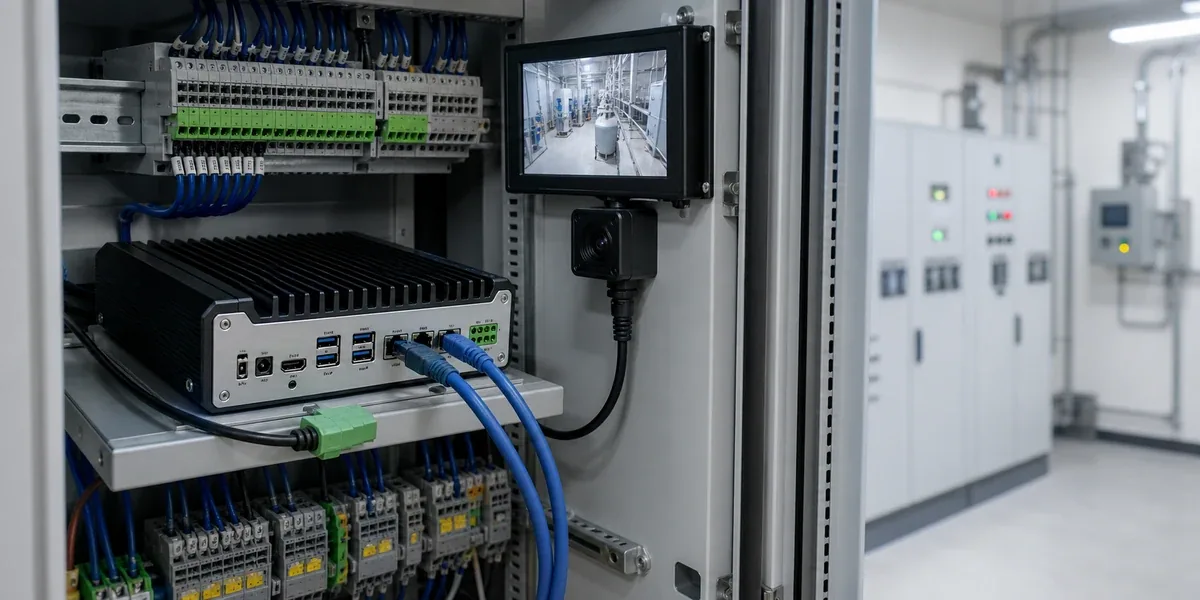
Many edge AI projects start with a hardware question: is RK3566 enough, or should the project move directly to RK3588? That question cannot be answered by chip names alone. The real decision depends on the model workload, the number of peripherals, environmental stress, 24/7 operating requirements, and whether the device will later be managed by an IoT platform.
The core conclusion is this: AIHub-Z3 is a better fit for lightweight AIoT, smart buildings, home or store security, energy management, and single-channel lightweight vision. AIHub-Z5 is a better fit for industrial vision, multi-peripheral integration, HDMI display output, complex security systems, and edge-server-style deployments. If the project only needs local state collection, lightweight recognition, rule execution, and platform upload, Z3 is often more economical. If the site needs stronger NPU capacity, wide-temperature operation, rich peripherals, and heavier on-site inference, Z5 is worth the higher cost.
Decision Block
Choose
AIHub-Z3when the algorithm is light, peripherals are limited, the environment is mild, and the project cares about power and cost. ChooseAIHub-Z5when the site has multiple cameras, scanners, displays, printers, industrial peripherals, or sustained high-load inference. The real selection object is not a benchmark score. It is whether the on-site workload can run reliably and remain maintainable.
1. Start with the workload, then compare RK3566 and RK3588
1.1 Z3 and Z5 are not simply “low end” and “high end”
AIHub-Z3 uses RK3566 and is specified with a 1TOPS NPU. It is positioned as a high-performance, low-power intelligent IoT edge device for smart homes, security, smart buildings, smart restaurants, and energy management.
AIHub-Z5 uses an RK3588-class octa-core platform and is specified with a 6.0TOPS NPU. It supports Android 12 and emphasizes industrial design, wide-temperature operation, rich peripheral interfaces, and HDMI output for industrial automation, smart security, and edge-server scenarios.
The difference is not simply “Z5 is stronger, so it is always better.” A more useful framing is this: Z3 balances cost, power, and lightweight edge workloads; Z5 strengthens compute, peripherals, environmental tolerance, and sustained high-load operation.
1.2 Break the site into six questions
Before selecting the device, answer six questions:
| Question | Lightweight answer | Complex answer |
|---|---|---|
| Algorithm load | Single-channel detection, simple classification, lightweight behavior logic | Multi-channel vision, higher frame rate, complex model, or concurrent tasks |
| Peripheral count | A few sensors, one camera, ZigBee / Wi-Fi / Ethernet access | Cameras, display, barcode scanner, card reader, printer, USB storage, and more |
| Site environment | Indoor, stable temperature, low dust and vibration | Industrial site, wide temperature, vibration, dust, long runtime |
| Display output | No local display, or simple management UI only | HDMI display, casting, or on-site screen |
| Cost constraint | Many nodes, sensitive per-site budget | High-value single site, stability and capability first |
| Operations model | Platform upload, remote status, and rule execution | On-site diagnostics, continuous operation, monitoring, and upgrades |
If most answers fall on the left, evaluate AIHub-Z3 first. If most answers fall on the right, evaluate AIHub-Z5 first.
2. When AIHub-Z3 is the better choice
2.1 Lightweight AIoT and smart building gateways
The main strengths of AIHub-Z3 are low power, controlled cost, and multiple communication options. The product material notes Bluetooth, Wi-Fi, wired networking, and ZigBee expansion, which makes it suitable for aggregating field devices, sensors, and lightweight AI tasks at the edge.
Z3 fits scenarios such as:
- smart home control
- home or small-store security
- smart restaurant device coordination
- smart building state collection
- energy management and local rules
- single-channel or low-frequency AI vision recognition
In these scenarios, the value of the edge box is usually not continuous large-model inference. It is local device access, local judgment, rule execution, and platform upload. A 1TOPS NPU can support lightweight recognition and event logic, but it should not be designed as a high-concurrency vision server.
2.2 Many deployment points with budget pressure
The Z3 price range in the product material is materially lower than Z5. If a project will be copied across stores, floors, cabinets, or equipment points, per-node hardware cost quickly becomes a system-level cost.
If each node only needs state collection, lightweight models, local rules, and platform access, the value of Z3 is covering more field points at a lower cost. If every node is upgraded to Z5 only for “future capacity,” the project may pay for hardware and operations before the workload is confirmed.
2.3 Where Z3 is not suitable
Z3 should not be used as the primary device for:
- multi-channel video inference
- high-frame-rate industrial vision inspection
- sustained high-load edge-server workloads
- field workstations with many USB, HDMI, scanner, printer, and display peripherals
- harsh industrial environments requiring 24/7 high-load operation
These limits do not mean Z3 is weak. They mean the task has moved beyond the reasonable boundary of a lightweight AIoT gateway.
3. When AIHub-Z5 is the better choice
3.1 Industrial vision and complex security
The core value of AIHub-Z5 is higher compute capacity, stronger peripheral expansion, and a design better suited to complex environments. The product material specifies an RK3588-class octa-core platform, 6.0TOPS NPU, dust resistance, vibration resistance, interference resistance, heat dissipation, and wide-temperature operation.
Z5 fits scenarios such as:
- industrial vision inspection
- multi-channel smart security analysis
- edge servers
- on-site AI inference workstations
- recognition terminals with display output
- systems with cameras, scanners, card readers, printers, and displays
In these scenarios, the project risk is usually not whether the model can run once. The risk is whether the system can keep running, handle peripherals, stay stable on site, and remain maintainable after deployment. Z5 is closer to an edge host for complex sites than a simple IoT gateway.
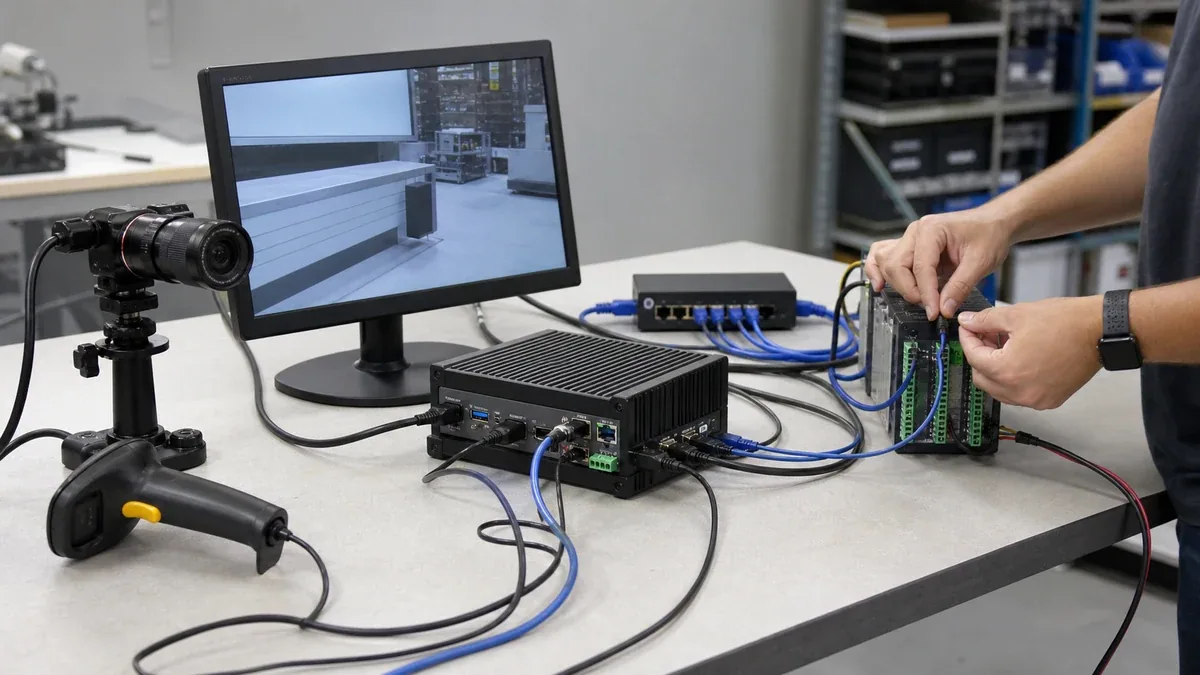
3.2 Peripheral and display output requirements matter
Many industrial and commercial systems are not just “camera plus algorithm.” Real sites may require:
- camera input
- HDMI display output
- barcode scanner or card reader
- printer
- USB import/export
- local operator interface
- connection to an upstream system or IoT platform
If these capabilities are required together, Z5's peripheral support and HDMI audio/video output are more important than the NPU TOPS number alone. Failed peripheral integration, unstable display output, or insufficient interfaces can block delivery even when the model itself runs.
3.3 Where Z5 is not suitable
Z5 should not be the default answer for every project. It is often unnecessary when:
- the site only needs sensor aggregation and simple local rules
- the project has one lightweight recognition channel and strict cost pressure
- many deployment points have low per-node workload
- the environment is mild and does not need industrial tolerance
- the customer has not confirmed the algorithm, peripherals, or data workflow
Boundary Statement
If the requirement is only “we may run a more complex algorithm later,” but there is no clear model, frame rate, peripheral list, temperature environment, or operations requirement, moving directly to Z5 may convert uncertainty into hardware cost. Confirm the workload first.
4. A practical Z3 vs Z5 selection table
| Project condition | Recommended path | Reason |
|---|---|---|
| Lightweight AIoT, building control, energy management | AIHub-Z3 | Enough compute and communication capability, easier to deploy broadly |
| Single-channel vision or lightweight behavior analysis | AIHub-Z3 first | Good fit for low-power local judgment and platform upload |
| Multi-channel vision, industrial inspection, complex security | AIHub-Z5 | Needs stronger NPU capacity and sustained workload support |
| Cameras, display, scanner, printer, or many peripherals | AIHub-Z5 | Interfaces and HDMI output become critical |
| Mild indoor environment with many nodes | AIHub-Z3 | Per-node cost and power matter more |
| Wide temperature, vibration, dust, and 24/7 operation | AIHub-Z5 | Industrial design and heat stability matter more |
| Unvalidated PoC | Start with Z3, or test one Z5 node | Do not bulk-buy high-spec hardware before confirming load |
The point is that Z3 and Z5 cover different site complexity, not that one replaces the other. When the wrong direction is chosen, the problem is usually cost, peripherals, stability, or expansion boundary mismatch.
5. A better selection flow

This flow turns model selection into workload validation. Once the model, peripherals, environment, and operations path are clear, the Z3/Z5 boundary usually becomes visible.
6. How this maps to product selection
If your project is lightweight AIoT, smart building, smart restaurant, energy management, or local device coordination, start with the AIHub-Z3 edge computing box. It is better suited as a low-power, cost-controlled intelligent field node.
If your project is industrial vision, smart security, on-site AI inference, multi-peripheral integration, or an edge-server scenario, start with the AIHub-Z5 edge computing box. It is better suited for sustained compute and peripheral integration at complex sites.
If the edge box also needs device records, remote monitoring, alarms, work orders, and long-term operations, evaluate the ZedIoT IoT platform together with the hardware. For vision or speech workloads, also review YOLO custom development and FunASR speech recognition development as part of the model deployment path.
7. Conclusion
Choosing between AIHub-Z3 and AIHub-Z5 should not be reduced to “RK3566 or RK3588.” More useful questions are:
- Is the workload lightweight recognition or multi-channel complex inference?
- Are the peripherals limited to networking and one camera, or do they include displays, scanners, printers, and card readers?
- Does the site need wide-temperature operation, interference tolerance, and 24/7 runtime?
- Will per-node cost scale across many deployment points?
- Does the system need platform-based remote operations later?
If the project focuses on lightweight AIoT, smart buildings, energy management, and single-channel recognition, AIHub-Z3 is usually the more economical starting point. If the project involves industrial vision, complex security, many peripherals, and high-load on-site inference, AIHub-Z5 better matches the edge-host requirement. The goal is not to buy the highest specification. The goal is to match compute, interfaces, environment, cost, and operations to the real site.