

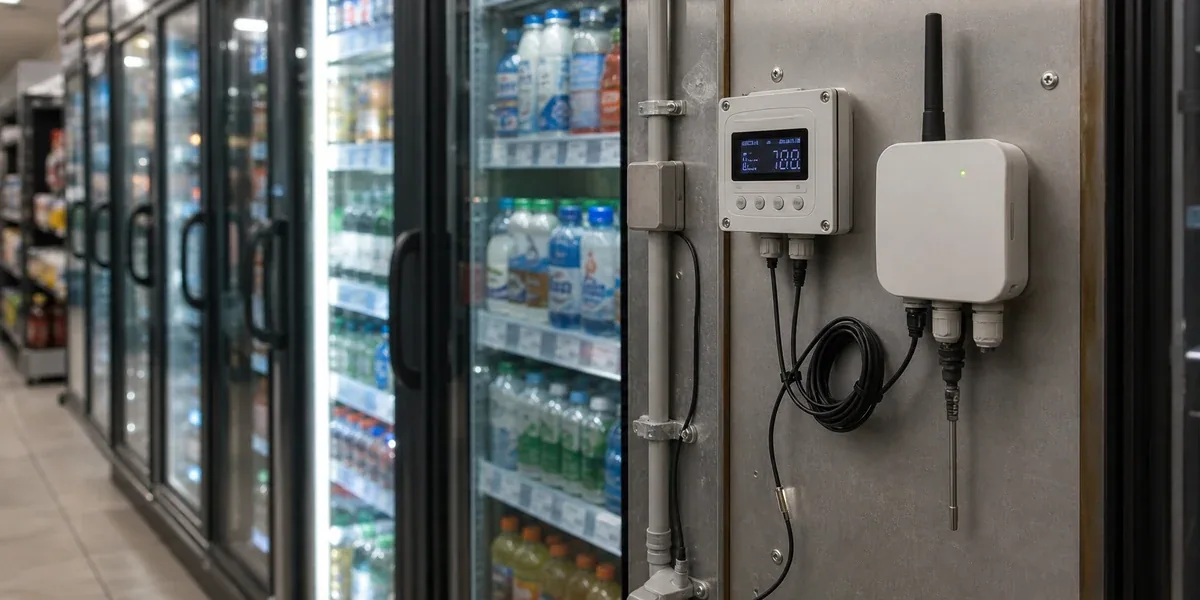
Many commercial refrigeration projects start with a simple question: should the smart temperature controller use ZigBee or Wi-Fi? That question cannot be answered by protocol names alone. The real decision depends on how many cabinets are installed, who owns the local network, whether the deployment needs grouped maintenance, whether alarms must be delivered reliably, and whether door sensors, energy metering, or platform operations will be added later.
The core conclusion is this: if a store or site has many refrigeration cabinets, dense device points, and a need for gateway-based fleet management, ZigBee smart freezer temperature controllers are usually the better fit. If the deployment has only a few independent cabinets, stable on-site Wi-Fi, and no appetite for an extra gateway, Wi-Fi smart freezer temperature controllers are often faster to launch. ZigBee is not automatically “more professional,” and Wi-Fi is not automatically “too simple.” They match different operating boundaries.
Decision Block
ZigBeefits dense, multi-cabinet deployments where a gateway can organize local devices and feed a platform.Wi-Fifits small deployments where each controller can safely depend on an existing wireless network. Once the project involves grouped inspection, remote parameter templates, alarm history, and future expansion, the decision must shift from “can the device connect?” to “can the installed base be maintained?”
1. Start with the deployment model, not the protocol
1.1 A refrigeration controller is not an isolated endpoint
In real commercial refrigeration projects, the controller usually needs to do several jobs:
- read temperature probe data
- control compressor, fan, defrost, or alarm outputs
- record high-temperature, low-temperature, probe-fault, and power-recovery events
- upload status to a platform
- support remote status checks, parameter changes, and alarm notifications
For one device, both ZigBee and Wi-Fi can provide connectivity. When the deployment grows into a row of cabinets, a store, multiple stores, or a small cold room, the difference becomes a system-level issue.
1.2 The real choice is the network operations model
Choosing ZigBee or Wi-Fi means choosing between two operating models:
| Dimension | ZigBee smart freezer controller | Wi-Fi smart freezer controller |
|---|---|---|
| Access path | Controller joins a ZigBee gateway, then the gateway connects to the platform | Controller connects directly to on-site Wi-Fi and the platform |
| Best fit | Many cabinets in one area | A few independent or distributed cabinets |
| Site dependency | Gateway placement and ZigBee coverage | Customer Wi-Fi coverage, password, isolation policy, and router stability |
| Operations focus | Gateway online status, node joining, link quality, grouped maintenance | Wi-Fi credentials, router load, IP network changes, site network support |
| Expansion | Better for door sensors, energy metering, and other low-rate nodes | Faster for single-device launch, but harder to manage at scale |
The practical takeaway is simple: if the deployment will become a fleet of devices, the ZigBee gateway model usually contains operational complexity better. If the project only has one or two units, Wi-Fi direct connection reduces the first installation step.
2. When ZigBee smart freezer controllers are the better choice
2.1 Multiple refrigeration cabinets in the same store or cold room
Beverage cabinets, fresh-food displays, convenience-store freezers, and small cold rooms are often deployed in groups. A single store may have several display cabinets, back-room freezers, low-temperature cabinets, and fresh-storage units. If every controller connects directly to Wi-Fi, the site may face several problems:
- every controller needs Wi-Fi credential maintenance
- the router carries more IoT endpoints
- password or router changes require device reconfiguration
- network isolation, weak signal, or router restarts can affect every controller
In this case, a ZigBee gateway separates low-rate device access from IP network access. Controllers join the local ZigBee network, while the gateway handles the upstream platform connection. For multi-cabinet deployments, that separation is often easier to operate than direct Wi-Fi for every unit.
2.2 Refrigeration telemetry is low-rate data, not high bandwidth
Freezer temperature controllers usually upload temperature, relay status, defrost state, door events, alarms, energy usage, and online status. These are small, low-rate data points. They do not need Wi-Fi bandwidth.
The value of ZigBee is that it:
- fits low-rate sensing and control
- organizes many nearby device nodes
- lets a gateway supervise node status
- makes future door, humidity, and energy-metering nodes easier to add
When the payload is small data, low-frequency status, and control events, ZigBee is valuable not because of bandwidth, but because it turns a group of controllers into a manageable local device network.
2.3 The customer network is not fully under your control
In retail chains, convenience stores, and franchise environments, the device vendor often does not control the site network:
- Wi-Fi passwords may change
- routers may be replaced or restarted
- guest, staff, POS, and operations networks may be isolated
- cabinets may sit near weak-signal areas
- IT teams may not want many controllers joining the main Wi-Fi
ZigBee does not eliminate all connectivity risk, but it changes the boundary. Instead of every controller depending directly on customer Wi-Fi, the gateway depends on upstream networking and the controllers depend on a local ZigBee network. That boundary is easier to diagnose.

The point of this structure is not “add a gateway for its own sake.” The point is to separate the low-rate field device network from the platform connection. In multi-cabinet deployments, that separation reduces long-term uncertainty.
3. When Wi-Fi smart freezer controllers make more sense
3.1 Only a few independent cabinets, with stable Wi-Fi already available
If the deployment has only one or two cabinets, such as a small store, a stand-alone display freezer, a single lab cabinet, or a temporary project, a Wi-Fi controller is often more direct:
- no extra gateway is required
- the controller can connect to the platform directly
- installation steps are fewer
- the first-phase cost is easier to explain
In this situation, a ZigBee gateway may add unnecessary complexity. If the customer only needs remote temperature viewing and alarm delivery for a small number of devices, Wi-Fi is a reasonable choice.
3.2 Fast launch matters more than fleet governance
Wi-Fi has a shorter launch path. If the site network is stable, coverage is strong, and credentials can be maintained, the controller can go online directly.
Wi-Fi is a better fit when:
- cabinet count is low
- the installation is near a reliable router
- the customer allows device access to a fixed Wi-Fi network
- devices are not moved often
- there is no plan to add many extra sensor nodes later
Boundary Statement
A Wi-Fi solution is not unprofessional. But it makes the site IP network a direct dependency of every controller. If the customer network changes often, the number of devices grows, or the project needs cross-store governance, the initial simplicity of Wi-Fi can become maintenance cost.
4. Five questions that are easy to miss
4.1 Who owns the site network?
If the customer IT team owns the network, the equipment vendor may not be able to guarantee stable Wi-Fi credentials, router behavior, isolation policy, or signal quality. A ZigBee gateway can at least consolidate most controller nodes behind a more controlled access path.
4.2 How many devices are deployed now, and how many later?
A single controller can be selected for connection convenience. A group of controllers should be selected for maintenance convenience. If the same architecture will be copied across stores, cabinets, or sites, the ZigBee gateway model deserves priority.
4.3 Must alarms arrive reliably?
High temperature, low temperature, power loss, probe fault, and door-open alarms cannot be evaluated only by asking whether the device is online. The team also needs to know where a failure sits: controller, gateway, Wi-Fi network, or platform connection.
After the connection model is selected, the next question is how controller data supports freezer controller remote monitoring and alerts, including alarm history, maintenance records, and remote operations.
4.4 Will the system add door sensors, energy metering, or environment data?
ZedIoT-style refrigeration deployments may include temperature control, input detection, multiple outputs, energy metering, and platform monitoring. If door sensors, energy nodes, humidity sensors, or other low-rate endpoints will be added later, a ZigBee local network is usually easier to extend.
4.5 Is remote parameter management required?
Refrigeration control is not just live temperature. Teams often need to adjust hysteresis, compressor delay, defrost cycle, alarm thresholds, and display behavior. The more devices there are, the more important remote parameter templates and grouped maintenance become. Protocol choice must serve platform operations, not just first-time connectivity.
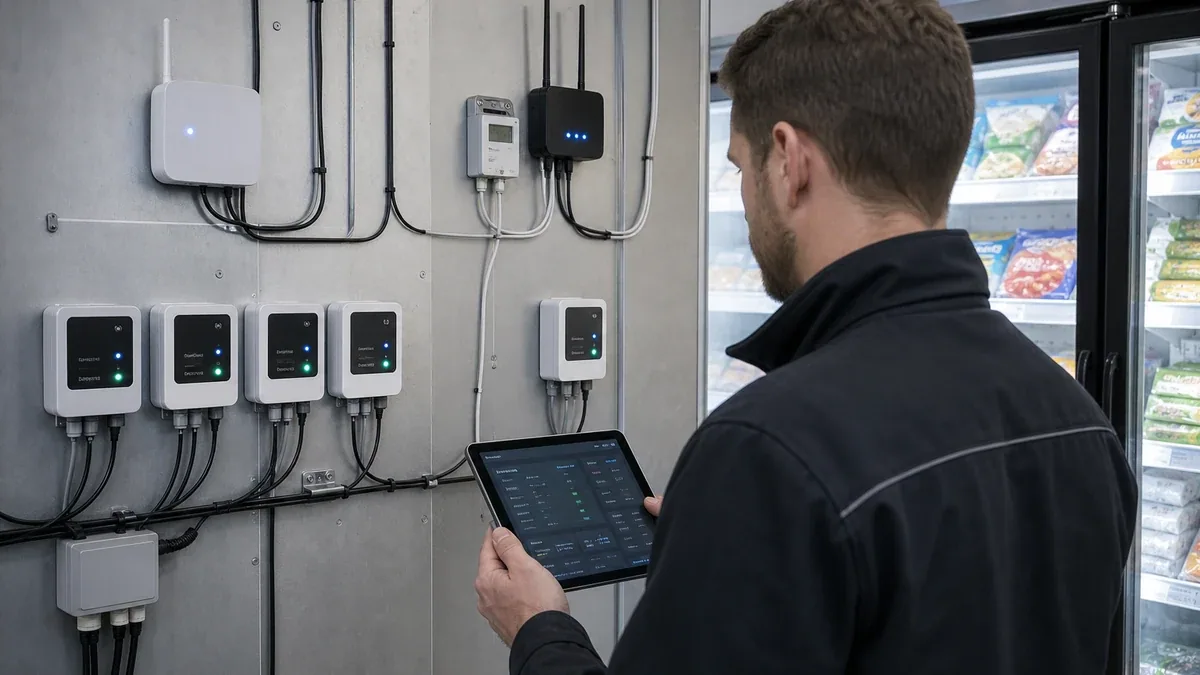
5. A practical selection table
| Project condition | Recommended path | Reason |
|---|---|---|
| One or two independent cabinets with stable Wi-Fi | Wi-Fi direct | Fast launch, no gateway needed |
| Several cabinets in one store | ZigBee + gateway | Easier node joining, monitoring, and maintenance |
| Repeat deployment across stores | ZigBee first | Reduces each controller’s dependency on customer Wi-Fi |
| Customer rejects gateways but allows Wi-Fi access | Wi-Fi | Lower installation friction, but network ownership must be clear |
| Door sensors, energy metering, or humidity nodes will be added | ZigBee | Low-rate local device expansion is more natural |
| Temporary validation or small pilot | Wi-Fi or ZigBee | The priority is validating control logic and platform workflow |
| Alarms, history, and remote parameters are required | ZigBee + platform is usually stronger | Better fit for treating devices as a manageable installed base |
This table does not mean ZigBee always beats Wi-Fi. It means that once the project moves from one cabinet to a group of cabinets, the network model affects long-term operations more than the single-device hardware price.
6. How this maps to product selection
For commercial freezers, beverage cabinets, fresh-food displays, or small cold rooms, the product path can be mapped like this:
- For multi-cabinet store deployments that should connect through a gateway, start with the ZigBee smart freezer temperature controller.
- For a small number of independent cabinets with stable Wi-Fi, start with the Wi-Fi smart freezer temperature controller.
- For remote monitoring, alarms, history, device records, and long-term operations, also evaluate the ZedIoT IoT platform.
If you are still deciding whether you need a smart controller at all, read the companion article: Smart Temperature Controller vs Basic Thermostat.
7. Conclusion
Choosing ZigBee or Wi-Fi for a commercial smart freezer temperature controller is not about picking the “better” wireless protocol. The more useful questions are:
- Is this one device, or a group of devices?
- Is site Wi-Fi stable and controllable over time?
- Will door sensors, energy metering, or other low-rate nodes be added later?
- Are alarms and remote parameter changes required?
- Who will diagnose faults after deployment?
If the project has only a few independent cabinets and stable Wi-Fi, a Wi-Fi smart freezer controller is the fastest route. If the project has many cabinets, multiple stores, or long-term remote operations, a ZigBee smart freezer controller with a gateway and platform is usually more robust. The key is not the wireless protocol itself. It is whether the refrigeration control system remains connectable, alertable, recordable, and maintainable in the real store or cold-chain environment.
For supermarket, grocery, and retail refrigeration deployments, these controller networks can become part of a refrigeration monitoring solution for supermarkets with dashboards, alerts, and multi-site visibility.