

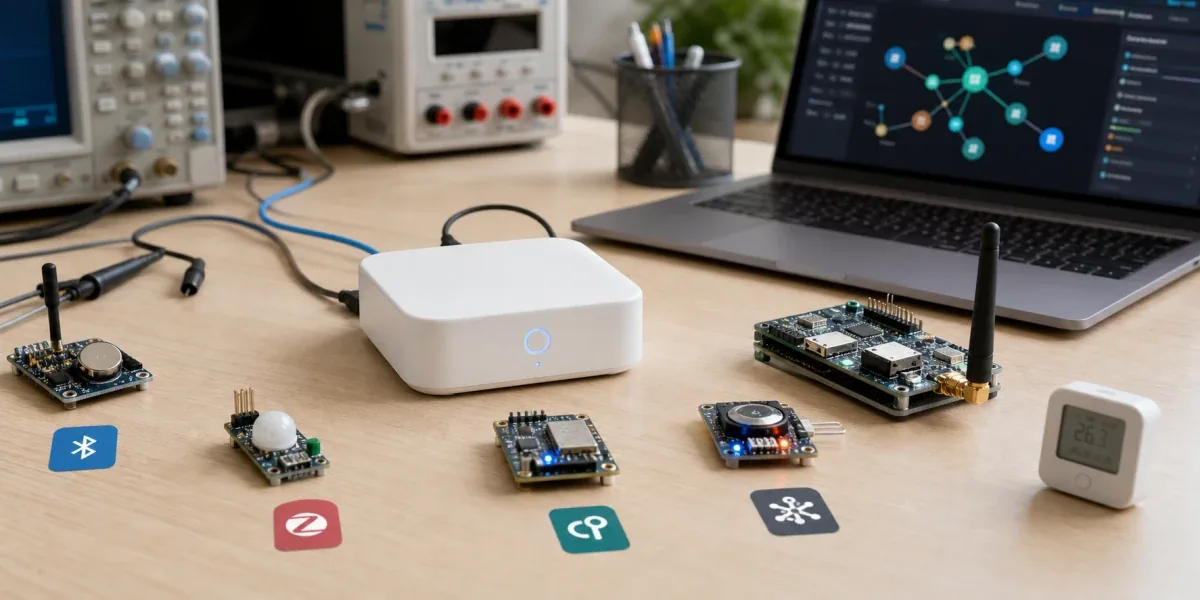
A Tuya gateway architecture should not start with the question "how many protocols can this gateway support?" The harder question is whether the gateway clearly owns sub-device lifecycle, protocol translation, DP semantics, online state, fallback behavior, and cloud synchronization. Multi-protocol radio support is only the entry point. Without a clear gateway boundary, teams later run into pairing failures, state drift, Matter bridge gaps, App inconsistencies, and platform-integration rework.
The core conclusion is: a Tuya gateway should be designed as the lifecycle and semantic boundary for sub-devices, not as a universal wireless relay. BLE is useful for nearby discovery and some low-power devices. Zigbee is useful for mature local mesh sub-devices. Thread and Matter are useful when the product needs a path into the Matter ecosystem. Tuya still needs stable DP and product models to represent device capabilities. The gateway's job is not to flatten every protocol into one channel. It is to translate joining, control, reporting, heartbeat, unbinding, and abnormal states into a model that can be maintained by the platform.
| Architecture question | Recommended judgment |
|---|---|
| You need to connect Tuya Zigbee or BLE sub-devices | Let the Tuya gateway own binding, state sync, and App-side lifecycle |
| You need to connect third-party Zigbee or Matter sub-devices | Decide whether this is configuration-file mapping or protocol development; do not assume zero-cost compatibility |
| You need to expose Zigbee sub-devices to Matter ecosystems | Use a Matter bridge approach, but design DP-to-cluster mapping and compatibility limits explicitly |
| You need enterprise platform integration | Do not evaluate only local radio support; also design tenancy, permissions, ownership, and event synchronization |
Definition Block
In this article, a
Tuya gatewayis not only a wireless gateway device. It is the system boundary that connects sub-devices, the local network, Tuya Cloud, the App, and external platforms. It must handle pairing, protocol adaptation, DP semantic mapping, online state, command delivery, and abnormal recovery.
1. A gateway is a lifecycle boundary before it is a protocol list
The most underestimated part of a multi-protocol gateway is that it must help each sub-device enter the system and remain manageable inside it.
Tuya's official documentation describes two paths for connecting sub-devices to gateways. One path uses configuration files: teams configure sub-device DPs and protocol translation rules on the Tuya Developer Platform. The other path uses protocol development: teams implement compatible sub-device integration based on Tuya's integration protocols. This distinction matters. Configuration files fit stable and rule-based mapping. Protocol development fits custom devices, third-party devices, or deeper protocol handling.
A gateway architecture needs at least five responsibilities:
- Pairing entry: open the joining window and handle retries, failure prompts, and local admission.
- Identity and ownership: bind a sub-device to the right gateway, home, project, tenant, or site.
- Protocol translation: map Zigbee clusters, BLE profiles, Matter endpoints/clusters, or private frames into platform capabilities.
- State maintenance: maintain online/offline state, heartbeat, last report time, error codes, and local cache.
- Platform synchronization: turn local reports into DP or event data, and turn platform commands into local protocol actions.
If the gateway only forwards packets, the App and cloud layer see unstable device states. If the gateway absorbs too much business logic, field variation becomes locked into gateway firmware. A healthier boundary is this: the gateway owns local protocol and lifecycle handling, while the platform owns the unified device model, permissions, and cross-site governance.

2. BLE, Zigbee, Thread, and Matter should not be compared at the same layer
A common multi-protocol mistake is treating BLE, Zigbee, Thread, and Matter as interchangeable options at the same layer. In a real architecture, they solve different problems.
| Protocol or path | What it is best used for | Architecture boundary |
|---|---|---|
| BLE | Nearby discovery, low-power devices, provisioning, and some lightweight sensors | It should not become the universal long-term mesh control plane |
| Zigbee | Mature smart-home and building sub-devices, local mesh, low-power sensors | Vendor cluster differences and gateway compatibility still matter |
| Thread | IPv6 low-power mesh, often paired with Matter over Thread | It requires a border-router path and Matter ecosystem support |
| Matter | Application-layer interoperability across ecosystems | It does not replace Tuya DP modeling or platform governance |
Tuya's Matter Connectivity documentation says that a Matter gateway can connect to Thread sub-devices and bridge Zigbee sub-devices into a Matter network. It also notes that enabling Thread connectivity and bridging Zigbee sub-devices into Matter requires a DP engine file uploaded to the Tuya Developer Platform. That is the important architectural signal: a Matter bridge is not an automatic conversion layer that makes every legacy device a full Matter device. It is a mapping layer that must be designed.
Decision Block
If the product goal is stable management inside Tuya App and Tuya Cloud, design the sub-device model and DP semantics first. If the product also needs Apple, Google, Alexa, or other Matter ecosystems, design the Matter bridge mapping separately. Do not use "supports Matter" as a substitute for sub-device lifecycle, DP modeling, and platform permission design.
3. Sub-device lifecycle should be designed as a state machine
A sub-device is not "done" after pairing. In production, it moves through discovery, joining, binding, reporting, control, offline handling, recovery, migration, and unbinding.
Tuya's sub-device documentation describes a typical activation flow: the user selects a gateway in the App and adds a sub-device, the gateway allows joining, the sub-device enters pairing broadcast, and after joining the same network it is bound through the gateway to the cloud. In engineering terms, that simple flow is a state machine.
| State | What the gateway must do | What the platform must do |
|---|---|---|
| Discovery | Open the joining window and receive broadcast or scan results | Show a clear add-device entry and device type |
| Join | Complete network joining, keys, and protocol negotiation | Record the device-to-gateway relationship |
| Activation / binding | Assign sub-device identity and cloud ownership | Write home, project, tenant, or user scope |
| Normal operation | Translate reports, deliver commands, maintain heartbeat | Store state and trigger automation or events |
| Offline / abnormal | Detect heartbeat timeout, cache state, expose errors | Show explainable state in the App and platform |
| Unbind / migration | Clean local association and prevent orphan devices | Delete, migrate, or reassign ownership |
This state machine must be designed early. The hardest bugs are often not "one command failed." They are "who owns this device, is it still online, and why does the App disagree with the platform?"
4. The DP model is the semantic contract between gateway and platform
In the Tuya ecosystem, a DP is not just a field. It is the contract through which the device, gateway, cloud, App, and external integrations understand device capabilities. For gateway projects, the earlier the DP model stabilizes, the easier it becomes to control multi-protocol variation.
For example, the same "door opened" meaning might come from a Zigbee cluster, BLE profile, or Matter endpoint. The gateway can see different protocol frames, but the platform and App should not need to understand every low-level difference. A better split is:
- keep protocol details close to the device side
- let the gateway parse only the necessary protocol and error behavior
- use stable DP and product models at the platform layer
- expose business meaning and audit data to enterprise integrations
This is why Tuya's sub-device documentation describes the gateway converting sub-device protocol data into DP data before reporting it to the cloud. If the mapping is too coarse, the App state becomes inaccurate. If the mapping is too detailed, the DP model becomes polluted by low-level protocol details.
5. A Matter bridge needs its own compatibility boundary
Matter is valuable for gateway projects because some device capabilities can enter a broader smart-home ecosystem. But it is not free interoperability.
Tuya's Matter architecture documentation notes that non-Matter devices such as Zigbee, Bluetooth mesh, and Sub-GHz devices can be connected to a Matter fabric through a Matter bridge. In real projects, that direction needs three explicit decisions:
- Which sub-device capabilities can be represented by Matter clusters?
- Which Tuya DP semantics cannot be fully mapped to Matter?
- Who resolves ownership, permission, and state conflicts after bridging?
If the goal is only to make traditional Zigbee devices visible to a Matter controller, a bridge may be enough. If the project needs enterprise permissions, fleet operations, alarms, asset management, or after-sales diagnostics, a Matter bridge still cannot replace Tuya Cloud or a business platform.
6. When a Tuya gateway should not be treated as a universal bridge
A Tuya gateway is useful for connecting many sub-device types into the Tuya ecosystem and upper-level platforms. It should not be expected to solve every interoperability problem.
It is a poor fit when:
- the project requires fully local operation, no cloud account, and no platform binding
- the team expects arbitrary third-party Zigbee, BLE, or Matter devices to join without adaptation
- the enterprise platform wants all low-level protocol details without DP or product-model abstraction
- the use case requires hard real-time control, safety interlocks, or industrial deterministic response
- the manufacturer wants full long-term ownership of Matter, Thread, Zigbee stacks and certification boundaries
This does not mean Tuya gateways are unsuitable for complex projects. It means complex projects cannot evaluate the gateway only by protocol badges. They must also evaluate ownership, DP modeling, event synchronization, permissions, offline recovery, and maintenance cost.
7. Conclusion: design the system boundary before selecting protocol entries
The right order for Tuya gateway and sub-device architecture is: define the gateway's system responsibility first, decide how BLE, Zigbee, Thread, and Matter enter the system second, and then design DP semantics, lifecycle state, and platform synchronization. If the project starts by stacking protocol support, it may become easy to connect but hard to maintain.
For enterprise IoT systems, a sustainable Tuya gateway architecture must answer four questions: how sub-devices enter the system, how capabilities are abstracted, how state stays consistent, and how abnormal conditions are traced and recovered. Only when those questions are answered does a multi-protocol gateway become an operable system boundary instead of a hardware feature list.
Related reading
- Tuya Local Control vs Cloud API vs App SDK: What Should You Choose?
- Why Tuya Projects Fail on DP Modeling, Not API Calls
- Designing Multi-Tenant Tuya Integrations for Enterprise Platforms
References
- Tuya Developer: Connect Sub-Devices to Gateways: https://developer.tuya.com/en/docs/connect-subdevices-to-gateways/connect-sub-devices-to-gateways?id=Kcvyyu8e994ip
- Tuya Developer: Connecting to Sub-devices: https://developer.tuya.com/en/docs/iot-device-dev/integrated_sdk_dev_guide?id=Kb8xhsyhnddfp
- Tuya Developer: Matter Connectivity: https://developer.tuya.com/en/docs/iot-device-dev/matter-SDK?id=Kcgwl1i58g01f
- Tuya Developer: Matter Architecture: https://developer.tuya.com/en/docs/iot-device-dev/Matter_technical_framework?id=Kd2unlxmqmwjm