

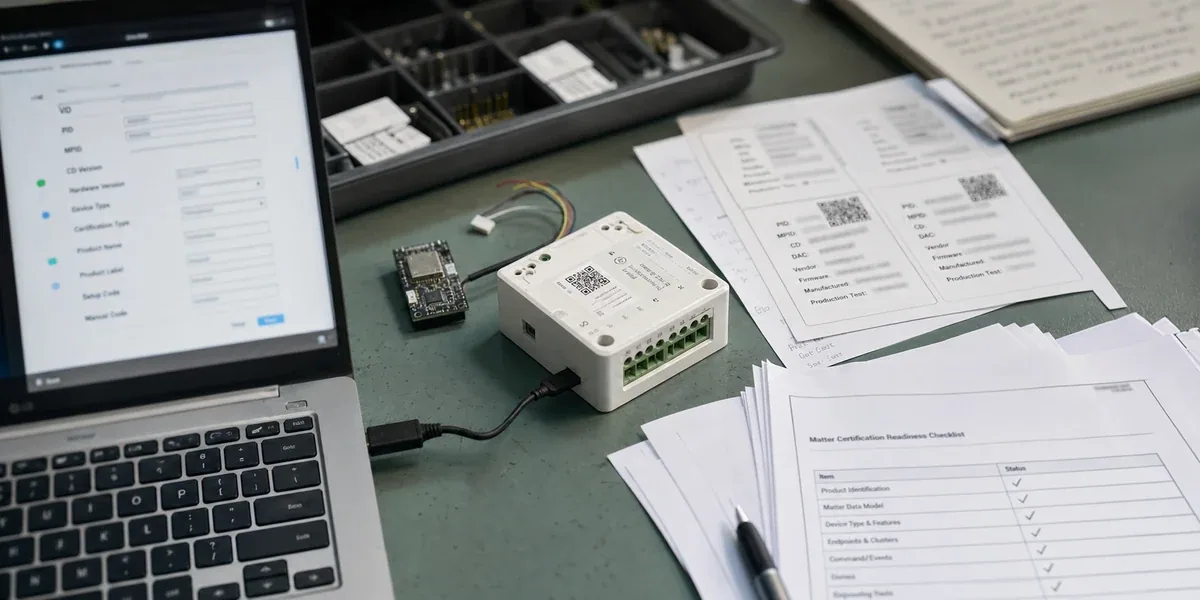
The most common Tuya Matter project failures are not caused by an SDK that cannot compile or a prototype that cannot be commissioned once. The harder failures appear later, when product configuration, certification data, production writing, setup codes, firmware versions, and the physical shipping device are not kept in sync.
If that chain is not closed before production, an engineering prototype can still look successful. The project may fail when the PID or MPID does not match certification paperwork, vendor data differs between firmware and labels, Certification Declaration data is prepared too late, or a QR code that worked in the lab is not the same as the code printed on the final product.
This article does not repeat why Matter is useful. For the product-fit question, see When Does Tuya + Matter Development Actually Make Sense?. This article focuses on the delivery question: how should Tuya Matter configuration and certification be managed as one production chain?
The Short Answer: Configuration Is Not Just A Console Form
Tuya Matter configuration is not ordinary backend metadata. It affects product identity, certification data, setup codes, factory writing, labels, firmware versions, and how third-party ecosystems recognize the device. Once this information enters production and certification workflows, changing it is no longer a simple form edit. It may require re-saving configuration, reflashing, regenerating labels, repeating tests, or updating certification material.
A practical rule is simple: if a field appears on the device, in a certificate, on a QR code, in certification paperwork, or inside a third-party ecosystem, it must be version-controlled before the prototype is frozen.
This is different from many cloud API integrations. If a cloud API field is wrong, it can often be corrected server-side. Matter product identity and setup data travel with the physical device, the packaging, the test lab, and the user's ecosystem controllers.
Seven Common Pitfalls
| Pitfall | What it looks like | Real cause | What to do before production |
|---|---|---|---|
| PID / MPID planning happens too late | Prototype, certification files, and labels describe different products | Product identity was treated as temporary development data | Freeze product identity during EVT / DVT and record the version |
| Vendor and product data changes casually | Ecosystems show unexpected product names, models, or vendor strings | Platform, firmware, and labels do not share one source of truth | Maintain one product identity sheet used by firmware, platform, and packaging |
| Certification data is prepared late | Missing or mismatched material appears right before submission | Certification was treated as a separate final step | Prepare declaration, test records, and target ecosystems before firmware freeze |
| Setup code and QR labels are not tested with final material | Lab commissioning works, printed labels fail | Only debug QR codes were tested | Run commissioning tests with final labels, enclosure, and packaging |
| Device type mapping is too broad | Third-party ecosystems expose only basic or wrong capabilities | Tuya-specific DP behavior was not mapped to Matter standard semantics | Confirm Matter device type and clusters before deciding what stays in the Tuya App |
| Firmware and configuration versions are split | Devices from the same batch behave differently | Firmware, configuration, certificates, and factory script versions are not tied together | Track firmware + configuration + production script as one release bundle |
| Factory writing lacks a failure path | Small batches pass, scaled production has random onboarding failures | Writing, verification, retry, and quarantine rules are unclear | Factory scripts must verify write results and produce traceable logs |
These failures share one trait: they may not show up on the first prototype. A successful Matter demo only proves that one device, one certificate path, one setup code, and one controller combination worked. It does not prove that the production process is repeatable.
Configuration, Certification, And Production Belong In One Flow

The diagram is about control, not bureaucracy. Tuya Matter configuration sits between product definition, firmware, labels, production tests, and certification. Any change that affects device identity or commissioning should go back through capability mapping, firmware versioning, label review, and test records.
1. Do Not Let Temporary PID Or MPID Values Survive Prototype Stage
Many teams use temporary PIDs, model names, or vendor data while they are bringing up hardware. That is acceptable during exploration, but it should stop before certification preparation and pilot production.
The risk is that PID and MPID values are not human-only notes. They are tied to product identity, certification material, production writing, and ecosystem recognition. If temporary values enter labels, QR codes, test reports, or firmware, correcting them later costs more than managing them properly at the start.
Create a Matter product identity sheet that includes product name, model, vendor data, PID / MPID, hardware version, firmware version, target device type, target ecosystems, and the related Tuya product configuration. Firmware, platform configuration, packaging, and certification material should all refer to this same sheet.
2. Confirm Matter Capability Boundaries Before Designing Tuya DPs
Tuya projects often start from DP design. Matter projects need one extra step: decide which capabilities can be expressed through Matter device types and clusters, and which capabilities must stay in the Tuya App, Smart Life, or a customer's own app.
If that boundary is unclear, the product will have two realities. The Tuya App may show the complete feature set, while Apple Home, Google Home, or another ecosystem exposes only basic features. For the user, this is not an advanced feature being hidden; it is a mismatch between product promise and ecosystem behavior.
The better order is to define target ecosystems and Matter capability scope first, then design Tuya DP behavior and app experience. For gateway-heavy products, also revisit Designing a Tuya Gateway for BLE, Zigbee, Thread, and Matter Devices to decide which capabilities belong at the bridge layer and which should stay outside Matter.
3. Test QR And Setup Codes With Final Material
A common engineering mistake is to test only the QR code displayed on a laptop or a temporary debug label. That does not cover the real shipping risk.
Users interact with printed labels, packaging, manuals, enclosure markings, or NFC onboarding information. QR size, contrast, curved surfaces, plastic film, reflections, placement, and manual layout can all affect commissioning. If final material is not included in regression testing, support issues can appear even when firmware is correct.
Use at least three rounds of testing: first with engineering setup codes to prove the protocol path, then with pilot labels to prove written data and scan behavior, and finally with the final enclosure and packaging to prove the user's real onboarding path.
4. Certification Material Should Not Wait Until Firmware Is Finished
Matter certification is not a documentation task at the end of development. Certification material constrains product identity, capability declarations, firmware versioning, test scope, and production data.
If the team finishes firmware first and prepares Certification Declaration data, test records, target device types, and ecosystem notes later, it may discover that the implementation does not match the declared behavior, labels do not match platform configuration, or a firmware version cannot explain a test result.
A safer approach is to start certification preparation before DVT. Every firmware freeze should answer three questions: which Matter configuration version does this firmware use, which test records belong to that configuration, and do those records explain the final label and setup code?
5. Factory Scripts Must Verify Data, Not Only Write It
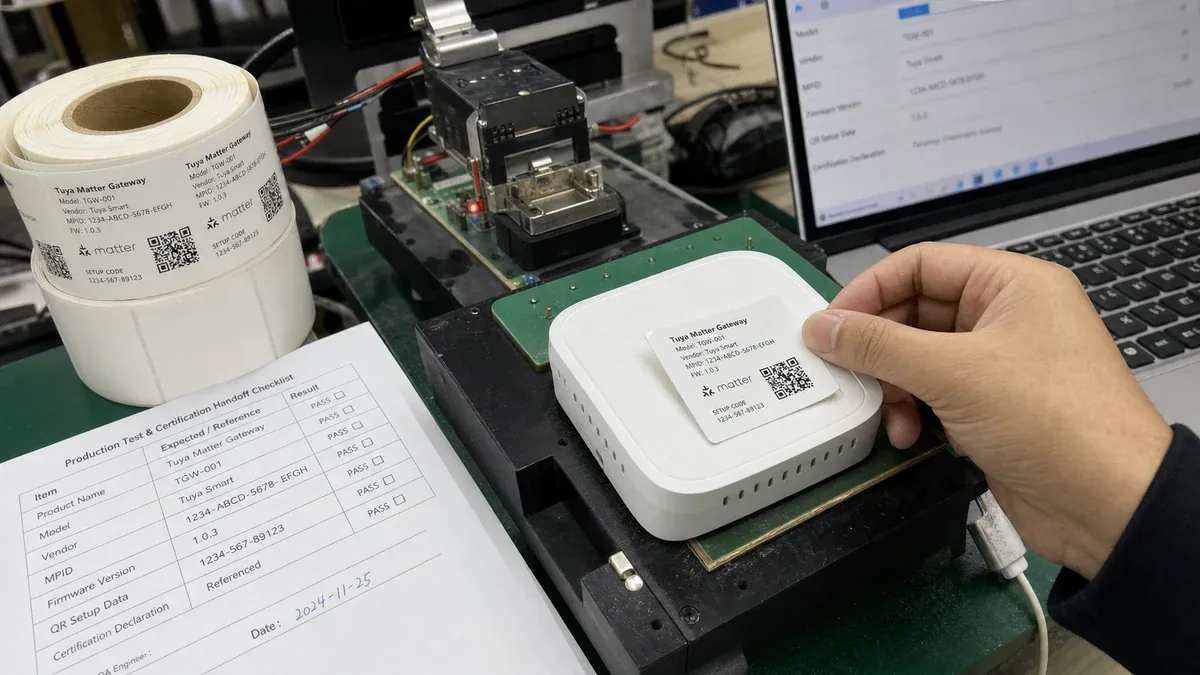
Matter-related production data should not be treated as written just because the script finished. Factory scripts should write, read back, verify, sample commissioning behavior, retry controlled failures, quarantine failed devices, and archive logs.
Without verification, small pilot runs may look fine. At hundreds or thousands of units, intermittent write failures, label mismatch, repeated setup codes, identity confusion, and certificate binding errors become support and recall risks.
Each device should leave a traceable record: serial number, label batch, write time, configuration version, firmware version, production script version, write result, verification result, and failure reason. For Matter products, those logs are the evidence needed to investigate cross-ecosystem commissioning problems.
6. When Not To Rush Into Certification
Do not certify if the device type is still changing. Device type affects ecosystem presentation, capability mapping, and test scope. Late changes are expensive.
Do not certify if core behavior still depends on many private DPs. First decide whether those capabilities are Tuya App enhancements or part of the sales promise. If they are part of the sales promise but cannot be expressed in Matter ecosystems, product positioning should be adjusted before certification.
Do not certify if production writing and label processes have not passed a pilot run. The greater the difference between the certification sample and the mass-production device, the less the certification result proves about the real delivery process.
Do not certify if the supply chain has not fixed the module, firmware branch, certificate handling, and packaging material. In a Matter project, hardware, software, platform configuration, and physical material are one delivery chain, not four independent closing tasks.
Pre-Release Checklist
Before certification and pilot production, confirm the following:
- Product name, model, vendor data, PID / MPID are frozen and match platform configuration, firmware, and labels.
- Matter device type and clusters are confirmed; capabilities that cannot be expressed in Matter are assigned to the Tuya App or a custom app.
- Certification Declaration data, certificates, test records, firmware versions, and configuration versions are traceable.
- Setup code, QR code, NFC, or manual onboarding path has been tested with final material.
- Factory scripts include write verification, retry handling, quarantine rules, and log archival.
- Pilot production has validated the real user onboarding path, not only a lab commissioning path.
- Every late change has an impact review: reflashing, relabeling, retesting, or certification material updates.
The purpose of this checklist is not process for its own sake. It reduces late rework. A Tuya Matter project should discover identity and configuration problems before certification, packaging, and production have already started.
Conclusion: Manage Matter Delivery As An Identity Chain
A Tuya Matter project succeeds or fails on more than SDK quality, module choice, or one successful commissioning demo. The real delivery risk is whether product identity, capability mapping, certification material, setup codes, firmware versions, and production writing are managed as one chain.
If configuration is treated as a console form, certification as the final step, and factory writing as someone else's problem, failures will surface late and cost more. A stronger approach is to manage Tuya Matter configuration, certification, and production testing as one system from the beginning. Every piece of information that appears on the device, label, certificate, or third-party ecosystem must have a version, source, verification path, and change-control decision.