
The hard part of a Tuya AI hardware project is not deciding whether AI sounds attractive. The hard part is separating three different decisions: whether the product is built around AI interaction, whether the team needs a fast validation platform for voice and display hardware, and whether the final product still mainly depends on reliable TuyaOS connectivity, DP modeling, app control, and mass-production stability.
If AI interaction is the main product value, evaluate Wukong AI first. If the current goal is to validate voice, screen, camera, speaker, firmware flashing, and device-control paths, T5AI-Core or T5AI-Board is the better engineering step. If AI is only an auxiliary feature and the device still needs deterministic connectivity and control, standard TuyaOS is usually the lower-risk production path. These paths are not ranked from basic to advanced. They answer different project questions.
1. Put the three paths back into the right questions
Tuya's Wukong AI 3.0 documentation positions it as a hardware development framework for AI hardware, with emphasis on chip-module adaptation, software development ecosystem, and support from hardware selection through mass production. The T5AI-Board and T5-AI Gateway documentation describe development boards that expose microphones, speakers, display options, camera interfaces, GPIO, serial debugging, USB, Wi-Fi, Bluetooth, and Zigbee-oriented validation paths. The TuyaOpen SDK Quick Start connects AI products, agents, device control, custom firmware, and DP implementation into one development workflow.
That means the selection question should not be "which one is stronger?" A better set of questions is:
- Is the product an AI-first device, or a normal IoT device with some AI assistance?
- Is the next risk hardware validation, firmware path, cloud authorization, or mass-production support?
- Does the product need camera, display, voice input and output, local inference, or multimodal interaction?
- Can the control behavior be represented cleanly through Tuya DPs and standard commands?
- Is the main failure risk AI experience, hardware manufacturing, or normal IoT reliability?
If a team cannot answer these questions, choosing the newest AI route moves too much cost into hardware, model behavior, user interaction, and supply chain too early. Staying on standard TuyaOS without checking the AI interaction path can also make a genuinely AI-first product feel constrained by a traditional control model.
2. Wukong AI fits hardware where AI is the product
Wukong AI is a better fit when the device value comes from voice interaction, multimodal behavior, local AI, or AI personality. Examples include AI toys, AI speakers, smart displays, AI IPC devices, and interaction devices where users buy the product for continuous recognition, response, and content behavior instead of simple remote control.
Under that condition, Wukong AI is not just another SDK choice. Its value is that chip adaptation, development framework, reference projects, IDE workflow, supply-chain support, and commercialization support are part of the same path. For a product team, it reduces the organizational cost of moving from an AI demo to a hardware product.
The cost is also higher. When AI becomes the main feature, the team must own experience consistency, model limits, audio pipeline behavior, screen interaction, power, thermal design, privacy, and field diagnostics. If the product is only a reliable connected controller, forcing it into an AI hardware framework can turn a simple IoT project into a combined hardware, AI, content, and support project.
3. T5AI-Core and T5AI-Board fit validation before commitment
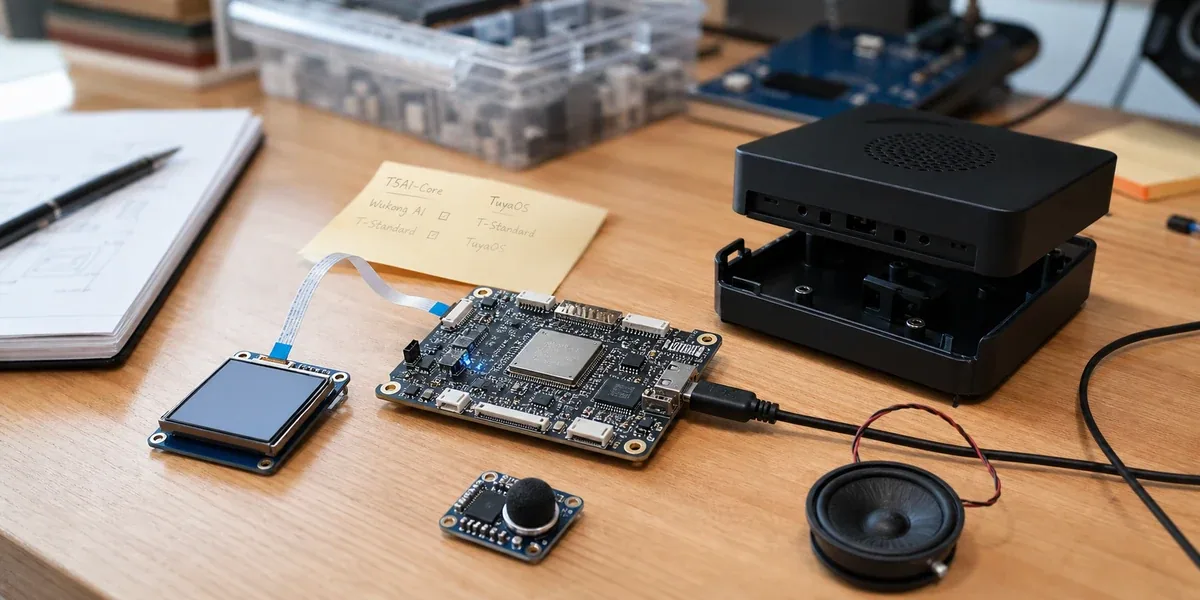
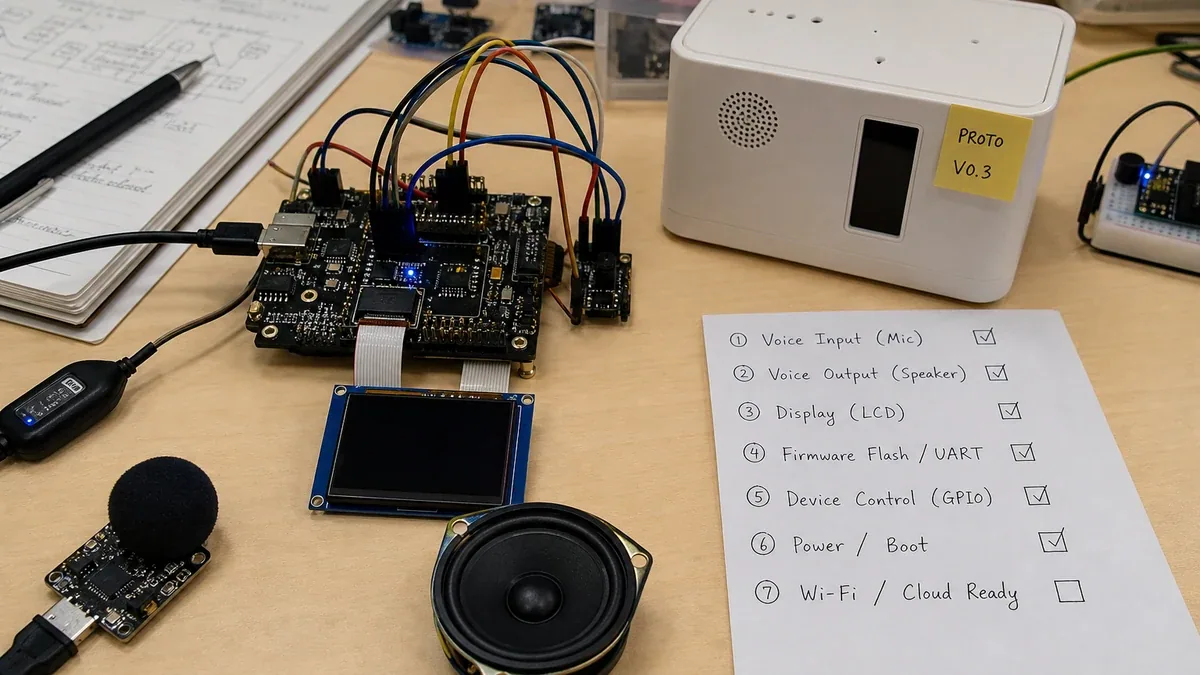
T5AI-Core and T5AI-Board are more useful as a fast validation layer. The official T5AI-Board documentation lists microphones, speaker output, display support, camera interfaces, USB, GPIO, UART, I2C, SPI, and I2S. Those are exactly the parts of an AI hardware idea that need early validation before a team commits to a custom board.
If the team is not yet sure that users need voice interaction, display feedback, self-control commands, or an AI agent entry point, validating on a T5AI board is safer than jumping directly into custom hardware. It helps answer concrete questions early:
| Validation target | Why it should be tested early |
|---|---|
| Microphone and speaker | Voice products usually fail first on pickup, echo, noise, or response latency |
| Small display and camera | Multimodal interaction affects UI, bandwidth, power, enclosure, and test plans |
| DP and device control | AI commands must land on verifiable product functions, not just prompts |
| Firmware flashing and logs | Production devices need debugging, authorization, rollback, and failure analysis |
| Network and cloud readiness | Cloud-dependent AI devices need weak-network and offline behavior defined early |
The boundary is clear: a development board is not a production architecture. A board can validate voice and display interaction, but it does not settle acoustic structure, enclosure material, thermal design, EMC, production testing, or support tools. It reduces uncertainty. It does not replace product engineering.
4. Standard TuyaOS is still better when AI is not the main function
Many devices do not need an AI hardware route. Lights, plugs, sensors, thermostats, sub-devices, simple controllers, and reliability-first commercial devices still depend on connectivity, control, state synchronization, DP modeling, app experience, OTA, and production stability.
If AI is used for scenario recommendations, configuration help, customer support, app-side Q&A, or cloud automation, standard TuyaOS plus platform-side AI is usually more appropriate than custom AI hardware. The device stays simpler, power and production risk stay lower, and the AI complexity can live in the app, cloud, MiniApp, or enterprise console.
Standard TuyaOS does not mean "no AI." It means the device keeps deterministic control while AI is placed outside the constrained hardware. For high-volume devices, that boundary matters. Adding a more complex SoC, display, audio path, and test process to every unit for a small number of AI scenarios increases BOM, factory testing, and field-diagnostic cost.
5. A practical decision path

The point of the diagram is not to isolate the paths. It is to identify the main risk. If the risk is the AI experience, Wukong AI deserves early evaluation. If the risk is whether the hardware interaction path works at all, T5AI-Board is the more practical first step. If the risk is stable production and device management, standard TuyaOS remains the lower-risk path.
6. When not to jump into an AI hardware route
Do not move directly into Wukong AI or a complex T5AI hardware path just because the roadmap contains the word AI when:
- The device is mainly a traditional controller and users will not talk to it often.
- AI can be handled in the app, cloud, or operations console instead of on every device.
- The product is highly constrained by cost, power, size, or reliability.
- The team has not settled DP modeling, pairing, OTA, logging, and support diagnostics.
- There is no clear voice, screen, camera, or local-inference scenario.
These products are better served by standard TuyaOS first. Once the control loop is stable, AI can be added at the application or platform layer. Otherwise the team adds uncertainty across hardware, firmware, models, user interaction, and supply chain at the same time.
7. Recommended rollout sequence
For a real Tuya AI hardware project, avoid locking the chip, enclosure, and production path too early. A safer sequence is:
- Decide whether AI interaction is the primary product function.
- Use T5AI-Board or a similar board to validate microphone, speaker, display, DP control, and firmware flow.
- If AI is the core experience, evaluate whether Wukong AI covers the needed chip, framework, tooling, and production support.
- If AI is only assistance, keep the device on standard TuyaOS and move agents, knowledge, and automation into the app, MiniApp, cloud, or enterprise console.
- Before custom hardware, complete plans for production authorization, logging, OTA, rollback, weak-network behavior, and field diagnostics.
The practical rule is simple: Wukong AI is for AI-first hardware, T5AI-Core and T5AI-Board reduce prototype risk, and standard TuyaOS protects deterministic control and production stability. If a project cannot yet explain whether AI is the main feature, an auxiliary feature, or a demo feature, it should not start from the most complex hardware path.
Sources
- Wukong AI 3.0 Hardware Development Framework
- Tuya Embedded Technology
- T5AI-Board Development Board
- T5-AI Gateway
- TuyaOpen SDK Quick Start