

Industry & Background
Industry: Transportation Safety / Fleet Solutions
This case documents our experience in ESP32 vehicle safety device development for a US-based startup exploring a compact emergency alert device for vehicles and fleet use.
The product concept involved a physical panic button connected to a microcontroller, designed to trigger alerts through wireless connectivity. The device needed to operate reliably in a vehicle environment, powered by a vehicle electrical system, and enclosed in a durable housing suitable for real-world deployment.
Why the Client Contacted Us
The client contacted us at an early ideation stage, before committing to hardware prototyping. Their key concerns were:
- Whether ESP32 was suitable for a vehicle-powered safety device
- How to design a reliable alert-triggering architecture
- What firmware structure would support future feature expansion
- Estimated development cost and realistic timelines
They were specifically looking for custom ESP32 firmware development support combined with hardware feasibility guidance, rather than a software-only consultation.
ESP32 Prototype Development Scope
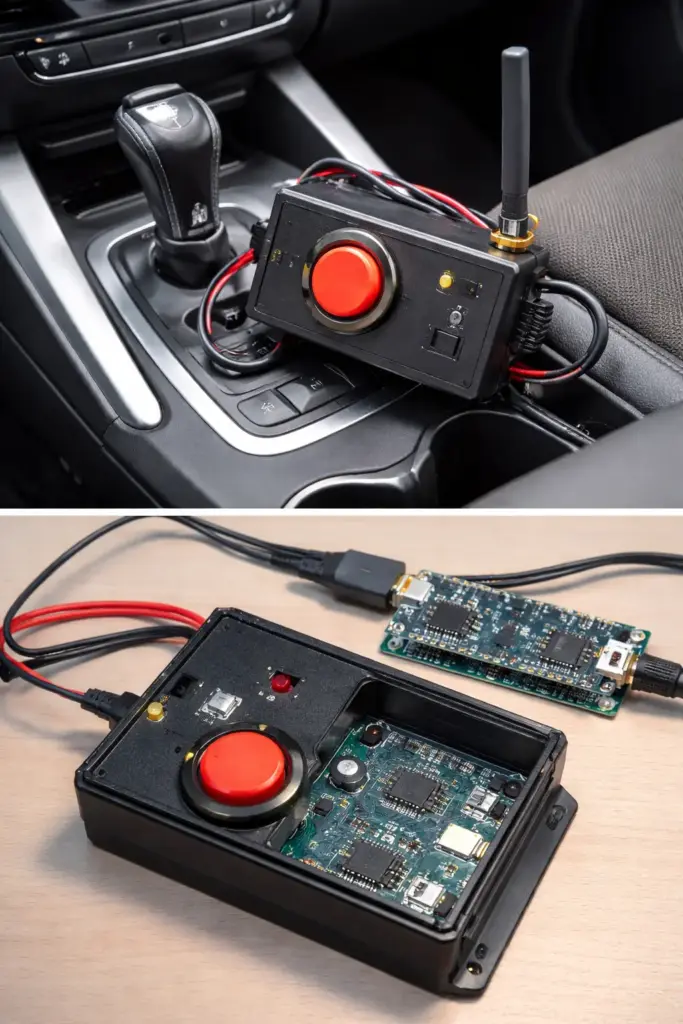
To support the client’s goals, we provided early-stage ESP32 prototype development planning and technical evaluation, including:
- ESP32 platform feasibility assessment for vehicle safety use cases
- Connectivity strategy discussion (WiFi vs external cellular modules)
- Firmware architecture planning for alert triggering and status reporting
- Power input considerations for vehicle electrical systems
- Guidance on next-step hardware prototyping
This phase focused on risk reduction and technical clarity before hardware investment.
Technical Considerations for Vehicle Safety Devices
Vehicle-deployed ESP32 devices introduce unique challenges compared to standard IoT products:
- Power stability: Vehicle voltage fluctuations require careful power design
- Reliability: Emergency devices must respond instantly and consistently
- Connectivity: Alert delivery must be robust even in variable network conditions
- Expandability: Future firmware updates and OTA planning
Our experience with ESP32 vehicle safety device development allowed us to guide the client through these constraints realistically.
These considerations are common in vehicle-deployed systems and are part of our custom ESP32 firmware development experience, encompassing both safety and industrial devices.
Project Status & Outcome
The engagement resulted in a validated technical approach and development roadmap, enabling the client to proceed with hardware prototyping and investor discussions with greater confidence.
Related ESP32 Development Capabilities
This case reflects our broader experience in ESP32 vehicle safety device development, alert systems, and embedded firmware architecture for mission-critical applications.
Planning an ESP32-Based Safety Device?
If you are planning an ESP32-based vehicle safety or alert device and need support with hardware architecture, firmware design, or prototype planning, our team can help you evaluate the right technical approach.