
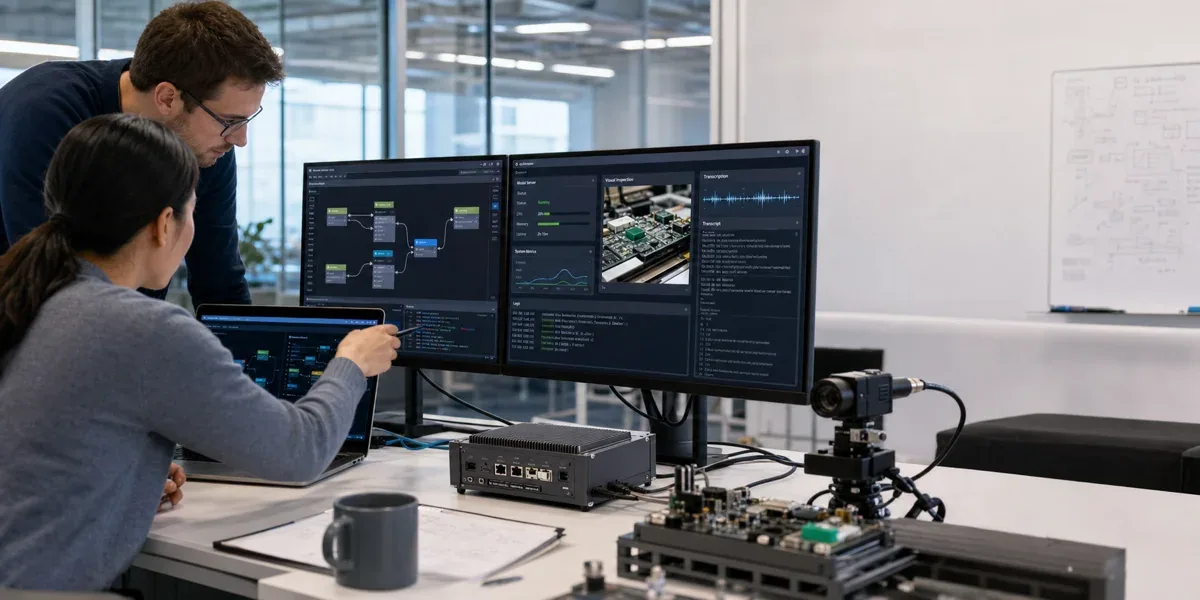
An enterprise AI development toolchain should not start with "which tool is popular." It should start by separating the business task chain: which layer provides model capability, which layer orchestrates workflows, which layer runs private or local inference, which layer handles vision input, which layer handles speech input, and which layer integrates with business systems. OpenAI, Dify, Ollama, YOLO, and FunASR can appear in the same project, but they solve different problems. Comparing them as if they were the same kind of tool leads to weak architecture decisions. Combining them by system role leads to maintainable enterprise AI applications.
| Project goal | Tools to consider first | Best fit | Main boundary |
|---|---|---|---|
| Strong model capability | OpenAI | Multimodal reasoning, tool calling, structured output, content generation | Data compliance, API cost, external dependency |
| Fast AI application workflow | Dify | RAG, Workflow, Agent prototypes, configurable operations | Deep customization, complex state, strong transactions |
| Local or private model runtime | Ollama | Intranet inference, offline demos, sensitive data, edge nodes | Model quality, hardware, concurrency, operations |
| Vision detection and recognition | YOLO | Object detection, visual inspection, device recognition, edge vision | Dataset quality, false positives, deployment hardware |
| Speech recognition and transcription | FunASR | ASR, meeting transcription, voice input, offline speech workflows | Noise, accents, punctuation, domain vocabulary |
The core conclusion is: choose an enterprise AI stack by the path from input recognition to model inference, workflow orchestration, tool calls, and business-system writes. If the project is only a support knowledge base, Dify plus a hosted model may be enough. If it involves device visual inspection, YOLO is part of the input layer. If the project must run inside a private network, Ollama or a private model service belongs in the architecture from the beginning. If voice is the interface, FunASR accuracy and noise handling can determine whether the upper-level Agent is reliable.
1. Split the task chain before comparing tools
A common enterprise AI mistake is to put OpenAI, Dify, Ollama, YOLO, and FunASR into one table and ask which one is better. That comparison is structurally wrong. OpenAI is a model-capability entry point. Dify is an application workflow and RAG platform. Ollama is a local model runtime path. YOLO is a family of vision detection models. FunASR is a speech-recognition capability. They do not live in the same layer.
A more useful architecture separates the layers:
- Input layer: user text, images, video frames, audio, sensor data, and business forms.
- Recognition layer: YOLO for visual detection, FunASR for speech recognition, and language models for text understanding.
- Model layer: hosted models such as OpenAI, or local and private models through Ollama or managed model services.
- Orchestration layer: Dify for configurable Workflow, RAG, and common Agent flows; LangGraph or custom services for more complex state machines.
- Tool and system layer: CRM, ERP, ticketing, IoT platforms, databases, permission systems, and audit logs.

This structure avoids two weak extremes. One extreme is connecting only to a model API and putting all business logic into prompts. The other is adding every popular AI tool without assigning clear ownership for permission, state, rollback, and system integration.
2. OpenAI belongs in the strong model layer
OpenAI is a strong fit for the model-capability layer: complex text understanding, long-context reasoning, multimodal analysis, tool calling, structured outputs, and high-quality content generation. If the project needs to quickly test whether AI can understand business material, produce useful answers, or call external tools, OpenAI is often the fastest validation path.
But OpenAI is not the whole application architecture. In enterprise systems, the model answer is only one step. User identity, data permission, knowledge updates, approval flow, operation audit, retry behavior, and cost control cannot be solved by the model alone.
Decision Block
If the main project risk is whether model capability is strong enough, use OpenAI to validate the upper bound. If the main risk is whether the process can write, approve, roll back, and audit reliably, OpenAI should remain the model layer while business state stays in a controlled backend or orchestration layer.
3. Dify is useful for fast AI application workflows
Dify's value is not replacing every backend service. Its value is making common AI application flows configurable. RAG, Workflow, prompt management, knowledge bases, Agent tool calls, and operations-side tuning can move faster in Dify than in a fully custom first version.
Dify fits projects with three traits:
- The business flow is reasonably clear, but prompts, knowledge bases, and node order will change often.
- The team wants business or operations users to adjust the flow without every change becoming a code release.
- The target is customer support, internal knowledge assistants, automatic summaries, form processing, or lightweight approval assistance.
Dify should not own the core state of a strong transaction system. If the flow touches complex permissions, money, device control, production scheduling, or irreversible operations, Dify should be an AI assistance layer. The final write and permission decision should be owned by the business system.
4. Ollama fits local AI, private deployment, and edge validation
Ollama is useful when models need to run locally or inside a private network. Typical scenarios include customer data that cannot leave the environment, demos where cloud access is unreliable, edge nodes that need offline inference, and development teams comparing open-source models quickly.
Its strengths are simple deployment, fast model switching, and local feasibility testing. In production, however, Ollama is an entry point for private model operation, not a full enterprise model platform. It does not automatically provide high concurrency, permission isolation, monitoring, rollout control, caching, or audit trails.
If the project needs production reliability, evaluate four things early: hardware cost, model quality, response latency, and operational responsibility. Local small models can reduce data exposure, but they may also bring weaker reasoning and more self-managed infrastructure.
5. YOLO and FunASR are input-layer capabilities
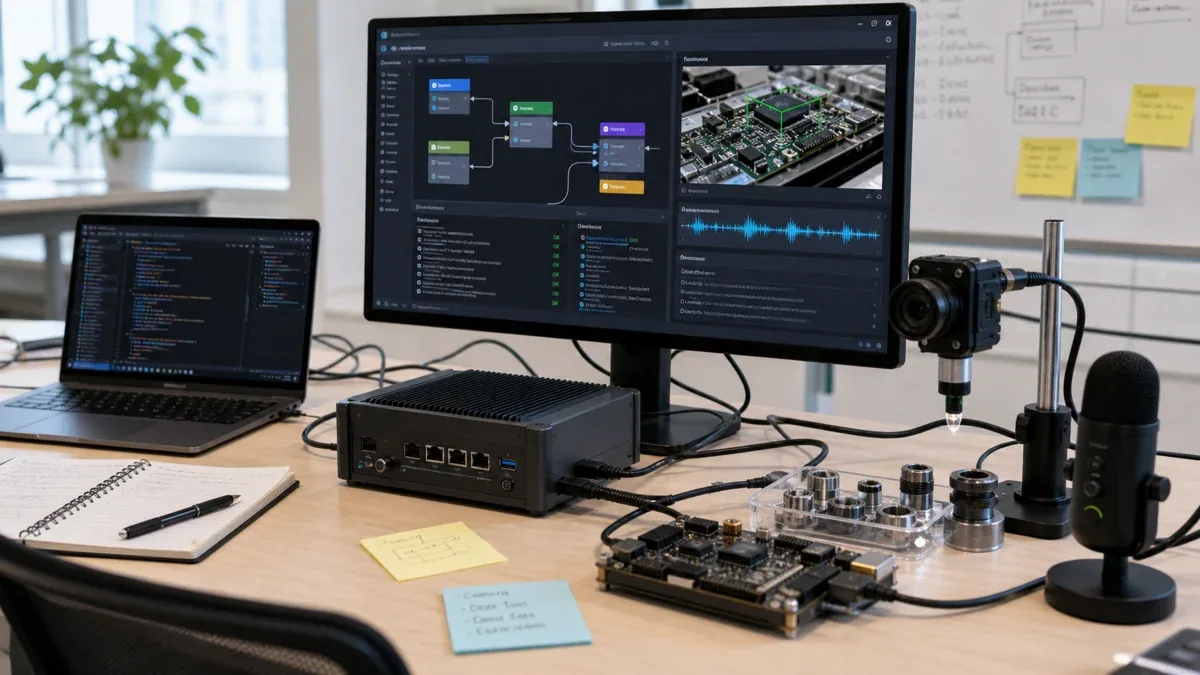
Many AI projects fail not because the language model is weak, but because input quality is poor. If the camera recognition is wrong, downstream tickets, alerts, and analysis become wrong. If speech recognition mishears device names or customer intent, a smarter Agent only automates the wrong action faster.
YOLO fits object detection, visual inspection, device recognition, people and vehicle detection, and edge vision inference. The real work is not only choosing a model. It includes dataset quality, labels, camera angle, lighting, false-positive cost, false-negative cost, and edge hardware deployment.
FunASR fits speech recognition, offline transcription, meeting records, device voice input, and Chinese speech scenarios. The important question is not only whether audio becomes text. It is whether the system handles noise, accents, hotwords, domain vocabulary, punctuation, speaker separation, and post-processing.
For vision and speech projects, input-layer accuracy sets the ceiling of the whole AI system. If YOLO or FunASR output is unstable, do not hand the result directly to an Agent for automatic execution. Add confidence thresholds, human confirmation, retries, and audit records first.
6. Three common combinations
6.1 Fast AI application validation
Best for knowledge-base Q&A, internal assistants, support FAQ, sales-material generation, and lightweight data processing.
Recommended combination: Dify + OpenAI + business APIs.
The goal is fast value validation. Dify manages workflow and knowledge configuration, OpenAI provides model capability, and business APIs provide real data and write paths. The boundary is clear: do not make Dify the only authority for permission and transactions.
6.2 Private AI assistant
Best for intranet knowledge bases, sensitive documents, offline demos, and edge-site decision assistance.
Recommended combination: Ollama or a private model service + RAG framework + custom permission layer.
The goal is data boundary and control. Model capability may be weaker than hosted frontier models, and hardware plus operations costs may be higher. This combination is best when data sensitivity, network limits, or control requirements matter more than maximum model quality.
6.3 Multimodal field system
Best for industrial inspection, store audits, warehouse recognition, device voice control, and field ticket generation.
Recommended combination: YOLO / FunASR + OpenAI or local models + custom business backend.
The goal is connecting real-world signals to business systems. YOLO and FunASR turn field input into structured signals. The model interprets or generates the next step. The backend owns permissions, tickets, audit, and rollback.
7. When not to use the whole stack
Not every enterprise AI project needs OpenAI, Dify, Ollama, YOLO, and FunASR together.
- If the input is text only, YOLO and FunASR are unnecessary.
- If private deployment is not required, do not add local model operations at the start.
- If the flow is only a simple question-answer task, complex Agent orchestration may be unnecessary.
- If business actions are irreversible, do not let a model or low-code workflow write directly to the core system.
- If data quality is weak, document preparation, permission modeling, and data governance matter more than changing models.
The more tools the stack has, the more important system boundaries become. The long-term cost of enterprise AI is often not the model call itself. It is data updates, permission checks, exception handling, audit logs, cost monitoring, and integration with existing systems.
8. A practical selection order
A safer selection order looks like this:
- Define the business goal: Q&A, retrieval, automation, visual detection, voice input, or a multimodal field system.
- Define the data boundary: internet access, private deployment, customer privacy, and production-data rules.
- Define the input shape: text, documents, images, video, audio, or device events.
- Define workflow complexity: simple Q&A, configurable Workflow, stateful Agent, or strong business transaction.
- Choose tools last: OpenAI, Dify, Ollama, YOLO, FunASR, or custom components.
The final rule is simple: use OpenAI for strong model capability, Dify for faster AI application delivery, Ollama for local and private model validation, YOLO for vision input, and FunASR for speech input; keep permission, state, audit, and critical business writes in controlled systems. That is the difference between an enterprise AI toolchain and a demo.