

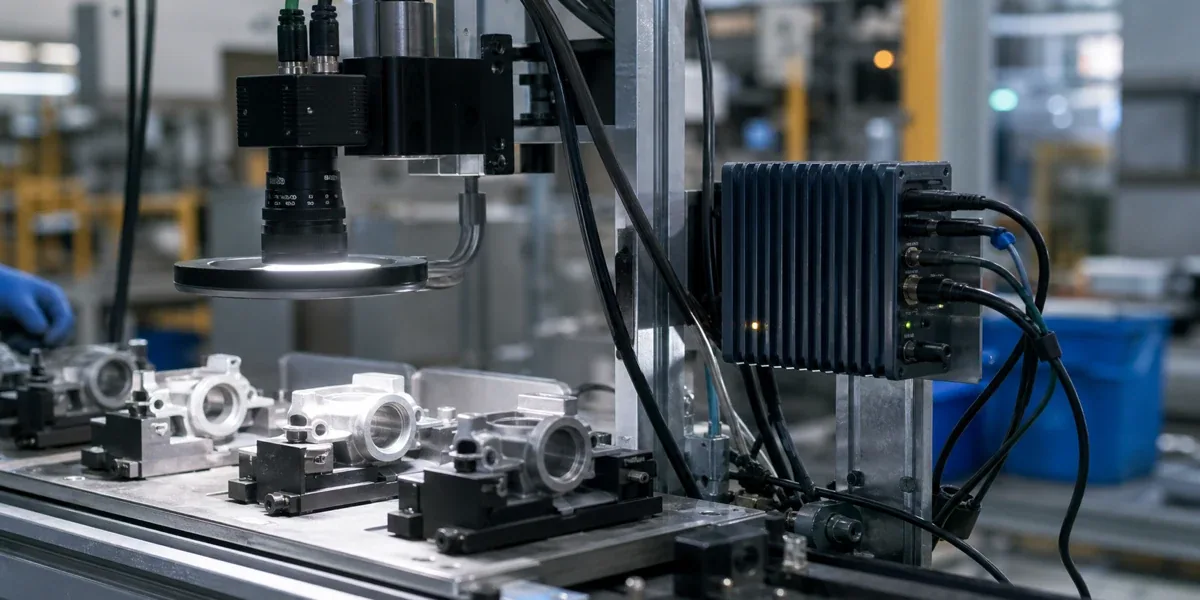
YOLO is a strong fit for a specific class of vision problem: determine whether a visible object is present, identify its class, and locate it in an image quickly enough for a downstream decision. It can be the main detector for missing-part checks, package and pallet counting, material recognition, vehicle or personnel detection, and region-entry events when object appearance is reasonably stable and the cost of false positives and false negatives can be stated separately. It is usually not sufficient by itself for micron-level measurement, invisible internal defects, extremely fine scratch segmentation, or end-to-end product quality traceability across several stations.
That distinction matters because YOLO is a detector, not a complete inspection system. The camera and lens determine whether the target can be seen. Lighting and fixtures determine whether the input remains stable. The dataset determines which variation the model has encountered. Thresholds, tracking, and business rules determine how predictions become actions. The edge runtime determines whether deadlines remain predictable. Review, observability, and rollback determine whether mistakes can be contained. A team can improve model mAP and still fail production acceptance if these responsibilities are left undefined.
This guide follows the implementation path from an acceptance contract to production operation. An internal RK3566 YOLOv8 test and the specification of an in-house warehouse recognition terminal provide concrete examples, but their frame rates, camera distances, and hardware configurations are not universal promises. The reusable lesson is the method: define the failure envelope first, then choose data, model, runtime, and hardware.
1. The first deliverable is an acceptance contract, not a model file
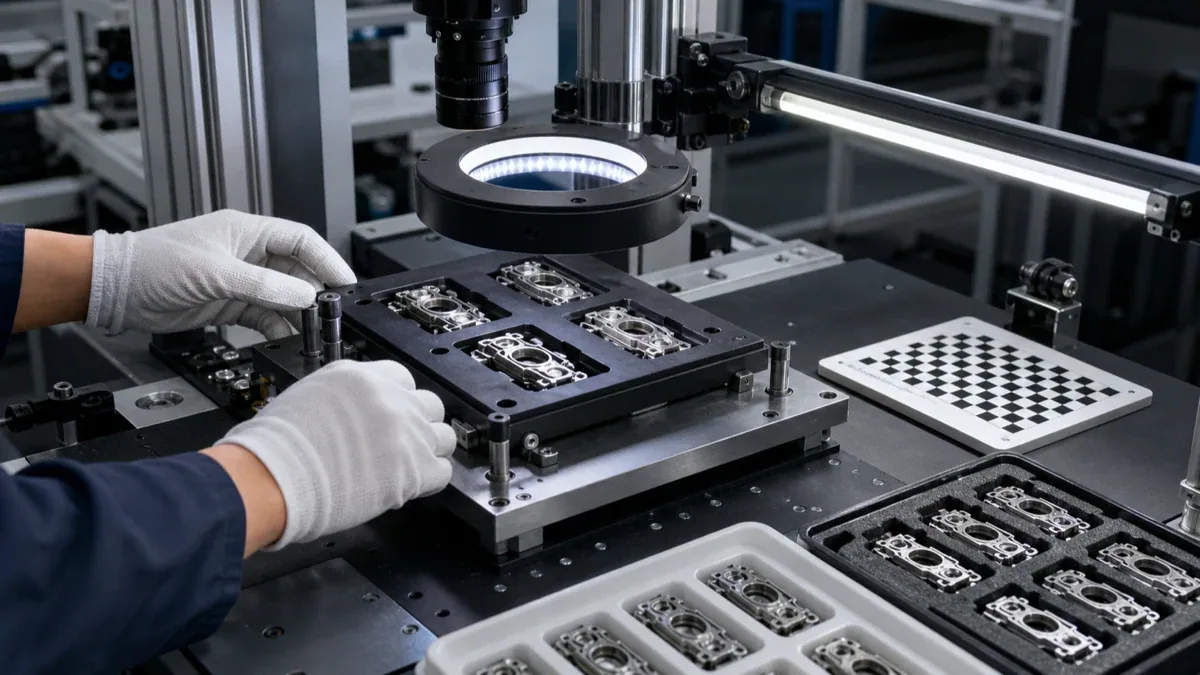
Vision projects often begin with questions about model versions, parameter counts, input resolution, or TOPS. Those questions are necessary, but they come after a more important deliverable: an executable acceptance contract. The contract should define the object or defect, what constitutes a false negative and a false positive, the deadline from trigger to result, the route for uncertain predictions, and the amount of station variation that requires revalidation.
“Ninety-five percent accuracy” is not an acceptance contract. Image-level accuracy and instance-level accuracy produce different outcomes when one image contains ten parts. Overall accuracy can also hide every missed defect when defects are rare. An industrial evaluation should separate precision, recall, false positives, and false negatives by class, then isolate safety- or quality-critical defects from ordinary classes. Ultralytics validation can report precision, recall, F1, TP, FP, and FN, but the availability of a metric does not decide which business error matters most.
Latency also needs an end-to-end definition. Exposure, image transfer, preprocessing, inference, NMS, rule evaluation, and the PLC, MES, or WMS call all consume the same deadline. A 30 ms model inference does not prove that a reject actuator receives its decision within 100 ms. Camera buffering, Python postprocessing, queue contention, or a network request can push the system beyond the physical window in which the item remains at the inspection point.
The acceptance set should therefore be divided into risk buckets. Clean nominal images, boundary cases, reflections and occlusions, dirty optics, shifted parts, confusing negative objects, and changed batches need separate results. A release should not pass because a high-volume easy bucket averages out a small high-risk bucket. If the business owner cannot explain the consequence of each error type, the team does not yet have enough information to decide whether YOLO is the right tool.
2. Build the dataset around the failure envelope
A collection of several hundred clean product photos will usually overestimate production performance. In a real station, exposure, focal distance, motion blur, reflective surfaces, part orientation, batch color, occlusion, and lens contamination can alter the input more than the nominal product class does. If those variables are absent from the dataset, the model learns the photography setup instead of the business object.
A practical dataset has three layers. The first represents normal production across products, shifts, stations, and common operating conditions. The second deliberately explores the failure envelope with displaced parts, missing components, glare, low light, blur, partial occlusion, contamination, and visually similar negatives. The third is a time-separated holdout set collected on different days, batches, or after maintenance. Splitting adjacent frames from one video between training and validation creates near duplicates and can make metrics look excellent without proving cross-batch stability.
Annotation rules must be versioned as well. The team needs to agree whether a box covers the complete object or only its visible portion, whether overlapping items receive separate annotations, when an unreadable target becomes ignore, and whether a damaged part remains its base class or becomes a defect class. When the rule changes, old labels cannot silently mix with new ones. Conflicting label semantics become noise in the loss function and later appear as unstable predictions near exactly the cases that matter most.
INT8 deployment creates another dataset responsibility. The calibration set is not an arbitrary subset of the clean training images. Ultralytics export documentation calls for representative calibration data, and the internal RK3566 history shows why: quantization errors become most visible around small targets, dense scenes, and complex textures. Calibration should cover actual exposure, target scale, and background variation. After export, every risk bucket needs to be evaluated again rather than relying on one aggregate mAP comparison.
The feedback loop should define which images return for review. Uploading all production video is expensive, difficult to govern, and often unnecessary. More useful candidates include low-confidence detections, disagreements between the model and a human reviewer, inputs rejected by an image-quality rule, and a controlled sample of normal traffic per shift. A returned image is useful only when it remains traceable to camera_id, station, timestamp, model_version, preprocessing version, thresholds, and the eventual business outcome.
3. The detection path starts with optics and triggering
If the relevant feature is not separable in the source pixels, a larger model will rarely rescue the project. A wide field of view can reduce a small defect to a few pixels. Long exposure can smear a moving part. Uncontrolled reflections on metal or plastic can erase the edge the model needs. Training longer in these conditions makes the detector more familiar with unstable input; it does not recreate missing visual information.
Real recognition terminals reduce this uncertainty before inference. The in-house warehouse recognition workstation documented in this workspace uses a fixed five-megapixel overhead camera, an approximately 75 mm capture height, and alternative barcode and human-interaction paths. These details do not establish a general accuracy claim. They demonstrate a system design choice: constrain working distance and placement, then preserve a deterministic fallback when appearance alone is ambiguous. Moving the same model to a handheld camera, arbitrary table, and changing daylight requires a new acceptance evaluation.
Triggering must match object motion. A static fixture may use a presence sensor to capture only after the part settles. A conveyor may require a photoelectric sensor, encoder position, or carefully managed video timestamps. Multiple cameras need a synchronization window. If capture occurs while an object has only partly entered the frame, the model receives truncation and motion blur that confidence tuning cannot repair.
Preprocessing must remain identical to the validated pipeline. Color order, resize strategy, letterboxing, normalization, orientation, and input layout all matter. Common failures include feeding BGR where RGB was expected, stretching where training used letterbox, or changing NCHW to NHWC for an accelerator without updating the adapter. A deployment should include golden images and compare preprocessing summaries and expected outputs during startup, so a format regression is not mistaken for model drift.
Business postprocessing begins after YOLO returns detections. NMS removes duplicate boxes, ROI rules decide whether a detection is inside the active station, tracking prevents repeated counts, and a mapping layer converts class IDs into material or defect codes. NVIDIA DeepStream exposes ROI, direction, line-crossing, and overcrowding analytics above detector and tracker metadata. That separation illustrates the system boundary: an industrial application consumes an event under a condition, not a raw set of coordinates.

4. Size edge hardware against the full deadline and workload
TOPS is an initial filter, not a sizing result. A single fixed camera that processes a few frames per second is very different from a sixteen-stream system that continuously decodes video, runs detection and tracking, evaluates ROIs, records evidence, and publishes events. Even when both use the same model, they place different loads on memory bandwidth, video codecs, CPU postprocessing, storage, and the runtime scheduler.
An internal historical test makes this concrete. With YOLOv8 Detection at fixed 640×640 input, batch size one, and CPU-side postprocessing on RK3566, the record reports roughly 12–18 FPS for INT8 and 3–5 FPS for FP16. Those numbers belong to that model, toolchain, and test condition; they are not a performance promise for another board or a newer YOLO release. The reusable observation is that unsupported operations and CPU fallback can prevent theoretical NPU capacity from becoming end-to-end throughput. Calibration quality and graph continuity can change whether an edge target is usable.
Hardware validation should run the full pipeline. Measure capture rate, preprocessing P50 and P95, inference P50 and P95, postprocessing P50 and P95, end-to-end P95, CPU and accelerator utilization, memory high-water mark, dropped frames, temperature throttling, and restart recovery. Continuous deployments also need soak tests inside the target enclosure, at realistic temperature, with the planned number of cameras and the actual evidence-retention policy.
The export backend should match the device. Ultralytics supports deployment formats such as ONNX, TensorRT, OpenVINO, and Rockchip RKNN, and Rockchip provides a YOLOv8 path in its model zoo for RK3566 and related platforms. A successful export only proves that a graph was produced. Each backend still needs independent output-tensor, NMS, accuracy, and latency validation. Dynamic shapes, embedded NMS, precision changes, and vendor graph transformations can all alter behavior.
Production capacity needs headroom. Logging, evidence capture, network retries, model switching, and workload bursts consume resources that a model-only benchmark ignores. If the laboratory average already saturates the device, a temperature increase or simultaneous camera trigger will create backpressure. The admission rule should reserve thermal and throughput margin instead of treating “the demo runs” as “the system can operate.”
5. Thresholds form a risk-routing policy, not one magic number
One global confidence threshold rarely serves every class. A high-impact defect may justify more human review to minimize false negatives, while an ordinary material class may prioritize fewer false stops. Thresholds should vary by class, station, and action risk and should be selected from validation curves rather than adjusted until boxes look stable in a demo.
A three-way decision is often safer than a binary answer. High-confidence detections that agree with station rules may proceed automatically. A middle band can request a second capture or enter human review. Low-confidence input, severe blur, missing calibration, or an out-of-distribution scene should return “unable to decide” instead of forcing a class. The ability to abstain prevents uncertainty from becoming an irreversible physical action.
False positives and false negatives belong in different cost models. Rejecting a good part increases review, downtime, and rework. Passing a bad part can create a quality incident, recall, or safety risk. Because those consequences differ, optimizing one overall F1 score is not enough. Acceptance should expose errors by consequence and verify that the planned human-review capacity can absorb the uncertain band.
Video decisions may require more than a single-frame confidence. Tracking IDs, multi-frame voting, ROI dwell time, and line-crossing state can reduce transient noise, but they add state and latency. As the rule layer grows, event replay becomes necessary. An operator should be able to see why an event fired or did not fire instead of receiving an unexplained final status.
6. Release the model, configuration, and business rules together
A vision release is not one .pt, .onnx, or .rknn file. A reproducible version includes weights, class mapping, input resolution, preprocessing, NMS, per-class thresholds, ROIs, camera parameters, annotation rules, the training-data snapshot, runtime version, and target hardware. Replacing weights while retaining old thresholds, or changing exposure without revalidation, can alter production outcomes even when the nominal model version appears unchanged.
Use shadow and canary stages before broad activation. Shadow mode runs a candidate on the same production images but does not control reject, inventory, or safety actions. It compares candidate and incumbent outcomes. Canary then limits the new release to one station, line, or small device group. Expansion should stop automatically if a critical false-negative bucket, P95 latency, image-quality rejection rate, or review volume exceeds its budget.
Rollback must restore the model and its dependent configuration. A signed manifest can identify model hash, runtime, threshold set, camera configuration, and compatible hardware. The device verifies files and disk space before switching, then runs golden-image checks after activation. If startup fails, it atomically restores the previous manifest. Rolling back only the model while leaving a newer ROI or class map can continue to generate incorrect business codes.
Observability should describe business error, not just device health. Useful signals include input-quality rejection, confidence distributions by class, sampled FP and FN by shift, reviewer-overturn rate, abstention rate, queue backlog, camera availability, model-version distribution, and the success rate from prediction to business action. Raw images should be retained only under an explicit access and retention policy, especially when a station captures workers, customers, or sensitive production material.
7. Prove recovery with failure injection before go-live
A release rehearsal should not consist of one clean video. Partially cover the lens, reduce illumination, disconnect a camera, delay the inference service, fill an output queue, present an unknown object, and activate an invalid candidate version. Then verify that the system enters its planned degraded state. A safe result is not that the detector continues drawing boxes; it is that unreliable input is recognized, dangerous automation stops, evidence is retained, and a human is notified.
Downstream failure also needs rehearsal. If MES, WMS, or PLC communication fails, a detection event should carry an idempotent ID into a bounded retry or manual queue. It must not repeatedly reject a part, decrement inventory twice, or disappear silently. The vision service owns perception; the operational system owns business state. Their interface needs a read-back or receipt rather than an unconfirmed HTTP call.
Power loss and process restart are acceptance cases. On restart, the system should restore cameras, load the last approved manifest, bound or discard stale frames, and avoid replaying old input as a new event. If model initialization takes tens of seconds, the operating mode during that interval must be explicit: unavailable, bypass, stopped line, or human inspection.
Finally, the team should be able to reconstruct a decision. The event record should identify device, camera, model and configuration versions, input evidence, thresholds, rule result, reviewer changes, and whether the physical or business action succeeded. Without that chain, faster model iteration creates more disputes rather than better operations.
8. When YOLO fits, and when another method should lead
YOLO fits when object boundaries are visible, the number of classes is manageable, station variation can be constrained, low latency matters, and boxes or masks can drive a well-defined rule. Missing-component checks, wrong-part detection, package counting, vehicle or person entry, pallet recognition, and many fixed-station material tasks are reasonable candidates for a scoped proof of concept.
If the decision depends on exact pixel area, contour, or crack geometry, instance or semantic segmentation may be more appropriate than ordinary detection. If classes differ mainly by fine texture, classification, metric learning, or anomaly detection may carry the decision. If the requirement is dimensional tolerance, calibrated traditional machine vision should lead. If the defect is not visible, X-ray, ultrasound, thermal imaging, or another sensor is required; more visible-light training data cannot reveal absent information.
Cross-camera identity, dwell time, and path analysis require tracking and temporal association above YOLO. Writing a result into inventory, quality, or maintenance workflows requires authorization, idempotency, review, and integration. The right reason to choose YOLO is not popularity. It is that YOLO can solve the perception step within a measurable budget while every remaining responsibility has an explicit owner.
Commercial teams should also review licensing before committing a product architecture. Ultralytics currently distinguishes the AGPL-3.0 open-source path from Enterprise terms for proprietary, embedded, and commercial use. That assessment belongs in the proof-of-concept admission checklist, not after hardware has entered production.
For project planning, start with the YOLO custom development capability page, then compare a fixed station with handheld scanning and warehouse recognition workflows. If detection is one part of a broader AI system, the enterprise AI development toolchain guide helps separate model, application service, and deployment responsibilities.
Conclusion
YOLO inspection succeeds when acceptance, failure-envelope data, optics, triggering, end-to-end latency, risk thresholds, review, versioning, and rollback form one system. When targets are visible, input can be controlled, and error costs can be measured, YOLO is an efficient detector. When the source image lacks the required information, responsibility spans systems, or the business cannot tolerate an unbounded uncertain result, another model, sensor, or control layer must carry part of the decision.
A reliable sequence is straightforward: sign the acceptance contract before collecting data; collect the failure envelope before comparing models; fix optics and preprocessing before tuning thresholds; benchmark end-to-end P95 on the target device before sizing hardware; and prove shadow, canary, rollback, and failure recovery before allowing predictions to trigger physical actions. It makes the proof of concept more disciplined, but it avoids the much more expensive outcome of a successful demo that cannot survive production.