

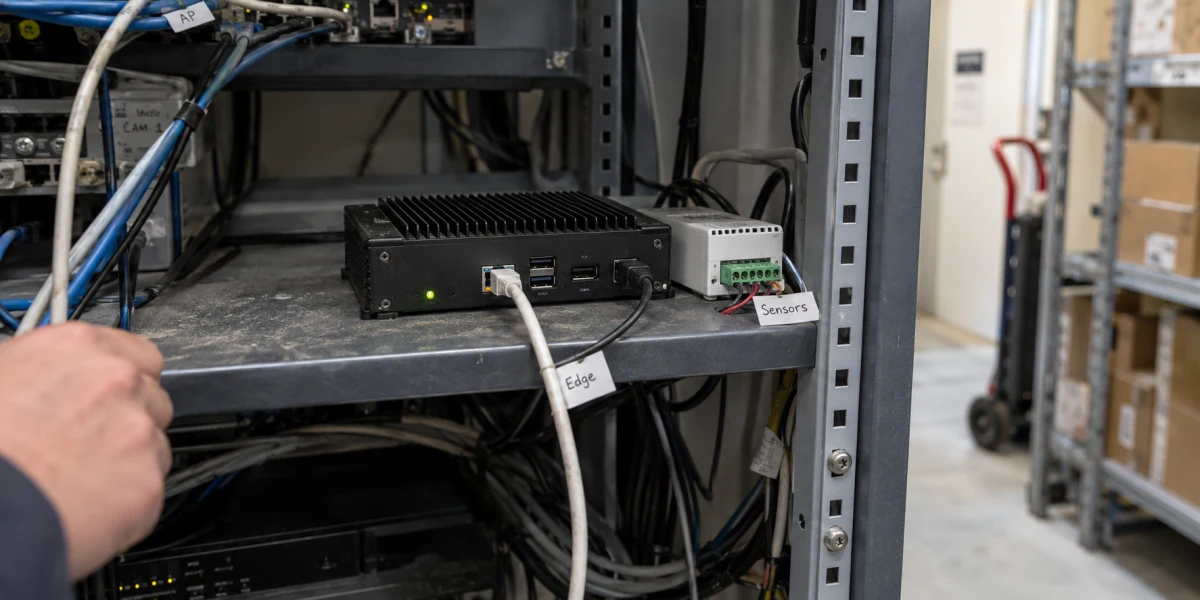
An RK3566 box may boot Linux, connect a few devices, and run an inference demo without being ready to serve as a production edge node. The real question is not whether each function can run in isolation. It is whether collection, inference, rules, storage, and uplink can run together during a business peak while the critical path still meets its deadline. The node must also degrade predictably when a process or peripheral fails, recover without a technician standing beside it, and retain enough evidence to explain the event.
RK3566 is often a sensible cost-and-capability starting point for rules, protocol aggregation, low-frequency event recognition, and voice-command assistance. That conclusion holds only when the team defines the deadline, resource ceiling, and failure consequence for each task, then tests the target image, peripherals, and network for sustained periods. If the project requires continuous multi-stream video inference, several large models, heavy local analytics, or a latency spike can stop a production line, neither “1 TOPS” nor a smooth five-minute demo is sufficient selection evidence.
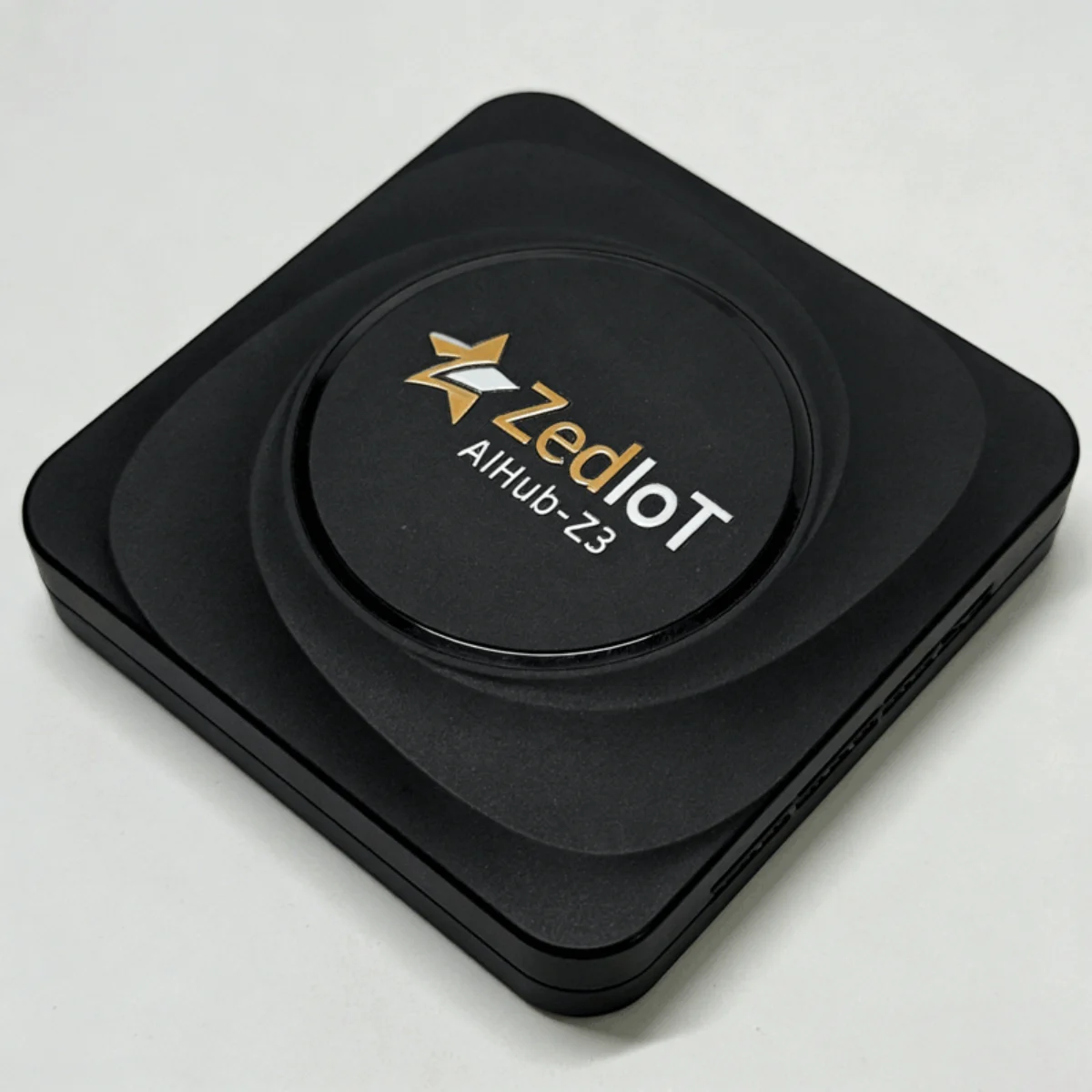
This article uses the local AIHub-Z3 product material as a physical product anchor. The material records an RK3566 platform, configurations up to 8 GB of memory and 128 GB of storage, and connectivity directions that include Wi-Fi, Bluetooth, wired networking, and optional ZigBee. Rockchip’s official RK3566 material lists a quad-core Cortex-A55 CPU, Mali-G52 GPU, 1 TOPS NPU, media engines, and high-speed interfaces. Those sources identify available building blocks. They do not prove a target model’s frame rate, the stability of a particular peripheral combination, or 24/7 thermal behavior. The boundaries below are therefore an acceptance method, not an untested product-performance promise.
Business deadlines and headroom define a lightweight workload
A rules engine sounds lighter than computer vision. Yet a rules process that receives thousands of property changes per second, writes each change to a database, and executes a script for every event can saturate CPU, storage I/O, and locks before an event-triggered image classifier does. A model may be relatively large but run only after a door sensor requests a single-frame inspection. Classifying tasks as “rules,” “vision,” or “voice” hides the scheduling pattern that determines whether the system remains stable.
A more useful definition is operational. A lightweight edge workload has a known arrival rate and completion deadline, leaves headroom during normal operation, survives short bursts without delaying the critical path, allows noncritical functions to be throttled, and returns to a healthy state after the burst. “Lightweight” describes the envelope of the complete workload rather than the name of an algorithm or protocol. If one of those conditions cannot be maintained, the workload should be split or moved to a more capable platform.
Consider an energy gateway for a chain store. Meters and refrigeration controllers may be summarized every few seconds or minutes. Alarm evaluation might need to finish within seconds, while report synchronization can wait. That workload tolerates batching, local buffering, and staggered uploads, so the system can preserve predictable headroom. If the same box must also decode several video streams, run continuous detection, and drive a local dashboard, network traffic, memory bandwidth, and heat become shared constraints. Continuing to call the result a lightweight gateway would misrepresent both the purchasing specification and the delivery responsibility.
The project should therefore define business deadlines before comparing processor specifications. A safety-related interlock that must respond in 100 milliseconds cannot share the same scheduling assumptions as a cloud synchronization task that can wait 30 seconds, even if the payload size is identical. The first path needs explicit priority, execution budgets, and failure protection. The second can yield. Average CPU utilization alone cannot prove this separation; the acceptance record needs critical-path P95/P99 latency, queue growth, expiration, and drop counts.
Four resource chains form the gateway capacity architecture
RK3566 exposes CPU, GPU/NPU, memory, storage, and multiple I/O options, but they are not independent capacity boxes. Camera capture consumes memory bandwidth. Image preparation uses CPU or GPU. NPU inference still requires data movement and post-processing. Logging and a local database contend for storage. Estimating visual capacity from NPU TOPS alone ignores the earlier bottlenecks in the end-to-end chain.
The first chain is business control. Protocol parsing, rules, state machines, and local actions are mainly CPU-bound and require predictable latency. They may not keep all cores busy, but image decoding, log compression, or a software update must not starve them. A sound design assigns a priority and execution budget to critical control work, moves bulk synchronization and report generation into deferrable queues, and sheds noncritical load when queue depth crosses a stop line.
The second chain is inference. Rockchip’s 1 TOPS figure identifies an advertised NPU class; it does not convert directly into a frame-rate promise for a target model. Model architecture, quantization, input size, operator support, preprocessing, post-processing, and runtime versions all change the result. RK3566 may have ample room for low-frequency, event-triggered classification or detection. Continuous video requires separate measurements for capture, decode, preprocessing, inference, post-processing, and business confirmation. Reporting only kernel inference time hides much of the latency users experience.
The third chain is memory and storage. Memory holds more than the model: the operating system, containers, caches, message queues, frame buffers, and temporary files compete for it. A short average may look safe while a frame burst or log surge triggers reclaim, swapping, or an out-of-memory kill. Storage capacity is not enough either. Database writes, media retention, and update downloads contend for I/O and affect media life. Acceptance should observe available memory, write latency, and storage growth in steady state, at peak, and during recovery.
The fourth chain is device and network I/O. A listed UART, USB, Ethernet, Wi-Fi, or ZigBee path does not prove that the target peripheral set is compatible. Driver versions, USB power, serial electrical layers, radio interference, cabling, and offline buffering all affect delivery. The AIHub-Z3 photograph proves the product form, and the local material records product directions, but the exact ordered configuration and its field stability still require a sample, an interface list, and wiring tests.
These chains must appear on the same capacity map. If protocol backlog makes inference input stale, or media retention prevents control logs from being written, every component-level benchmark may pass while the system fails. Capability proof is not a collection of successful module demonstrations. It shows which task keeps priority, which task yields, and which condition stops the workload when modules contend.

The diagram places compute and interfaces back into one business chain instead of presenting them as isolated specifications. A workload occupies a deployable region only while the business deadline and resource levels remain valid together. Crossing a stop line must invoke an agreed throttle, degradation, or split; allowing backlog to grow until the node stops responding is not a capacity policy.
Where rules, event recognition, and voice assistance fit
Protocol aggregation deployment starts with priority
Rules and protocol aggregation are among the easiest workloads to make predictable on an RK3566 gateway. Typical duties include protocol conversion, property normalization, local threshold evaluation, offline buffering, and batched uplink. They have a natural priority order: collection and safety-related actions first, cloud synchronization and history replay later. Once drivers and protocol adapters are qualified, throughput, queue depth, processing latency, and reconnect recovery can quantify capacity instead of relying on perception.
Event triggers change how vision is implemented
Low-frequency event vision can also fit. A door contact, motion sensor, or business transaction can trigger image capture; the box processes one frame or a short sequence and uploads a structured result. Changing “watch continuously” into “work on an event” reduces sustained decode, memory, and NPU pressure. If missing an event carries a significant cost, however, the system must retain the source event, model version, and confidence. Saving only the final label makes a false result difficult to investigate.
Voice and local UI share the same capacity budget
Voice assistance can serve as a command entry, keyword detector, or occasional transcription path. It should not be marketed by default as an unlimited, multi-channel real-time speech server. Microphone arrays, echo cancellation, noise reduction, VAD, ASR, and intent handling are separate stages. A delay or failure in any stage changes the experience. A quiet-room demonstration does not cover field noise, far-field capture, connectivity loss, or the resource pattern of a long conversation.
A lightweight local interface may coexist with these tasks, but browser engines, chart queries, and video previews belong in the same budget. An idle maintenance page may consume little; loading a large history window can create CPU and memory spikes. If the interface is only a service entry point, reduce refresh rates and cap query windows. If it is a continuously visible business display, test it as part of the formal workload rather than treating it as a free accessory.
What these cases share is not a simple algorithm. They support prioritization. Critical paths have explicit deadlines, secondary paths can buffer, presentation and synchronization can degrade, and failures have compensation paths. If every function receives highest priority or all features must run at peak rate simultaneously, architecture cannot establish that RK3566 is enough. Only a complete stress test or a platform upgrade can resolve the question.
Sustained load exposes three errors hidden by a demo
The first error is assuming that low average utilization means spare capacity. A demo often runs for minutes, before caches grow, logs rotate, connection retries accumulate, or thermal behavior stabilizes. After hours or days, fragmentation, queue growth, temporary files, retry storms, and thermal throttling may emerge. Averages erase those peaks, while business failures occur precisely during them.
The second error is treating a running model as a completed inference pipeline. NPU execution proves that conversion and operators are broadly compatible. The product still must capture audio or video, convert formats, preprocess inputs, post-process outputs, debounce results, and commit a business action. If the input is already stale or the database blocks confirmation, good NPU latency does not produce a timely business decision.
The third error is calling a system recoverable because a power cycle works. Manual reboot covers the simplest recovery path. Field failures are more selective: a single process stalls, a USB device disappears, a network link flaps, storage fills, a model file is corrupted, or an update is interrupted. The node must distinguish process restart, feature degradation, and full reboot, then reconcile any data gap. Blind automatic reboot can hide a recurring fault instead of resolving it.
A sustained test should not be a peak benchmark only. Reproduce the arrival pattern: run normal traffic, add a burst, then combine it with an offline interval, log growth, or peripheral reconnect. Observe whether the critical path keeps its deadline. After pressure clears, verify that queues shrink, memory returns, missing uploads are replayed, and alerts explain what happened.
This article does not present pre-existing AIHub-Z3 numbers for a particular model or peripheral set because those numbers are meaningful only with a fixed image, model, input, and environment. Publishing a benchmark that was not run would be more misleading than publishing no number. The actionable result here is a stable test contract that can turn the next sample run into reviewable evidence.
Acceptance depends on levels, yielding order, and recovery evidence
Freeze the input before testing. Record the system image, kernel and drivers, model and runtime, process or container versions, device list, network conditions, event rates, and ambient temperature. Without those conditions, a changed result cannot be explained and a lab result cannot be reproduced at a customer site.
Define green, yellow, and red resource levels. Green means normal business can run for the required duration with meaningful headroom. Yellow is a bounded burst where media retention, dashboard refresh, or cloud replay must be throttled. Red means a critical deadline is broken, a queue grows continuously, or memory and temperature approach a stop line; the node must reject new noncritical work or enter a safe mode. The exact percentages are not universal and should be selected from the target workload and failure consequence.
Every level needs an action. When CPU or memory enters yellow, specify what pauses first. After connectivity returns, decide whether real-time messages or historical replay has priority. When the NPU queue grows, choose among reducing sampling, dropping expired inputs, or switching to a smaller model. When storage approaches the ceiling, define which media may be removed and which audit trail must remain. If these choices are not made before launch, pressure will cause the system to sacrifice business functions accidentally.
The recovery loop answers four questions: Was the fault detected? Did degradation activate within the allowed time? Did critical business continue? Did the system reconcile data and return to green afterward? A successful reboot is not a substitute. The acceptance record should correlate fault injection time, alert time, action time, recovery time, and data gap in one event trace. That evidence distinguishes automatic recovery from a test operator rescuing the node manually.
Observability must explain a recovery, not only display averages
CPU, memory, and temperature curves show that resources changed, but they do not prove whether business was harmed. Logs and metrics also need to identify the task, input batch, queue, degradation action, and recovery result. Otherwise, a dashboard may report “healthy” because a process restarted while business data is still missing. For a fleet, reconstructing one remote event trace is usually more useful than retaining many context-free averages.
For a cost-sensitive RK3566 node, headroom is more valuable than the highest short-lived score. Saving one hardware tier can be a false economy if it creates frequent site visits, blocks updates, or requires retuning whenever traffic grows. Conversely, a lower-power platform can become a reliable deployment unit when its yellow-level yielding order is explicit, its critical path stays stable, and its recovery loop is repeatable.
Projects that should stop adding work to RK3566
The first stop line is the inability to isolate critical and noncritical work. If a report query, model update, or media upload causes device-control latency to miss its deadline, reducing log volume or tuning a thread can only mask the architectural conflict. Split compute-intensive work into another node or select a platform with more resources and suitable interfaces.
The second stop line is continuous multi-stream high-resolution video or several large models. Bottlenecks may occur concurrently in decode, memory bandwidth, NPU, post-processing, and cooling. Reducing one input size may not restore a sustainable margin. If the business also requires high frame rates, low latency, and continuous operation, evaluate RK3588, Jetson, x86 GPU, or a dedicated accelerator and include their power, cost, and software-maintenance tradeoffs.
The third stop line is a field interface or reliability requirement outside the tested board-level product. Isolation, CAN, dual Ethernet, cellular connectivity, wide temperature, dust, vibration, or certification cannot be inferred from the SoC peripheral list. If many USB adapters and external power supplies are needed to assemble the required interfaces, added failure points may erase the box’s cost advantage.
The fourth stop line is incomplete operational ownership. When device count grows, the team must see versions, resource levels, queues, peripheral state, and recent faults remotely, and it needs safe update and rollback. A faster CPU does not fix missing operations. It may encourage more features on the same node and increase the blast radius. Complete device management, logging, alerting, and release governance before deciding that hardware is the limiting factor.
AIHub-Z3 is one product anchor for an RK3566 lightweight-edge design, not a universal answer. Its recorded specifications can create a sample checklist; the selection evidence still comes from the target workload. For a direct model-tier comparison, read AIHub-Z3 vs AIHub-Z5. If the target is already continuous industrial vision, use the RK3588 industrial-vision boundary instead of relabeling a heavy workload as lightweight.
Final judgment
An RK3566 AIoT gateway is justified when the target workload has a defensible operating envelope: critical deadlines are explicit, CPU, NPU, memory, storage, and I/O retain headroom, noncritical functions have a yielding order, and faults recover automatically with reviewable evidence. Rules aggregation, event-triggered recognition, voice assistance, and a controlled local interface can all deliver useful edge intelligence inside that envelope.
Without frozen test inputs, sustained-load records, and degradation and recovery stop lines, a successful demo proves only that the project deserves a sample test. It does not prove that the design is ready for fleet deployment. Place the AIHub-Z3 or another RK3566 box in the target chain and test against business deadlines and failure consequences. Adopt it when it stays inside the envelope; split the workload or upgrade when it does not. That judgment is more conservative than comparing TOPS, and much closer to delivery reality.
References
- Rockchip RK3566 product page
- Rockchip RK3566 Brief Datasheet
- Local AIHub-Z3 product material and photograph, listed in
pipeline.yamlunderevidence_artifacts