

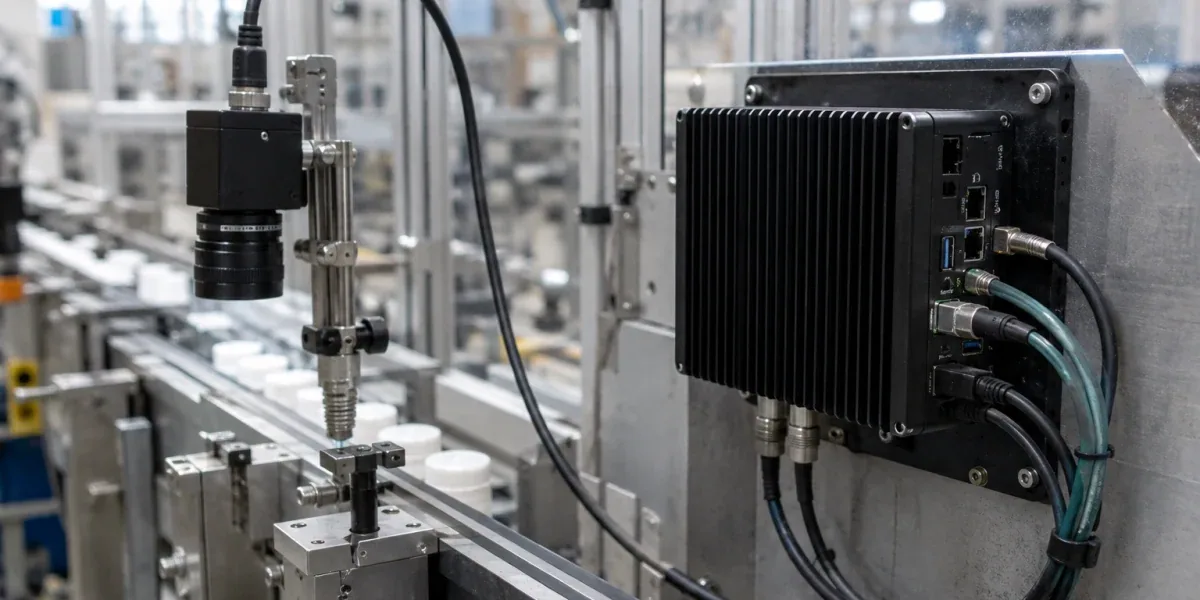
Buying an RK3588 box advertised with a 6 TOPS NPU does not buy a production-ready vision system. RK3588 is a strong candidate when the workload has a bounded camera count, a model that can be qualified through the RKNN toolchain, enough end-to-end cycle-time margin, an explicit low-confidence or failure path, and a team prepared to manage the model, runtime, driver, application, and configuration as one compatibility set. If those conditions are missing, a larger TOPS number will not resolve the actual system uncertainty.
The practical conclusion is narrow. RK3588 fits station-level vision tasks that can be bounded, degraded safely, and tested: fixed-station inspection, assisted warehouse recognition, area or PPE event detection, and local inference from a small number of cameras. It should not be selected from peak compute alone for dense multi-stream 4K analytics, hard real-time actuation, complex 3D workloads, or arbitrary research models that have never run on the target board. Start with the business decision path and work backward to the silicon.
1. Bound the vision decision before choosing the processor
The first design question is not which YOLO release to use. It is where a business decision begins and ends. In an inspection cell, the beginning may be a photoelectric trigger. The end may be a bounding box shown to an operator, an accepted warehouse transaction, or a reject actuator confirmed by a PLC. A workflow that permits a 500 ms human review is not the same system as a line that must reject a part within 80 ms.
RK3588 becomes attractive when a station has a fixed acquisition pattern, a known resolution and frame rate, and a result that can either be queued within a strict limit or handed to an operator. Its CPU, NPU, video, display, and peripheral capabilities can keep images on site and allow useful inference during a cloud outage. The benefit is a shorter and more controllable data path. It is not a guarantee of deterministic control.
A requirement such as “eight 4K streams, real-time detection, 99.9% accuracy, and continuous operation” is not testable until it names the model, pixel format, exposure, per-stream frame rate, preprocessing, postprocessing, business action, and ambient conditions. Decode capacity, NPU peak compute, and a single-model demo benchmark measure different parts of the system. Combining them into one capacity claim hides memory bandwidth, frame copies, CPU postprocessing, queuing, and thermal throttling.
A usable system boundary should state at least six things: the target object and cost of an error; camera and optical conditions; model and input contract; end-to-end latency expressed as percentiles; the degraded action for every major failure; and the retention and review policy for input data. RK3588 is only an assessable platform after those items can be written into an acceptance plan.
The best-fitting deployments also isolate failure. One station can stop producing results when a camera disappears, route low-confidence cases to a person, reduce input rate when temperature or queue depth exceeds a limit, and report the reason upstream. If the application instead requires microsecond synchronization, safety-rated deterministic behavior, or a common clock across many cameras, that responsibility belongs with an FPGA, a dedicated frame grabber, a real-time controller, a safety PLC, or another purpose-built platform.
2. An edge box is a pipeline, not an NPU
Rockchip's public RK3588 brief advertises an NPU rated up to 6 TOPS. The official RKNN-Toolkit2 flow converts a trained model on a development PC and runs the resulting RKNN artifact through C/C++ or Python APIs on the target. The official RKNN Model Zoo provides RK3588 examples for classification, detection, segmentation, and other model families. Those sources establish a supported deployment route; they do not qualify a custom model or production camera path.
Each frame still passes through acquisition, ISP or pixel conversion, memory movement, resizing and normalization, NPU inference, postprocessing, business rules, and result delivery. A mismatched pixel format or an unbounded queue at any stage can separate end-to-end latency from the quoted inference time. With larger inputs, color conversion, mask processing, NMS, and serialization on the CPU may exhaust the cycle budget before the NPU does.

The value of this diagram is the failure budget attached to every stage. A final FPS counter can average away camera drops, stale frames, and interface delays. An NPU latency number cannot explain why an operator received the result seconds later. Acceptance telemetry should therefore preserve P50, P95, and P99 for every stage, along with queue depth and dropped-frame counters, and compare end-to-end P99 with the actual station cycle time.
“YOLO is supported” is also an incomplete compatibility statement. Conversion can move unsupported operations to the CPU. INT8 quantization can change recall for small or low-contrast defects. Toolkit, runtime, NPU driver, and model artifact versions form a tested combination, not independent upgrade choices. A defensible delivery retains conversion logs, operator placement, calibration data version, output comparison on the target board, and the complete software manifest. Any runtime or model change invalidates the old evidence.
The camera side needs the same discipline. The Linux V4L2 userspace API gives applications a standard media interface, but a device that opens successfully has not yet demonstrated correct exposure, trigger behavior, buffers, pixel format, or timestamps for the station. Android camera paths need equivalent counters and acceptance evidence. An API callback is not proof of image quality or bounded latency.
3. What the AIHub-Z5 form factor proves—and what it does not
Zed's existing AIHub-Z5 material records an RK3588-based Android 12 edge box with NPU and peripheral connectivity. The first-party product image shows USB, Type-C, HDMI, dual RJ45, antenna, and power interfaces. That is evidence of a physical integration surface for cameras, networks, and display devices. It is not proof that a particular camera driver, PoE topology, hardware trigger, isolated I/O module, or field protocol is already integrated.
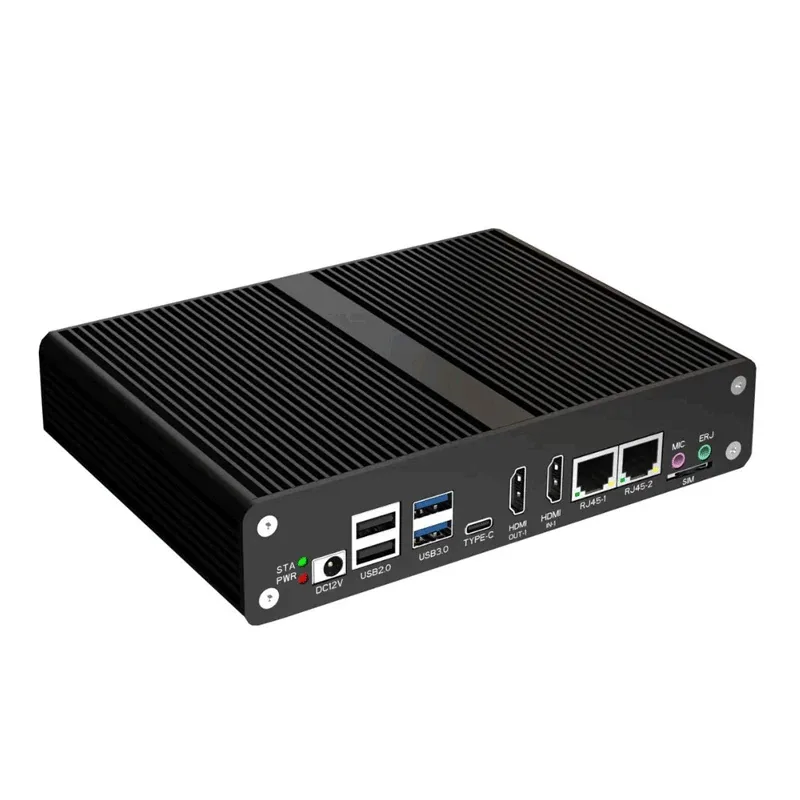
A port list only becomes useful after responsibilities are assigned. The project must decide whether USB cameras may be hot-plugged, whether camera and business traffic require separate networks, how the model and queues recover after power loss, whether HDMI is only a service interface, and whether serial or GPIO paths require isolation. Treating two Ethernet ports as automatic redundancy usually fails because routing, health detection, and application reconnection were never designed.
The first-party AI warehouse recognition workstation provides a second kind of evidence. Its documented configuration combines an RK3588 host with an overhead camera, a binocular camera, barcode scanning, card access, two displays, and serial peripherals. That is closer to a real industrial vision delivery because recognition must be bound to a person, material, and inventory action. The system value comes from the perception, interaction, and business record loop—not the NPU specification in isolation.
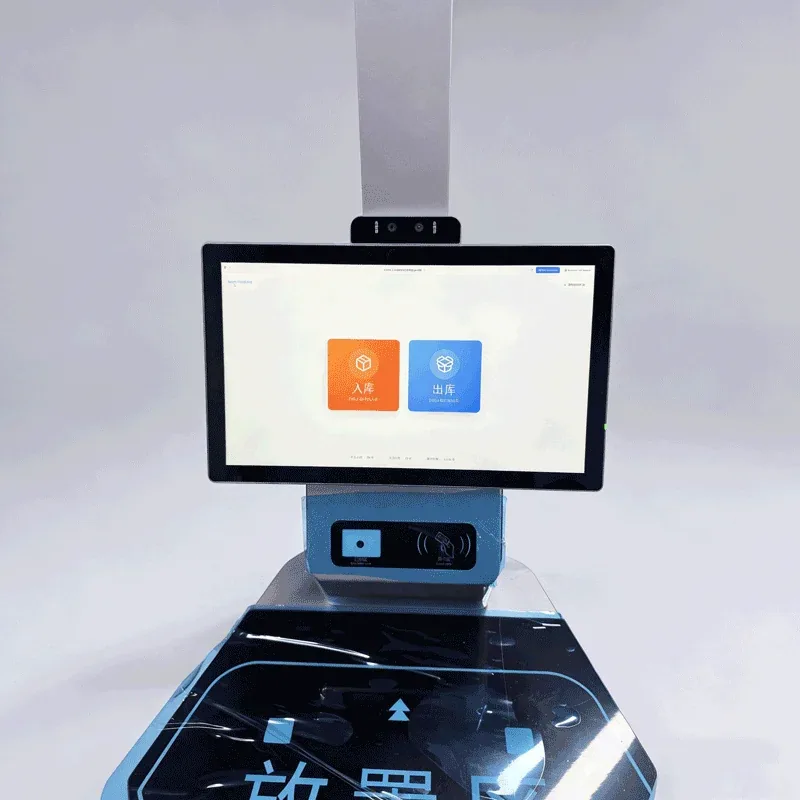
The limitation is equally important. This review did not run a model on the target box and did not measure power, temperature, throughput, accuracy, camera recovery, or sustained operation. We therefore use these materials only as evidence of a product and integration form factor. We do not repeat accuracy, payback, wide-temperature, or “second-level” outcome claims from sales material. Any contracted metric must be reproduced with the customer's parts, optics, camera, cycle time, and environment.
In a production architecture, a device such as AIHub-Z5 is best treated as a recoverable vision application node. It may own camera acquisition, model inference, a bounded local cache, non-safety business rules, and adapters to WMS or MES. A safety interlock, deterministic reject action, and final inventory consistency should remain with a safety controller, real-time control path, and system of record respectively. Assigning all of those responsibilities to the edge box turns a model update or network fault into a single point of operational failure.
4. Use five failure budgets to qualify the target workload
The first budget is acquisition. Fixed stations with controlled lighting, stable focus, and repeatable object pose are easier to qualify because the input distribution is constrained. Moving objects, transparent material, strong reflections, and frequent product changeovers move the problem into optics and data. When exposure, trigger timing, or pose cannot be stabilized, improving the image path usually delivers more value than buying a faster accelerator.
The second budget is model compatibility. The exact model must convert, preserve required accuracy, and run through the selected toolkit/runtime/driver combination on the target. Official examples are useful starting points, but custom operations, dynamic shapes, large segmentation masks, tracking state, and model cascades change CPU, memory, and NPU demand. A team that frequently adopts research models but cannot maintain RKNN conversion and regression data may spend less over time on a more general CUDA or x86 inference environment.
The third budget is latency. Allocate time to capture, preprocessing, inference, postprocessing, and the business interface, and sign off P99 rather than an average. An assisted warehouse workflow can queue an occasional slow frame within a strict limit. A high-speed reject line cannot safely “catch up” because an old result may be applied to a new part; expired frames should be dropped and surfaced as missing decisions. If the team cannot state when a result becomes too old to use, it is not ready to qualify real-time vision.
The fourth budget is thermal and resource behavior. A short demonstration does not represent a sealed cabinet, high ambient temperature, or continuous load. Testing should log SoC/NPU temperature, clock frequency, memory, swap, storage, per-stage latency, and the installation geometry until the device reaches thermal steady state. If throttled P99 exceeds the station cycle, the design fails. A larger heat sink, fan, or enclosure can be a valid correction, but dust, acoustic, and maintenance costs must be accepted with it.
The fifth budget is recovery. Camera loss, runtime crashes, network interruption, full storage, corrupted model artifacts, and sudden power loss require explicit system states. The node may restart acquisition, roll back a model, or transfer work to an operator, but it must never keep emitting stale results without a freshness marker. Recovery passes only when the business can explain which decisions were missed, how long recovery took, whether records need reconciliation, and whether unsafe or untraceable actions occurred.
These budgets define the useful workload range. Fixed-station classification or detection, assisted warehouse recognition, area event detection, and local inference from a small number of cameras can usually be bounded and degraded. Dense multi-stream 4K segmentation, complex 3D reconstruction, hard-synchronized low-latency action, very large models, or rapid use of arbitrary operators more often justify Jetson or a discrete GPU, an x86 accelerator, FPGA or dedicated vision controller, or a hybrid edge-cloud system.
| Workload | RK3588 fit | Evidence required before production |
|---|---|---|
| Fixed-station object or defect detection | Often a fit when optics are stable and the cycle has margin | Target-board P99, false accept/reject results, thermal steady state, review or reject loop |
| Assisted warehouse recognition | Good fit when low-confidence cases can go to a person | Changeover dataset, review path, idempotent WMS writes, offline buffering |
| A small number of security or area-event cameras | Conditional fit with bounded streams, resolution, and models | Per-stream drops, queue limits, privacy policy, reconnect tests |
| Multi-stream 4K segmentation or model cascades | Not justified by 6 TOPS alone | Full-pipeline stress test and comparison with a discrete GPU platform |
| High-speed deterministic rejection or safety interlock | Usually not an application-only edge-box responsibility | Deterministic trigger, real-time controller, safety analysis, fail-safe design |
The point is not that RK3588 only handles simple models. Its advantage depends on a bounded path. As the workload demands general operators, large memory, cross-camera synchronization, or safety determinism, a more capable platform can reduce integration risk. As it prioritizes local processing, compact hardware, low power, and a small peripheral loop, RK3588 can be the better system fit.
5. Write the acceptance contract before the purchase specification
A signable qualification contract needs eight gates: model conversion and accuracy, camera acquisition, end-to-end latency, thermal steady state, failure recovery, observability, upgrade and rollback, and data governance. The package for this article includes evidence/rk3588-vision-qualification-contract.yaml, a machine-readable list of required evidence and pass conditions. Projects should set their own thresholds, but they should not silently remove these responsibility domains.
The model gate retains conversion logs, operator placement, calibration data, and target-board output comparison. The camera gate records resolution, pixel format, exposure, trigger, and drops. The latency gate records stage percentiles and end-to-end P99. A demo video or average FPS cannot replace any of these items because it does not expose long-tail delay, stale frames, or distribution shift.
Thermal and recovery gates separate a prototype from a field system. Sustained-load testing must continue until temperature and frequency stabilize, then inject camera loss, network interruption, full storage, and power-cycle conditions. Each injection records device state, business state, and the operator path. A restarted process is not a complete recovery if the system cannot identify which parts or transactions were missed.
The observability gate should emit model version, input count, drops, queue depth, stage latency percentiles, temperature, restart reason, and business result. Without those signals, a false result leads to guesswork. With them, the team can distinguish optical change, camera failure, model drift, runtime fallback, and an upstream API timeout. The telemetry adds implementation and storage cost, but that is the price of maintaining edge nodes remotely.
The rollout gate treats the model, runtime, driver, application, and configuration as a compatibility set. Release artifacts need versions and integrity checks, rollout scope must be bounded, and a failed set must return to the last known-good set. Updating only a model file without recording its converter and runtime creates unexplained device differences. Supporting upgrade without rehearsing rollback merely amplifies field-service cost during a fleet-wide failure.
The data governance gate states which original frames, crops, embeddings, and logs may leave the device, how long they remain, and who can access them. Edge inference only improves privacy when data is actually bounded. Uploading every frame indefinitely for debugging replaces a cloud dependency with hidden data debt. For people, license plates, or medical materials, this gate should be decided before model experimentation.
Teams evaluating hardware can use the AIHub-Z5 edge computing box as a candidate integration form factor, then qualify it through these eight gates. For a detection or segmentation migration, our YOLO customization and deployment capability can help build the target-board path. Production approval should still depend on the customer's model, optics, camera, cycle time, and environment.
Conclusion
RK3588 is useful for industrial vision not because 6 TOPS is a large-looking number, but because it can place camera handling, inference, bounded local rules, and business adapters in one manageable site node. For fixed inputs, a small camera set, safe degradation, and reviewable results, it is often a compact and practical choice. For dense high-resolution streams, hard real-time or safety action, complex 3D, or arbitrary model experimentation, it can hide risk in CPU load, memory traffic, thermals, and software compatibility.
The purchase decision should end with evidence: the target-board model, complete camera path, P99 latency, thermal steady state, recovery exercises, observability, rollback, and data governance. Until those results exist, the processor specification only proves that the platform deserves a test—not that it deserves production approval.