


n8n is most useful when it turns hand-offs scattered across webhooks, CRM, email, forms, tickets, and internal APIs into a visible process that can be replayed and handed to a person. It can accept a lead, validate and enrich fields, call AI for classification or summarisation, update CRM, create a ticket, and notify an owner. It should not become the source of truth for order value, inventory, refunds, permissions, or command outcomes.
The quickest way to decide whether a process belongs in n8n is to price the failure. A delayed notification or missed daily report can usually be retried. A duplicate customer, repeated refund request, or unreviewed AI message sent to a customer has a different consequence. n8n is a business orchestrator, not a universal system of record, and it does not turn non-deterministic AI into a deterministic transaction.
This guide proves that boundary through four business actions: lead intake, email triage, order-exception handling, and AI-assisted approval. Each action is described with the same contract: trigger, input, source of truth, side effects, duplicate protection, human exit, and completion evidence. That makes the decision more useful than a catalogue of connectors.

1. Write a business action contract before drawing a workflow
A production automation needs seven explicit facts. Who triggers it? What input is accepted? Which system owns the final state? Which external side effects occur? How is a duplicate request recognised? Who takes over when it fails? What evidence proves completion? The workflow canvas should implement this contract rather than replace it.
Consider a website form that creates a CRM lead. The trigger is a webhook; the input contains contact and requirement fields; CRM owns the lead record; side effects include creating or updating a contact, assigning an owner, and sending an acknowledgement. An idempotency key can combine source and external_submission_id. Incomplete or suspicious submissions enter a human queue. Completion is not a green workflow execution: it is a CRM lead_id that can be read back and linked to the n8n execution_id.
This exposes three common mistakes. A successful node does not necessarily mean the business action completed; HTTP 200 may only mean that another system accepted a request. A retry is not necessarily a safe recovery because an email, contact, or refund side effect may already have happened. A parseable AI response is not necessarily executable because classification, amounts, and customer messages still need policy checks.
Assign a cross-system correlation_id to each business action and carry it into webhook logs, CRM notes, tickets, and notifications. n8n's execution views support status filtering, failed-execution retries, and loading previous execution data for debugging. Those are valuable engineering tools, but operations must still be able to trace a correlation ID to the final business record instead of relying on execution history that may later be pruned.
| Action | Appropriate n8n responsibility | Responsibility that stays in a business system or service | Primary containment |
|---|---|---|---|
| Form to CRM | Validate, enrich, route, call the CRM API | Customer merge rules, ownership permissions, master data | Idempotency key, conflict queue |
| Email and ticket | Classify, summarise, create a ticket, remind | SLA state, customer commitments, final correspondence | Confidence rule, human draft |
| Order exception | Assemble context, request approval, notify | Price, inventory, payment, and refund transaction | Business command API, approval, reconciliation |
| AI-assisted process | Retrieve, extract, recommend, draft | High-risk decisions and irreversible actions | Schema validation, policy, human confirmation |
The important conclusion is consistent across the table: n8n can move context to the right person and system, while the source of truth and irreversible actions remain behind a transactional and authorised interface.
2. Four workflows have four different risk boundaries
Lead intake is one of the safest starting points. After receiving a form, n8n can validate required fields, domain, region, and consent, then query CRM for an existing contact. New leads receive a record; existing leads receive a source update; uncertain merges go to a human queue. AI may summarise requirements or suggest an industry label, but it should not overwrite customer master data. The production value comes from transparent hand-offs, not from the generated prose.
Email triage is more sensitive. A workflow can retrieve an email, remove signatures and quoted history, extract account, product, urgency, and intent, then create a ticket or reply draft. The outbound path should split three ways. High-confidence, low-risk acknowledgements may be sent automatically. Price, delivery, refund, legal, or safety commitments require approval. Low confidence, failed attachments, and prompt-injection indicators go to a manual queue. Model output should pass JSON schema, allowed-value, and length validation before it is mapped to an email node.
An order exception is a good use of n8n as a control tower and a poor use of scattered direct transaction calls. When a warehouse reports a shortage, the workflow can read the order, inventory, customer tier, and substitutes, produce an exception summary, and open an approval. After approval, it calls an internal order-action service with an action_id, order version, and approver. That service owns optimistic locking, reservation, amount calculation, idempotency, and the database transaction. n8n records the request and result. A timeout or replay can no longer bypass the order domain's integrity rules.
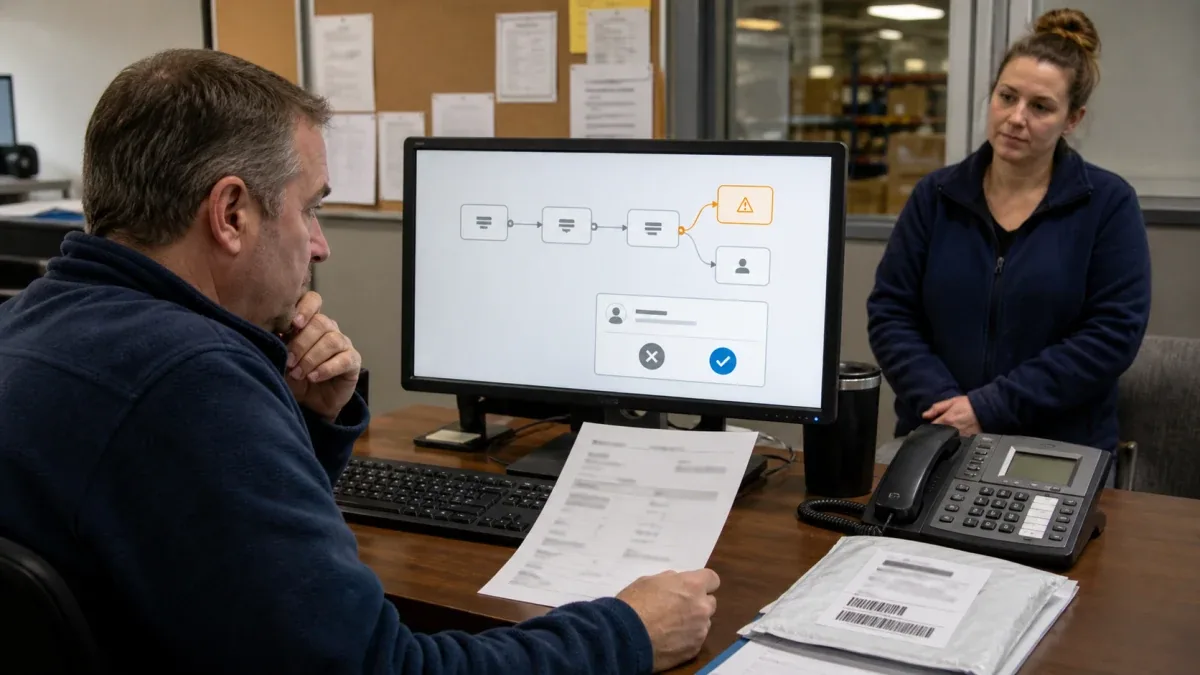
AI-assisted approval demonstrates the correct boundary most clearly. A model may recommend “possible duplicate account”, “route to pre-sales”, or “refund reason matches policy”. The recommendation should arrive with source passages, rule matches, uncertainty, and model version. n8n's Gmail node provides a send-and-wait-for-approval operation; its documentation positions this for simple approvals and points more complex approvals to the Wait node. The useful capability is not the button itself. It is the ability to pause with context, receive an explicit authorisation, and resume a controlled action.
3. Reliability comes from replay-safe design, not more retries
Many workflows need only a dozen nodes on the happy path. Their production incident appears in the moment when a downstream system completed an action but n8n did not receive the response. If CRM created the contact and the connection dropped before the response arrived, a blind retry may create another record. Increasing the retry count cannot solve this ambiguity; the side effect must be replay-safe.
The first layer is idempotency. A webhook should validate its signature and timestamp window, then derive an idempotency key from the business request. Internal APIs should accept the same action_id, persist the first result, and return it for subsequent requests. For a SaaS API without idempotent writes, query by an external ID before creation and document the remaining race between query and create. High-risk writes may need a single domain service to serialise them.
The second layer is a state boundary. Avoid one long workflow that receives input, calls AI, waits for approval, writes a transaction, and sends every notification. Split the process into “accept and issue a ticket”, “prepare a recommendation”, “wait for approval”, “execute a command”, and “distribute the result”. Each stage has an input version and completion receipt. The split exists so that recovery starts at a known checkpoint, not to make the canvas look tidy.
The third layer is an exception ledger. Execution history helps engineering debug a node; business operations need a record that answers who is affected, whether money or a commitment changed, who owns the next action, and when it is due. Store correlation_id, workflow/version, business object, stage, last side effect, retry count, owner, next action, and deadline. Close the exception only after reading back the business state.

The decisive elements are not the AI node. They are the action ticket, risk gate, idempotent API, read-back receipt, and exception owner. Without any one of them, a workflow can be technically successful while the business action fails.
4. Put a deterministic shell around every AI step
AI introduces failure modes that ordinary field mapping does not. The same input may produce a different expression; a model may omit a field, misunderstand an attachment, invent a customer or product, or treat instructions inside an email as trusted system commands. A production workflow therefore needs a deterministic shell around the model.
Minimise the input. Send only the fields required for the task, redact sensitive data where practical, and mark external text as untrusted content. Credentials used by tools and HTTP nodes should have least privilege; a read-only task should not receive write access. n8n's security audit can identify unprotected webhooks, missing security settings, risky nodes, filesystem interactions, and database-expression risks. An audit is a useful point-in-time check, not a continuous authorisation system, so credentials still need rotation, node restrictions, and change review.
Constrain the output. Even if the model is asked for a fixed schema, validate enumerations, amount ranges, dates, referenced objects, and source evidence. AI should return a recommended_action; it should not construct fully authorised parameters for a payment, permission, refund, or device command. Those actions pass through a policy layer or domain service.
Define the human boundary using both risk and uncertainty. A single confidence number is not enough because model confidence may not be calibrated to the business. Low-risk, reversible actions with complete rules may run automatically. High-risk or irreversible actions require approval. Unparseable, contradictory, or policy-free cases are rejected from automation. The approval surface must show original evidence and the exact side effect, not only the model's conclusion.
5. Production needs version, capacity, and permission controls
A demonstration often keeps workflows, credentials, and test data in one instance. Production needs separate development and production boundaries, restricted publish rights, workflow version evidence, and environment-specific credentials. n8n's source control and environments tutorial uses Git push/pull to move workflows between instances and recommends avoiding bidirectional push and pull on the same instance to reduce overwrite and merge risks. Feature availability depends on plan, so procurement must verify it rather than assuming every deployment includes it.
Capacity is not predicted by node count. Webhook bursts, execution duration, AI latency, attachment size, database connections, and downstream rate limits shape the queue. A readiness test should replay peak traffic and measure acceptance rate, execution waiting time, end-to-end P95, failure rate, retries, human backlog, and downstream 429 responses. Queue workers may increase concurrent execution capacity, but they do not make a non-idempotent side effect safe and cannot bypass a SaaS rate limit.
Observability must combine technical and business signals. Technical signals include running, waiting, and failed executions, node latency, and credential errors. Business signals include lead-posting rate, duplicate contacts, missing tickets, approval age, old exceptions, and reconciliation differences. Workflow success alone will miss incidents such as a write to the wrong customer that returned a successful API response.
Upgrades and rollback require rehearsal. Before publishing a new workflow, run fixed samples and simulated downstream failures to check field mappings, expressions, AI schemas, and side-effect counts. Route controlled traffic to the new version, preserve the previous version, and write a rollback instruction. If a domain API changes, maintain compatibility with old and new workflows before switching traffic. Direct edits on the production canvas make failures difficult to associate with a version.
6. When a custom service becomes necessary
n8n can own most logic when the process is notification, summarisation, synchronisation, and human-task orchestration. Move a critical part into a custom service when it requires a multi-table transaction or strict ordering, deterministic latency, complex tenant permissions, reusable signing, rate limiting, idempotency and compensation, a long-term source of truth, or when an error affects money, stock, safety, or a customer commitment.
This does not mean rewriting the workflow. A practical division is: n8n owns triggers, context assembly, cross-system orchestration, approval, and notification; a domain service owns rules, state machines, transactions, and idempotency; CRM, ERP, ticketing, or device platforms own final facts; observability combines technical and business outcomes. An archived n8n and Tuya production design in this workspace follows the same rule: n8n orchestrates business events, while a command service owns authentication, rate limits, confirmation, and compensation. Refund, inventory, and customer-permission workflows benefit from the same boundary.
The implementation decision is then concrete. If a team lacks stable APIs, data ownership, and exception handling, giving business users a canvas does not create a reliable system. If stable business APIs already exist but staff spend time copying data, forwarding messages, and chasing cross-system follow-up, n8n can make those hand-offs visible quickly. Its best role is not to replace engineering but to join engineering boundaries to operating processes.
7. A bounded first release
Do not begin with “company-wide intelligent automation”. Choose one process with stable volume, writable rules, a clear source of truth, and failures that a person can recover, such as website leads into CRM or support email into ticketing. Collect a week of examples covering normal, duplicate, incomplete, downstream timeout, and high-risk content. Then define the action ticket, idempotency key, manual queue, and completion receipt.
Start in shadow mode: let the workflow recommend an action without producing critical side effects. Compare its result with current human handling, fix mappings and risk rules, then enable only the low-risk path. Inject downstream timeouts, 429s, expired credentials, duplicate webhooks, invalid AI JSON, and approval expiry. Acceptance should prove that side effects are not duplicated, every failure has an owner, high-risk actions cannot bypass approval, and the business system can read back the final result.
Only then add a second process using the same correlation, exception, approval, and observability conventions. The reusable asset is not a beautiful canvas. It is a control plane that makes every automated action explainable, traceable, and stoppable.
References
- n8n Webhook node documentation
- n8n execution history and retry documentation
- n8n source control and environments tutorial
- n8n security audit documentation
- n8n Gmail approval operation
- n8n and Tuya production layering
- Dify versus custom AI application development
If you are evaluating webhook, CRM, email, form, or AI automation, begin with a business action contract and five failure samples. ZedIoT can help design and implement the n8n workflow, internal API, AI risk gate, human approval, and production observability as one controlled system.