


A successful firmware update in a laboratory proves one narrow fact: one device wrote and booted one image under one set of conditions. It does not prove that different hardware revisions, carriers, batteries, flash wear levels, peripheral combinations, or long-offline devices can take the same update safely. A production IoT OTA system is not a file distributor. It is a release control plane that limits blast radius, decides whether exposure may expand, and reconciles ambiguous devices back into an operable state.
Canary delivery is not the act of putting 1%, 10%, and 100% behind three buttons. If the first 1% all sit in one office on one hardware batch and one network, the release has tested only one failure domain. If a ring has no admission rule, observation window, stop signal, or recovery path, batching merely delays the same incident. The useful unit of safe OTA is an explainable failure domain governed by a verifiable release contract, not a percentage.
This guide focuses on the fleet control plane: cohort topology, per-device admission, layered health evidence, abort semantics, rollback reachability, and late-device reconciliation. Our companion guide on separating firmware, model, and configuration releases answers what should be versioned independently. This article answers how one release moves through a real fleet and reaches a defensible end state.
1. Set the failure budget before choosing a canary size
Release design should begin with what the operation can afford to lose, not with a platform's default percentage. Five minutes of cold-store gateway downtime may create a telemetry backlog. Five minutes of access-controller downtime may require staffed access. Repeated downloads to a battery sensor may consume months of expected life. These devices cannot share one canary size and abort threshold.
Classify consequences first. A transient interruption may recover automatically after reboot. A degraded feature may require remote intervention while the primary operation continues. A broken boot chain or incompatible peripheral driver may require a site visit. A change affecting safety, assets, or regulatory duties needs a maintenance window, dual approval, and a local bypass. For each class, record the maximum affected population, maximum invisibility time, and named recovery owner.
This changes what “1%” means. One percent of 100,000 low-risk sensors is 1,000 devices and may exceed the service team's recovery capacity. One percent of twenty critical gateways is less than one device and proves nothing. A better upper bound for the first ring is the smallest set that covers the high-risk failure domains without exceeding remote and field recovery capacity.
Give every release a release_id and immutable manifest. Bind the image digest and signature, supported hardware and bootloader range, allowed source versions, partition requirements, configuration migration, rollback target, and expiry. A device receives a specific release job rather than a vague instruction to install “latest”. Our project evidence separates OTA into a Device Job—with per-device state, pause, retry, and rollback—rather than a real-time command. That distinction is the foundation of a controllable fleet release.
2. Build rings from failure domains, not random samples
Device grouping must represent operational importance and technical variation. Useful dimensions include hardware_revision, bootloader, current firmware, region, carrier, power source, storage capacity, peripherals, customer/SLA, maintenance window, and availability of local recovery. Do not reserve these tags for dashboards. Snapshot the intended target when creating a high-risk job so that membership cannot silently change mid-release.
A practical topology often has four rings:
| Ring | Purpose | Typical membership | Evidence required to expand |
|---|---|---|---|
| Engineering | Prove packaging, signature, migration, and telemetry | Physically reachable internal devices, at least one per hardware revision | Install, first boot, and rollback drill complete |
| Risk coverage | Expose technical failure domains | Weak networks, power boundary, carriers, peripherals, old bootloaders | Complete health window for every critical domain |
| Business canary | Test realistic work | Lower-criticality sites performing real operations | Business signals, alerts, and operator feedback healthy |
| Expansion | Increase exposure under control | Batches by region, customer, or maintenance window | Prior-ring SLO, mature sample, and observation time satisfied |
Do not judge these rings with one fleet-wide success rate. If 196 of 200 devices succeed but all four failures share one hardware revision, that revision has already failed admission. Reports must slice results by cohort, and rare high-consequence events must trigger explicit rules rather than disappear inside an average.
Azure Device Update forms groups from device tags and describes deployments as dynamic: devices provisioned or moved into a group can receive an active deployment. That makes membership semantics a design decision. For a risky one-time release, prefer a target snapshot. If continuous deployment is required, send new members through an admission queue instead of allowing them to bypass the canary.
3. Require a per-device admission contract
The ring decides who should update first. The admission contract decides whether a particular device may update now. Run checks once in the cloud and again on the device because inventory can be stale while only the device knows its current power, storage, temperature, and workload.
The cloud can validate model, revision, current version, certificate state, last-seen time, site, maintenance window, and mutually exclusive jobs. The device should verify the signature, download and write capacity, stable power, thermal state, bootloader support, rollback slot, migration prerequisites, and whether the primary workload can pause. Avoid a single FAILED bucket. Statuses such as REJECTED_INCOMPATIBLE, DEFERRED_POWER, DEFERRED_WINDOW, FAILED_DOWNLOAD, FAILED_VERIFY, FAILED_INSTALL, and FAILED_HEALTH lead to different remedies.
Downloads are also part of the risk envelope. A fleet starting at once can overload a CDN, carrier, site link, or battery. Apply per-site and per-carrier rate limits, support range resume and digest verification, and make retries back off. AWS IoT Jobs supports fixed and exponential rollout rates, including increases based on notified or successful executions. Those service-level criteria are useful pacing tools, but a higher delivery rate still needs a control-plane decision based on install, boot, and business health.
Admission failures are operational evidence. A concentration of old bootloaders reveals a missing prerequisite campaign. Persistent low-power deferrals reveal a mismatch between deadline and battery policy. Storage failures in one batch expose an inventory or package error. Preserve reason, observation time, next evaluation, and owner in a cohort_admission_contract so that “not updated” becomes a managed queue rather than an invisible remainder.
4. Make success pass four layers of evidence
Downloaded is not successful, and online after reboot is not enough. Treat each execution as four health layers.
Installation integrity covers signature and digest verification, writing the intended slot, and validating any configuration migration. Boot integrity covers bootloader selection, absence of restart loops, watchdog behaviour, storage mount, and critical driver initialisation. Functional health covers authentication, telemetry, Device Job reception, required peripherals, and plausible local-control output. Business health covers the operation itself: no cold-chain sampling gap, gateway backlog drains, alarms remain within baseline, and staff workflows continue.
These layers need different time horizons. Boot checks can complete in minutes. Memory leaks, connection oscillation, or sampling drift may require hours or a full operating cycle. Each ring should therefore require both a mature sample and a minimum observation duration. Percentages without a minimum sample mislead small canaries; time without execution volume lets an offline population create false confidence.
ESP-IDF demonstrates the device-side confirmation model. With rollback enabled, a newly booted image remains pending verification until the application confirms operability; otherwise a reboot can return to the previous image. The cloud should treat that local confirmation as evidence instead of declaring success on an MQTT reconnect. Implementations differ across bootloaders and RTOSes, but the principle is stable: the new image enters probation while a component outside that image retains a last-known-good path.

Confirm image must occur after the health window, or an A/B design can overwrite the last-known-good image too early. Stop expansion is also not synonymous with killing every IN_PROGRESS execution. Interrupting a flash write may be more dangerous than letting it finish. Define separate semantics for stopping new dispatch, cancelling queued work, allowing in-flight work to settle, and requesting device-side rollback.
5. Define executable abort rules before release
An incident is the wrong time to negotiate how many failures are too many. Store the abort policy with the release and make both automated decisions and operator overrides auditable. AWS IoT Jobs AbortConfig combines failure types such as FAILED, REJECTED, or TIMED_OUT with a minimum executed population and threshold percentage. Azure Device Update supports automatic rollback based on a failure percentage and minimum failed-device count. This is the correct shape: a threshold needs both denominator maturity and a failure boundary.
A production policy should not rely on one total failure percentage. Combine signals:
- Stop immediately for a safety or data-corruption event; do not wait for statistical confidence.
- Stop one hardware or region cohort when its install failures exhaust that cohort's budget.
- Stop expansion when first-boot rollback, reboot loop, authentication failure, or telemetry loss exceeds baseline.
- If download failures rise while running devices remain healthy, hold the rate and investigate distribution rather than rolling back good devices.
- Stop on degraded business signals even when technical health is green; a device can be online and wrong.
- Give field operators a one-action hold for problems that telemetry cannot represent, with reason and identity recorded.
An abort_recovery_ledger should retain the trigger, first affected cohort, counts in every state, containment action, rollback target, decision maker, timestamps, evidence, and next review. That ledger answers which devices are still writing, which confirmed the new image, which will roll back automatically, and which require service. A single release status cannot coordinate recovery.
Retry by failure type. A network timeout can back off. An invalid signature, incompatible hardware, or insufficient partition should not retry blindly. Failed first-boot health should normally rollback. A business anomaly should freeze expansion and preserve diagnostics. Three retries for every failure wastes bandwidth and power while repeatedly exercising deterministic defects.
6. Prove rollback reachability before exposure
A rollback button in the console does not mean the device can return. The path requires a bootable old image, a bootloader that detects failure, backward-compatible configuration or data, and either local autonomous recovery or continued connectivity for a remote instruction. If the new image cannot connect, a cloud-only rollback command creates a circular dependency.
Exercise at least three faults for every hardware revision in the engineering ring: image verification failure, first-boot self-test failure, and health degradation after some runtime. Record final slot, configuration version, cloud job state, telemetry recovery, and whether physical access was required. Validate that the old release can read necessary migrated data. Use an expand-migrate-contract pattern for irreversible storage changes, or delay the irreversible step until after image confirmation.
Legacy single-slot devices, insufficient flash, or immutable old bootloaders do not have equivalent automatic rollback. Options include a much smaller ring, maintenance-window-only updates, a serial/USB/recovery-card path, a prerequisite boot-chain release, or exclusion from high-risk features. Risk is not removed by setting rollback_supported: true in inventory.
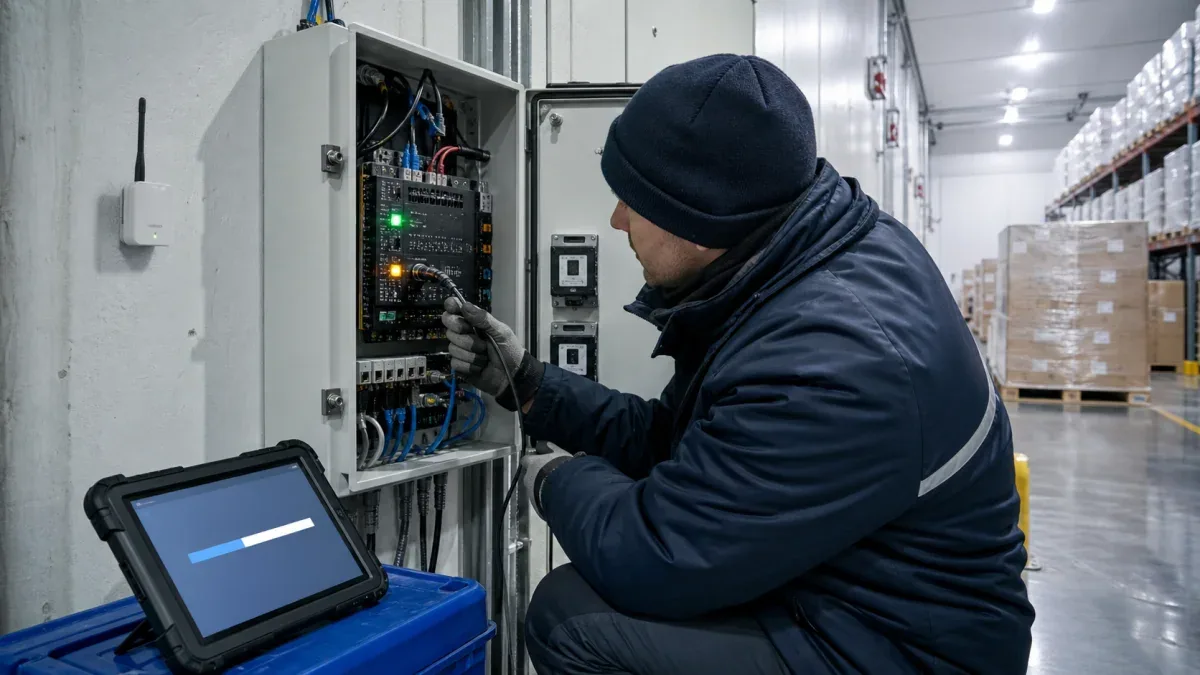
The field recovery path has a calculable operational cost: personnel, travel, downtime, site permission, and spares. Before release, count devices with automatic rollback, remote recovery, and field-only recovery. Keep canary exposure below the capacity available to recover the last group.
7. Offline and late devices decide whether a release can close
An IoT fleet is never online at once. Seasonal assets, mobile equipment, and weak sites may appear weeks after release creation. Treating “95% completed” as release closure leaves the remainder on vulnerable software or lets them install an already-aborted release later.
Give each release an explicit lifecycle. ACTIVE may admit eligible devices. HELD stops new dispatch while preserving evidence. SUPERSEDED points to a newer permitted release. EXPIRED forbids new installs. CLOSED means every target is terminal or sits in an exception queue with an owner. When a late device reconnects, rerun admission instead of trusting a weeks-old cached job. Cancel an aborted or expired job and resolve the current permitted path.
Reconcile ambiguous states such as half-downloaded, installed-without-report, or cloud-failed/device-successful. Persist release_id, stage, digest, and last error on the device. Use idempotent reports and a version read-back in the cloud. Do not assume a long IN_PROGRESS execution failed and reinstall it automatically. On reconnect, query local slot and running version, then continue, confirm, or rollback.
Break completion into confirmed success, automatic rollback, explicit rejection, deferred condition, invisible awaiting reconciliation, field service, and removed from scope. A release can close only when each bucket has a rule and owner. A green percentage chart cannot replace that responsibility ledger.
8. Start small without deleting the control-plane skeleton
A fleet of dozens may not need a full commercial OTA platform. Object storage/CDN, signing, a Device Job table, a device-state table, and a release worker can form a minimum loop. Still preserve the semantics: immutable manifest, target snapshot, admission, state machine, ring pacing, abort policy, health evidence, rollback target, and audit trail.
Build in four increments. First, prove signing, resumed download, A/B slots, and first-boot confirmation on engineering devices. Second, add cohort tags, release rings, and per-device job state. Third, connect business health, abort policy, and recovery ledger. Fourth, automate expansion only after fault injection covers weak networks, power loss, full storage, invalid signatures, driver initialisation failure, and cloud timeout. Recovery drills should precede rollout automation.
Before production, ask five questions. Does the first group cover the most dangerous failure domains? Which mature evidence authorises expansion? What happens to in-flight devices after a stop? Can a disconnected new image still reach the last-known-good version? Which release will a device install when it returns three weeks later? If the manifest, state machine, and recovery ledger answer these directly, the system has the foundation for fleet-scale OTA.
References and evidence boundary
- AWS IoT Jobs rollout, scheduling, abort, timeout, and retry
- AWS IoT Jobs API rollout and AbortConfig
- Azure Device Update deployment lifecycle and automatic rollback
- Azure Device Update groups
- ESP-IDF OTA validation and rollback
The project evidence behind this guide is an architecture and operations design for Device Jobs plus an earlier Edge AI versioning package. It is not fresh production telemetry from a customer fleet. The control shapes are reusable, but percentages, observation windows, service capacity, and SLOs must be calibrated on the target hardware, networks, workflow, and failure budget.