

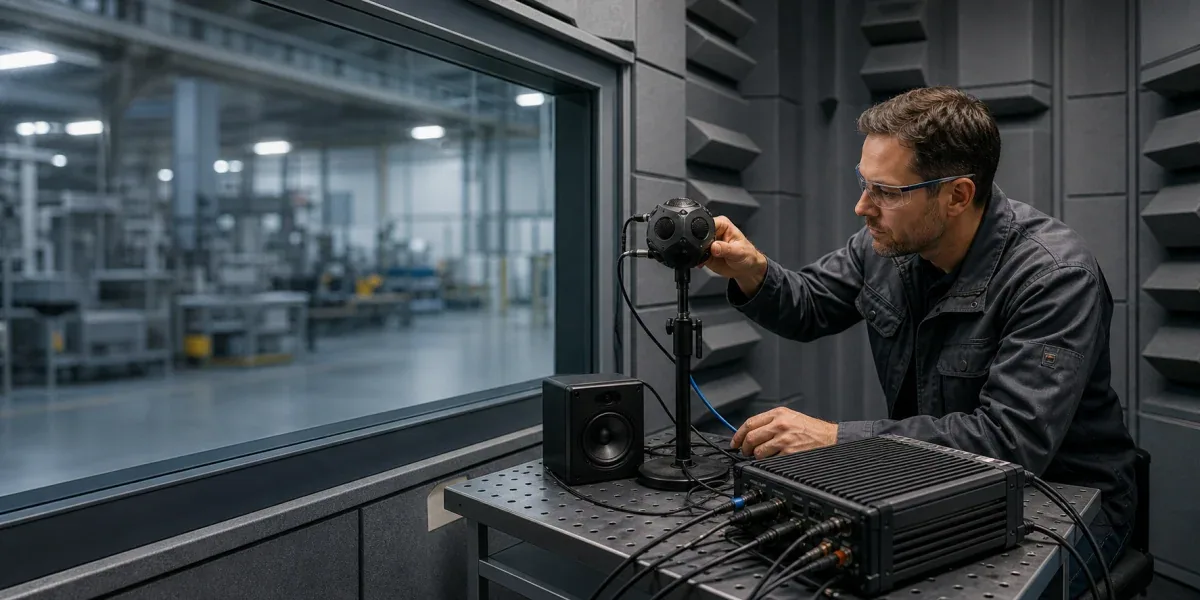
FunASR belongs on the shortlist when audio must remain in a factory, clinic, meeting room, or private network; transcription must continue during an Internet outage; or the team needs control over models, terminology, retention, and deployment versions. It is not one universal speech model. It is an open-source toolkit that can combine ASR, voice activity detection (VAD), punctuation, speaker processing, and several runtime paths.
A managed cloud ASR service is often the simpler choice when the project values managed regional infrastructure, elastic capacity, service-level commitments, and broad language support more than local control, and when approved governance allows audio to leave the site. The useful comparison is therefore not “which provider has the best accuracy?” Accuracy claims are not portable across microphones, noise, languages, hardware, and runtime configurations.
This guide supplies two project artefacts. An audio-boundary contract eliminates architectures that cannot satisfy privacy or availability requirements. A recognition error budget turns “the transcript sounds good” into testable business acceptance. The article uses current FunASR repository, model-selection, and deployment documentation. It does not claim measured performance on your hardware or audio.
1. Write the audio-boundary contract before downloading a model
The first document for a voice project should answer six questions: may raw audio leave the site; is the transcript equally sensitive; which functions must survive disconnection; is the workload a live stream, a minute-scale job, or overnight batch processing; is the output an editable transcript or an executable command; and who will own models, capacity, patches, and failed-job recovery after launch?
Those answers usually produce three architectural lanes:
- On-site closed loop: audio and text must stay on the local network and the service must work offline. Evaluate a local FunASR path and make model caching, authentication, and redacted logging mandatory.
- Private speech service: devices may send audio to a company data centre but not to a third-party cloud. Package FunASR as an internal HTTP or WebSocket service with central version and capacity management.
- Managed service: approved audio may enter a compliant cloud region, demand is volatile, and the team does not want to operate inference infrastructure. Validate managed ASR first and add a local path only if domain quality, cost, or offline requirements justify it.
The contract must also distinguish transcription from control. A mistaken ordinary word in meeting notes can usually be corrected. Confusing “stop” with “start” in a machine command cannot be covered by average word error rate. Executable voice actions need a constrained grammar, authenticated identity, current device state, safety interlocks, and explicit confirmation. ASR provides candidate text; it does not receive final control authority.
2. FunASR selection means choosing a model and a runtime
The FunASR project describes itself as a speech recognition toolkit for offline, streaming, and edge deployment. Toolkit features can include ASR, VAD, punctuation restoration, speaker pipelines, and models for emotion or audio events. The repository source uses the MIT License, while pretrained weights may carry separate terms. A commercial review must inspect the model card for every chosen checkpoint rather than treating the repository licence as a blanket model licence.
Current official guidance offers several starting points:
| Workload | Initial route to evaluate | Why it is a plausible baseline | Validation still required |
|---|---|---|---|
| Mandarin meetings, recordings, and operational transcription | Paraformer with VAD and punctuation | Established Mandarin-oriented file and streaming paths | Long-audio segmentation, numbers, domain terms, overlapping speakers |
| Multilingual transcription with emotion or audio-event labels | SenseVoice-Small | Non-autoregressive model with multiple speech-understanding outputs | Whether the extra labels serve a real requirement, language mix, long-audio handling |
| Difficult contextual audio across Chinese, English, Japanese, or dialects | Fun-ASR-Nano route | Official LLM-based ASR candidate | CPU/GPU runtime, first and final latency, memory, concurrency cost |
| Live captions, contact centres, and continuous audio | Runtime WebSocket service | Partial results and long-lived streaming | VAD endpointing, chunk size, backpressure, reconnects, slow clients |
| High-concurrency CPU or embedded realtime ASR | ONNX/C++ or GGUF route | More control over dependencies and deployment shape | Target silicon, threads, quantisation impact, concurrency, thermal behaviour |
This table identifies where to start testing; it does not declare a winner. The same checkpoint has different startup, concurrency, error-handling, and observability characteristics in Python, ONNX/C++, a WebSocket runtime, or an OpenAI-compatible API. Record model name and revision, FunASR version, runtime, hardware, quantisation, and launch command together. Without that bundle, an upgrade result cannot be reproduced.
3. FunASR creates different value across four voice workloads
Offline batch transcription is usually the easiest baseline. Recordings, videos, call archives, or inspection media enter a queue; VAD segments silence; ASR produces text; punctuation, speaker labels, and terminology corrections follow. Time-to-first-token may be less important than processing cost per audio hour, safe retries, and traceability. Save input checksums, model versions, segment timestamps, and failure reasons instead of producing an untraceable block of text.
Live captions and meeting assistants add endpointing problems. Segments that are too short lose context; long segments delay final text. Partial text may be revised later, so the user interface must distinguish tentative and final output. The connection layer must handle reconnects, duplicate chunks, slow consumers, and silence. FunASR's deployment matrix explicitly asks teams to validate chunk size, VAD, endpointing, punctuation, diarisation, reconnect behaviour, and client backpressure with real audio. A different model does not remove those state-management problems.
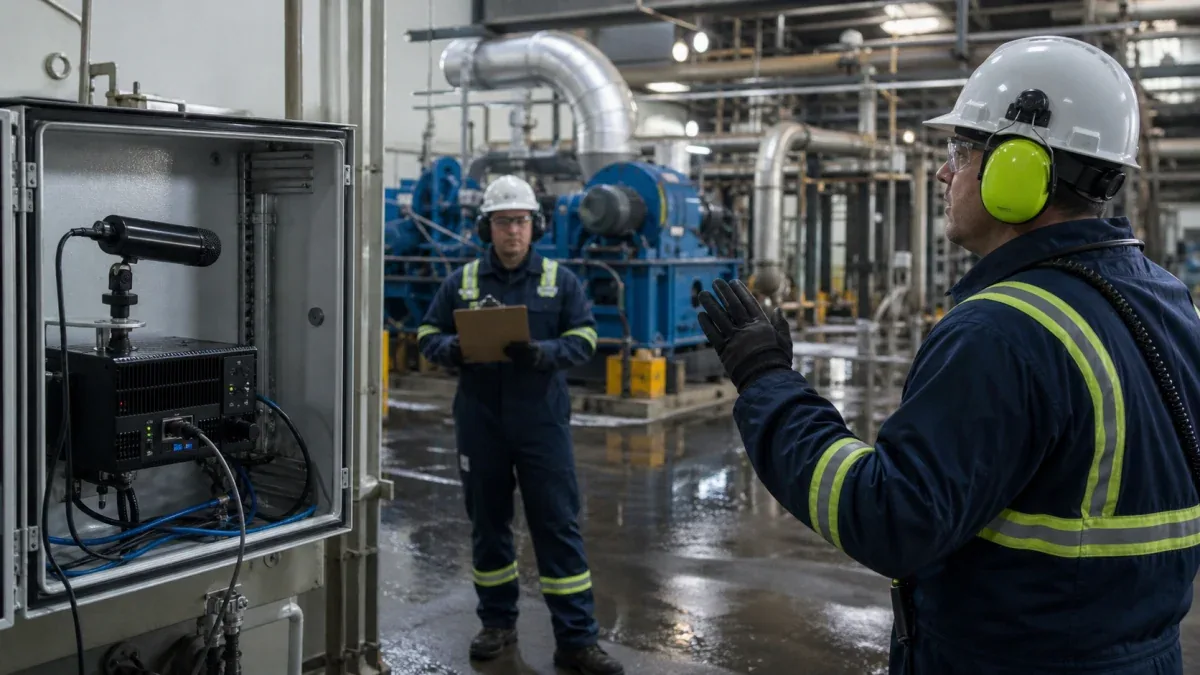
Industrial or device voice input is dominated by containment. Machinery noise, reverberation, masks, hearing protection, far-field microphones, equipment codes, and code-switching all change the input distribution. FunASR can turn audio into text on a local edge computer, but start, stop, unlock, payment, or configuration changes must pass a command allowlist, user identity, device-state, risk, and confirmation gate. Uncertain, late, or out-of-grammar results should be rejected instead of sent to an LLM to guess.
Contact-centre and domain dictation depend on terminology and auditability. Hotwords may help company names, product codes, and specialised terms, but they are not an accuracy guarantee and can amplify homophone errors. Deterministic post-processing is a reasonable first step for fixed known terms. Decoder-time biasing or a more contextual model should be tested only when the evidence requires it. Medical, legal, and customer commitments also need source-audio location, human amendments, and version history; an automatic transcript is not a final record by itself.
4. The minimum production architecture for private ASR
A reliable local speech service is more than a loaded model behind an open port. Separate acquisition quality, segmentation, recognition, text normalisation, risk decisions, and completion evidence:

The input gate rejects unsupported codecs, sample rates, empty files, excessive uploads, and obvious clipping, then assigns stable segment identities. Pin the inference version. A process /health response is not enough; use known audio to verify actual inference. Add authentication, TLS, upload-size limits, rate limits, and tenant isolation before exposing the API beyond a trusted network. Those controls also appear in the official FunASR readiness checklist.
Record audio duration, checkpoint and revision, device, queue time, first-partial latency, final latency, failure type, and output segment count. Do not place raw audio or full transcripts into ordinary application logs by default. When retention is required, define purpose, roles, encryption, retention period, and deletion workflow.
5. Replace “good accuracy” with a recognition error budget
WER and CER are useful, but neither independently proves business fitness. Build a stratified evaluation set from the target distribution rather than clean demo speech. Cover short commands, long passages, silence, noise, reverberation, overlapping speakers, target accents, numbers, negation, product names, equipment codes, and replay after a network break. Official FunASR model guidance suggests starting with 20–50 representative files and tracking quality, latency, throughput, memory, failures, and upload limits together.
A recognition error budget has four layers:
- Text errors: WER/CER, recall for numbers and domain terms, punctuation, and timestamp deviation.
- Interaction errors: early VAD cuts, late endpointing, unstable partial text, and duplicates after reconnect.
- Business errors: wrong customer or device match, lost negation, accepted dangerous command, and human correction rate.
- Runtime errors: timeout, out-of-memory, queue overload, model-download failure, and bad first request after restart.
Assign a treatment to each failure. Editable transcription can flag a segment for review. Live captions may delay confirmation. A low-risk query can ask the speaker to repeat. A safety-relevant command must fail closed. The business owner should define what level blocks release; then every candidate must run against the same audio, hardware, and runtime.
6. FunASR versus managed cloud ASR
| Decision dimension | Leans towards FunASR / private deployment | Leans towards managed cloud ASR | Common false assumption |
|---|---|---|---|
| Data boundary | Audio or text cannot leave the site, private network, or owned region | An approved cloud region and data-processing agreement are acceptable | Local does not automatically mean secure |
| Availability | Operation must continue offline and an edge node can be maintained | Internet dependency is acceptable | API reachability is not end-to-end availability |
| Capacity | Load is predictable and the team can manage queues and sizing | Demand is bursty and elastic service is valuable | A local single-user demo proves no concurrency |
| Language and domain | Target audio can be evaluated and adapted directly | Broad managed language features are required | A vendor benchmark represents your microphones |
| Operations | The team owns containers, compute, monitoring, and security | The team wants an API and managed SLA | Open source means zero operating cost |
| Economics | Stable volume and reusable hardware support ownership | Low or volatile use makes metering convenient | Engineering, on-call, upgrades, and failures are free |
A hybrid design is often more practical than a binary choice. Keep privacy-sensitive or outage-critical transcription on-site and send approved, low-risk long-form audio to a managed service. Alternatively, perform local VAD and constrained command recognition while routing only clips that need advanced multilingual processing. Both paths must share an output schema, deduplication identity, and audit fields so that fallback cannot trigger a business action twice.
7. A pilot plan without invented performance targets
Start with data and boundaries. Confirm consent and retention, collect authorised clips from the target environment, and label speaker, noise, language, terms, and critical business fields. Identify red cases such as negation, numbers, decimals, equipment actions, and names.
Create a reproducible baseline using the simplest Python or OpenAI-compatible API path. Pin checkpoint, revision, FunASR version, command, runtime, and hardware. Emit machine-readable results and state whether model download and warm-up are excluded. Add VAD, punctuation, diarisation, or hotwords one change at a time so that an improvement has an attributable cause.
Move into the target runtime only after the baseline. Streaming projects then test WebSockets, chunks, reconnects, and backpressure. Batch projects test queues, long files, concurrency, and replay. Edge projects add temperature, disk, disconnection, restart, and model-update checks. Connect downstream systems only after the error budget passes, initially in suggestion or draft mode.
Finish with shadow traffic. The existing path remains the system of record while the new ASR produces comparison results. Humans review disagreements and high-risk segments. Expand traffic only when quality, latency, capacity, security, and rollback have evidence. A higher version number is not evidence that a model upgrade is safer.
8. When FunASR is the wrong choice
Prefer a managed service when nobody owns Linux or containers, model cache, compute capacity, monitoring, vulnerability remediation, and upgrade regression, while the project still requires a defined SLA. Open source reduces one kind of dependency by transferring operating responsibility to your team.
Do not launch from a clean demo when the target language, accent, or audio type lacks representative and lawfully collected evaluation data. Obtain the data and annotation conditions first, or select a service with explicit coverage and support.
No FunASR model, cloud API, or other single recogniser should make a final safety, financial, medical, or legal decision. Add deterministic policy, authorisation, human confirmation, domain transactions, and complete audit. Recognition output is evidence, not authority.
9. The decision in one page
FunASR fits teams with a clear local or offline boundary, a Chinese-first, meeting, industrial, or private-transcription workload, and the willingness to own evaluation and operations. Its strength is the ability to choose models and runtimes inside an owned environment and compose VAD, punctuation, speaker processing, and business interfaces. The trade-off is equally important: the team must prove quality, size capacity, protect the API, manage upgrades, and review each model-weight licence.
Use the audio-boundary contract to remove unsuitable architectures, compare FunASR and managed candidates through one recognition error budget, and finish with a shadow pilot on target hardware and real audio. For help integrating private speech into devices, operations, meetings, or enterprise workflows, see our FunASR AI development capability. For the wider division of responsibility across language models, orchestration, vision, and voice, read our enterprise AI toolchain decision guide. Our ASR and TTS deployment decision guide provides additional background on recognition versus speech generation.