

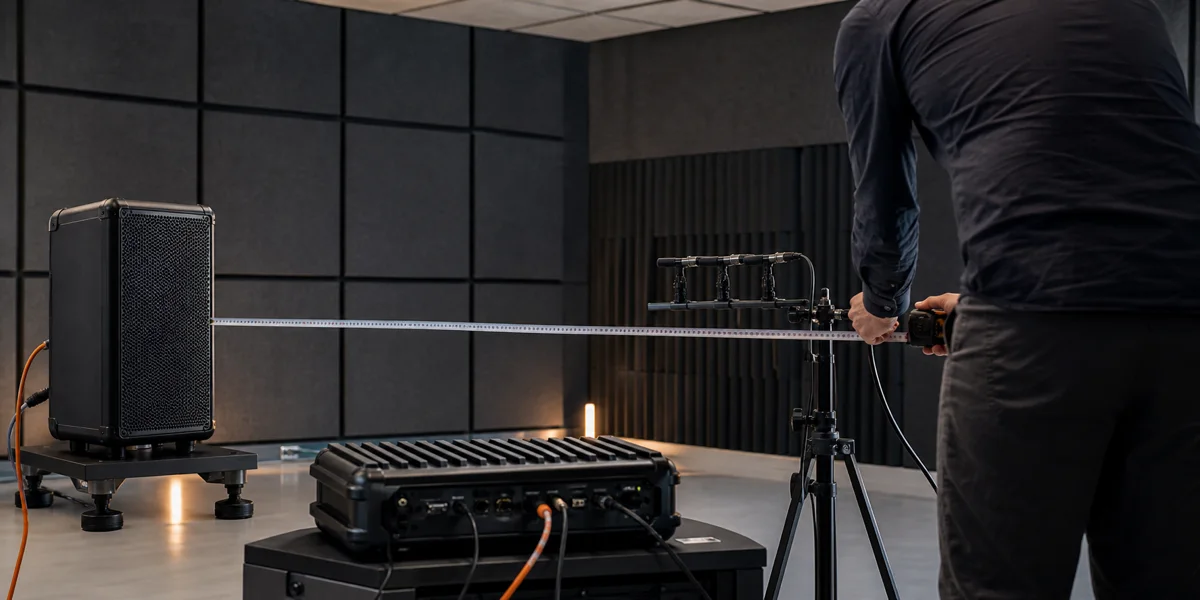
ASR and TTS are not competing models. They are two pipelines running in opposite directions: automatic speech recognition turns audio into text, while text-to-speech turns text into audio. The useful enterprise question is therefore not “ASR or TTS?” It is two separate questions: may raw input audio leave the device or site, and must recognition survive a network outage; must synthesized audio start immediately, use a governed voice, or remain available offline?
The default decision can be explicit. When requirements are changing, demand is bursty, and nobody owns a model-serving platform, begin with managed APIs and a measurable business loop. Move an ASR or TTS stage to the edge only when raw-audio policy, offline duty, measured round-trip limits, or stable long-running demand justify owning capacity and lifecycle operations. Hybrid placement is not a weak compromise. It is the deliberate separation of duties that must remain local from duties that may use a cloud service.
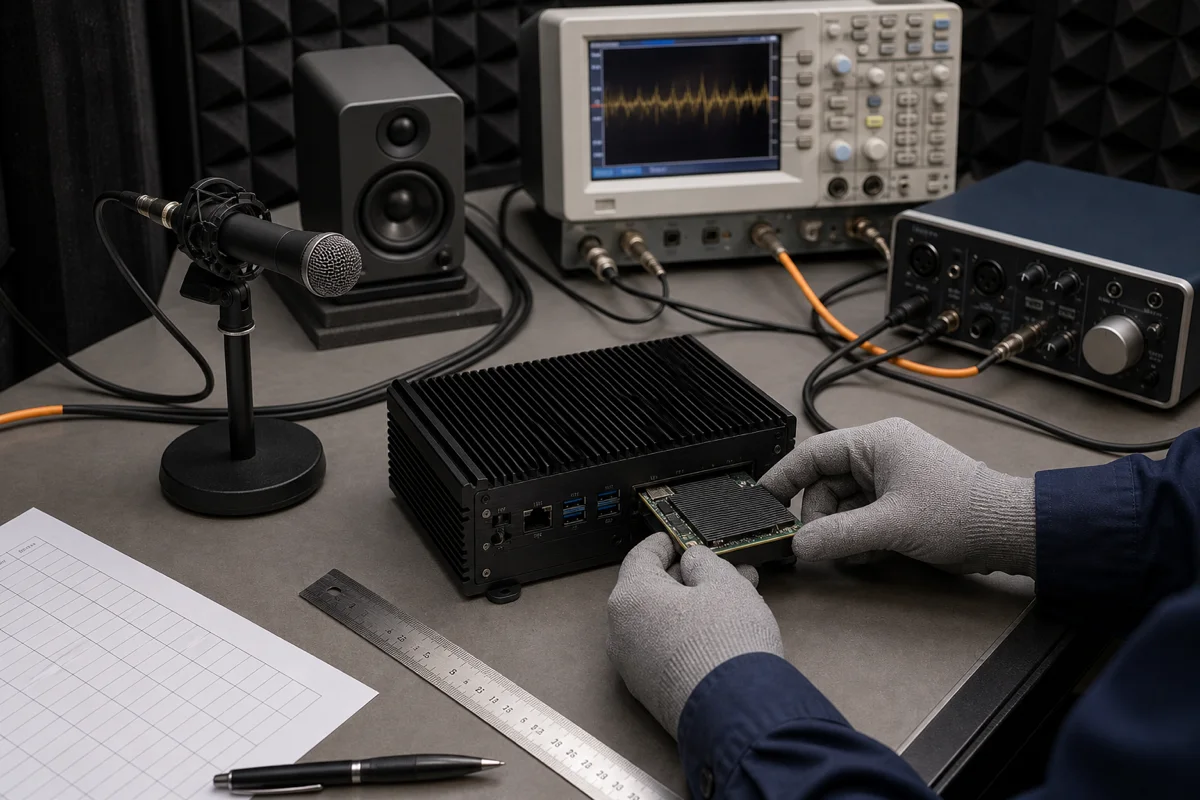
1. Start with two data flows moving in opposite directions
ASR's sensitive surface is its input. A microphone may capture voices, location clues, operating conditions, and conversations that were not intended for the product. Even if the application retains only text, upload buffers, retries, service logs, and diagnostic samples create an audio path. The first ASR elimination rule follows: if raw audio may not leave the device, factory, or private network, a cloud recognizer cannot be the default candidate.
TTS has a different sensitive surface: output content and voice rights. The input may contain a routine prompt, a health record, a security alert, an internal work order, or an operational command. A custom voice adds consent, permitted purpose, revocation, and misuse controls. TTS selection is consequently not a contest for the most human-sounding demo. It must define time to first audio, interruption recovery, pronunciation dictionaries, voice versioning, and the ability to revoke or replace a voice asset.
The two stages can use different placements. A factory terminal can keep wake-word detection, voice activity detection, endpointing, and sensitive commands on site while sending explicitly permitted general queries to a managed recognizer. The TTS side can cache high-frequency fixed prompts locally and synthesize only dynamic content through a managed service. This split is more testable than labelling the entire product “cloud” or “on premises.”
2. Use a placement matrix before comparing models
| Constraint | Cloud-first | Hybrid-first | Local or edge-first |
|---|---|---|---|
| Raw audio boundary | Export is permitted and retention/deletion are controlled | Filter, redact, or select audio locally | Raw audio may not leave the device or site |
| Offline duty | The feature may pause or escalate to a person | Critical intents stay local; complex requests use cloud | Recognition or playback must continue during outage |
| Latency | Network and provider queue fit the measured budget | Local VAD, endpointing, or cache removes dominant delays | Field traces prove the cloud path cannot meet the limit |
| Demand | Low, bursty, or rapidly changing | Stable baseline local; overflow to cloud | Sustained demand supports capacity and on-call ownership |
| Domain adaptation | Hints and dictionaries are sufficient | Local rule/keyword path plus general cloud recognition | Controlled models, dictionaries, and release cadence are required |
| Operations | The team does not own inference capacity | The team owns only mandatory local components | Named owners cover images, models, metrics, regression, and rollback |
For ASR, local placement often starts with front-end work rather than a complete private recognition cluster: wake word, VAD, endpointing, noise handling, critical commands, or sensitive-data filtering. For TTS, the first local asset is often a cache of frequent, fixed, safety-relevant prompts rather than a service that synthesizes every dynamic paragraph.

3. Total cost is not an API price comparison
Managed ASR is commonly metered by processed audio duration, channel count, model, and processing mode. Managed TTS can be metered by characters or by text and audio tokens. Google's current official rules illustrate the distinction: Speech-to-Text counts successfully processed audio in one-second increments and bills channels separately, while traditional Text-to-Speech models count characters and newer models may meter text and audio tokens. Prices and free allowances change. A production decision should link to the current official page instead of treating a figure copied into an article as a contract.
Local cost must include compute, spares, energy, storage, model and container releases, dictionaries, voice assets, metrics, regression, on-call duty, security updates, and failure recovery. Distributed edge sites add installation, failed-upgrade recovery, and physical replacement. A system with no API invoice can be more expensive than cloud operation because its cost is distributed across people and equipment.
This revision includes a reproducible payload probe performed on the current Mac. It did not run an ASR or TTS inference model. Two synthesized samples converted to 16 kHz mono PCM measured approximately 32 KB/s. The same samples encoded to Opus with a 24 kbps target measured approximately 3 KB/s. The narrow conclusion is that encoding materially changes transport and storage scale. A real estimate still adds TLS and request framing, buffers, retries, metadata, object storage, replicas, retention, and egress. Commands and measurements are retained in evidence/audio-payload-probe.txt.
Three formulas establish a comparable cost envelope:
- Managed ASR cost = effective audio minutes x channels x current rate + storage, transport, and processing.
- Managed TTS cost = billable characters or tokens x current rate + generated-audio delivery and cache cost.
- Local monthly equivalent = amortized compute and spares + site operations + platform/model labor + expected incident and field-support cost.
The formulas are comparable only when they use the same demand window, retention policy, and availability objective. Comparing a cloud proof of concept with a highly available edge fleet produces a false break-even point.
4. Evaluate business loss, not just WER or pleasant sound
ASR needs an evaluation pack tied to business consequences. Word error rate is widely used, and NIST SCTK provides alignment and scoring tools. Chinese workflows often add character error rate, but segmentation, number normalization, punctuation, and domain terms can materially change the score. More importantly, recognizing “close pump three” as “close pump five” has a larger consequence than dropping a filler word. Numbers, negations, asset names, command parameters, and safety-sensitive intents therefore need separate pass rates in addition to WER or CER.
TTS evaluation must separate human likeness from task fitness. Measure time to first audio, total synthesis time, real-time factor, long-input stability, abbreviation and number pronunciation, domain names, intelligibility on target speakers and in target noise, plus MOS or task success under a defined blind-test protocol. Listening to a hand-picked demo in the development team is not a blind test.
| Layer | ASR measures | TTS measures | Shared operational slices |
|---|---|---|---|
| Quality | WER/CER, critical entities, negation, high-risk intents | Pronunciation, intelligibility, MOS/task success, long-text stability | Language, scenario, device, and version |
| Latency | Endpoint, first partial, final result, RTF | First audio, total synthesis, RTF | p50/p95/p99, timeout, queue, cold start |
| Reliability | Empty result, truncation, repetition, language-switch failure | Silence, interruption, repetition, voice drift | Error, retry, fallback, resource use |
| Governance | Audio retention, transcript correction, PII | Input text, voice consent, misuse trace | Tenant, app, site, model-version audit |
The official Whisper model card explicitly describes uneven performance across languages and accents, hallucination risk, and the need for robust evaluation in the target context. FunASR's official deployment matrix lists Python, API, Docker, Kubernetes, WebSocket, ONNX, and C++ routes. These sources do not prove that either system is best for an enterprise corpus. They support a more modest and useful conclusion: target audio, runtime, and service behavior must be evaluated together.
5. Observability must separate network, model, and product failures
A report that “the voice assistant did not respond” can originate in capture, VAD, endpointing, encoding, network, authentication, ASR, intent logic, a business tool, TTS, or playback. If the application records only total latency and one error code, operators cannot tell whether the user did not finish speaking, upload retried, inference queued, or the output device failed.
Give each session a trace identifier. Connect capture start, detected speech start/end, encoding completion, first ASR partial, final transcript, business result, first TTS audio, and playback completion into one timeline. Raw audio and text do not need to enter routine logs. Length, hashes, language, version, site, result class, and latency buckets can support operations, with identifiable content restricted to an approved sampling workflow.
Runtime events should identify version, route, and fallback outcome. Useful fields include asr_model_version, tts_voice_version, route=local|cloud|cache, fallback_reason, audio_duration_ms, queue_ms, first_result_ms, and first_audio_ms. These make old/new comparisons possible and prove whether a degradation path actually ran during an incident.
6. Upgrades and rollback revolve around a corpus contract
Voice-model upgrade risk is not limited to a service failing to start. A new ASR release may improve average WER while regressing a family of asset names, an accent, or negation. A more natural TTS voice may change abbreviations, alarm levels, or number pronunciation. Container health checks will not detect those failures.
Each release candidate must lock model or voice, runtime, dictionary, normalization rules, and configuration. Replay a versioned corpus and segment results by language, site, device, microphone, noise, and critical intent so that an average cannot hide a critical regression. Use shadow traffic or a bounded canary before changing the default route.
Rollback cannot depend on downloading a large model again at an impaired field site. An edge node should retain the last accepted model and required dictionaries, switch atomically, and define behavior for timeout, resource exhaustion, quality regression, consent revocation, and network recovery. TTS cache objects must be keyed by text, language, voice, dictionary, and generator version to prevent mixed pronunciations after an upgrade.
7. Three failure patterns expose unsuitable architectures
Failure pattern one: moving everything on device to reduce latency without first measuring the network path. The dominant delay may be endpoint waiting, a business API, or playback buffering rather than cloud inference. Instrument the path first and move only a dominant, controllable stage.
Failure pattern two: selecting ASR on quiet laboratory recordings. Field microphones, distance, motor noise, echo, accents, overlapping speech, and device variation can reverse the result. Without representative samples from target equipment and environments, the team cannot make a production accuracy claim.
Failure pattern three: equating open-source TTS with zero cost and unrestricted voice rights. A local engine such as Piper provides a practical local synthesis path, but the exact engine, voice model, training-data statement, distribution path, and product use still require review. The team also owns dictionaries, capacity, and security maintenance.
Cloud-first is unsuitable when raw audio cannot cross the boundary, critical operation must survive an outage, or output voice and content need strict organizational control. Local-first is unsuitable when demand is exploratory, languages and features change quickly, sites lack manageable compute, or no owner covers metrics, patches, dictionaries, regression, and rollback.
8. A 30-day pilot can produce a defensible decision
In week one, define the contract. List the boundary for audio, text, logs, voice, and cache. Mark the intents that must survive offline operation. Define business-error and latency limits and name operations and rights owners.
In week two, build the samples. ASR coverage includes target microphones, environments, languages, accents, critical entities, and failure conditions. TTS coverage includes numbers, units, abbreviations, domain names, long text, alerts, and playback in quiet and noisy conditions. Version the corpus and use it unchanged across candidates.
In week three, compare cloud, hybrid, and local baselines under the same workload. Capture quality, latency, capacity, resources, failure modes, and real labor. Do not put results from different networks, corpora, or concurrency levels into one ranking.
In week four, inject outage, rate limit, managed-API timeout, edge resource exhaustion, model-quality regression, dictionary mismatch, and voice revocation. A design enters release review only when traces prove its fallback and rollback behavior.
The final decision is not whether cloud or local is more advanced. It is which placement stays inside the data boundary, achieves quality and availability at an acceptable total cost, and can be safely withdrawn when the next upgrade fails.
Conclusion
ASR and TTS require independent selection. ASR centers on raw-audio boundaries, recognition consequences, and offline duty. TTS centers on time to first audio, pronunciation contracts, voice rights, and cache lifecycle. When requirements are unstable and operations ownership is absent, cloud services are the lower-risk baseline. When privacy, outage survival, or a measured latency limit becomes a hard constraint, localize the affected stage.
A sustainable voice product is not built around a permanent model list. Its durable assets are target corpora, segmented measures, observable timelines, cost envelopes, and verified rollback. Those assets remain useful when model names change next year.
FAQ
Must ASR and TTS use the same provider?
No. Their data directions, evaluation criteria, and failure modes differ. Session tracing, authentication, rate limits, versioning, and fallback should still be unified at the product layer.
Is local ASR always faster than managed ASR?
No. Edge compute, model size, endpointing, concurrency, and cold start all change the result. Measure an end-to-end trace instead of one inference call.
When should TTS be pre-generated?
High-frequency, stable prompts that must play offline are strong candidates. Key each object by text, language, voice, dictionary, and generator version.
Does open source mean unrestricted commercial use?
No. Review the engine code, model weights, voice assets, training-data statements, and distribution plan for the exact versions used.