

The most expensive mistake in local AI selection is not choosing the second-best model. It is downloading a popular model before defining where data may go, how many requests must run concurrently, what latency is acceptable, and who owns the service after the demo. A model loading on a laptop proves that a file can be loaded. It does not prove that a knowledge assistant can be accepted, that the license fits commercial use, or that an upgrade will preserve business behavior.
A stronger process starts by deciding which data and tasks must remain local. It then establishes compute, latency, concurrency, and operations limits. Only after those constraints are explicit should a team shortlist model families and compare them on its own data. Local deployment is a decision about control and execution location; model selection is a joint decision about task quality, capacity, licensing, and lifecycle. A top-ten list cannot replace either.
1. Reject the wrong question before ranking models
Generic lists often mix open-weight models, hosted APIs, research releases, and commercially licensed weights, then summarize them with labels such as “good at reasoning” or “runs on one GPU.” That creates three engineering errors.
First, callable does not mean self-deployable. A candidate belongs in a local deployment shortlist only when the organization can legally obtain the weights and operate them on infrastructure it controls. Hosted services such as Claude or Gemini can be evaluated as cloud or hybrid alternatives, but they are not local-weight candidates.
Second, parameter count is not business quality. General, coding, reasoning, multimodal, and embedding models serve different contracts. A knowledge assistant needs citations and safe refusal. A coding assistant needs repository context. An edge assistant must respect power, package size, cold start, and offline operation. A public benchmark cannot substitute for those conditions.
Third, “it runs” does not mean “we can operate it.” A production service needs identity, rate limits, logs, version control, regression tests, staged rollout, rollback, and capacity alerts. Without those owners, private deployment replaces a visible API bill with less visible infrastructure and operational cost.
The first pass should therefore eliminate options that fail data, licensing, capacity, or ownership requirements. Scoring starts only after those hard constraints are satisfied.
2. Translate the business request into five hard constraints
An actionable selection brief needs at least five constraint groups.
| Constraint | Required question | Consequence if omitted |
|---|---|---|
| Data boundary | May source text, prompts, retrieved passages, logs, and outputs leave the private network? | “Local” is treated as safe while vectors or logs still leave the boundary |
| Task contract | How are outputs, refusals, citations, and structured fields accepted? | Teams compare chat impressions instead of business fitness |
| Capacity budget | What are peak concurrency, context, first-token, and total response limits? | A single-user demo becomes a queued or out-of-memory service |
| License and supply | Which weight, derivative, and commercial terms apply to the exact version? | A successful pilot cannot proceed under the intended business model |
| Operational ownership | Who owns images, weights, quantization, monitoring, regression, upgrade, and rollback? | Incidents cannot be assigned to model, runtime, data, or application layers |
The data boundary deserves more detail. Some factories prohibit raw data from leaving a site but allow anonymous metrics in the cloud. Some organizations prohibit retention but permit controlled inference. Others require operation through a network outage. Those constraints lead to local-only, local-first with cloud escalation, or cloud-first with local sensitive workloads. Calling all three “private AI” hides the architecture decision.
The task contract must also be testable. “Build a knowledge base” is not a contract. “Every answer must cite an approved passage, refuse unsupported questions, return a valid schema, never issue direct device control, and fall back to a rule or human on timeout” is testable.
3. Use capacity bands to shrink the shortlist
This revision includes a reproducible static capacity check on the current work machine. It is an Apple M1 system with 16 GiB of unified memory. After reserving 4 GiB for the operating system and applications, the planning budget is 12 GiB. The script estimates Q4 weight storage at approximately 0.5 byte per parameter and adds 25% planning headroom.
The resulting planning values are about 4.66 GiB for 8B and 8.15 GiB for 14B. They are about 18.63 GiB for 32B and 40.75 GiB for 70B, which exceed this machine's planning budget. This is not a throughput benchmark. It excludes KV cache, context growth, concurrency, runtime fragmentation, and architecture-specific behavior, and no model was executed.
The defensible conclusion is narrow: 32B and 70B should not enter the first single-machine pilot on this 16 GiB host. Small models and some 14B variants still require real runtime tests. The script and exact output are retained in the evidence package.
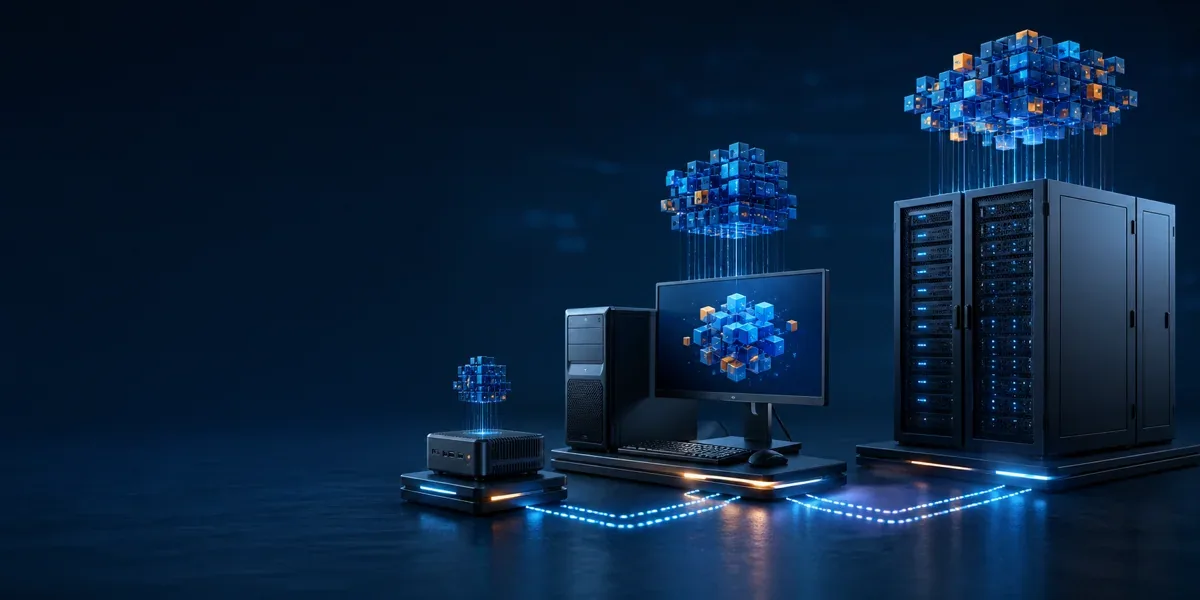
Three capacity bands help organize the next step:
| Band | Typical candidates | Better-fitting jobs | First validation target |
|---|---|---|---|
| Device or small edge | 0.5B–4B, usually quantized | Classification, extraction, short summaries, controlled routing, offline assistance | Power, package size, cold start, offline stability |
| Workstation or single node | 7B–14B, quantized or low precision | Internal assistants, RAG, coding support, low-concurrency multimodal work | Long-context memory, queueing, first-token latency |
| GPU server or cluster | 30B+ or large MoE | Higher-quality reasoning, complex coding, shared service | GPU topology, throughput, elasticity, cost, failure domains |
MoE models add a common trap. Fewer active parameters per token do not make total weights, model loading, interconnect, and runtime requirements disappear. Capacity planning must use the exact checkpoint, quantization, context, and inference backend.
4. Group model families by task, not popularity
A durable shortlist is a set of replaceable model families, not a permanent ranking. Official sources show that Qwen3 spans small dense and MoE variants and documents local or service paths through Ollama, llama.cpp, vLLM, and SGLang. Gemma 3 spans compact text models and 4B, 12B, and 27B multimodal variants. Mistral 3 includes 3B, 8B, and 14B Ministral candidates for local and edge use. Phi-4-mini targets compact and edge scenarios. DeepSeek-R1 publishes distilled variants derived from Qwen and Llama families. Llama has its own weight access, license, and local inference requirements.
Those facts create candidates; they do not select a winner.
| Workload | Example families for a pilot | Validate first | Do not infer |
|---|---|---|---|
| Chinese RAG and tool use | Appropriate Qwen3 4B/8B/14B variants | Citation, refusal, JSON, domain terms, tool arguments | Public benchmark rank equals internal factual quality |
| Lightweight edge and offline assistant | Small Gemma 3, Phi-4-mini, Ministral 3 3B/8B | Footprint, power, cold start, offline behavior | An “edge” label means it runs on any IoT chip |
| Reasoning and analysis | DeepSeek-R1 distills, Qwen reasoning variants | Reasoning latency, output length, verifiability, cost | More reasoning tokens are always safer or cheaper |
| General enterprise assistant | Suitable Llama, Qwen, Gemma, or Mistral variants | Language, RAG, tools, governance, license | One model can optimize every department’s workflow |
| Shared high-throughput service | Candidates supported by vLLM, SGLang, or TensorRT-LLM | Batching, concurrency, GPU utilization, recovery | Workstation results extrapolate directly to a cluster |
Model versions, backend support, and licensing can change. The maintainable asset is the task contract, test data, and decision record—not the leaderboard published on one date.
5. Apply a weighted score only after hard elimination
A weighted matrix must not compensate for hard failure. Set elimination thresholds first: incompatible license or weight access; measured peak memory above budget; critical-task success below the business threshold; or an unauditable sensitive-data path. Any one of these removes a candidate.
Then score the remaining options. A practical starting matrix for knowledge and IoT operations assistants is:
| Dimension | Weight | Reproducible measure |
|---|---|---|
| Task correctness and refusal | 30% | Real-question pass rate, unsupported refusal, citation consistency |
| Capacity and latency | 20% | Peak memory, p50/p95 first token, total response, concurrency |
| Data and security boundary | 15% | Egress points, log content, identity, network, storage controls |
| Operability | 15% | Metrics, logs, traces, versioning, canary, rollback |
| License and supply stability | 10% | Weight source, license, pinned images, dependency health |
| Three-year TCO | 10% | Hardware, hosting, power, support, upgrade, incident cost |

Lock model version, quantization, system prompt, sampling, context, retrieval, and hardware before testing. Otherwise the team compares configurations, not models. Blind business review is useful: hide model names and let reviewers grade answers, citations, formatting, and failure type.
6. Include idle capacity and operations in TCO
Local deployment is not automatically cheaper. Cloud cost is often usage-based. Local cost includes peak capacity, idle time, power, facilities, spares, networking, support, upgrades, and on-call work. A simple three-year model is:
TCO = servers and accelerators + facilities and power + software/support + platform engineering + evaluation/upgrades + incidents and idle capacity
For low-volume work with controlled data egress, a hosted API may cost less because the company does not buy peak capacity. For steady high volume, strict data locality, or mandatory offline operation, local infrastructure may be justified. A hybrid design can keep sensitive or offline tasks local and escalate difficult low-frequency requests to a governed cloud service, but it needs classification and fallback rules.
Edge fleets add lifecycle cost. Once a model reaches hundreds of store gateways or industrial nodes, distribution, resumable updates, disk space, rollback packages, power, and thermals matter. A smaller model can be valuable because it is easier to distribute, start, and revert—not just because one prompt is faster.
7. Production ownership includes observation, upgrade, and rollback
Track at least three version layers: model weights and quantization, inference runtime and image, and prompt/retrieval/tool configuration. Recording only “Qwen” or “Llama” cannot reproduce an incident. A family may stay constant while tokenizer, chat template, quantization, context, or tool behavior changes.
Minimum telemetry includes request volume, queue time, first-token and total latency, input/output tokens, peak memory, timeouts, OOM, structured-output failures, retrieval hit, missing citations, refusal, and human takeover. High-risk workflows should also record whether a recommendation was accepted, but logs must not retain sensitive text without control.
Do not overwrite production during an upgrade. Pin the old stack and regression set, run old and new configurations on identical inputs, compare quality, latency, memory, and failure modes, then canary the new version. Define rollback triggers in advance: p95 latency over limit, doubled schema failures, lower critical-question success, or repeated OOM. Keep old weights, image, configuration, and compatible data schema ready.
8. Preserve failure cases, not only successful demos
Failure one is leaderboard success but task failure. A reasoning model scores well publicly but produces long, slow, unstable JSON for an internal ticket workflow. The answer is not endless prompt tuning. It may be a smaller instruct model aligned with the contract.
Failure two is single-user success but capacity failure. A demo runs on an idle workstation. Shared use adds context, concurrency, and KV cache, creating queues and OOM. The remedy is a peak test, concurrency control, context limits, and degradation—not a claim that the model “runs on one GPU.”
Failure three is local execution but governance failure. Weights and documents stay inside the network, but the API has no identity, logs store full prompts, or RAG returns another department's content. The defect is access control, data classification, and audit design. “Local” is not the security conclusion.
9. When local deployment should not be the default
If volume is low, controlled egress is acceptable, the team lacks model-platform operations, and the task depends on rapidly evolving frontier reasoning or multimodality, a governed cloud service may be the better first choice. Buying a GPU cluster before stabilizing the workload turns exploration into sunk cost.
For hard real-time control, safety interlocks, or high-impact automated decisions, an LLM should not be the final controller, local or cloud. It can generate an explanation or candidate action, but deterministic rules, state machines, authorization, and human confirmation should own execution.
If license terms, weight provenance, dependency images, and security updates cannot be maintained, “open” does not make the model production-ready. Open weights reduce access friction; they do not provide supply-chain or lifecycle guarantees.
10. What a useful pilot must leave behind
A two-to-four-week pilot should produce a version-pinned shortlist; a real, de-identified business test set; pass, failure, refusal, and human-review definitions; fixed hardware and parameters; memory, latency, concurrency, and error evidence; license review; identity and logging design; a three-year TCO assumption; and an exercised upgrade and rollback path.
An installation screenshot and a few chat transcripts are not enough for procurement or production. Even if the final decision rejects local AI, a pilot that establishes data boundaries, capacity limits, and failure modes has produced a reusable decision asset.
11. Decision for program owners
Use a two-stage process. First, eliminate options that fail data, license, capacity, or operations requirements. Then compare the survivors under the same business contract with blind review and TCO. 3B, 8B, 14B, and 32B are capacity entries, not quality conclusions. Qwen, Gemma, Mistral, Phi, DeepSeek, and Llama are candidate families, not a permanent order.
If the team lacks a task contract and regression set, do not argue about brands. If it lacks peak capacity evidence, do not label “runs” as “production-ready.” If it lacks access control and rollback, do not label “local” as “secure.” For a controlled path from PoC to production, see ZedIoT AI Development and Ollama for Local AI and Private Deployment.
References and evidence boundary
- Qwen3 official repository: https://github.com/QwenLM/Qwen3
- Google Gemma 3 model card: https://ai.google.dev/gemma/docs/core/model_card_3
- Mistral 3 official announcement: https://mistral.ai/news/mistral-3/
- Microsoft Phi-4 mini announcement: https://techcommunity.microsoft.com/blog/educatordeveloperblog/welcome-to-the-new-phi-4-models—microsoft-phi-4-mini–phi-4-multimodal/4386037
- DeepSeek-R1 official repository and license: https://github.com/deepseek-ai/DeepSeek-R1
- Meta Llama models repository: https://github.com/meta-llama/llama-models
- Ollama model library: https://ollama.com/library
- Local evidence:
evidence/local-capacity-check.shandevidence/local-capacity-check.txt
No model was executed for this revision, so this article reports no tokens-per-second result or quality ranking. Vendor benchmarks identify candidate capabilities and deployment forms only. Final selection requires the organization's own data, hardware, parameters, and acceptance contract.