

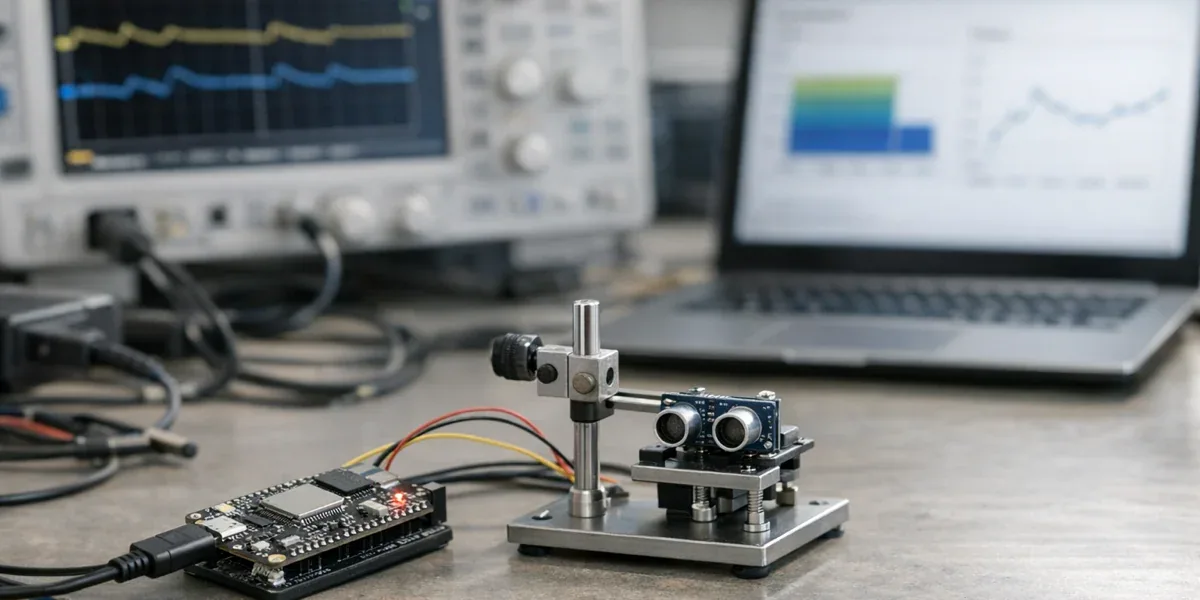
When people ask whether ESP32-S3 can run TinyML, the useful answer is not a simple yes or no. ESP32-S3 has dual-core Xtensa LX7 CPUs, up to 240 MHz clock speed, 512 KB on-chip SRAM, SIMD instructions, and optional PSRAM. It is clearly more suitable for lightweight edge AI than many basic microcontrollers. But the success of a TinyML product usually depends less on the headline AI capability and more on whether the model, memory, sampling task, wireless stack, and real-time response all fit into the same resource budget.
The core conclusion is this: ESP32-S3 is a reasonable TinyML target for small INT8-quantized models with bounded input windows and controlled inference frequency; it is not a good target for large models, continuous high-frame-rate vision, complex multi-model pipelines, or edge AI workloads without a clear latency and memory budget. If a team only proves that one Invoke() call works, but does not measure tensor arena peak usage, PSRAM trade-offs, peripheral contention, Wi-Fi/BLE concurrency, and end-to-end latency, the prototype may become a demo that cannot survive production.
Definition block
In this article,
ESP32-S3 TinyMLmeans running small machine learning inference workloads on an ESP32-S3-class microcontroller with TensorFlow Lite Micro or a similar runtime. Typical examples include sensor anomaly detection, keyword spotting, simple gesture recognition, low-resolution image classification, and device-side state decisions. It does not mean moving cloud-scale AI models directly onto an MCU.
Decision block
If the model can be quantized to INT8, the input window is bounded, each inference can finish within a controlled latency budget, and the device still has enough memory for sampling, connectivity, logging, and OTA, ESP32-S3 is a practical option. If the workload needs large inputs, high-frame-rate vision, multiple chained models, or sustained high throughput, a stronger edge processor is usually the right boundary.
1. Short answer: ESP32-S3 can run TinyML, but “can run” is not the product question
1.1 A successful single inference does not prove system readiness
ESP32-S3 has real hardware strengths. Espressif's datasheet lists a dual-core Xtensa LX7 processor, up to 240 MHz clock speed, 512 KB SRAM, a 128-bit data bus, and dedicated SIMD instructions. Espressif's esp-nn component also provides optimized implementations for ESP32-S3 vector instructions, often used to accelerate neural network operators in TFLite Micro deployments.
Those capabilities establish a TinyML foundation, but they do not make every model a good fit. In practice, the harder questions are:
- Can the model, tensor arena, input/output buffers, logs, connectivity stack, and OTA all fit together?
- Does INT8 quantization preserve the accuracy that the product actually needs?
- Are the model operators supported by TFLM and the optimized ESP32-S3 path?
- Does inference block I2S, ADC, camera capture, Wi-Fi, BLE, or control command handling?
- After long-running operation, are heap fragmentation, temperature, power draw, and watchdog behavior still acceptable?
The evaluation should not start with “can the model be compiled into firmware?” It should start with whether the inference path has a closed resource budget.
1.2 Where ESP32-S3 fits, and where it does not
| Use case | ESP32-S3 fit | Practical judgment |
|---|---|---|
| Vibration, temperature, current, or other low-dimensional anomaly detection | High | Small input windows and controlled sampling rates make this realistic |
| Keyword spotting, event sound detection, lightweight audio preprocessing | Medium | Works only if audio buffers, Wi-Fi contention, and RAM are controlled |
| Low-resolution image classification or presence detection | Medium | Possible, but input size, PSRAM, camera bandwidth, and latency must be tested together |
| Multi-stream video, complex object detection, continuous visual analytics | Low | Input and compute demand exceed the MCU boundary quickly |
| Multi-model pipelines, online learning, LLM or RAG-style workloads | Very low | Compute, memory, and storage boundaries are mismatched |
Judgment: If the input is low-dimensional, low-frequency, and technically bounded, ESP32-S3 TinyML can be valuable. If the task is really continuous vision, multimodal understanding, or large-model inference, the MCU should not be treated as the main edge AI compute node.
2. Bottleneck one: on-chip SRAM and the tensor arena
2.1 TFLM memory is not just a malloc problem
TensorFlow Lite Micro is built around the tensor arena. The official TFLM memory documentation describes this arena as a shared continuous buffer split into Head, Temporary, and Tail sections for shared tensor buffers, scoped scratch buffers, and persistent runtime data. That means a model's deployability is not just its file size. Intermediate activations, scratch buffers, operator state, and input/output tensors can dominate the peak memory requirement.
ESP32-S3's 512 KB on-chip SRAM has to serve several parts of the system:
- FreeRTOS task stacks
- Wi-Fi / BLE protocol stacks
- driver DMA and sampling buffers
- the TFLM tensor arena
- application state, logs, and communication payloads
- OTA, file system, and configuration buffers
If too much SRAM is assigned to tensor_arena, inference may work but networking, logging, sampling, and OTA become fragile. If the arena is too small, model initialization or scratch allocation fails.
2.2 PSRAM increases capacity, but does not erase latency
Many ESP32-S3 modules include PSRAM. That helps with image inputs, audio buffers, and larger models. But PSRAM is not a transparent replacement for on-chip SRAM. It is usually accessed through an external memory interface and cache, making it better for large buffers or less time-critical data than for hot tensors, real-time scratch buffers, or strict latency paths.
A more reliable memory plan treats memory as tiers:
- On-chip SRAM: real-time tasks, stacks, DMA-sensitive buffers, and hot tensors.
- PSRAM: frame buffers, larger input windows, non-real-time caches, and data that can tolerate latency.
- Flash: model constants, configuration, and versioned resources, but not random hot-path reads.
Judgment: For ESP32-S3 TinyML, PSRAM solves capacity pressure, not deterministic latency. If hot tensors or input pipelines repeatedly fall onto a slower path, the final symptom will still be inference jitter and task timeouts.

3. Bottleneck two: quantization changes the model boundary
3.1 INT8 is the default reality for MCU TinyML
On an MCU like ESP32-S3, INT8 quantization is usually not an optional optimization. It is often what makes deployment possible. It reduces weight and activation memory and makes it easier to use optimized kernels. But quantization changes numerical behavior, especially in these areas:
- boundary samples near anomaly thresholds
- noisy audio or vibration signals with device-to-device variation
- low-light, blurry, compressed, or lens-dependent image inputs
- decisions that depend on ranking or confidence thresholds
Looking only at average accuracy after quantization can hide the failures that matter in the field. A better acceptance process uses both a representative calibration set and a field replay set, with typical, boundary, and noisy samples tested separately.
3.2 Operator coverage matters more than file format
Being able to convert a model into .tflite does not mean it will run reliably on TFLM. TensorFlow Lite Micro is designed for microcontrollers, so its operator set, memory planning, and kernel support are more constrained than desktop or mobile TensorFlow Lite. Model architecture should favor operators that are supported by TFLM, benefit from ESP-NN where relevant, and have predictable scratch requirements.
Three practical checks should happen early:
- Constrain the model architecture before training so it avoids MCU-hostile operators.
- After conversion, run real
AllocateTensors()andInvoke()tests with the micro runtime. - Use
RecordingMicroInterpreteror similar allocation logging instead of guessingtensor_arena_size.
Judgment: ESP32-S3 TinyML model design should be driven backward from deployment constraints. Training a general model first and trying to squeeze it into an MCU later is usually the expensive path.
4. Bottleneck three: real-time budget and peripheral contention
4.1 Single-inference latency is not the full metric
Many prototypes record only one inference duration. A real device cares about the full cycle:
sampling window -> preprocessing -> inference -> postprocessing -> local control or telemetry
If a vibration model runs once every 500 ms, an 80 ms inference may be acceptable. If a voice trigger pipeline needs continuous sampling and low-latency response, 80 ms may interfere with audio buffers and network upload. If the same device also runs Wi-Fi, BLE, display, buttons, logs, and OTA, inference must be part of the scheduling model rather than a standalone benchmark.
4.2 Camera, I2S, ADC, and Wi-Fi compete for the same MCU
ESP32-S3 is useful for sensor-rich lightweight AI nodes, but every peripheral path consumes memory, DMA, CPU time, and interrupt budget. Typical failure modes include:
- Camera frame buffers use PSRAM, forcing the inference arena to shrink or access slower memory.
- I2S audio capture and inference run at high load at the same time, causing audio gaps or inference jitter.
- Wi-Fi uploads, logs, or OTA operations stretch the inference cycle.
- Task stacks look sufficient in demos but fail during pressure tests.
- Long synchronous inference or postprocessing triggers watchdog issues.
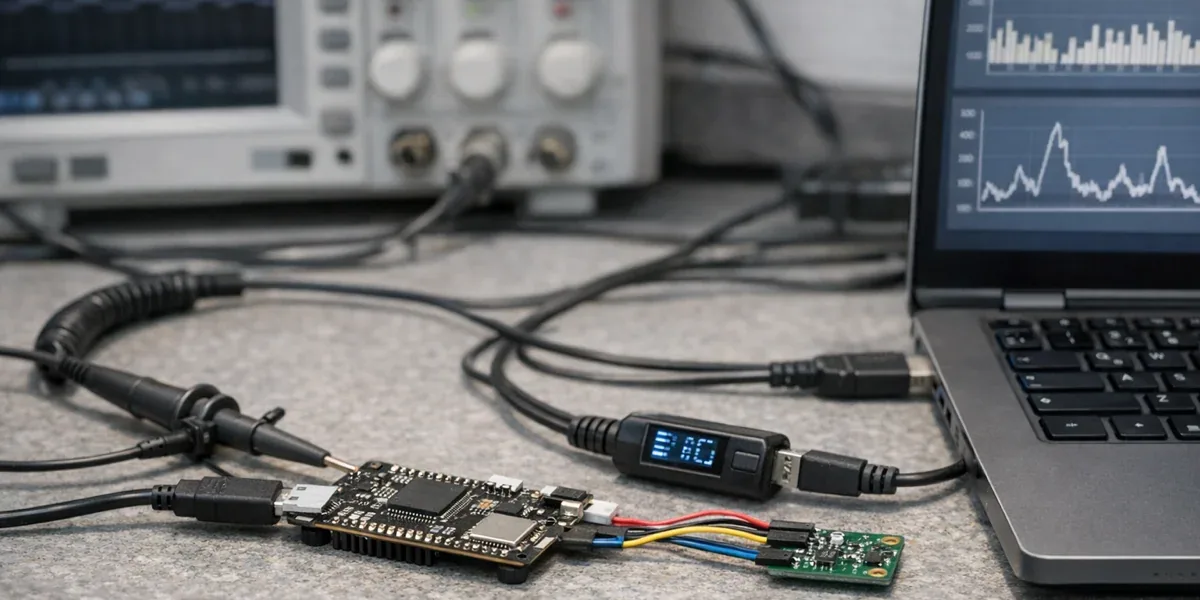
At minimum, an ESP32-S3 TinyML project should record these metrics:
| Metric | Why it matters | Recommended acceptance method |
|---|---|---|
tensor_arena_size peak | Determines whether the model initializes and runs reliably | Log allocation details after AllocateTensors() |
| Remaining on-chip SRAM | Determines safety for networking, stacks, and logs | Record lowest free heap during stress tests |
Invoke() P50 / P95 | Shows average latency and tail latency | Run thousands of iterations with real inputs |
| sampling-to-decision latency | Determines business usability | Measure the real peripheral path, not only the model |
| latency under Wi-Fi / BLE load | Shows online behavior | Run with real communication load |
| power and temperature | Affects battery and enclosure design | Test under the target duty cycle |
Judgment: If an ESP32-S3 TinyML proposal does not show memory peak, tail latency, and peripheral-concurrency behavior, it proves demo feasibility at most. It does not prove product readiness.
5. A safer implementation order for ESP32-S3 TinyML
5.1 Lock the product decision before locking the model
The safer order is not “find a model, then find a board.” It is:
- Define the device-side decision: what must be inferred locally?
- Define the input window: sampling rate, window length, feature count, image size, or audio segment.
- Define the latency budget: how quickly must a result be produced, and what happens if it is late?
- Build the smallest useful model first: prefer INT8, a small operator set, and explainable features.
- Then test on hardware: arena, heap, peripheral concurrency, and power.
- Finally decide whether the edge node needs stronger hardware.
This order prevents the team from spending weeks compressing a model into ESP32-S3 only to discover that the business requirement needs higher resolution, lower latency, or continuous connectivity.
5.2 A practical gate before small-batch production
Before an ESP32-S3 TinyML design moves into a pilot or small production batch, it should meet these conditions:
- The model is INT8 and has a representative calibration set.
tensor_arena_size, peak heap, and task stack usage are recorded.- Inference runs with real sampling, networking, and logging load.
- P95 or P99 latency meets the business budget, not just average latency.
- OTA, logs, and configuration were not sacrificed to fit the model.
- Model version, thresholds, input features, and firmware version can be traced together.
- Unsuitable cases are explicit, such as high-frame-rate vision, multi-model chains, or hard real-time control.
6. When to stop forcing ESP32-S3 and use a stronger edge platform
Changing platform is not a failure. It is often the correct system boundary. These signs mean that compressing the model further is probably less useful than choosing stronger hardware:
- The input itself is large, such as multi-stream images, high-rate audio, or long time-series windows.
- INT8 quantization causes false positives or false negatives that affect the business decision.
- PSRAM is used simultaneously for frame buffers, model input, and communication buffers, and tail latency becomes unstable.
- The device needs multiple models or complex postprocessing.
- The same unit also acts as a gateway, protocol adapter, UI device, or local database cache.
- OTA, logging, and diagnostics are being reduced to make room for the model.
Final judgment: ESP32-S3 is a strong TinyML edge node, not a general-purpose edge AI host. It works best when it moves small, well-defined decisions closer to the device: anomaly screening, pre-trigger filtering, low-dimensional state recognition, and lightweight voice or image event detection. Once the workload becomes high-throughput, multi-model, multimodal, or strongly real-time, ESP32-S3 should return to its role as a sensing and control node while a stronger edge compute unit handles the main inference path.