

ESP32-P4 Desktop Companion Robot with Rotating Dock
A desktop companion robot concept needed a responsive main unit and rotating dock that could bring voice, sensing, lighting, motion, charging detection, connectivity, and remote maintenance into one coherent product behavior.
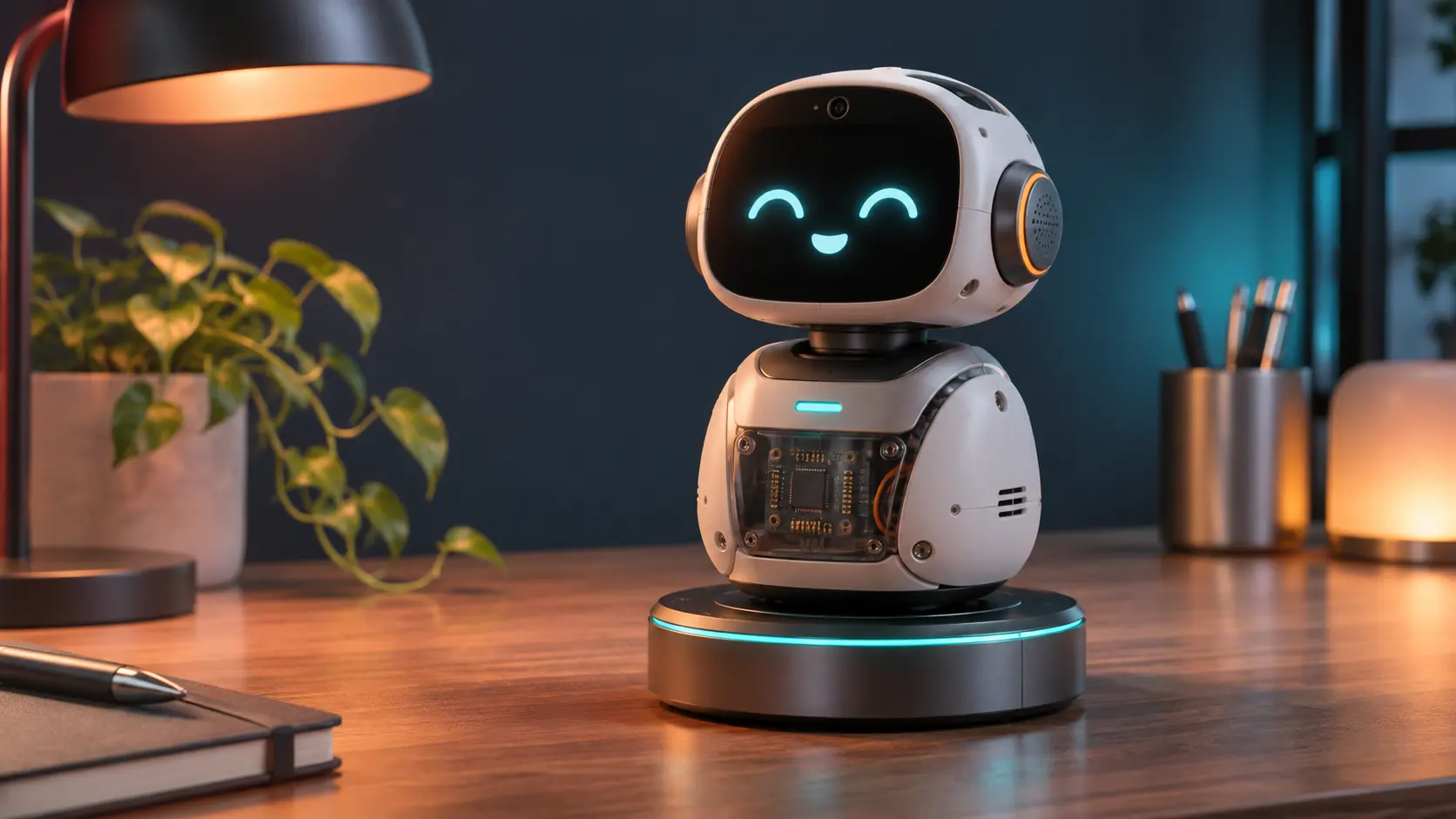
Coordinate a robot host and dock without turning every peripheral into a separate demo
Voice interaction, radar and touch sensing, RGB feedback, motor control, charging contacts, USB attachment detection, and cloud connectivity had to remain responsive together while protecting safe movement and recoverable field behavior.
- Project focus
- ESP32-P4 companion robot
- Delivery scope
- Host and dock protocol + Voice and sensing runtime
- Operating goal
- Coordinated architecture
Hardware, firmware, and product behavior had to be validated together
- 01
Define clear responsibilities between the main unit and rotating dock
- 02
Schedule audio, sensing, UI feedback, and motor tasks on constrained embedded resources
- 03
Keep movement natural while honoring limits, interlocks, and fault states
- 04
Support diagnostics, versioning, OTA, and recovery after installation
Design the robot as a coordinated embedded system
ZedIoT structured the host and dock around ESP32-P4 application processing, wireless coordination, explicit device-state messages, audio and sensor tasks, bounded motor control, charging and accessory detection, and a connected maintenance path.
Host and dock protocol
Define states and commands for rotation, charging, attachment detection, and fault interlocks.
Voice and sensing runtime
Coordinate microphone, speaker, radar, touch, IMU, temperature, and RFID events through bounded tasks.
Motion and safety
Apply position limits, feedback, controlled acceleration, and recoverable motor fault behavior.
Connected lifecycle
Provide device identity, MQTT or cloud integration, diagnostics, OTA, and version recovery planning.
From user interaction to safe, visible robot behavior
Sense
Voice, radar, touch, and local sensors produce validated interaction events.
Decide
The host combines device state, user intent, and safety conditions before issuing an action.
Move and respond
The dock executes bounded motion while lighting, audio, and UI communicate the robot state.
Maintain
Logs, connectivity, and controlled updates support diagnosis and product evolution.
A product baseline for an expressive, maintainable companion robot
The project clarified host-and-dock boundaries and a practical route from interaction proof of concept to maintainable connected product behavior.
Coordinated architecture
The robot host, rotating dock, interaction sensors, and motion system use clear state and responsibility boundaries.
Interaction composition
Voice, sensing, light, and motion can be orchestrated as one user-facing response rather than independent demos.
Service-ready lifecycle
Diagnostics, version visibility, OTA, and recovery are planned as part of the product operating model.
Early motion validation
Movement limits, fault conditions, and installation-dependent safety questions are made visible before production tooling.
Final motor safety, mechanical lifetime, charging-contact reliability, acoustics, EMC, wireless performance, and any product-specific certification must be validated on the finished hardware and intended use environment.
ESP32-P4 companion robot questions
What did ZedIoT deliver for this esp32-p4 companion robot project?
ZedIoT structured the host and dock around ESP32-P4 application processing, wireless coordination, explicit device-state messages, audio and sensor tasks, bounded motor control, charging and accessory detection, and a connected maintenance path. The final scope depended on the customer's devices, interfaces, operating workflow, and acceptance criteria.
Can this project pattern be adapted to another product or site?
Yes. The reusable pattern is the way sense, decide, move and respond are connected. Device protocols, deployment topology, data ownership, and operating rules are validated for each new project.
What should be confirmed before starting a pilot?
A useful pilot starts with representative hardware, interface documentation, real operating conditions, expected users, failure cases, and measurable acceptance criteria. Final motor safety, mechanical lifetime, charging-contact reliability, acoustics, EMC, wireless performance, and any product-specific certification must be validated on the finished hardware and intended use environment.
Planning a related AI + IoT project?
Share the current device or system, the operating problem, available interfaces, intended users, and the result you need to validate. ZedIoT can help define a focused prototype and production path.
- AI + IoT product architecture review
- Hardware, firmware, cloud, and application integration
- Prototype planning and production support