

Smart Commercial Kitchen Weighing System for Accurate Feed Control
A commercial kitchen equipment provider needed more consistent ingredient dispensing, a clearer operator experience, and a path to synchronize weighing records with future cloud and business systems.

Control ingredient output with live measurement rather than manual correction
The client wanted to upgrade existing weighing tools into an integrated digital system. Accuracy, interference resistance, operator feedback, and connectivity had to be solved together for the equipment to support automatic portioning.
- Equipment
- Commercial weighing and feed control
- Main risk
- Over- or under-dispensing
- System goal
- Repeatable portions and data records
The original workflow could not guarantee consistent portions at operating speed
Unstable accuracy
Measurement drift and environmental interference led to over- or under-dispensing.
Manual correction
Operators had to compensate for inconsistent readings and an inefficient interaction flow.
No live feed control
Weight was not connected tightly enough to the dispensing logic for automatic stopping or adjustment.
No data interface
Records could not be exported or synchronized with future kitchen, ERP, or cloud systems.
Combine sensor quality, electronics, control logic, and connectivity
The project was delivered as one embedded equipment system rather than treating the scale, PCB, algorithm, interface, and data path as separate products.
Precision measurement
High-resolution sensors and an updated PCB reduce drift and improve the stability of repeated kitchen weighing cycles.
Interference control
The electronics and signal path were redesigned to reduce noise from motors, power equipment, and the commercial kitchen environment.
Feed-control logic
Real-time weight feedback stops or adjusts material dispensing as the measured weight approaches the target.
Data-ready connectivity
Ethernet support and a defined record model prepare the system for export, remote access, and upstream integration.
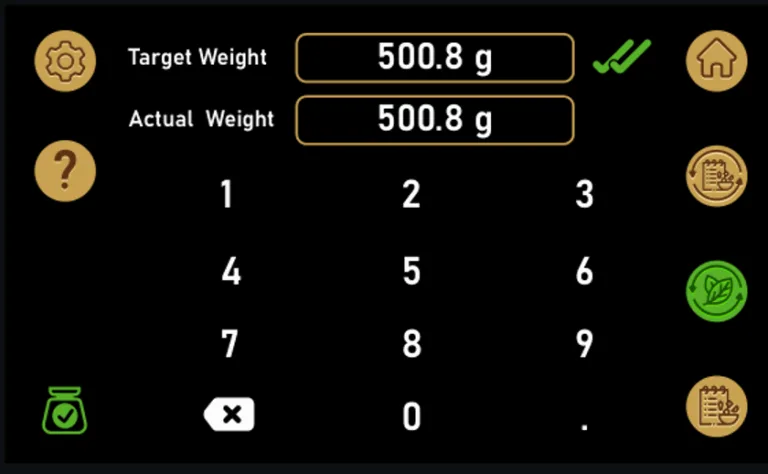
Keep target, actual weight, and control state visible at the point of use
The embedded interface gives the operator a direct view of target and measured weight while the feed-control logic uses the same live signal to manage dispensing.
The interaction can be extended to recipes, batch records, calibration, maintenance, and upstream data exchange.
Close the gap between measurement and material flow
Recipe or operator input defines the required ingredient weight.
The sensor and acquisition electronics provide stable live readings.
Control logic slows, stops, or corrects material feed near the target.
Result data can support export, traceability, and future cloud workflows.
More accurate feed control with a clearer path to connected operations
The published case reports a 35% increase in ingredient feed accuracy.
The redesigned interface and live feedback reduced manual correction.
Ethernet support prepared the system for future record export and remote access.
The architecture can extend to portioning, stepper-motor dispensing, and other foodservice equipment.
Smart kitchen weighing questions
What is a smart commercial kitchen weighing system?
It combines a load-cell or precision sensor, signal acquisition electronics, calibration, embedded control logic, an operator interface, and optional connectivity to manage ingredient portions consistently.
How does feed control use the weight signal?
The controller compares live measured weight with the target and adjusts, slows, or stops the dispensing mechanism according to defined control rules and equipment behavior.
Why is PCB and interference design important for kitchen weighing?
Motors, power supplies, long cables, grounding, moisture, and nearby equipment can affect low-level sensor signals. Stable acquisition requires careful analog, power, layout, shielding, filtering, and calibration design.
Can weighing records be sent to ERP, POS, or cloud systems?
Yes. Ethernet, serial, Wi-Fi, or another controlled interface can expose batch, recipe, target, actual weight, device state, and error records after the upstream data model is agreed.
Can the system support automatic portioning equipment?
Yes. The same measurement and control loop can be adapted to stepper motors, valves, conveyors, or other dispensing mechanisms after their speed, inertia, material flow, and safety constraints are tested.
Planning a connected weighing or dispensing product?
Share the target material, accuracy requirement, weighing cycle, motor or valve behavior, current electronics, interface needs, and production constraints. We will help define a practical prototype and validation plan.
- AI + IoT product architecture review
- Hardware, firmware, cloud, and application integration
- Prototype planning and production support