

A team managing a few hundred identical devices can assemble a workable control plane from private MQTT topics, remote commands, and an OTA API. The problem changes when the same product enters utilities, smart cities, or a large multi-vendor fleet. Procurement teams no longer ask only whether the device connects. They ask how it receives identity, changes servers, preserves object semantics, recovers from failed updates, and proves interoperability with another vendor.
The important LwM2M decision in 2026 is not whether it is lighter than a custom protocol. It is whether it should become the shared contract for device qualification, interoperability validation, and long-term operations. Regulated and long-lived deployments should usually put LwM2M in the product baseline. Closed, short-lived, hard-real-time, or extremely constrained systems should validate the cost first instead of adopting a standard mechanically.
| Project condition | Default decision | Cost that must be accepted |
|---|---|---|
| Multiple device vendors must join one platform | Prefer LwM2M objects and interfaces | Object versions, optional resources, and vendor extensions require governance |
| Devices will operate for 8–15 years and need credential rotation, server migration, and OTA | Put Bootstrap, Security, and Firmware Update in qualification tests | Real fault injection is required, not only a feature demo |
| Utility, smart-city, or critical-infrastructure procurement | Include interoperability results and audit evidence in acceptance | LwM2M does not replace sector certification, cryptographic compliance, or local law |
| One vendor, short lifecycle, and stable network | A simpler proprietary management plane may be reasonable | A future multi-vendor migration will cost more |
| Millisecond closed-loop control | Do not use LwM2M as the real-time control bus | Keep LwM2M in the management plane and control in PLCs, fieldbuses, or edge controllers |
The table does not mean that every device needs LwM2M. The more precise conclusion is: when replacement, certification, updates, and multi-vendor onboarding determine whether a fleet can remain operational, LwM2M creates value through a testable common boundary—not merely efficient messaging.
1. Why the 2026 signal is not just another protocol release
OMA SpecWorks currently lists LwM2M 1.2.2 as the latest release. The 1.2 line separates messaging from transport and covers transport choices beyond CoAP, improved bootstrap behavior, firmware update capabilities, and efficient encodings. The version number is not the most important signal. What matters is that real deployments and multi-vendor testing are moving the standard into procurement and operating processes.
SVE-44, held in April 2026, offered multi-vendor interoperability and specification-conformance testing for LwM2M Clients, Servers, and Smart City implementations across v1.0, v1.1, and v1.2. It demonstrates why "supports LwM2M" cannot remain a checkbox in a product sheet. Registration, object access, observations, bootstrap, and update behavior must work across implementation combinations.
OMA's March 2026 article about Germany's smart-meter rollout provides a more direct deployment signal. An LwM2M device-management platform was selected to manage Smart Meter Gateways in Germany's iMSys program. This example must not be generalized into "LwM2M automatically complies with German regulation." It does show, however, that standardized device management has entered vendor selection and production operations in a regulated energy environment.

This flow turns LwM2M from a compatibility claim into a deployment gate. Identity, semantics, interoperability, and recoverability must produce evidence at each layer. A device being online cannot hide a failure in any of them.
2. An executable LwM2M qualification baseline
2.1 Identity and bootstrap: prove that a device can change ownership safely
LwM2M defines interfaces among the Client, Server, and Bootstrap Server. Bootstrap is not simply the first write of a server address. It determines whether a long-lived device can change tenants, rotate credentials, replace a management platform, and recover from bad configuration.
Qualification should verify at least the following:
- every device has unique credentials instead of one PSK or certificate copied across a fleet;
- Client-Initiated Bootstrap failure does not create an unbounded retry storm;
- permissions of the Bootstrap Server and Device Management Server are distinguishable;
- after credential rotation, the behavior of old sessions, old servers, and recovery paths is defined;
- at retirement, server-side credentials, objects, and historical access can be disabled.
The LwM2M transport specification requires device-unique credentials and supports secure methods including high-entropy PSKs, Raw Public Keys, and X.509 certificates. Acceptance cannot stop at "DTLS/TLS is enabled." It must examine credential uniqueness, injection, rotation, and recovery.
2.2 Object models: prove that data means the same thing
LwM2M's object and resource model is one of its main strengths. Standard objects such as Device, Connectivity Monitoring, and Firmware Update let platforms operate different devices through stable URIs and data types. In 2026, OMA also highlighted that its object registry uses machine-readable XML definitions that include Object IDs, Resource IDs, data types, access modes, units, and ranges.
Standard objects do not eliminate semantic drift automatically. Teams still need to govern:
- whether object versions are fixed, backward-compatible, or negotiated by model;
- who allocates IDs and maintains schemas and change history for vendor objects;
- whether units, scaling, enumerations, and defaults remain stable across firmware;
- how a platform degrades when an optional resource is absent;
- whether object-support changes trigger re-registration and capability-index updates.
If a platform stores /3303/0/5700 as a floating-point value without preserving object version, unit, and device-capability context, it still does not have real interoperability.
2.3 Interoperability: replace a single-device demo with a combination matrix
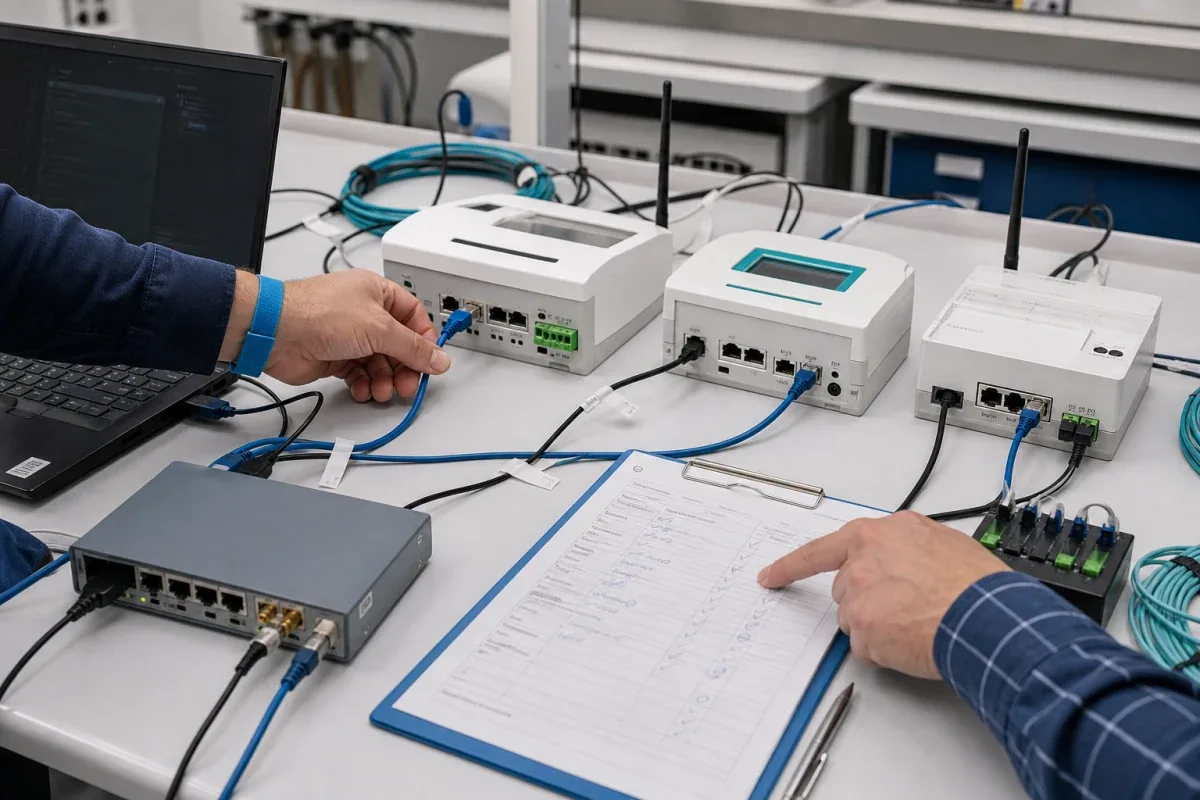
A multi-vendor program should maintain a minimum combination matrix: at least two Client implementations, two Server or Bootstrap Server implementations, and the transports and security modes used in production. Testing must cover not only happy paths but also block transfer, timeouts, duplicates, reconnection, queue mode, server changes, and object-version differences.
Vendor acceptance should retain:
- Client, Server, library versions, and configuration hashes;
- success and failure logs for Registration, Update, Deregister, and Observe/Notify;
- bootstrap, credential rotation, and server-migration results;
- interrupted downloads, integrity failures, installation failures, and rollback results;
- behavior for unknown objects, optional resources, and vendor extensions;
- unresolved interoperability limitations and the rationale for accepting them.
This is also the value of an SVE/TestFest: vendors find implementation differences early in confidential multi-vendor combinations. A project can use SVE results as evidence, but it must still test its own devices, networks, and security profile.
2.4 OTA and recovery: validate the state after failure
"The server sent Update and the device received it" does not complete OTA. Qualification must cover package provenance, integrity verification, installation state, post-reboot version confirmation, failed-update rollback, and batch control. Low-power devices also require tests for download windows, resume behavior, and battery thresholds.
The LwM2M Firmware Update object provides common state and result expressions. Staging strategy, image signing, A/B partitions, and business rollback remain product-architecture responsibilities. A safer division is:
- LwM2M expresses the target, download action, state, and result;
- the release system determines grouping, rate, pause, and rollback policy;
- the bootloader guarantees image verification and recoverable startup;
- the operations platform correlates results with batch, hardware version, and network conditions.
This matches the broader architecture of an IoT device-management platform: the protocol supplies only part of the control plane. Fleet indexing, rollout orchestration, audit, and alerting still belong to the platform.
3. Rewrite "supports LwM2M" as an acceptance contract
The most dangerous procurement sentence is "the device supports LwM2M 1.2." It does not identify the transport, security mode, object set, bootstrap flow, or error behavior. An executable requirement needs five layers.
3.1 Protocol profile
Fix the LwM2M version, transport binding, encoding, security mode, queue mode, block-wise transfer, and observation behavior. Every optional capability must be marked required, conditionally required, or unsupported.
3.2 Object contract
List standard objects, versions, mandatory resources, vendor objects, and the schema repository. The object contract should be released with firmware, not left only in a vendor wiki.
3.3 Failure and recovery
Define expected state, backoff, and recovery for DNS failure, expired certificates, unavailable bootstrap, interrupted firmware downloads, insufficient storage, and clock errors. Acceptance observes the final state instead of only an intermediate response code.
3.4 Security and audit
Record who changed what on which device, when the action was issued, whether the device acknowledged it, and the final result. Logs must not expose PSKs, private keys, or replayable authentication material.
3.5 Lifecycle exit
When a device changes tenants, returns for repair, is resold, or retires, the system must revoke credentials, clear server bindings, and retain required audit evidence. A bootstrap design without an exit process implements only half of the lifecycle.
4. What LwM2M cannot solve for you
First, LwM2M is not regulatory certification. It can provide identity, object, update, and audit interfaces, but it does not automatically satisfy energy, metering, medical, data-residency, or cybersecurity regulations. Each program still needs applicable-law analysis, threat modeling, and independent certification.
Second, LwM2M is not a real-time control bus. Millisecond interlocks, motion control, and protection logic belong in local controllers and deterministic networks. Separating management from control prevents public-network jitter from affecting safety actions.
Third, LwM2M is not a complete Fleet Ops product. Device search, staged cohorts, anomaly aggregation, work orders, customer permissions, and operational reports still require platform capabilities.
Fourth, standard objects do not mean zero integration. Device and platform vendors must agree on versions, optional resources, and extension objects. Otherwise, two systems that both claim LwM2M support can still fail to interoperate.
Programs that also need global connectivity and eSIM lifecycle control should put LwM2M and connectivity provisioning in one operating loop. See SGP.32 + LwM2M for global IoT deployment to avoid a profile moving to a new region while device-management policy remains attached to the old one.
5. A 12-point project-start checklist
- Fix the LwM2M version, transport, encoding, and security profile.
- Create a unique identity and credential-injection record for every device.
- Define trust boundaries among Client, Server, and Bootstrap Server.
- Maintain versioned schemas for standard and vendor objects.
- Test interoperability across at least two Client/Server combinations.
- Inject timeout, duplicate, outage, server-migration, and certificate-expiry faults.
- Validate interrupted update, failure, rollback, and post-reboot confirmation.
- Put capability, object version, and firmware version into the fleet index.
- Audit actor, target, parameters, acknowledgement, result, and time for remote actions.
- Keep staging, pause, and cohort rollback in the release-orchestration layer.
- Define credential revocation for tenant transfer, repair, and retirement.
- Keep sector regulation and certification as an independent gate.
If the program cannot produce evidence for items 1–6, the device is not ready for a regulated multi-vendor environment. If 7–12 are absent, the pilot may work, but long-term operational risk remains open.
FAQ
Is LwM2M 1.2.2 the only version to select in 2026?
No. OMA currently lists 1.2.2 as the latest release, but the practical choice depends on silicon, Client libraries, Server compatibility, and deployed fleets. Fixing a project profile and proving interoperability and downgrade behavior matters more than choosing a version number alone.
Does participating in an OMA SVE/TestFest mean project acceptance is complete?
No. An SVE provides valuable multi-vendor interoperability evidence, but the project still needs to test its devices, network, security profile, object extensions, OTA behavior, and applicable regulations. It is an input, not a complete compliance conclusion.
Should a small private deployment use LwM2M?
It can be worthwhile when devices have a long lifecycle, need secure bootstrap, must cross vendors, or require auditable OTA. A disposable single-vendor product without remote lifecycle requirements may use a simpler proprietary plane at lower initial cost, but the future migration cost should be recorded.
Conclusion
In 2026, LwM2M is most useful not as another lightweight IoT protocol but as a shared qualification language before multi-vendor devices enter long-term operations. It puts bootstrap, registration, objects, reporting, firmware update, and security credentials into testable interfaces, while SVE events expose interoperability problems before production.
A reliable program does not treat "supports LwM2M" as a marketing sentence. It turns protocol profiles, object contracts, fault recovery, audit, and exit procedures into deployment gates. The direct cost is a larger test matrix and more governance. The return is a fleet that can be replaced, updated, audited, and managed across vendors over a ten-year lifecycle.