

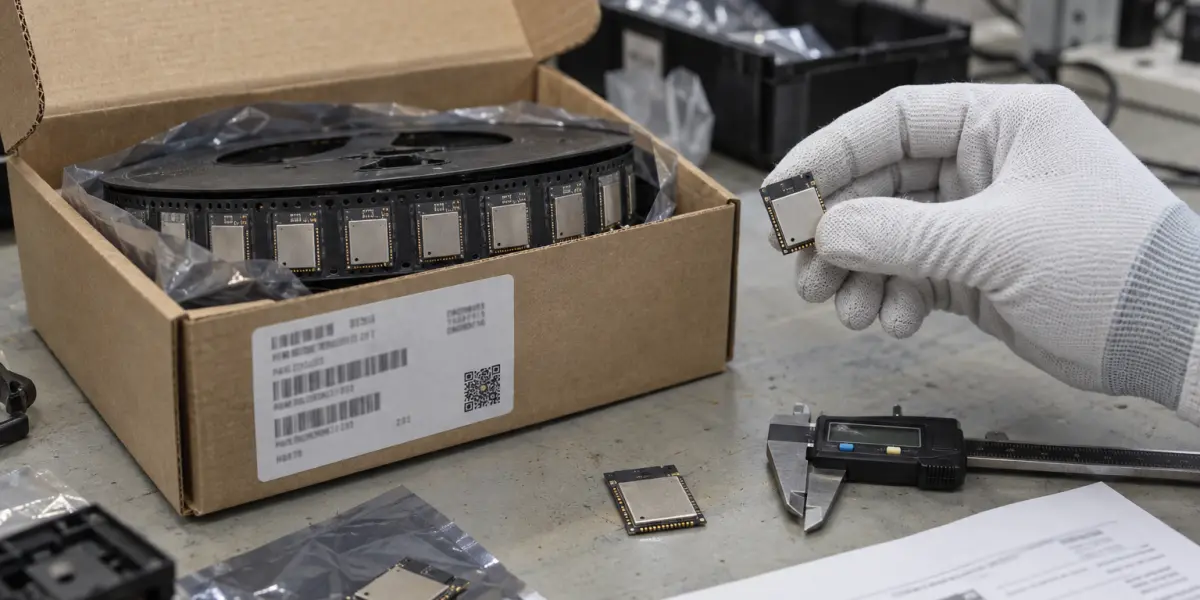
ESP32-S3-WROOM-1-N16R8 looks specific enough to order. It is not. The string usefully identifies a chip family, module format, and memory configuration, but it does not by itself prove the delivered lot, antenna option, certification status, or substitution compatibility. Reading a name and accepting a procurement object are two different jobs.
Use this sequence instead: preserve the complete part number, open the current ordering information for that exact module family, and then compare the quotation, package label, and project requirements. If one link cannot be matched, do not turn a remembered suffix rule into a BOM or approved-vendor rule.
A part number is not a universal decoder ring
Espressif's public module naming guide describes a module through elements such as SoC, module format, version, and memory configuration. Its ESP32-S3-WROOM-1-N16R8 example identifies an ESP32-S3 SoC, a WROOM-1 module, 16 MB Flash in the normal-temperature range, and 8 MB PSRAM. That is a useful starting point, not a replacement for the family datasheet.
The manufacturer also directs readers to the Series Comparison in the relevant datasheet to see which versions actually exist. A character may be meaningful in one family, revision, or lifecycle state without being a transferable rule for another. A suffix cheat sheet can therefore be technically correct and still create the wrong material decision.
Turn a name into a verifiable ordering object

Keep the whole string, not just “ESP32-S3”
ESP32-S3 names a chip family; it is not a module ordering code. WROOM, MINI, WROVER, and related module formats can differ in physical form, peripheral integration, and available configurations. Keep the full manufacturer part number in the BOM, quotation, and test order rather than leaving a family name in a free-text description.
This makes changes reviewable. When someone asks whether “another S3 WROOM” can replace the current module, the team can compare two complete objects and their datasheet entries instead of debating an ambiguous shorthand.
Use public suffix rules only for the fields they support
Espressif explains that N denotes Flash with the normal temperature range, H denotes Flash with the high-temperature range, and R denotes PSRAM. A module with an external antenna connector has a -U suffix. For example, ESP32-C3-MINI-1U-N4 has an external antenna connector whereas ESP32-C3-MINI-1-N4 has an integrated PCB antenna.
Those rules tell the team what to verify next. An external antenna can be appropriate when an antenna must sit outside a metal enclosure, but it also introduces connector, feed-line, assembly, and whole-product RF questions. Likewise, a memory or temperature marker does not prove that a finished product will pass environmental, EMC, or functional tests.
Do not sort version letters into an upgrade path
Version markers such as the D and E in ESP32-WROOM-32D and ESP32-WROOM-32E reflect module or silicon evolution. Espressif cautions that versioning does not follow a single rule across product lines. Do not infer an equivalent update in a different family by alphabetical order.
When a supplier proposes an “updated” module, retain the old and new full part numbers, the current datasheet version and date, the project conditions affected by the change, and the validation that must be repeated. If those facts cannot be matched to official material or a change notice, the right status is unresolved—not automatically equivalent.
Package labels trace a lot; they do not replace a specification check
The current ESP32 packaging documentation lists fields such as product name, part number, quantity, firmware information, seal date, lot number, OQC, and a QR code. The QR code can return production information including product name, product number, lot number, and quantity. These fields help purchasing, quality, and a supplier discuss the same delivered material.
They are not automatic release evidence. Compare the label's part number with the frozen project part number, then separately check requirements for antenna type, temperature, certification, firmware baseline, and dry packing. Espressif is transitioning between label styles in 2026; a layout difference is not, by itself, a specification change.
Two examples: names create questions, not final answers
| Name | What the public naming rules can identify | What still needs the family data or traceable material |
|---|---|---|
ESP32-S3-WROOM-1-N16R8 |
S3 family, WROOM-1 module, 16 MB normal-temperature Flash, 8 MB PSRAM | Whether that variant is available in the current series table; antenna, dimensions, pins, certifications, BOM fit, and software margin |
ESP32-C3-MINI-1U-N4 |
C3 family, MINI-1 module, external antenna connector, 4 MB normal-temperature Flash | Connector and antenna specification, enclosure clearance and RF results, delivered lot, regional certification, and replacement status versus the non-U version |
This is not a substitution table. Its purpose is to make procurement, hardware, and quality list the open checks before a quote turns into a production commitment.
Freeze a field set, not an “ESP32 name”
For every quoted or purchased module, maintain one object containing:
- the complete manufacturer part number and allowed version range;
- the linked datasheet or ordering-information revision and review date;
- Flash, PSRAM, temperature range, antenna form, dimensions, and project-specific non-substitutable fields;
- the applicable certification or compliance requirements and their owner;
- incoming records for packaging, quantity, label, lot, and dry packing; and
- substitution approver, trigger, and hardware, firmware, RF, or incoming checks that must be repeated.
The last item prevents a common shortcut. “The same ESP32 family” does not prove that an alternate module is safe for a product that has already passed prototype validation. A change can affect antenna, memory, pins, module revision, or certification boundaries. Early concept work may permit a wider candidate range, but that is not a production freeze.
What this guide cannot establish
This guide cannot authenticate a supplier's delivered material or guarantee that a suffix has the same meaning in every older series. It does not replace the target module's current datasheet, a manufacturer change notice, a project procurement specification, or incoming inspection.
If all you have is a blurred silk-screen photo, get the full label, supplier ordering code, existing project BOM, and matching family documentation before guessing at the characters. For metal cabinets, outdoor products, or weak-signal installations, antenna and installation conditions still need testing; a -U suffix alone cannot establish RF performance.
Bottom line
The goal is not to memorize N, R, H, and U. Build a traceable chain instead: complete part number → current family datasheet → package label and lot → frozen project fields. A name narrows the verification work; it does not replace the work.
This article is based on Espressif's public documentation only. It does not inspect a project BOM, delivered modules, or supplier records, and it makes no claim about authenticity, substitution, certification, cost, lead time, or lot release.