

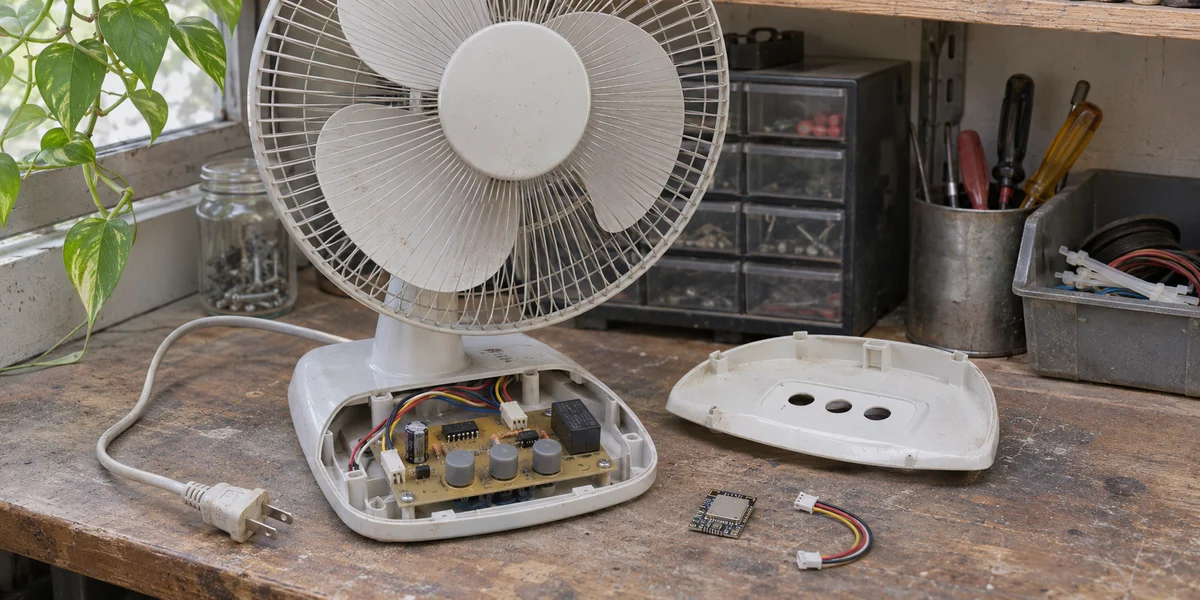
A fan already has speed buttons, oscillation and a timer. The new request is phone control. Replacing its working controller at the same time can turn a connectivity addition into a different product-development project.
Consider a hypothetical three-speed fan whose existing MCU owns the motor driver, physical buttons and local protection logic. Assume that it has a usable UART and the requested app functions are power, speed, oscillation and status. Under those conditions, the first candidate to validate is the existing MCU plus a Tuya network module, using the MCU SDK for the interface. Moving the application onto a networked controller remains an option, but needs a reason beyond the availability of a newer framework.
This is an imagined design review, not a customer case history. The product, spare interfaces and later requirement changes are assumptions. No prototype, schedule saving or measured result is claimed. Public documentation was checked on 20 November 2026.
What stays on the review table
For this fan, define two product behaviors before choosing software: physical speed buttons must remain useful without network access, and restarting the connectivity module must not put the motor output into an unspecified state. Keeping the old board means preserving those behaviors, not merely continuing to buy a familiar chip.
Tuya's MCU standard protocol overview describes interfacing an existing MCU with a network module over a serial connection. The MCU SDK provides the protocol adaptation; it does not supply the fan's motor-control application. In this scenario, the additional interface offers a place to examine the new connectivity work separately from the established control behavior.
A spare UART is only the beginning. The controller must still service receive queues while handling its existing work. Long blocking operations, buffer requirements and update traffic belong in the target-board investigation. No MCU or module has been selected here, so a resource figure from one vendor example cannot become a memory promise for this fan.
The module also needs power and antenna space. Keeping the control program does not preserve the validity of every earlier electrical or enclosure assessment. If the product cannot accommodate a workable radio layout, structural changes may outweigh the software advantage. “Less control code to change” describes one part of the comparison, not an already demonstrated reduction in overall effort.
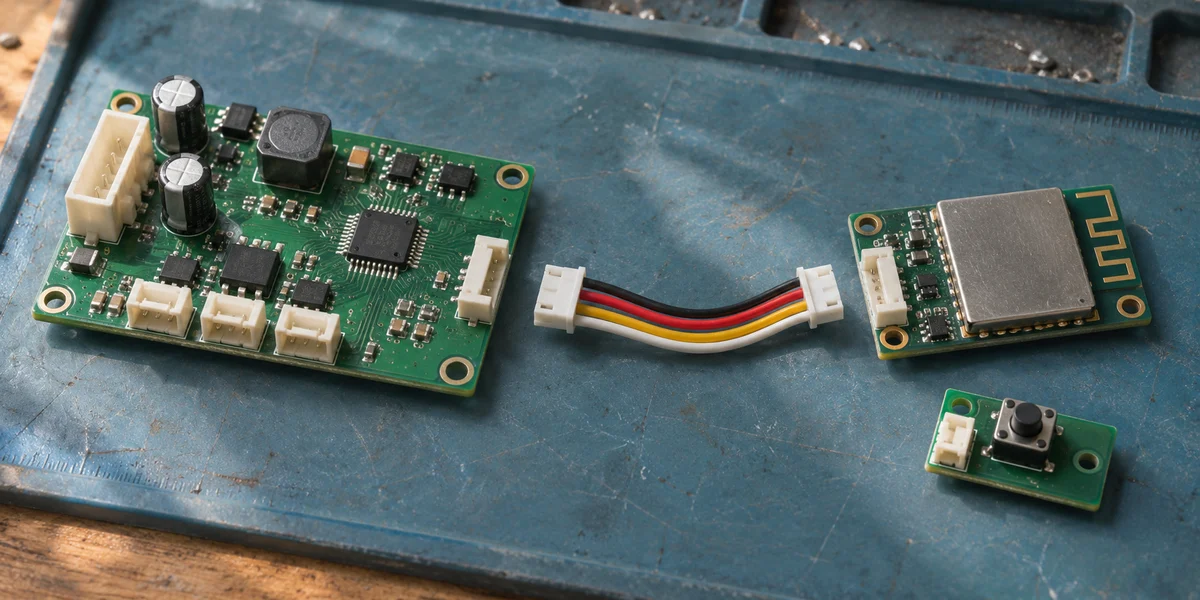
Generated illustration of the separate-board concept. It is not a Tuya product photograph, wiring reference or test result.
A requested speed is not an observed speed
Suppose the app requests speed two while local protection prevents the fan from starting. The connectivity module can receive the request without the motor accepting it. Echoing the requested value straight back to the screen would make the app appear healthy while the fan remains stopped.
Data points, or DPs, need product meanings rather than a name-only mapping to firmware variables. In this scenario, the original control rules evaluate the request, and the app is updated from the accepted or observed state. Whether a refusal reason should be visible is another product and panel decision. This is a proposed application contract, not a claim that the MCU SDK automatically creates separate requested, executed and rejected fields.
Physical buttons expose the other direction of the problem. If a user selects speed three on the housing, the control MCU remains the source of the actual state. The connected side should not indefinitely overwrite it with an old value. Reporting local changes, reconciling after reconnection and resolving conflicting values must be decided together. Switching SDK names does not resolve a conflict in state ownership.
The Wi-Fi protocol application guide positions generic module firmware as the intermediary between MCU and cloud. That supports the separation of communication from product control; it does not make message receipt proof that a requested physical action happened.
A useful prototype exercise would therefore send a remote start request while the local protection condition is active, then compare driver output, MCU state, reported data and the app display. Inconsistent evidence should lead to a state-contract repair, not repeated start commands intended to force the expected result. This exercise has not been run; it is a proposed validation input.
The update request changes the discussion
The initial requirement can leave remote updates of the old MCU as an explicit open decision. Now assume that the requirement changes to “update every firmware component from the phone.” A module's ability to receive an image does not establish that the original MCU can safely install it.
Tuya's MCU OTA documentation describes a Wi-Fi module downloading update data and transferring it to the MCU over serial. Installation, startup and recovery still depend on the receiving implementation. The phrase “supports OTA” cannot tell this review whether the old board has sufficient flash, an appropriate bootloader or a recoverable interrupted-update design.
Motor behavior during installation is a separate concern. If flash programming suspends the original control loop, the permitted operating state for an update must be specified and tested. Promising that connectivity never affects control while ignoring an update-induced pause would make the requirement internally inconsistent.
Two firmware images also create compatibility work. A newer module build might use fields an older MCU does not understand; a panel might still interpret a speed enumeration that has changed. The supported baseline should identify the module part, both firmware versions, DP definition and panel version. That does not require every component to update together. It requires incompatible combinations to be recognized rather than silently accepted.
If the old board cannot support recoverable updating, there are honest alternatives: limit remote updates to the connectivity module, or include changes to controller storage and boot design in a hardware revision. Declaring a TuyaOS migration does not answer that question either. The replacement implementation must satisfy its own update and control requirements.
Change the constraints, and the branches separate
Imagine the next version of the same fan now needs a display, extra sensors and more involved local interactions. The old MCU has no useful interfaces left, and its driver and task structure are already scheduled for replacement. Keeping it would push more coordination across the serial boundary. What initially contained change could become a source of complexity.
Under those revised assumptions, moving the application onto a networked controller deserves a parallel investigation. Tuya's product development kit documentation describes application, device-abstraction and driver layers. Those layers are a way to organize the replacement, not evidence that the existing motor driver can move unchanged or that every kit supports this product.
There is a naming trap here. MCU SDK and TuyaOS are not mutually exclusive ecosystems. Tuya's hardware product development guide lists MCU SDK and customizable TuyaOS development among its routes. The useful comparison in this review is between retaining a separate control MCU and moving product responsibilities onto a networked controller.
Nor is TuyaOpen a shortcut around target selection. The official README at the checked commit identifies supported targets and cross-platform capabilities. It helps shortlist candidates; it is not compatibility evidence for an unspecified original MCU. Board support, peripherals, authorization and update requirements still need checking. TuyaOpen and TuyaOS should not be treated as interchangeable firmware packages.
One counterfactual keeps the review honest: remove the new display and complex local interactions, returning to app power and three-speed control. Does the controller still need replacing? If not, the justification for migration comes from changed product responsibilities, not from connectivity alone. This prevents a next-generation roadmap from quietly becoming a prerequisite for a small retrofit.

A proposed review path, not a vendor state machine. Both candidates remain subject to target-product validation.
Which controller restarts during recovery?
Give both candidates the same hypothetical input: a communication task becomes stuck, and recovery restarts the connected side. This is not equivalent to losing the router connection. A network outage may only remove connectivity; a wireless-subsystem reset may discard communication context; a whole-controller reset restarts the applications hosted on that controller. Their effects cannot be represented by one “reconnects successfully” check.
With a separate MCU and module, restarting only the module leaves an opportunity for the MCU to keep reading buttons, applying protection and maintaining the specified output. This is an architectural opportunity, not an automatic two-chip guarantee. Shared supply collapse, coupled reset wiring or an MCU blocked waiting for communication could defeat it. The implementation must establish the actual electrical and software relationship.
On a single networked controller, the same stuck communication work might lead to a task restart or a system-wide watchdog reset. The target implementation determines which. If that controller also owns motor outputs, those responsibilities now restart with it. Startup pin states, button availability and any independent hardware protection become migration questions. Two software threads alone do not isolate reset, memory or power faults.
This gives the fan review a concrete reason to reject migration even when the new interfaces fit: under the required connectivity-recovery inputs, the candidate no longer meets the specified button or protection behavior, or its driver enters a prohibited output state. Retain separate control, or redesign the isolation before approving migration. Better connected features cannot offset a regression in required control behavior. Recovery deadlines and safety classifications must come from the product requirements; none is invented here.
What the next review needs to bring back
For the original fan assumptions, the recommendation remains to validate the MCU-plus-module candidate first. Its rationale is preserving established control responsibilities, not a proven lowest cost. The prototype must separately establish protocol operation, agreement between local and remote state, and behavior during connectivity or update failures. A successful app toggle cannot sign off all three.
Use the same inputs for the candidates: a local speed change followed by reconnection, remote start during protection, connectivity-side restart, and power restoration after an interrupted update. Specify permitted outputs and visible states before collecting observations. The comparison then concerns the product rather than which demo screen lights up first. Safety-related coverage must be expanded by the product's own risk analysis.
If the old-MCU candidate fails its resource, supply or recovery requirements, take that evidence into the migration review. If the networked controller takes ownership of drivers, demonstrate the same required local behavior again. Connected-side logs alone cannot establish it. Less control-code change and more two-image maintenance are predictions to investigate, not measured results favoring either route.
The decision is intentionally reversible: preserve the existing controller when the addition is primarily phone functions and the old system has headroom; consider migration when responsibilities truly change, old resources no longer suffice and a replacement meets the behavioral requirements. Keeping the conditions beside the decision avoids restarting the argument from framework names whenever a requirement changes.
For the wider app, factory and handover scope, see the existing-product Tuya delivery workflow. This article resolves a narrower hypothetical architecture decision; it does not establish that any real fan is ready for production.