

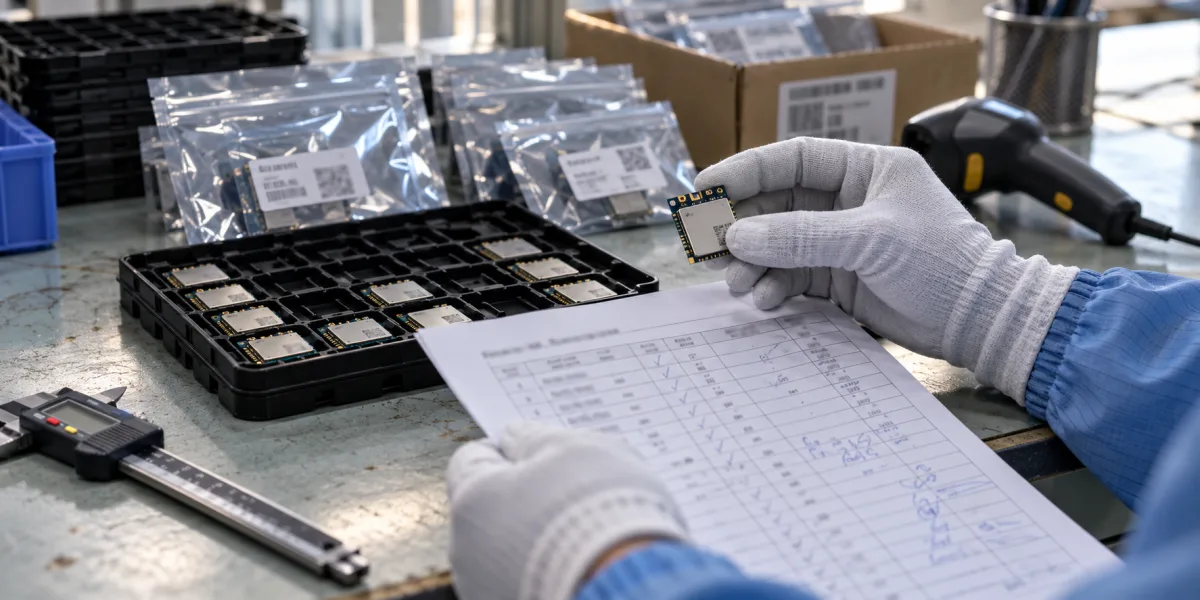
Two module quotes can both say “Wi-Fi” yet describe different products for your factory. One may need a different antenna layout; another may use a different firmware or authorization path. If the purchase order records only the protocol, quantity, and unit price, engineering may discover the difference when trial production is supposed to start.
Before buying in volume, align three things: the exact orderable hardware part number, its product and firmware configuration, and a factory-executable flashing, authorization, and test plan. The supplier, platform owner, and manufacturer should each be able to provide evidence for their part. If one part is missing, the team does not yet have a production configuration it can sign off. Tuya's production information guide lists product ID, protocol, module name, firmware name and version, and delivery mode among the information used for trial or mass production. A series name in a quote cannot stand in for those fields.
Identify the product combination, not just the component family
A product manager may say that this revision is still a Bluetooth device. Purchasing may report that a vendor has an equivalent module at the same price. Firmware may be waiting for a PID and firmware key. All three statements can be true, but they refer to different layers. A purchase-ready record should connect the product PID, protocol and function configuration, complete module part number and hardware revision, firmware identifier and version, authorization and delivery mode, and the production-test program version.
The connection matters more than the document title. Tuya separates product-development information from hardware-production information in its production setup. Ask the supplier and platform owner to confirm, in the same controlled record, which quote SKU corresponds to which module name and which production configuration the platform will apply. If that mapping cannot be established, keep the price as an indicative quote; do not treat it as a ready-to-release manufacturing order. This is a procurement inference from Tuya's documented fields, not a claim that a particular vendor's module has failed a test.
Hardware and platform sign-off answer different questions
At the hardware layer, collect the full part number, hardware revision, pinout and package, memory configuration, supply and temperature limits, antenna variant, and revision of the relevant datasheet. These answer whether the candidate fits the board and its operating environment. At the platform and production layer, collect the PID, function configuration, firmware identifier and version, delivery or authorization mode, and test tools. These answer whether the installed module can be configured and manufactured as the intended product. One layer passing does not sign off the other.
“Same protocol” is not a substitution rule. Different antenna or memory variants can change what must be checked on the final device, while a hardware revision can require a fresh review of supplier notices and certification scope. The exact differences depend on the actual module SKU; do not infer them from a family name or a photograph. Use the supplier's ordering data and the relevant datasheet revision as the reference.
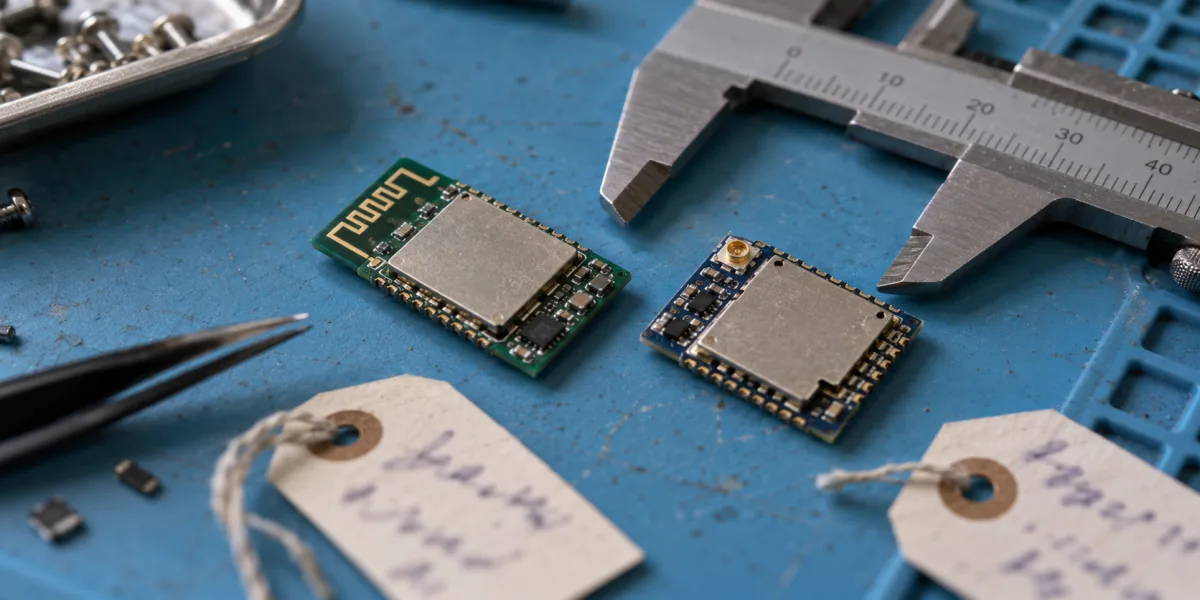
Illustrative image only. It does not represent a Tuya part number, vendor lot, or measured result.
Turn twelve RFQ checks into evidence your team can sign
The list below is not twelve signatures for twelve departments. Its purpose is to make each missing item visible: what should be supplied, who can evaluate it, and which commitment must wait until it exists. It is a starting RFQ, not a substitute for an individual product specification.
| Check | Evidence to request or produce | Do not assume, if missing |
|---|---|---|
| 1. Full module part number and hardware revision | Quote SKU matched to ordering data and sample or package markings | A family name identifies a production item |
| 2. Protocol, band, and product PID | Product configuration tied to the proposed module | Every module using the protocol fits the same product |
| 3. Flash, RAM, and interface | Datasheet for the exact variant and host interface drawing | Existing firmware or PCB remains compatible |
| 4. Antenna and enclosure | Antenna option and final-device layout or feed requirements | RF results from another enclosure still apply |
| 5. Power, temperature, and environment | Rated limits and the device's actual input and installation conditions | A bench startup proves field suitability |
| 6. Certification and target markets | Certificate identifiers, covered variants, and end-product responsibility | Module certification equals finished-product compliance |
| 7. MCU protocol and DP mapping | Host protocol revision, DP definition, and integration record | Matching feature names mean matching messages |
| 8. Firmware identifier and version | Platform production information and upgrade baseline | Any firmware version can be flashed under the same plan |
| 9. Flashing and authorization mode | Tool access, credential owner, quantity, and exception handling | Bare modules can automatically ship as finished devices |
| 10. PCBA and finished-product tests | Test items, fixture and software versions, and result retention | A power-on light tests networking and control |
| 11. Quantity, lead time, and approved sources | Batch sizes, committed dates, approved vendor list, and lot ID | A verbal lead time guarantees supply |
| 12. Substitution and change control | Change triggers, approvers, regression scope, and rollback | A factory may freely swap an “equivalent” part |
The first six checks define the hardware and market scope. Checks seven through ten determine whether the device can be made with the intended configuration. The last two govern interruptions and later changes. Leaving the latter half until the modules arrive can make the buying task look complete while preventing trial production from starting. Tuya's production-test overview distinguishes PCBA tests from finished-product tests and discusses networking and control tests. The actual acceptance criteria still depend on your device and manufacturing process.
Ask for records, not reassurance
“Firmware is ready” needs a version and a matching PID. “Authorization is available” needs a delivery mode, owner of the tools or credentials, and a path for failures at the factory. “Certified” needs a certificate whose coverage can be checked against the proposed variant and target market. Tuya's firmware management documentation describes version management; its certification process treats prototype, trial production, and product certification as distinct stages. The existence of those processes does not establish that your particular device has completed them.
An RFQ issue log can stay simple: document revision, provider, reviewer, and due date for each item. Missing ordering data pauses the formal order. Missing production information pauses the volume authorization plan. Missing final-device tests or certification evidence pauses any claim that a product is ready for sale. Those are different decisions. Calling all of them “waiting for the supplier” hides the next useful action.
If the DP definition itself is still changing, review the Tuya DP design guide before accepting check seven; a purchase order cannot settle the device's function semantics. For a project that needs to coordinate module choice, firmware, enclosure, and trial production, the Tuya development service is the appropriate place to define responsibilities across teams.
An alternative module changes the scope of validation
When the original part becomes unavailable, a vendor may offer another module using the same protocol. It might connect in a prototype and still require new PCB, firmware, certification, or production checks. Rather than asking only whether it is “compatible,” ask which previous conclusions remain valid and which need to be repeated.
A packaging-label change calls first for traceability and confirmation that the electronic item has not changed. A change in full part number, pins, memory, antenna, or hardware revision calls for a joint hardware, firmware, and RF impact assessment. A change in PID, firmware key, authorization mode, or test software may require rechecking flashing, pairing, control, upgrades, and exception recovery even if the board outline is identical. A new market or enclosure calls for a fresh certification and installation review. This is a way to scope verification, not a prescription that every change always requires the same full test campaign.
Tuya's flashing and authorization guide includes troubleshooting for a firmware identifier or version that does not match the license. A module that appears functionally similar can therefore fail on the manufacturing path. Attach firmware, authorization, and production-test outcomes to the substitution decision, not just two datasheets side by side. Until those outcomes exist, label the substitute a candidate rather than an approved alternate.
Prototype and trial production are separate approvals
At prototype stage, check physical fit, power-on, network connection, control, and target-firmware flashing. At trial production, check whether a factory can repeat the same configuration: fixture and tool versions, device identity and authorization, failed-unit handling, lot traceability, and finished-product test results. The first establishes technical feasibility. The second begins to establish that the manufacturing path is repeatable. A successful sample is not a replacement for that second decision.
If a team skips trial-production review to meet a delivery date, record the accepted risk in the project decision instead of describing the sample as “volume validated.” For an OTA-capable product, also identify the shipping firmware, upgrade target, and failure recovery path. One successful online upgrade is not evidence of dependable future upgrades across lots and revisions.
Compare quotes for the same obligation, not just the same price unit
Suppose candidate A is cheaper but the quote names only a module family and says that the factory will flash firmware “as usual.” Candidate B costs more but includes an exact orderable part number, ordering-data revision, mapped PID and firmware version, authorization responsibility, and a test-program reference. Neither number alone tells you which is the better buy. Ask A to provide the same material, then compare both candidates for the same quantity, delivery method, market, and acceptance conditions. Until then, the figures price different obligations.
If a candidate changes the interface or antenna, engineering should estimate PCB or enclosure changes, RF review, and prototype regression. If it changes firmware or authorization, the platform owner and manufacturer should estimate configuration work, tool permissions, fixture changes, and rework of failed units. These are project costs to measure, not fixed prices that can be copied from public documentation. A review sheet can identify whether each item is needed; actual amounts and timing require your own quotations and tests.
Three useful decision states
A candidate with complete information and a matching sample/factory path can proceed to controlled trial production. A documented candidate with an interface, firmware, or market difference remains an alternative under a named regression plan. A candidate missing a critical identity link may remain in the price comparison but should not enter a volume order. These states are not a rating of the supplier. They describe how far the current evidence lets the project move. New evidence can promote a candidate; a failed trial must move it back to investigation, regardless of a signed commercial agreement.
Name who approves each layer. Purchasing can confirm commercial terms; hardware can confirm interface, power, and RF; firmware and platform owners can confirm PID, version, and authorization; quality and manufacturing can confirm test coverage and lot traceability. A single role signing for all of them tends to move unresolved questions downstream. The volume order should cite the jointly accepted configuration baseline and change rules, not only a photograph of a working sample.
The decision states reflect evidence, not confidence in a vendor's promise. “Difference” means an assessed change in hardware, firmware, authorization, market, or factory testing—not a single checkbox.

Where this checklist is the wrong contract
When buying a finished, already-designed device, module traceability still matters, but the main RFQ object is the finished-product model, software and hardware versions, and end-device acceptance. Twelve module checks alone do not form a complete finished-product purchase agreement. If the target market, functions, or host interface are not yet known, freezing an exact module SKU may be premature; compare architectures and build samples first, then establish an orderable trial-production specification.
A one-off research prototype with no authorization or volume plan does not need a complete approved vendor list and factory fixture program up front. Still record the sample model, firmware, and platform configuration so that a later product team does not mistake the prototype for a manufacturing baseline. Conversely, a product shipped through multiple factories or markets cannot reduce certification and production ownership to a single “passed” cell. Market scope, tool permissions, and lot-level changes affect what actually needs checking.
An RFQ can be short without being ambiguous. Put the complete orderable part number, hardware revision, and target market on the first line; the PID, protocol, firmware baseline, and authorization or delivery mode on the second; and sample quantity, trial quantity, delivery date, packaging, and lot-traceability requirement on the third. Attach the device's interface, power, enclosure, antenna, and functional requirements. Ask the supplier for the matching datasheet revision, certification coverage, and change-notification rule; name who supplies the flashing and test tools.
For each response, use distinct states: confirmed, supplier evidence pending, our prototype test pending, or not applicable. A blank cell is not implicit compatibility. If the supplier proposes two variants, give each its own line rather than writing “equivalent module” across both. The quoted unit price can then be considered alongside any redesign, certification review, additional tests, or stock risk that this project actually needs to measure; do not invent a saving percentage or lead time before the quotes and test results exist.
To start, choose one complete candidate part number and ask purchasing, engineering, the platform owner, and the factory to fill in the three-layer identity chain and twelve evidence items. Move from documents to prototype, then from a passed sample to controlled trial production. Consider a volume order only after test, authorization, change, and traceability records can be repeated. If a new hardware revision, firmware version, or delivery mode appears later, reopen the affected approvals. This is a procurement and validation method supported by public process documentation; fitness, reliability, lead time, cost, and compliance for a particular product still depend on its own tests, formal quotes, and certificates.