
Meta has published a Muse Gadget SDK with ESP32 firmware. You can use it to connect a board to Muse and expose device commands. That makes a personal, non-commercial gadget prototype a reasonable experiment. It does not make a device containing a Muse SDK token a product you can sell. The source repository and the SDK token terms govern different rights: an Apache-2.0 code license does not supply permission to access the Muse service in a commercial product.
The architecture matters just as much as the terms. The ESP32 firmware pairs through a phone, joins Wi-Fi, and maintains an encrypted session to a Muse VM. The Muse agent is not running as a local model on the microcontroller. The board handles inputs, outputs, and device actions; the agent and service remain outside it. A team seeking an offline voice product or a customer-facing device with a long support commitment should not treat a successful gadget demo as proof that this architecture meets the product requirement. This article checks Meta's public documentation as of October 9, 2026. We have not flashed a board, paired a Muse account, or measured device performance for this article.
What the SDK actually puts on the device
The ESP32 Device SDK README describes firmware that pairs over BLE, joins the user's home Wi-Fi, and connects to Muse. Developers can add a display, button, sensor, actuator, or device-specific command. The supported experience depends on the board. A C5 development kit with a status light is not the same hardware proposition as a display-equipped S3 with audio peripherals, even though both can be found under the broad label “ESP32.”
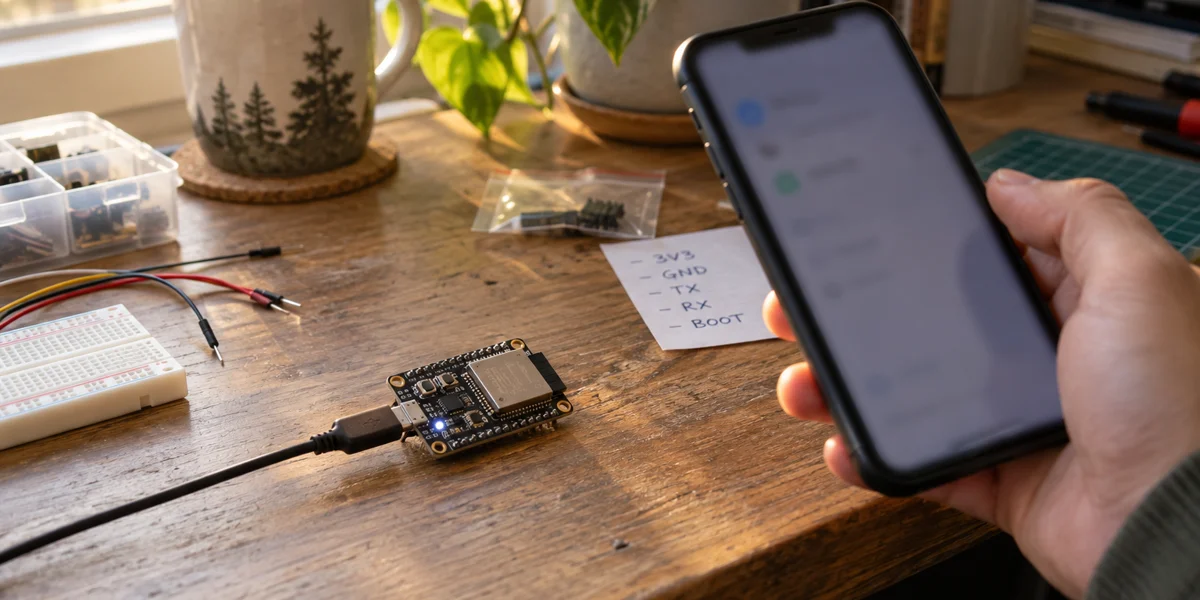
Meta names the ESP32-C5 DevKitC-1 as the quickest default starting point. Its status light and BOOT button fit the documented setup flow, and the default build targets that board. Other configurations live under devices/. A different board can require a new overlay, pin mapping, storage layout, display driver, or audio path. A chip-family match alone does not prove that a random module and enclosure can use the ready-made firmware. The device list is a better buying input than a generic ESP32 feature sheet.
Memory changes which capabilities are available. According to Meta's README, boards without PSRAM can still connect to Muse and accept control, but they do not run the optional home-network tunnel. If the project needs Muse to reach existing equipment through a local HTTP API, “the board pairs” is not sufficient evidence that the tunnel is present. If the project only needs a button or a small read-only command, purchasing a board for a full UI and tunnel may be unnecessary. Define the intended gadget behavior first, then choose hardware against that behavior.
The phone and cloud are real dependencies, not invisible onboarding details. Local pins may produce the input, but the pairing account, command session, reconnect behavior, and agent decision remain part of the overall path. This can be perfectly acceptable for a personal gadget experiment. It is different from an autonomous device that must detect speech, decide, and act while disconnected from a service. Those two products need different acceptance tests and different failure plans; a friendly demo can obscure the difference.
Prove one harmless command before adding a voice interface
For a first prototype, the default C5 board narrows the number of unknowns. Meta documents ESP-IDF v6.0.1, a data-capable USB cable, a personal SDK token, and the Muse mobile app as prerequisites. After flashing, the user enables Developer mode under Settings > Devices, adds the MuseGadget-... device, and confirms pairing with a physical press of BOOT when prompted. These are published setup steps, not a claim that our team has performed them on a board.
Choose a read-only response for the first custom command: for example, a demo button count with a sample timestamp. Starting with a door lock, heater, or motor immediately mixes transport validation with physical safety. Meta's developer instructions locate command advertisement in build_register_json() in main/noise_control.cpp through link.register. The corresponding link.invoke reaches on_ws_command() in main/app.c. Both locations need the same command name. A description that Muse can read is not an implementation of the action; the firmware must validate parameters and return a usable result.

The two arrows from firmware to Muse have different purposes: a device advertises a capability before Muse can invoke an action. Neither arrow means the agent model runs on the ESP32.
A device command is an API contract, not a prompt
A reading needs an object, a unit, a sampling time, and a stale-data rule. A bare 23.5 could be a temperature, battery voltage, or cached demo value. A handler that always returns success can make a routing test look like a sensor test. Synthetic values are fine while checking whether the command travels through the session, provided they are marked as synthetic and that test is not reported as a real measurement. Meta already uses sensors.read for environmental readings; adding a temperature sensor should follow that convention rather than inventing a new command name for every board.
For actions, the contract also needs allowed ranges, a timeout, a safe power-on state, and behavior under retries. Setting the same light level twice can be idempotent; triggering a relay twice may not be. If a command can cause motion, heat, or access control, a cloud-agent request is only one part of the safety case. The ESP32 handler still has to enforce the device's own rules, report failure truthfully, and leave the hardware in a known state after disconnection. The open-source extension point does not fill in those product-specific obligations.
Evidence should be kept in layers. A successful compile shows that the selected code and toolchain are compatible at build time. A device appearing in the app advances discovery and pairing. A returned JSON payload shows a particular command response in a particular session. A statement about reconnect behavior, bad parameters, repeated actions, or long-term availability requires separate logs and tests. Because this article has no hardware, account, or SDK token evidence, it gives a verification order rather than invented latency, success-rate, or reliability numbers.
The two gates a product team cannot defer
Source rights are not service rights
The repository's source is offered under Apache-2.0, while Meta's Gadget SDK Token Terms apply to the credential used with Muse. The current terms permit personal, non-commercial use and place conditions on devices shared with other people. They prohibit embedding the token in a device sold for payment or other consideration, publicly advertised, offered, or listed. The terms also state that the source license does not grant rights to tokens. For a team planning to ship a branded product or deploy one to paying customers, this is a design input before hardware selection, not a paperwork item to solve after a pilot. Commercial use would require an appropriate authorization from Meta; a public GitHub repository is not that authorization.
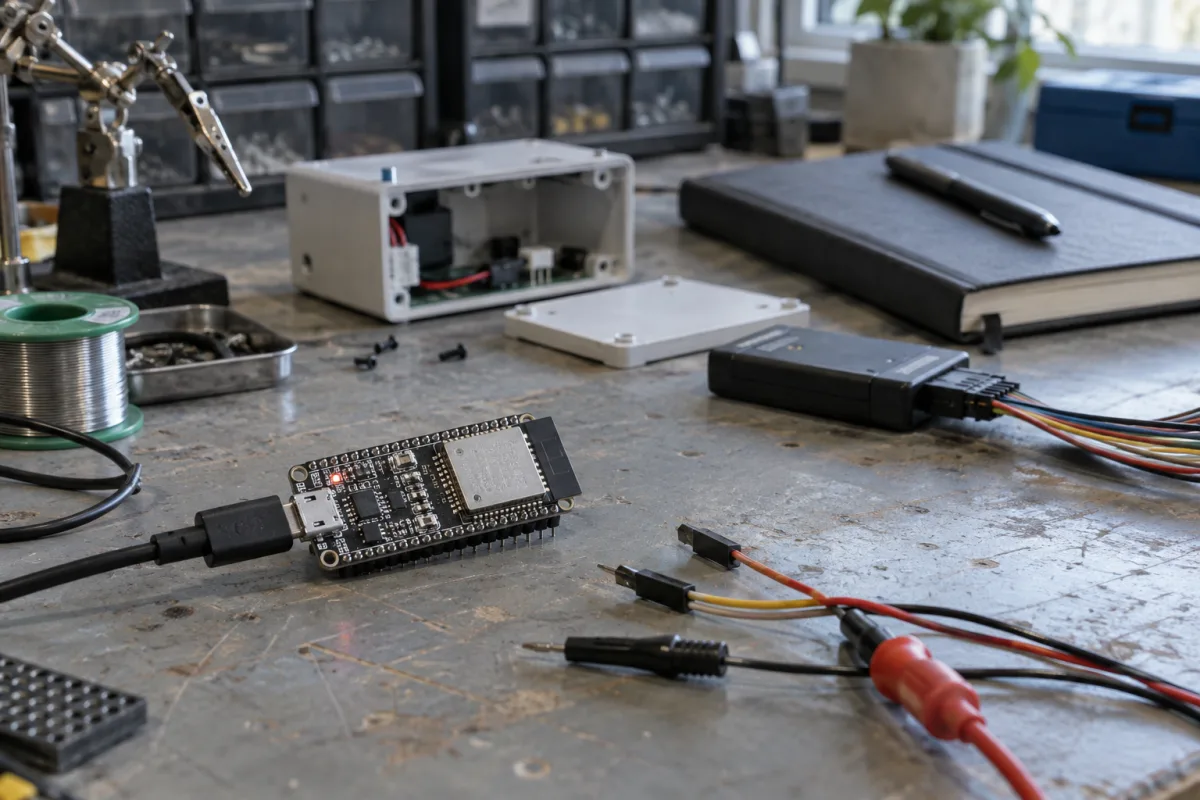
The token is not a substitute for a production identity system either. Meta says it ships inside the firmware and should be revoked and replaced if exposed. Wi-Fi credentials and device tokens are stored in NVS; the README strongly recommends NVS encryption where supported. Public development builds use a shared development signing key and do not enable Secure Boot. Those defaults favor experimentation and reflashing. A product supplied to someone else would need its own credential lifecycle, protected storage, trusted update process, and incident response. None of those outcomes follows automatically from pairing a board once.
Encryption is not manufacturer authentication
Community pairing requires a physical button press and creates a fresh encrypted session. Meta also warns that it has no manufacturer verification and does not prevent an active man-in-the-middle attack. An encrypted channel and a verified product identity answer different questions. A personal setup on a trusted network may fit the published experimental path. A device installed at a customer site, on a shared network, or in a regulated environment needs a separate threat model; the community pairing flow alone should not be presented as production authentication.
The terms identify the SDK and token as an unsupported, changeable offering. A seller promising years of service would therefore be taking responsibility for a dependency it cannot unilaterally keep available. Hardware compatibility, permission to access Muse, security posture, data-handling obligations, and service continuity are separate gates. Passing the first one does not make the others disappear. That distinction is the main reason to decide the intended use before investing in a polished enclosure or a sales demo.
Choose the next experiment—or stop the product assumption
For a personal, non-commercial experiment that can depend on the Muse app and online service, start with the supported C5 profile and one read-only command. Record the board and firmware revision, pairing state, command request and response, and failures. Then add a display, microphone, or actuator only if the first path works and the relevant board configuration supports it. This is a small, falsifiable prototype, not a miniature production launch.
For a customer device or paid product, stop the plan to ship the public SDK token as-is. Obtain the necessary permission for service use before representing Muse access as a product feature. Even with permission, independently evaluate device identity, credential storage, secure boot, update strategy, regional service availability, customer data handling, and an exit path if the service changes. A successful flash and pair sequence cannot stand in for these decisions.
If the actual requirement is offline voice or local control, the Muse Gadget SDK may be the wrong starting point. An ESP32 can still be an audio or control endpoint, but the inference and action architecture must be selected against the offline requirement and the relevant license. Our ESP32-S3 voice pipeline article discusses the device-side audio path, which is a different problem from Muse integration. For product-level firmware and hardware planning, see our ESP32 development service. It helps to state whether the target is a personal prototype or a commercial delivery before estimating either route.
Sources and verification boundary
- Meta Muse Gadget SDK repository
- ESP32 Device SDK README
- ESP32 SDK developer instructions
- Muse Gadget SDK Token Terms
These sources were checked on October 9, 2026. The repository and terms can change; check the current versions before building or committing to a product. This article does not report a firmware build, live pairing, command invocation, commercial authorization, or production security evaluation. The discussion of terms is an engineering reading of the public text, not legal advice.