
TuyaOS MCU SDK development services for production-ready device firmware
Turn MCU firmware, modules, DPs, OTA, and factory tests into one supportable device delivery path.
TuyaOS MCU SDK development should begin with the device contract: interfaces, data points, timing, local behavior, error states, provisioning, upgrade safety, and test evidence. We help teams translate those decisions into firmware that remains operable from prototype through production.
When TuyaOS MCU SDK development is the right scope
Use this route when the device needs a durable firmware contract across the MCU, module, DPs, local behavior, app or cloud expectations, upgrades, diagnostics, and production tests.
Best fit
New or existing smart devices with unresolved serial or peripheral integration, DP semantics, local control, firmware ownership, OTA, or factory-validation risks.
First scoped outputs
An interface and DP contract, firmware responsibility map, provisioning and OTA plan, prototype test matrix, diagnostic requirements, and production-risk list.
Choose another route instead
Use hardware development for broader electrical, PCB, enclosure, and module-selection work; use Cloud integration when the device is already stable but operations data must enter owned systems.
TuyaOS MCU SDK engineering modules
The service concentrates on the device-side behavior that must stay consistent across firmware, app panels, cloud commands, test tools, manufacturing, and post-launch support.
MCU, module, and peripheral integration
Review module route, UART or other interfaces, sensors, actuators, timing, reset states, power constraints, and the boundary between MCU and connectivity firmware.
DP model and device behavior
Define control, status, fault, alarm, schedule, and configuration semantics that users, panels, Cloud APIs, QA, and support can interpret consistently.
Provisioning, OTA, and diagnostics
Plan onboarding, network failures, version compatibility, update safety, logs, remote diagnostics, and support evidence before field rollout.
Prototype and factory validation
Turn representative device behavior into test cases, test points, production procedures, issue triage, and a repeatable handoff for pilot builds.
Choose the Tuya device-development path by the real firmware boundary
The right path depends on whether the primary risk is in the device firmware, the wider hardware product, or the ecosystem and platform connection.
| Decision area | TuyaOS MCU SDK development | Tuya hardware development | TuyaLink or Cloud-side integration |
|---|---|---|---|
| Best fit | MCU firmware, DPs, local behavior, OTA, diagnostics, and device validation. | Modules, electronics, interfaces, PCB, enclosure, prototype, and production hardware risks. | Existing devices or clouds that need ecosystem compatibility and operating-system integration. |
| Primary output | Firmware contract, DP semantics, test evidence, upgrade and diagnostic plan. | Module and electrical decision, product validation plan, and production handoff. | Device and identity mapping, event flows, command boundary, and platform operations. |
| Main risk | A weak DP or failure-state model makes every downstream layer expensive to maintain. | Late electrical or RF constraints force firmware and app compromises. | Cloud access without ownership and reliability design becomes hard to operate at scale. |
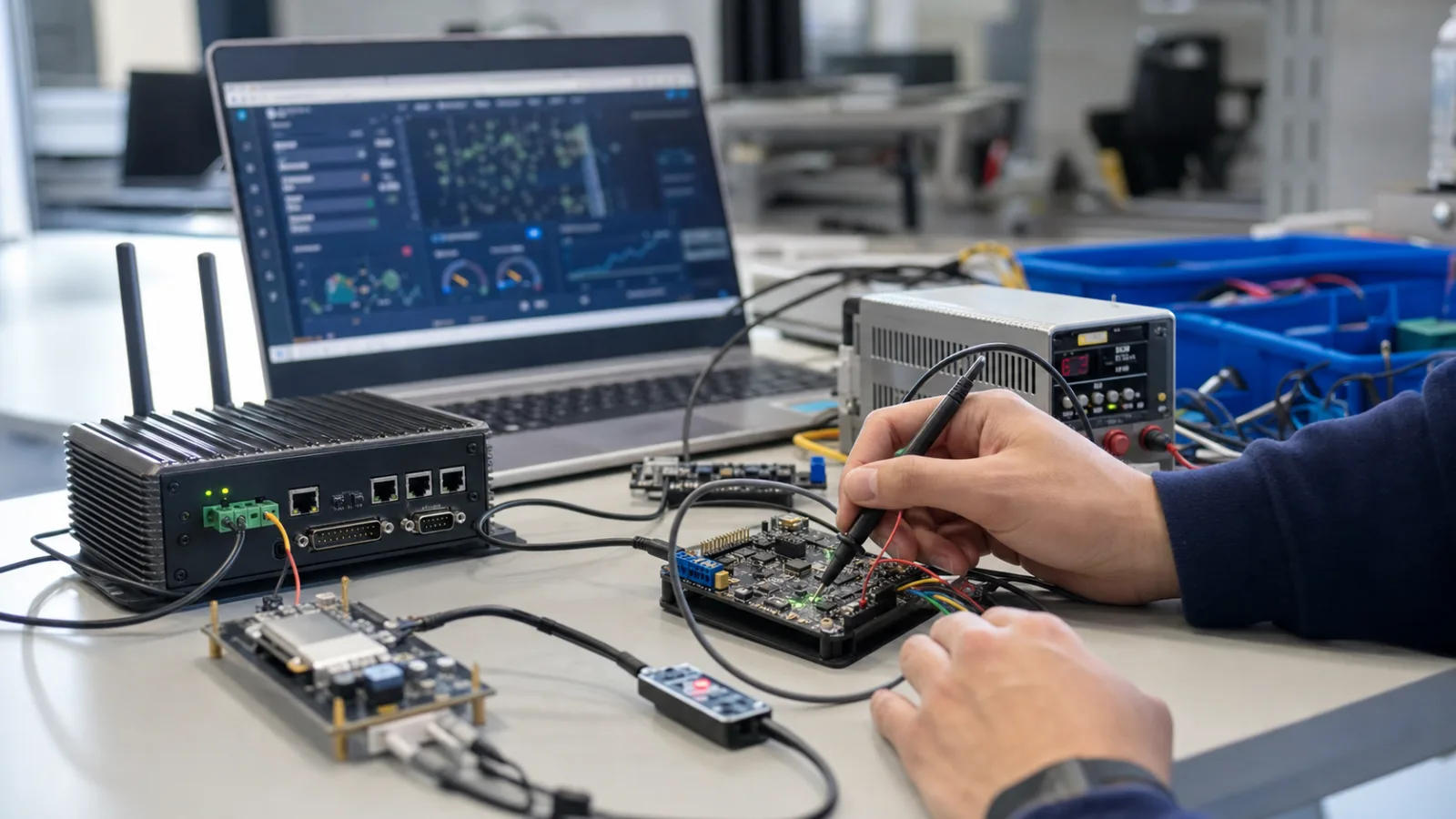
Make the device contract stable before every layer depends on it
Firmware is reliable when commands, states, faults, timing, updates, and diagnostics mean the same thing to the device, the app, the cloud, QA, manufacturing, and support teams.
DP semantics as a product contract
Define each data point's meaning, range, state, error behavior, ownership, and compatibility expectations before panels and APIs multiply.
Real failure-path validation
Test resets, offline states, weak networks, retries, malformed commands, version mismatches, and recovery paths with representative hardware.
Production and support evidence
Prepare test procedures, logs, version records, issue triage, OTA policy, and handoff documents that can operate beyond the development bench.
TuyaOS MCU SDK details that protect product reliability
The hidden work in device firmware is often not a feature itself, but the behavior that lets the feature survive installation, updates, field faults, and production repetition.
Interface and local control behavior
Clarify which operations stay local, what must be reported, and how the MCU and module recover after power, network, sensor, or communication failures.
- Serial, GPIO, and peripheral behavior
- Timing, retries, reset, and recovery
- Local safety and offline expectations
DP, state, and firmware compatibility
Keep data-point semantics stable so panels, scenes, Cloud services, manufacturing tools, and support records do not drift from real device behavior.
- Control, status, fault, and alarm fields
- Version and configuration compatibility
- Panel and API consequences
OTA, diagnostics, and production handoff
Design updates and evidence for the conditions the product will encounter after shipment, not only for the engineering demo.
- Upgrade and recovery policy
- Diagnostic logs and support notes
- Factory tests and pilot acceptance
TuyaOS MCU SDK development delivery path
The engagement turns device requirements into an observable firmware contract, a tested prototype path, and a production-ready handoff.
Product and business definition
Clarify target device types, Tuya ecosystem status, user roles, market plan, data ownership, and the first release boundary.
Scope, risk list, and delivery roadmapPrototype and integration validation
Validate DP model, app experience, cloud API, firmware behavior, account flow, and connected-device test cases before full development.
Prototype, API notes, and test planDevelopment and QA delivery
Build the app, panel, cloud integration, firmware coordination, dashboards, alerts, and business-system links according to the confirmed scope.
Production-ready modules and QA evidenceLaunch and iteration support
Support app release, Tuya project configuration, data monitoring, issue triage, documentation, and the next version roadmap.
Release handoff and iteration backlogWhy use ZedIoT for TuyaOS MCU SDK development
We connect embedded implementation with hardware, app, cloud, QA, factory, and support consequences instead of isolating firmware from the product.
Firmware with product context
The MCU and DP model are planned around real device controls, users, panels, cloud flows, and product requirements.
Validation beyond the happy path
The test path covers representative devices, connectivity faults, reset and recovery behavior, updates, and support evidence.
Production-minded handoff
Outputs can include test notes, diagnostic expectations, version boundaries, factory inputs, risk lists, and iteration priorities.
 Tuya Hardware DevelopmentExtend firmware work into modules, electrical interfaces, prototype validation, factory tests, and production hardware readiness.
 Tuya Matter DevelopmentUse this route when device firmware must support a validated Matter product and ecosystem launch path.
 ZedIoT PlatformUse a private AIoT platform when Tuya device data must connect with dashboards, alerts, APIs, and customer-owned operations.
 Custom IoT DevelopmentFor projects that need device connectivity, apps, cloud services, gateways, dashboards, and business workflows beyond Tuya alone.
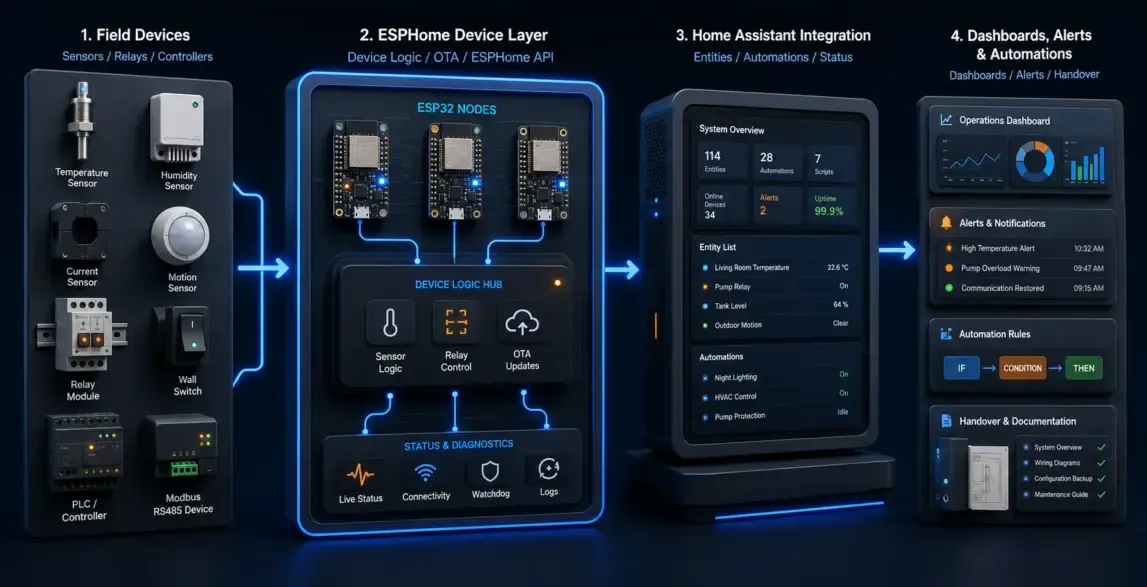 ESPHome + Home Assistant IntegrationA practical path when local automation, Home Assistant dashboards, and open integration are more important than a closed app flow.
 Tuya Product Development GuideCompare OEM App, App SDK, Cloud API, modules, TuyaOS, Matter, and launch-readiness choices before scoping the delivery path.
TuyaOS MCU SDK development guides
These guides help connect firmware, DP, module, OTA, and product-launch decisions before the first pilot build.
TuyaOS selectionWukong AI, T5AI-Core, or Standard TuyaOS: Which Path Fits Better?Separate AI-first hardware decisions from production devices that need deterministic connectivity, control, and lifecycle stability. DP designTuya DP Design GuideTreat DPs as a stable contract across firmware, panels, Cloud services, QA, and customer support.
 Device integrationLegacy Device to Tuya Module: DP, UART, and OTA WorkflowMap serial behavior, data points, firmware updates, and production validation for an existing product.
Confirm the ecosystem boundary before defining the development scope
Clarify the Tuya product path, account model, data ownership, integration boundary, and rollout expectations before implementation.
Can you work with our existing MCU and hardware team?
Yes. The scope can focus on firmware architecture, module interfaces, DP model, local behavior, onboarding, OTA, diagnostics, validation, and production-test planning alongside an existing hardware team.
Why should DP design be decided before app or panel work expands?
DPs carry the device contract across firmware, panels, cloud services, QA, factory tools, and support. Changing semantics late creates inconsistent behavior and higher rework across every dependent layer.
What should we prepare for TuyaOS MCU SDK scoping?
Share the device category, MCU and module or preferred module, interfaces and peripherals, current firmware or protocol documents, proposed controls and states, representative sample, target market, OTA expectations, and pilot or production timeline.
Send us your device type, Tuya status, and target market
Tell us the device category, current MCU and module, interfaces, existing firmware or protocol, expected DPs, target market, and pilot or production milestone.
Full contact pageSubmit project details